
The pH scale is your key to understanding how acidic...
 Science5 visualizações·Atualizado Jun 16, 2026·5 páginas
The Ultimate Guide to the pH Scale
1 / 5
1
of 5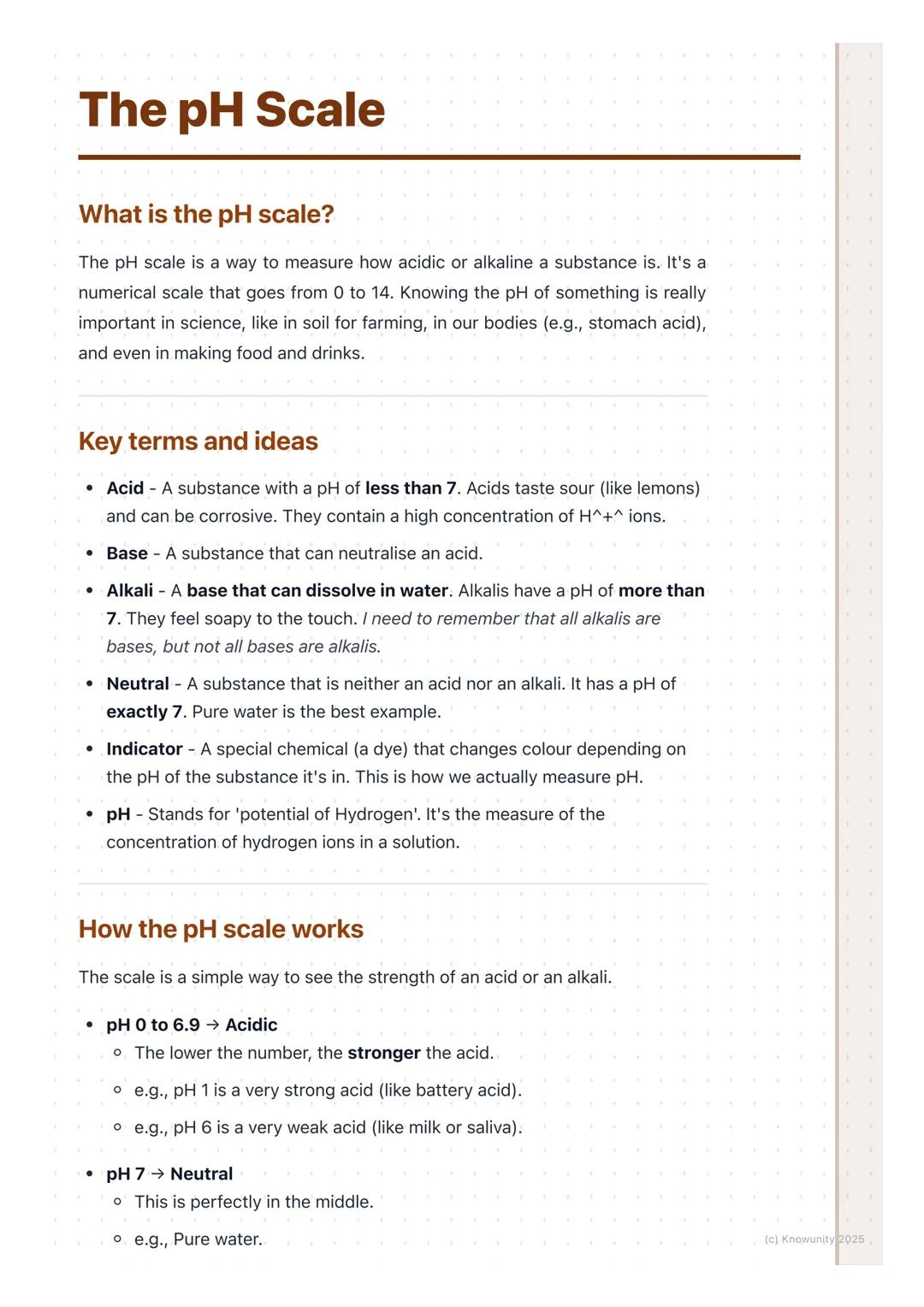
Understanding the pH Scale Basics
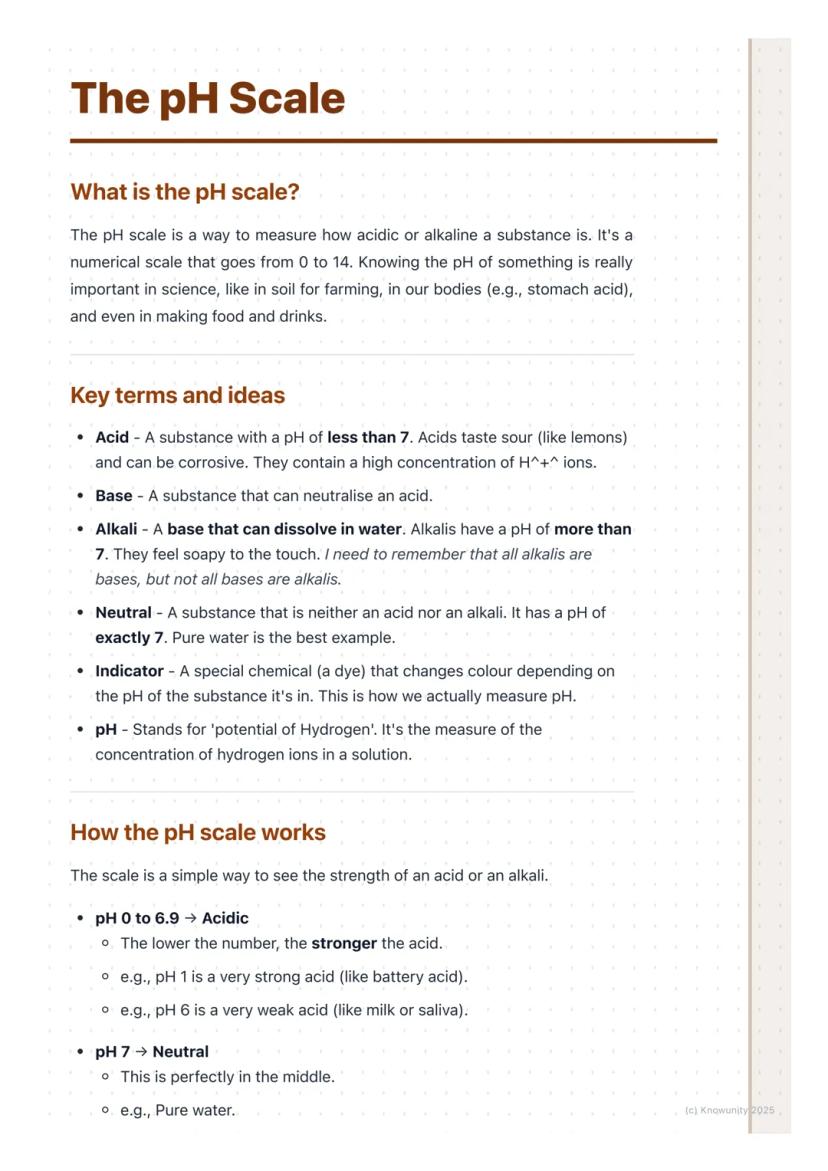
Ever wondered why lemons taste so sour or why soap feels slippery? It's all about pH - which stands for 'potential of Hydrogen' and measures how acidic or alkaline something is.
The pH scale runs from 0 to 14, and it's dead simple once you know the rules. Acids have a pH less than 7 and taste sour (think vinegar or citrus fruits), whilst alkalis have a pH greater than 7 and feel soapy to touch. Right in the middle at pH 7 is neutral - like pure water.
Here's what makes this tricky: the scale is logarithmic. This means each whole number represents a 10-times change in strength. So battery acid at pH 1 isn't just a bit stronger than lemon juice at pH 2 - it's actually 10 times stronger!
Key Insight: All alkalis are bases, but not all bases are alkalis. Alkalis are simply bases that can dissolve in water.
2
of 5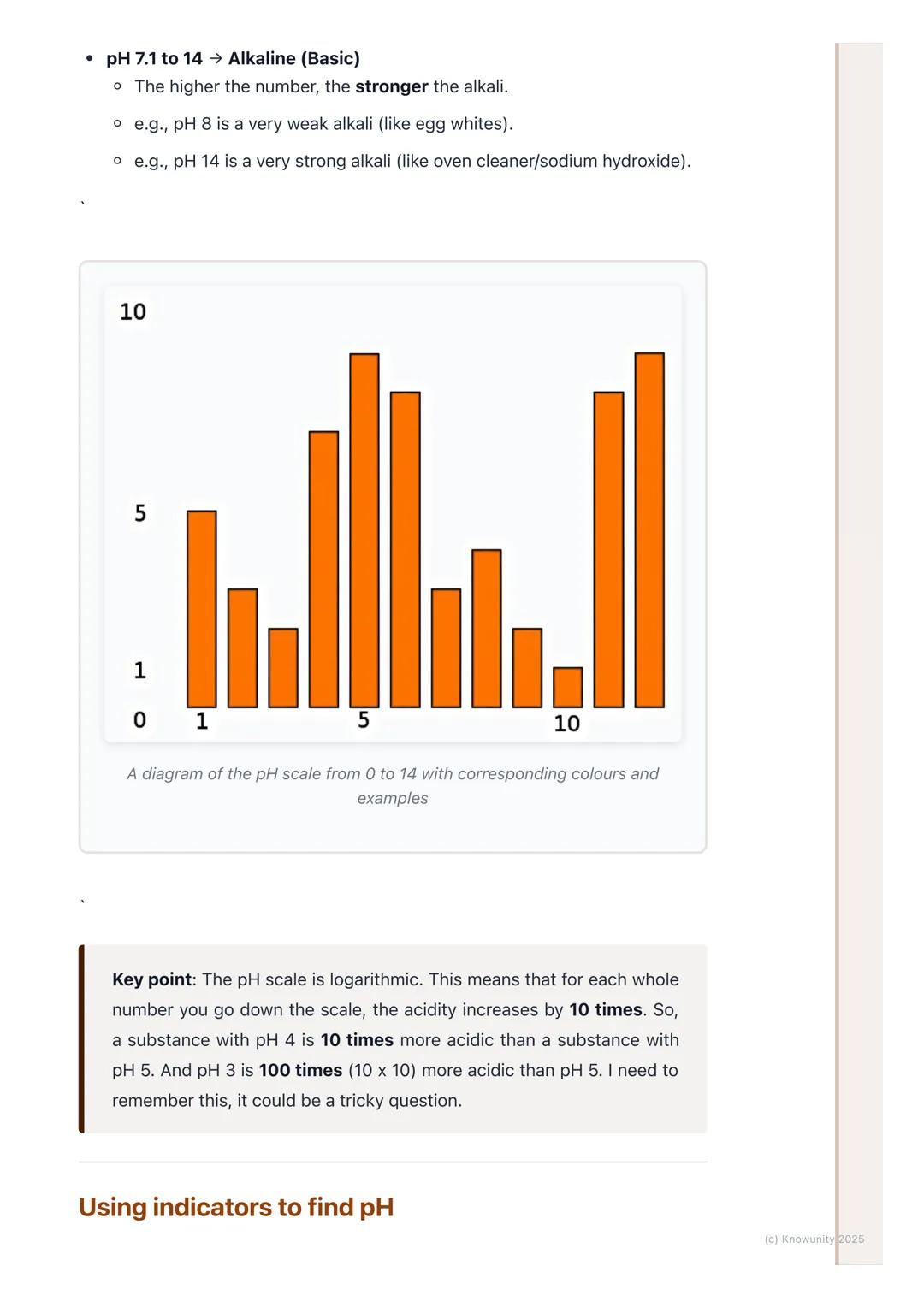
How Strong is Strong?
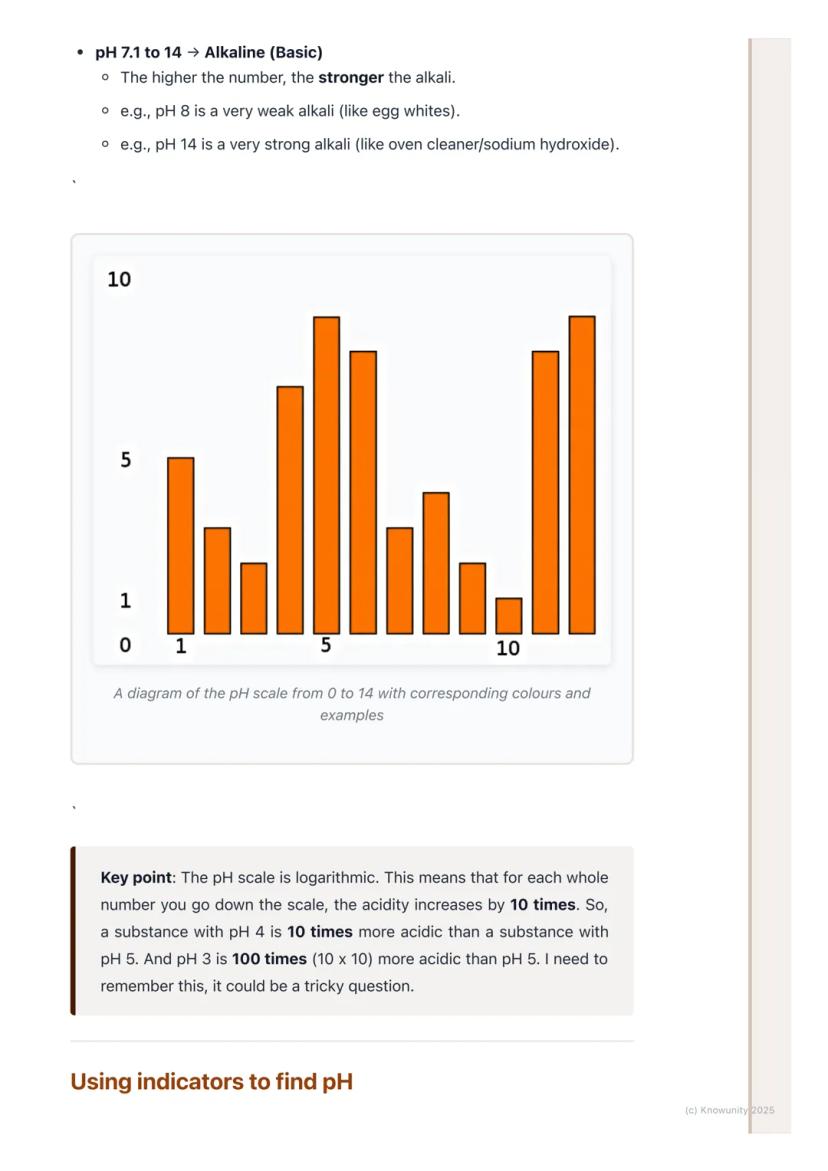
The pH scale breaks down into three clear zones that you need to master. Acidic substances get stronger as the numbers get smaller - so pH 1 battery acid will definitely ruin your day more than pH 6 milk will.
At exactly pH 7, you've got neutral territory. Pure water sits here perfectly balanced, neither acidic nor alkaline. It's your reference point for everything else.
Alkaline substances work the opposite way - higher numbers mean stronger alkalis. pH 8 egg whites are pretty mild, but pH 14 oven cleaner is seriously dangerous stuff that'll burn through skin.
Remember This: Each step down the pH scale means 10 times more acidic. So pH 3 is 100 times more acidic than pH 5!
3
of 5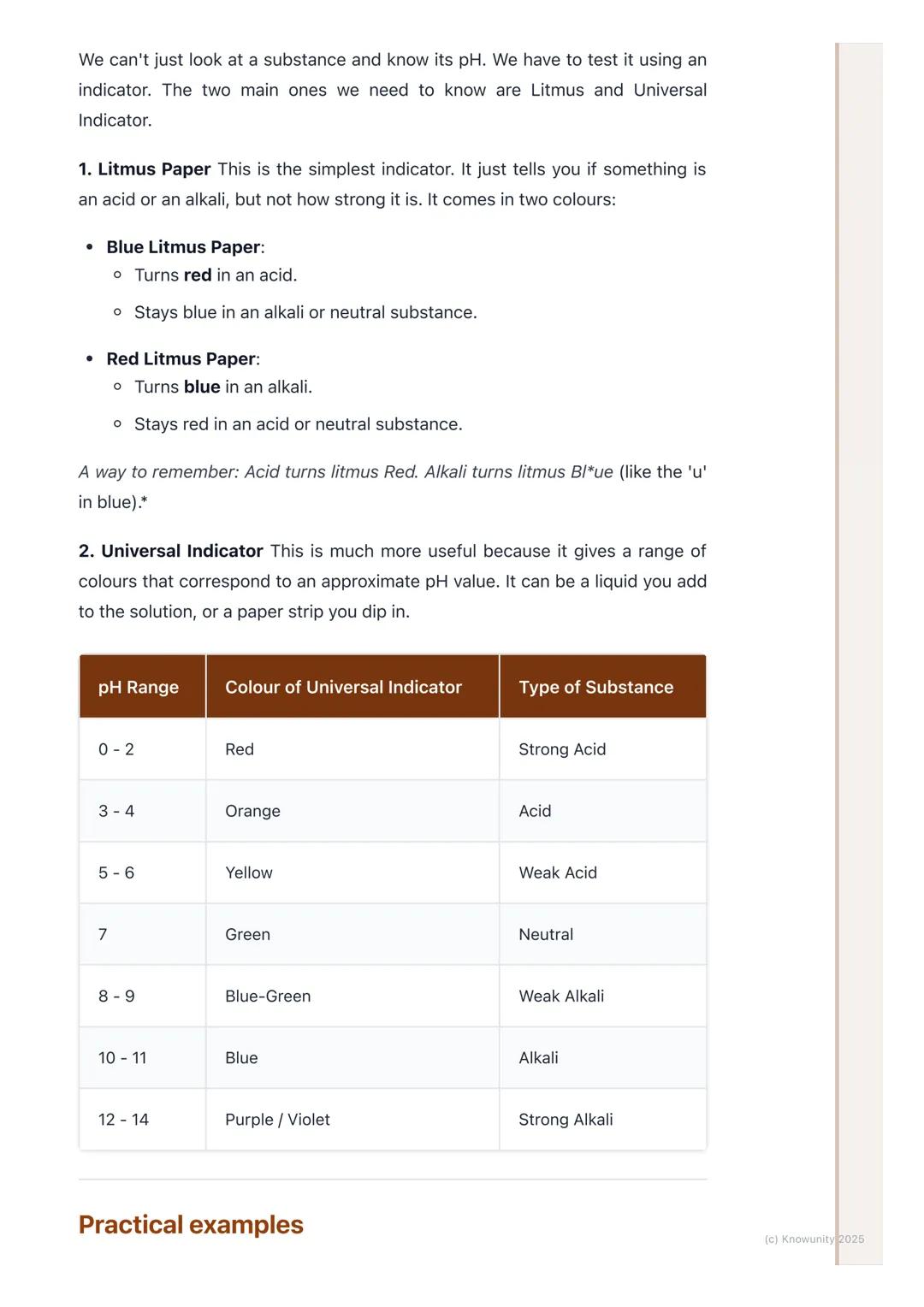
Testing pH with Indicators
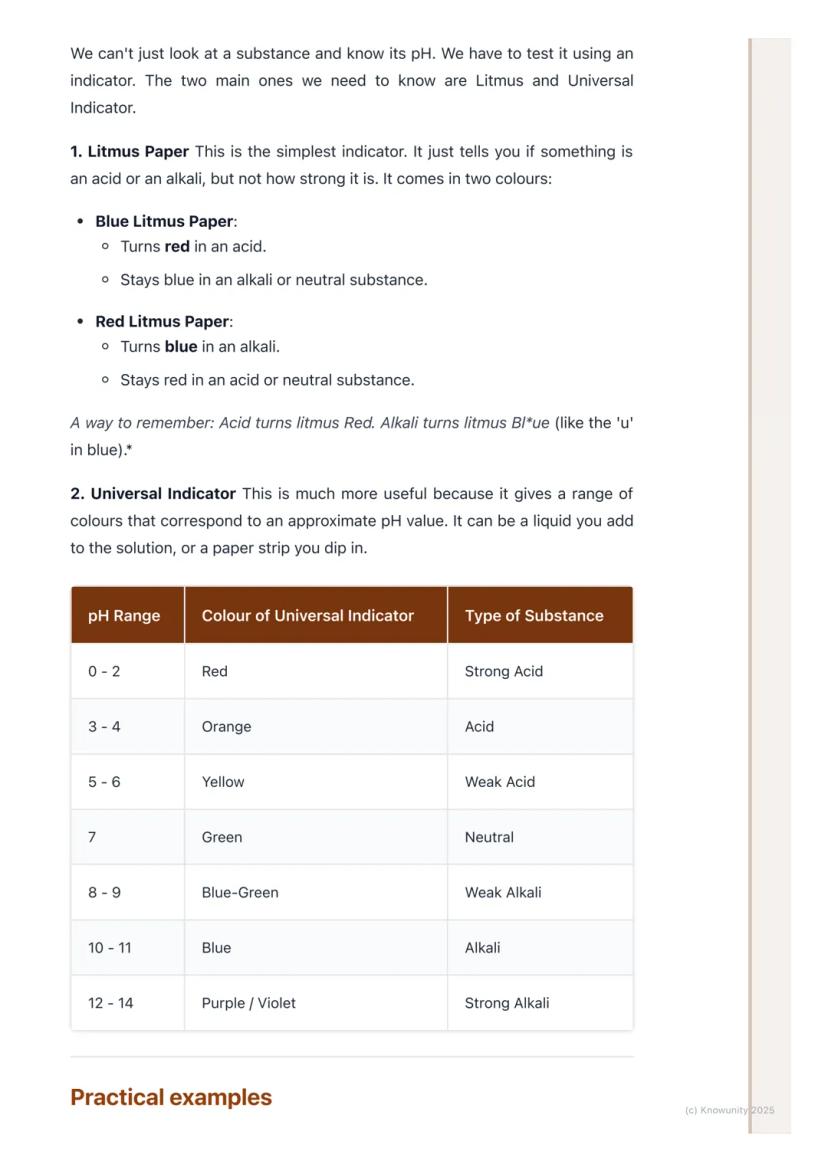
You can't just eyeball a substance and guess its pH - you need indicators, which are special chemicals that change colour based on acidity. There are two main types you'll use in the lab.
Litmus paper is the simple option that just tells you acid or alkali. Blue litmus turns red in acid (remember: "Acid turns litmus Red"), whilst red litmus turns blue in alkalis. It's handy for quick tests but won't tell you how strong the acid or alkali is.
Universal indicator is where things get interesting. This clever chemical gives you a rainbow of colours that match specific pH ranges. Red means strong acid , orange and yellow show weaker acids, green is neutral, and blue through to purple indicates increasingly strong alkalis.
Lab Tip: Universal indicator comes as both liquid drops and test strips - both work the same way and give you an actual pH reading.
4
of 5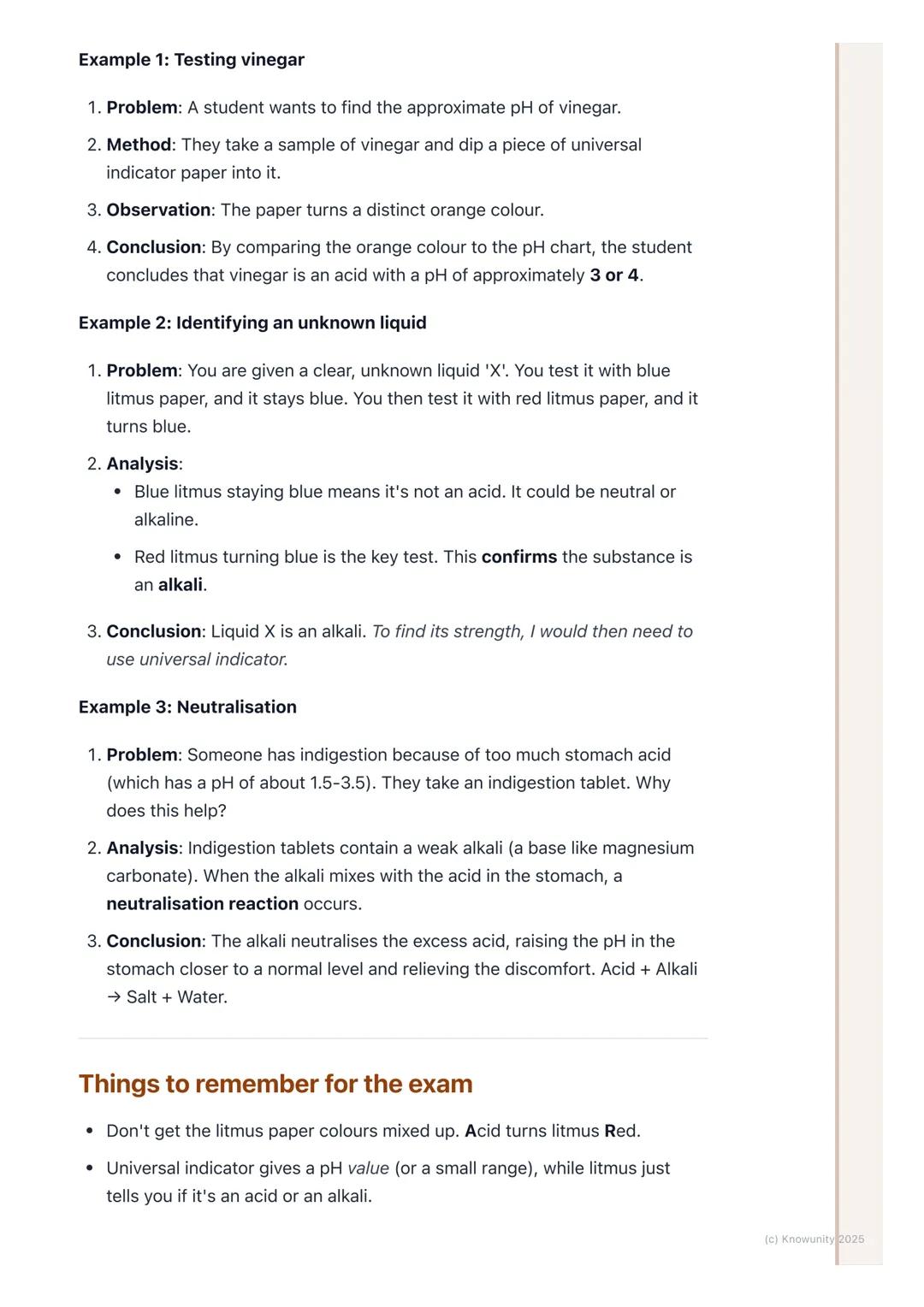
Real-World pH Examples
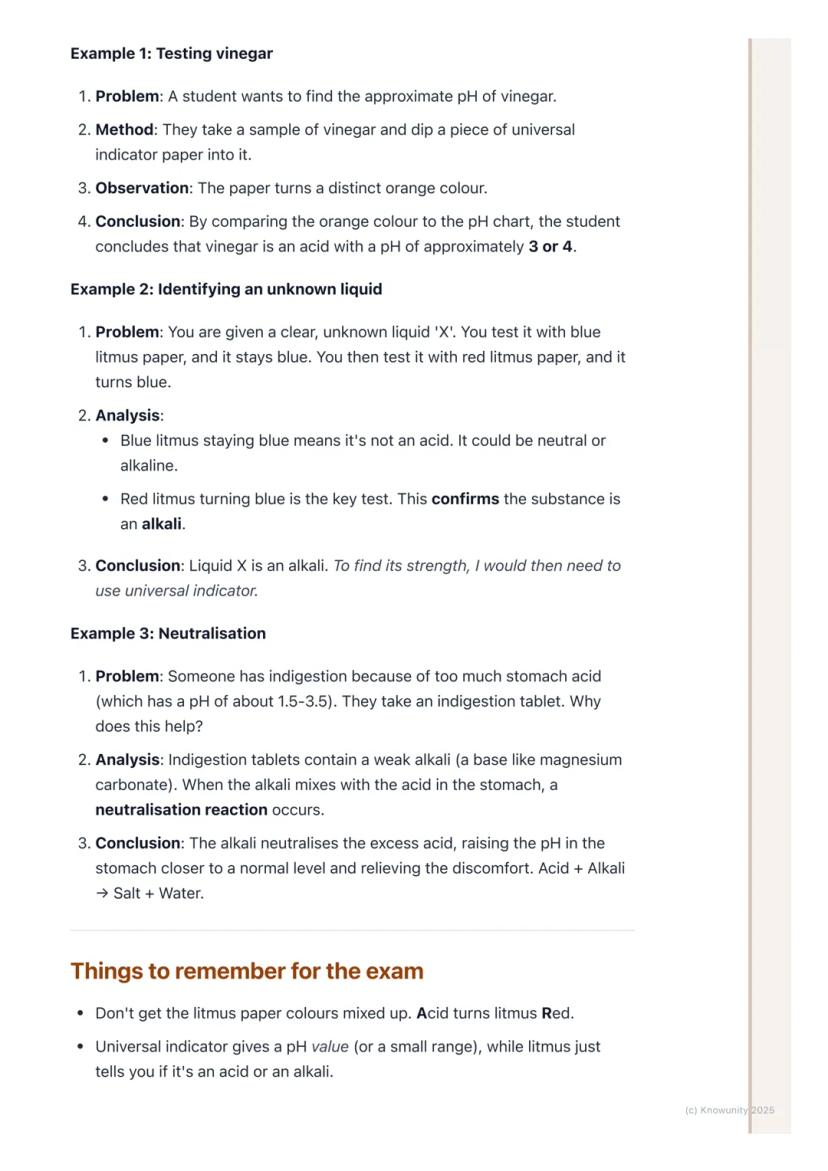
Let's say you're testing household vinegar with universal indicator paper. Dip it in, and you'll see it turn orange, telling you the vinegar is acidic with a pH around 3-4. That's exactly what you'd expect from something that tastes so sour!
Here's a trickier scenario: you've got an unknown clear liquid that keeps blue litmus blue but turns red litmus blue. The first test rules out acid (since blue litmus didn't change), and the second test confirms it's definitely alkaline. You'd need universal indicator to find out exactly how strong.
Neutralisation happens everywhere in real life. When you take an antacid for heartburn, you're adding a mild alkali to neutralise excess stomach acid. The reaction brings your stomach pH back closer to normal, which stops the burning sensation.
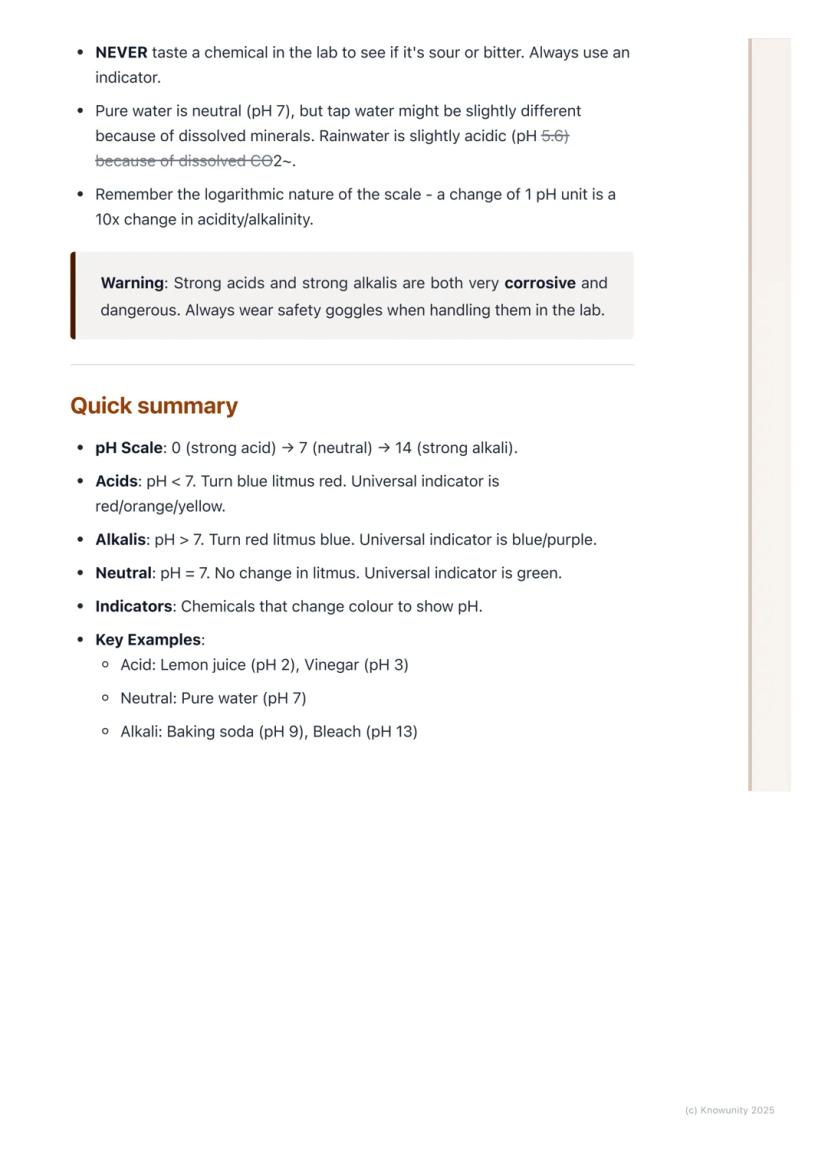
Safety First: Never taste chemicals to test if they're acidic! Always use indicators - your tongue isn't worth the risk.
5
of 5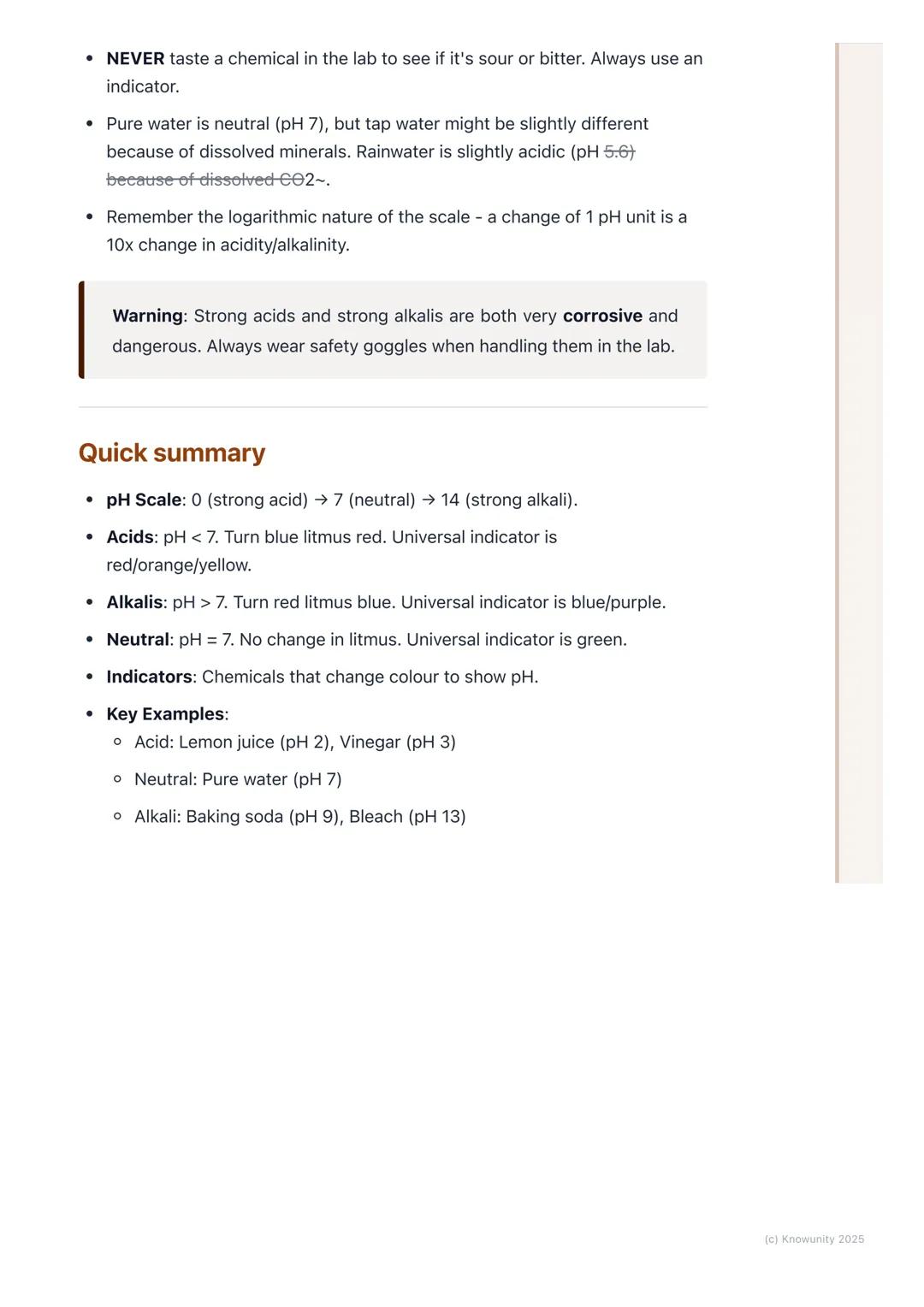
Key Points for Success
Remember that pure water is neutral at pH 7, but tap water might be slightly different due to dissolved minerals. Rainwater is actually slightly acidic (pH 5.6) because it picks up carbon dioxide from the atmosphere.
For your exams, focus on the indicator colour changes: acids turn blue litmus red and make universal indicator red/orange/yellow, whilst alkalis turn red litmus blue and make universal indicator blue/purple. Neutral substances keep blue litmus blue, leave red litmus red, and turn universal indicator green.
The most common mistake? Mixing up litmus colours. Just remember the simple rule: acid makes litmus red, alkali makes litmus blue. Strong acids and alkalis are both corrosive and dangerous - always wear safety goggles when handling them.
Exam Success: Know your examples! Lemon juice (pH 2), vinegar (pH 3), pure water (pH 7), baking soda (pH 9), and household bleach (pH 13).
Pensávamos que não ias perguntar...
O que é o Companheiro de Aprendizagem com IA da Knowunity?
O nosso companheiro de aprendizagem com IA foi especificamente criado para as necessidades dos estudantes. Com base nos milhões de conteúdos que temos na plataforma, podemos fornecer respostas verdadeiramente significativas e relevantes para os estudantes. Mas não se trata apenas de respostas, o companheiro foca-se mais em guiar os estudantes através dos seus desafios diários de aprendizagem, com planos de estudo personalizados, quizzes ou conteúdos no chat e 100% de personalização baseada nas habilidades e desenvolvimentos do estudante.
Onde posso fazer o download da app Knowunity?
Pode descarregar a aplicação na Google Play Store e na Apple App Store.
Como posso receber o meu pagamento? Quanto posso ganhar?
Sim, tem acesso gratuito ao conteúdo da aplicação e ao nosso companheiro de IA. Para desbloquear determinadas funcionalidades da aplicação, pode adquirir o Knowunity Pro.
Conteúdos mais populares de Science
7ScienceScience/Physics notes - Speed, density, work
Speed density work formulas
3rd Year81
ScienceAtomic Structure and the Periodic Table
Students will learn about the structure of atoms, including protons, neutrons, and electrons, and how elements are organised and classified in the Periodic Table based on their electronic configuration and chemical properties.
5th Year41
ScienceHuman Body Systems
An introduction to major human body systems such as the digestive, circulatory, respiratory, and nervous systems, understanding their basic functions.
2nd Year131
ScienceJunior Cert Science Notes: The Cell
Notes on the Cell
3rd Year261
ScienceCells
Junior cert science cells summary
1st Year611
ScienceHuman Reproductive System
A basic overview of the male and female reproductive systems, including their main structures and functions.
TY191
ScienceLight and Optics
Exploring the properties of light, including how it travels, reflects, and refracts, and how we perceive colours.
2nd Year50
Conteúdos mais populares
9 Irish
IrishIrish oral questions and answers
Questions and answers for the leaving cert oral
5th Year4264
 English
Key Quotes : Sive
Key Quotes and explanations: Sive
6th Year2842
IrishIrish oral questions
Outline of oral questions
5th Year2055
IrishIníon- le hÁine Durkin
Aine Durkin’s poem, Iníon: Themes & summary
5th Year850
IrishIrish poetry 2027
Iníon + Dínit an Bhróin
5th Year1133
IrishLC HL notes- Iníon (poem)
Includes poem in English and Irish, theme, key words & phrases
5th Year2284
EnglishCultural Context : Shawshank Redemption : Sive : Small Things Like These
Comparative Study : Cultural Context : Shawshank Redemption, Sive and Small Things Like These
6th Year1430
IrishMo Ghrá-sa (Idir Lúibíní)
Notes on mo ghrá-sa
5th Year380
IrishAn Gaeilge Aiste
Irish Language essay
6th Year1320
Não encontra o que procura? Explore outras disciplinas.
Avaliações dos nossos utilizadores. Eles adoraram tudo — e tu também vais adorar.
4.6/5App Store
4.7/5Google Play
A App é muito fácil de usar e está nem organizada. Encontrei tudo o que estava à procura até agora e consegui aprender muito com as apresentações! Vou usar a app para um trabalho escolar! E claro que também me ajuda muito como inspiração.
João Sutilizador iOS
Esta app é realmente incrível. Há tantas anotações de estudo e ajuda [...]. A minha disciplina problemática é Francês, por exemplo, e a app tem muitas opções de ajuda. Graças a esta app, melhorei o meu Francês. Eu recomendo a qualquer pessoa.
Sara C.utilizadora Android
Uau, estou realmente impressionado. Acabei de experimentar o app porque o vi anunciado muitas vezes e fiquei absolutamente surpreso. Este app é A AJUDA que você quer para a escola e, acima de tudo, oferece tantas coisas, como exercícios e folhas de fatos, que têm sido MUITO úteis para mim pessoalmente.
Anautilizadora iOS
Science5 visualizações·Atualizado Jun 16, 2026·5 páginasThe Ultimate Guide to the pH Scale
The pH scale is your key to understanding how acidic or alkaline substances are around you - from the lemon juice in your kitchen to the soap you wash with. It's a simple 0-14 scale that scientists use everywhere, and...
1
of 5
Cadastre-se para ver o conteúdo. É grátis!
- Acesso a todos os documentos
- Melhore suas notas
- Junte-se a milhões de estudantes
Understanding the pH Scale Basics
Ever wondered why lemons taste so sour or why soap feels slippery? It's all about pH - which stands for 'potential of Hydrogen' and measures how acidic or alkaline something is.
The pH scale runs from 0 to 14, and it's dead simple once you know the rules. Acids have a pH less than 7 and taste sour (think vinegar or citrus fruits), whilst alkalis have a pH greater than 7 and feel soapy to touch. Right in the middle at pH 7 is neutral - like pure water.
Here's what makes this tricky: the scale is logarithmic. This means each whole number represents a 10-times change in strength. So battery acid at pH 1 isn't just a bit stronger than lemon juice at pH 2 - it's actually 10 times stronger!
Key Insight: All alkalis are bases, but not all bases are alkalis. Alkalis are simply bases that can dissolve in water.
2
of 5Cadastre-se para ver o conteúdo. É grátis!
- Acesso a todos os documentos
- Melhore suas notas
- Junte-se a milhões de estudantes
How Strong is Strong?
The pH scale breaks down into three clear zones that you need to master. Acidic substances get stronger as the numbers get smaller - so pH 1 battery acid will definitely ruin your day more than pH 6 milk will.
At exactly pH 7, you've got neutral territory. Pure water sits here perfectly balanced, neither acidic nor alkaline. It's your reference point for everything else.
Alkaline substances work the opposite way - higher numbers mean stronger alkalis. pH 8 egg whites are pretty mild, but pH 14 oven cleaner is seriously dangerous stuff that'll burn through skin.
Remember This: Each step down the pH scale means 10 times more acidic. So pH 3 is 100 times more acidic than pH 5!
3
of 5Cadastre-se para ver o conteúdo. É grátis!
- Acesso a todos os documentos
- Melhore suas notas
- Junte-se a milhões de estudantes
Testing pH with Indicators
You can't just eyeball a substance and guess its pH - you need indicators, which are special chemicals that change colour based on acidity. There are two main types you'll use in the lab.
Litmus paper is the simple option that just tells you acid or alkali. Blue litmus turns red in acid (remember: "Acid turns litmus Red"), whilst red litmus turns blue in alkalis. It's handy for quick tests but won't tell you how strong the acid or alkali is.
Universal indicator is where things get interesting. This clever chemical gives you a rainbow of colours that match specific pH ranges. Red means strong acid , orange and yellow show weaker acids, green is neutral, and blue through to purple indicates increasingly strong alkalis.
Lab Tip: Universal indicator comes as both liquid drops and test strips - both work the same way and give you an actual pH reading.
4
of 5Cadastre-se para ver o conteúdo. É grátis!
- Acesso a todos os documentos
- Melhore suas notas
- Junte-se a milhões de estudantes
Real-World pH Examples
Let's say you're testing household vinegar with universal indicator paper. Dip it in, and you'll see it turn orange, telling you the vinegar is acidic with a pH around 3-4. That's exactly what you'd expect from something that tastes so sour!
Here's a trickier scenario: you've got an unknown clear liquid that keeps blue litmus blue but turns red litmus blue. The first test rules out acid (since blue litmus didn't change), and the second test confirms it's definitely alkaline. You'd need universal indicator to find out exactly how strong.
Neutralisation happens everywhere in real life. When you take an antacid for heartburn, you're adding a mild alkali to neutralise excess stomach acid. The reaction brings your stomach pH back closer to normal, which stops the burning sensation.
Safety First: Never taste chemicals to test if they're acidic! Always use indicators - your tongue isn't worth the risk.
5
of 5Cadastre-se para ver o conteúdo. É grátis!
- Acesso a todos os documentos
- Melhore suas notas
- Junte-se a milhões de estudantes
Key Points for Success
Remember that pure water is neutral at pH 7, but tap water might be slightly different due to dissolved minerals. Rainwater is actually slightly acidic (pH 5.6) because it picks up carbon dioxide from the atmosphere.
For your exams, focus on the indicator colour changes: acids turn blue litmus red and make universal indicator red/orange/yellow, whilst alkalis turn red litmus blue and make universal indicator blue/purple. Neutral substances keep blue litmus blue, leave red litmus red, and turn universal indicator green.
The most common mistake? Mixing up litmus colours. Just remember the simple rule: acid makes litmus red, alkali makes litmus blue. Strong acids and alkalis are both corrosive and dangerous - always wear safety goggles when handling them.
Exam Success: Know your examples! Lemon juice (pH 2), vinegar (pH 3), pure water (pH 7), baking soda (pH 9), and household bleach (pH 13).
Pensávamos que não ias perguntar...
O que é o Companheiro de Aprendizagem com IA da Knowunity?
O nosso companheiro de aprendizagem com IA foi especificamente criado para as necessidades dos estudantes. Com base nos milhões de conteúdos que temos na plataforma, podemos fornecer respostas verdadeiramente significativas e relevantes para os estudantes. Mas não se trata apenas de respostas, o companheiro foca-se mais em guiar os estudantes através dos seus desafios diários de aprendizagem, com planos de estudo personalizados, quizzes ou conteúdos no chat e 100% de personalização baseada nas habilidades e desenvolvimentos do estudante.
Onde posso fazer o download da app Knowunity?
Pode descarregar a aplicação na Google Play Store e na Apple App Store.
Como posso receber o meu pagamento? Quanto posso ganhar?
Sim, tem acesso gratuito ao conteúdo da aplicação e ao nosso companheiro de IA. Para desbloquear determinadas funcionalidades da aplicação, pode adquirir o Knowunity Pro.
Conteúdos mais populares de Science
7ScienceScience/Physics notes - Speed, density, work
Speed density work formulas
3rd Year81
ScienceAtomic Structure and the Periodic Table
Students will learn about the structure of atoms, including protons, neutrons, and electrons, and how elements are organised and classified in the Periodic Table based on their electronic configuration and chemical properties.
5th Year41
ScienceHuman Body Systems
An introduction to major human body systems such as the digestive, circulatory, respiratory, and nervous systems, understanding their basic functions.
2nd Year131
ScienceJunior Cert Science Notes: The Cell
Notes on the Cell
3rd Year261
ScienceCells
Junior cert science cells summary
1st Year611
ScienceHuman Reproductive System
A basic overview of the male and female reproductive systems, including their main structures and functions.
TY191
ScienceLight and Optics
Exploring the properties of light, including how it travels, reflects, and refracts, and how we perceive colours.
2nd Year50
Conteúdos mais populares
9IrishIrish oral questions and answers
Questions and answers for the leaving cert oral
5th Year4264
EnglishKey Quotes : Sive
Key Quotes and explanations: Sive
6th Year2842
IrishIrish oral questions
Outline of oral questions
5th Year2055
IrishIníon- le hÁine Durkin
Aine Durkin’s poem, Iníon: Themes & summary
5th Year850
IrishIrish poetry 2027
Iníon + Dínit an Bhróin
5th Year1133
IrishLC HL notes- Iníon (poem)
Includes poem in English and Irish, theme, key words & phrases
5th Year2284
EnglishCultural Context : Shawshank Redemption : Sive : Small Things Like These
Comparative Study : Cultural Context : Shawshank Redemption, Sive and Small Things Like These
6th Year1430
IrishMo Ghrá-sa (Idir Lúibíní)
Notes on mo ghrá-sa
5th Year380
IrishAn Gaeilge Aiste
Irish Language essay
6th Year1320
Não encontra o que procura? Explore outras disciplinas.
Avaliações dos nossos utilizadores. Eles adoraram tudo — e tu também vais adorar.
4.6/5App Store
4.7/5Google Play
A App é muito fácil de usar e está nem organizada. Encontrei tudo o que estava à procura até agora e consegui aprender muito com as apresentações! Vou usar a app para um trabalho escolar! E claro que também me ajuda muito como inspiração.
João Sutilizador iOS
Esta app é realmente incrível. Há tantas anotações de estudo e ajuda [...]. A minha disciplina problemática é Francês, por exemplo, e a app tem muitas opções de ajuda. Graças a esta app, melhorei o meu Francês. Eu recomendo a qualquer pessoa.
Sara C.utilizadora Android
Uau, estou realmente impressionado. Acabei de experimentar o app porque o vi anunciado muitas vezes e fiquei absolutamente surpreso. Este app é A AJUDA que você quer para a escola e, acima de tudo, oferece tantas coisas, como exercícios e folhas de fatos, que têm sido MUITO úteis para mim pessoalmente.
Anautilizadora iOS