
Ever wondered why mirrors work, why straws look bent in... Mostrar mais
 Science5 visualizações·Atualizado May 18, 2026·7 páginas
Understanding Light and Its Optical Properties
1 / 7
1
of 7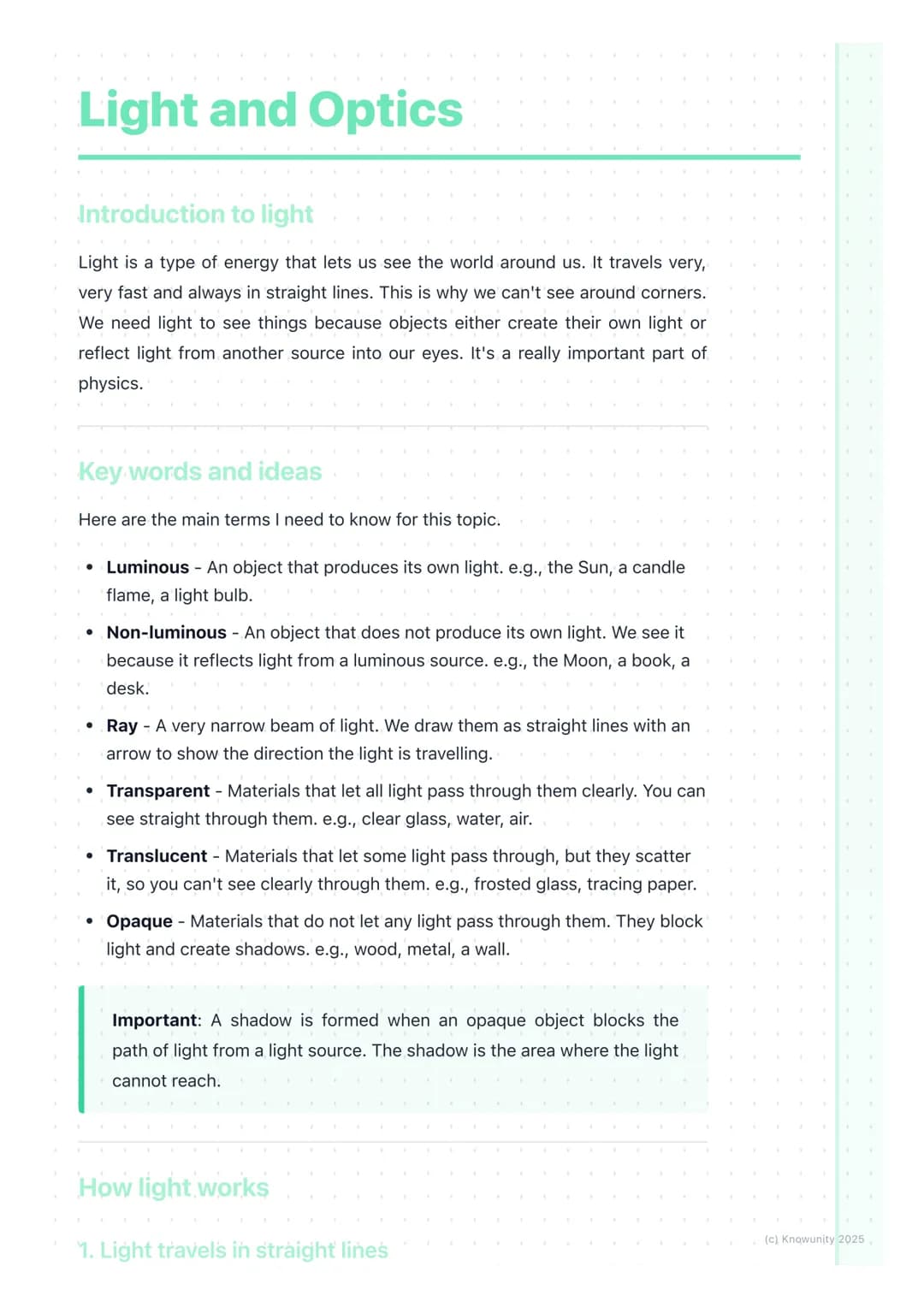
Introduction to Light
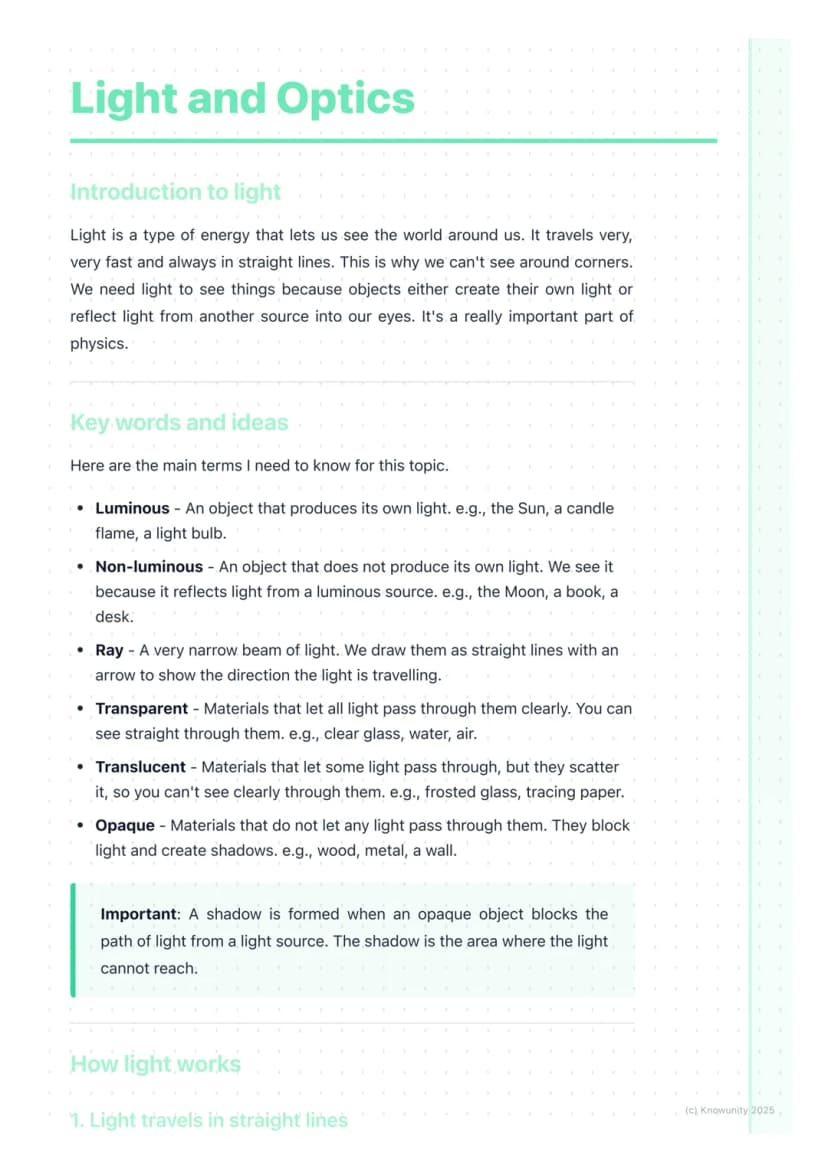
Light is literally everywhere around you right now, and without it, you wouldn't be able to read this! It's a form of energy that travels incredibly fast and always moves in perfectly straight lines. This is exactly why you can't peek around corners without actually moving your head.
Everything you see falls into two categories: luminous objects (like the sun, light bulbs, or your phone screen) that create their own light, and non-luminous objects (like this page, your desk, or even the moon) that we only see because they bounce light from luminous sources into our eyes.
When light hits different materials, three things can happen. Transparent materials like clear glass let all light pass through cleanly. Translucent materials like frosted bathroom windows let some light through but scatter it so you can't see clearly. Opaque materials like walls block all light completely, which creates shadows behind them.
Quick Tip: Remember that shadows form because opaque objects block light's straight-line path - no bending allowed!
2
of 7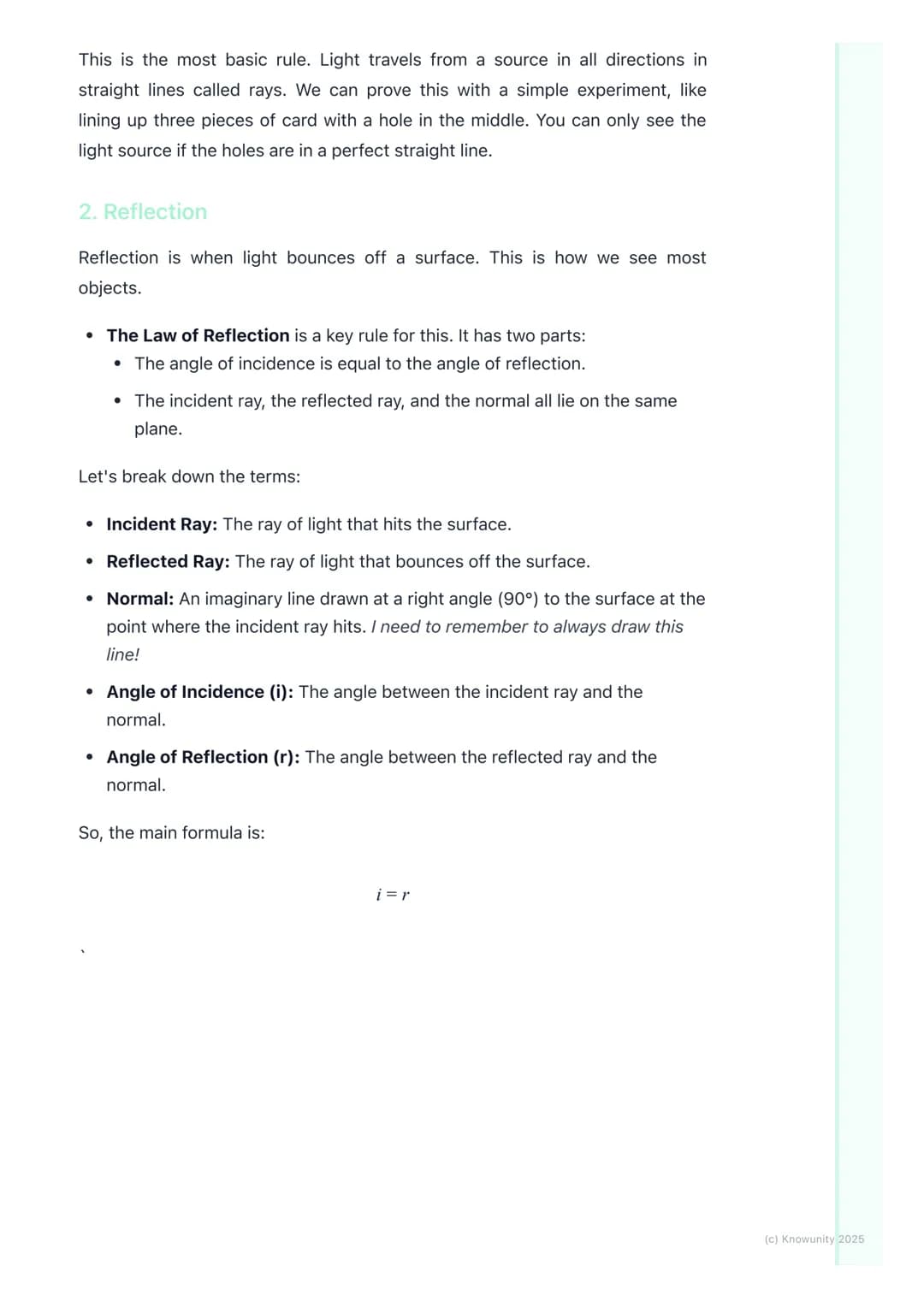
Reflection: When Light Bounces
Reflection happens every time you look in a mirror, but it's actually occurring constantly all around you. Most objects you see aren't making light themselves - they're reflecting it into your eyes.
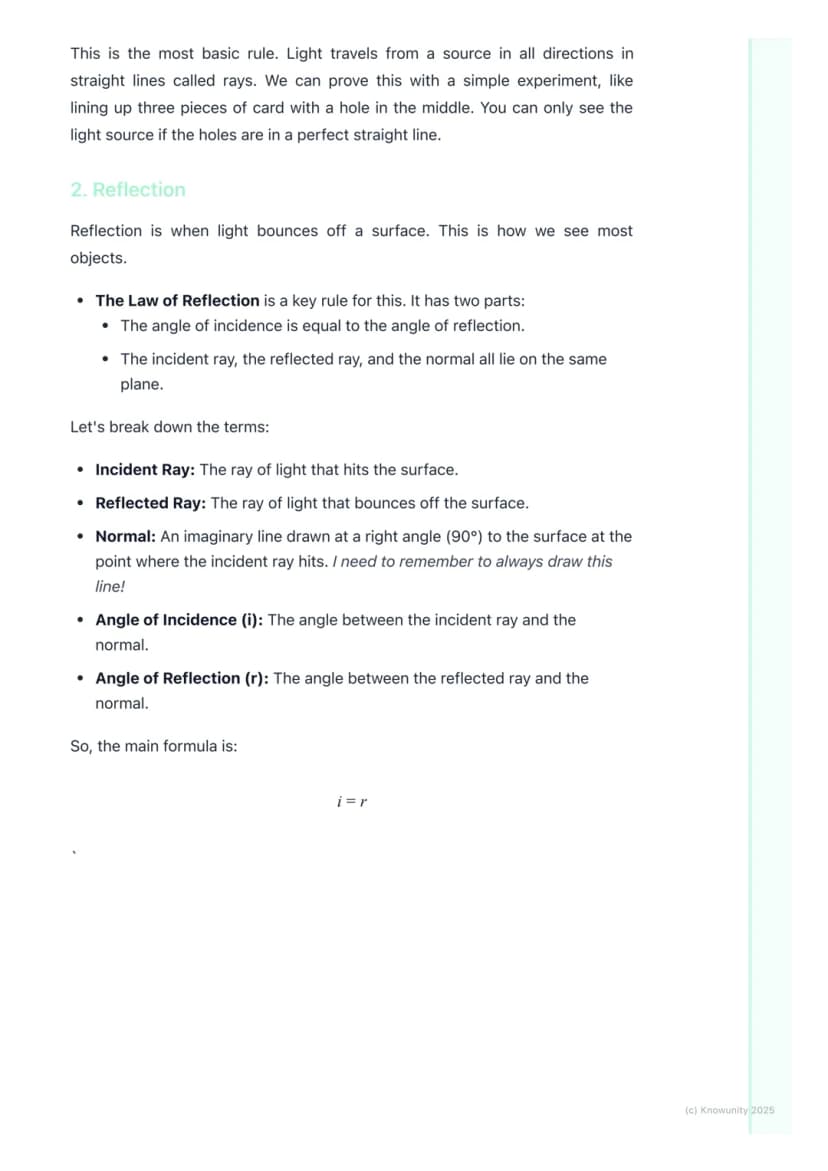
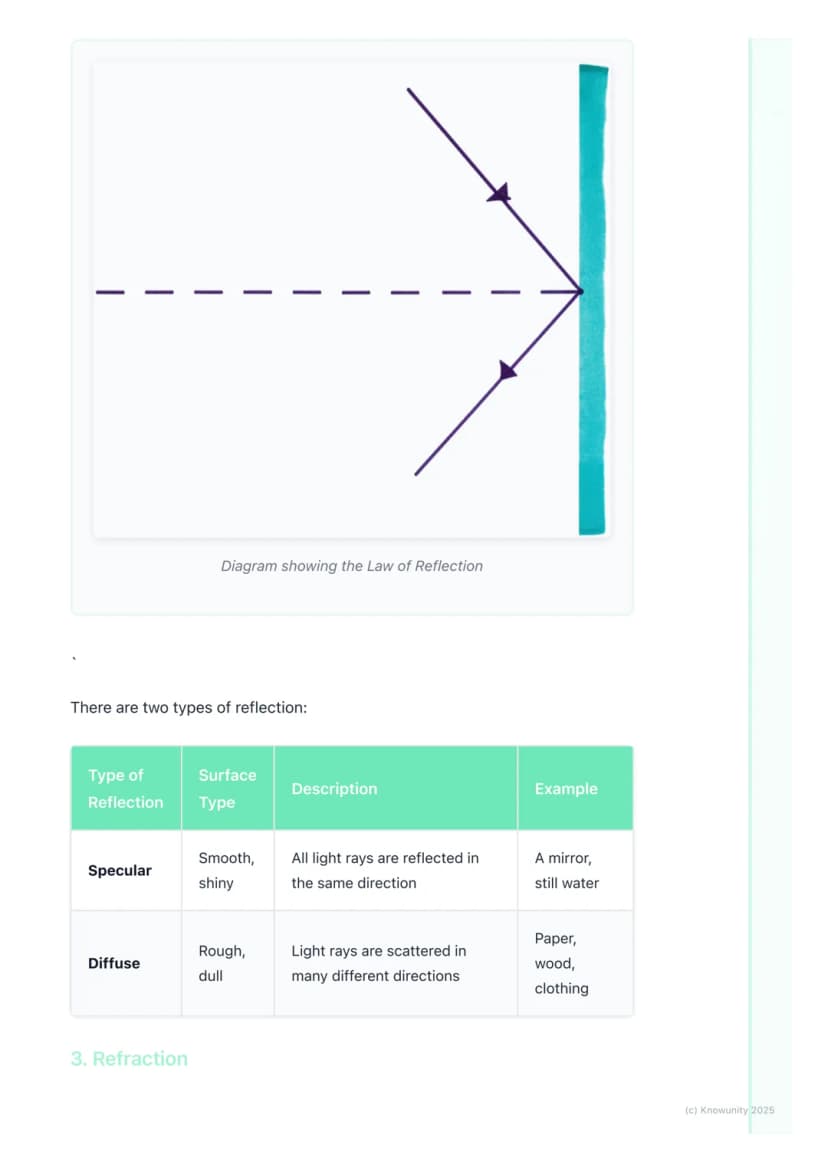
The Law of Reflection is your key rule here, and it's beautifully simple: the angle going in equals the angle coming out. When measuring these angles, always use the normal - an imaginary line drawn at 90° to the surface where the light hits.
There are two types of reflection you'll encounter. Specular reflection happens on smooth surfaces like mirrors, where all light rays bounce off in the same direction, giving you a clear image. Diffuse reflection occurs on rough surfaces like paper or clothing, where light scatters in all directions - this is why you can't see your reflection in a jumper!
Remember: Always measure angles from the normal, not from the surface itself - this is the most common mistake in reflection problems!
3
of 7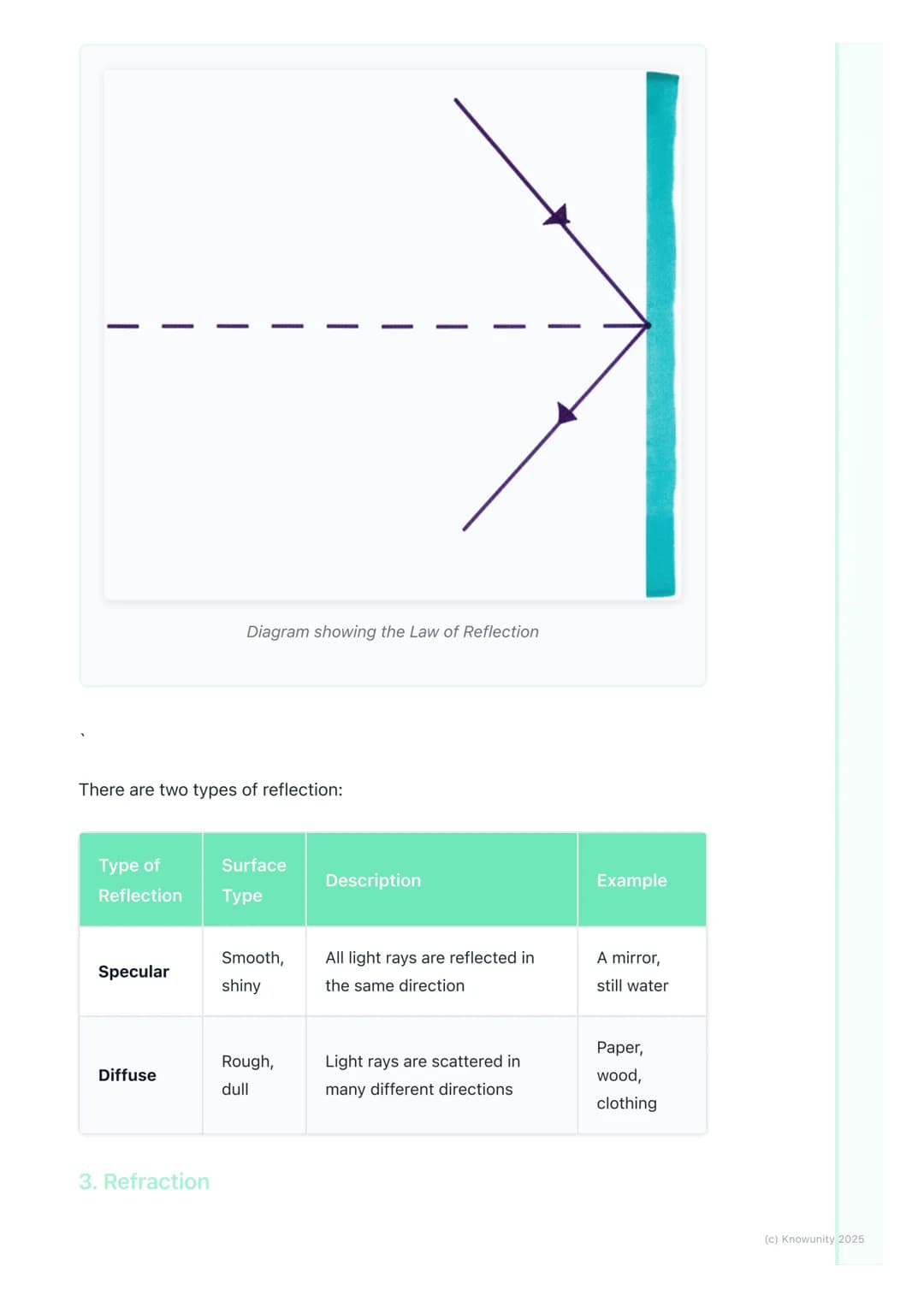
Refraction: When Light Bends
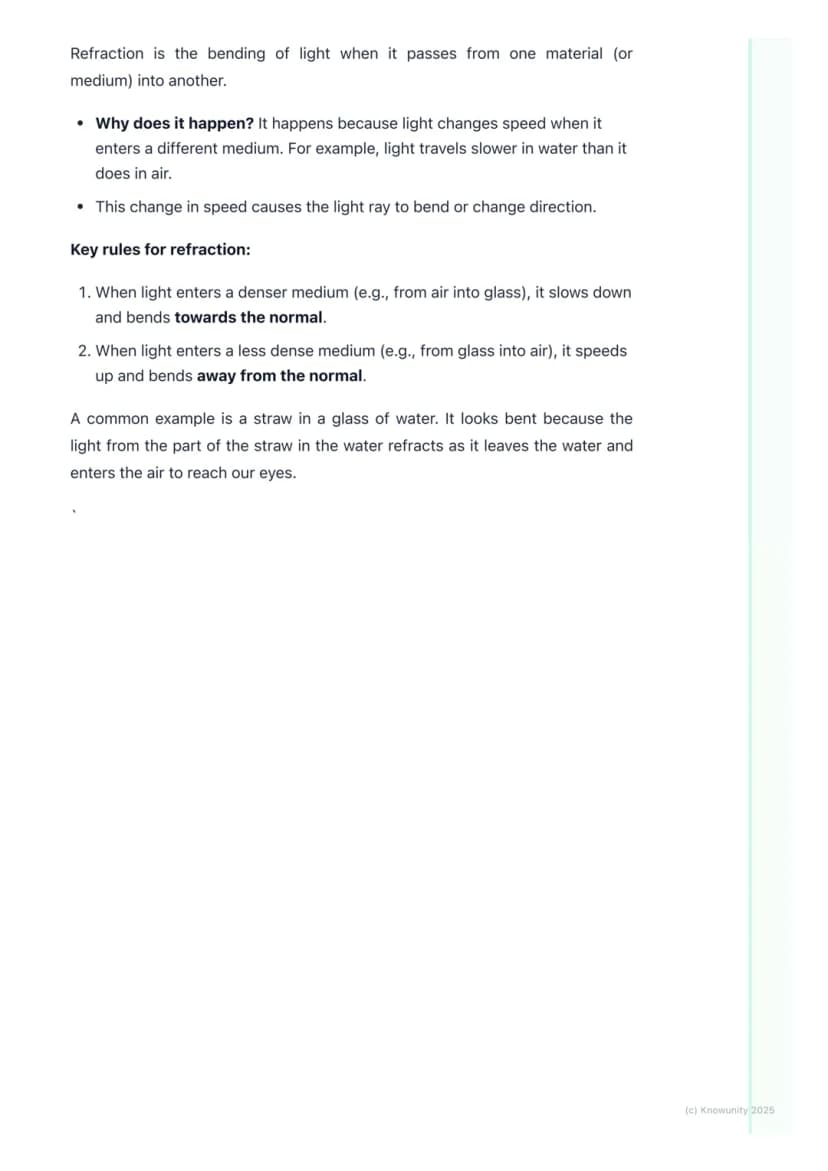
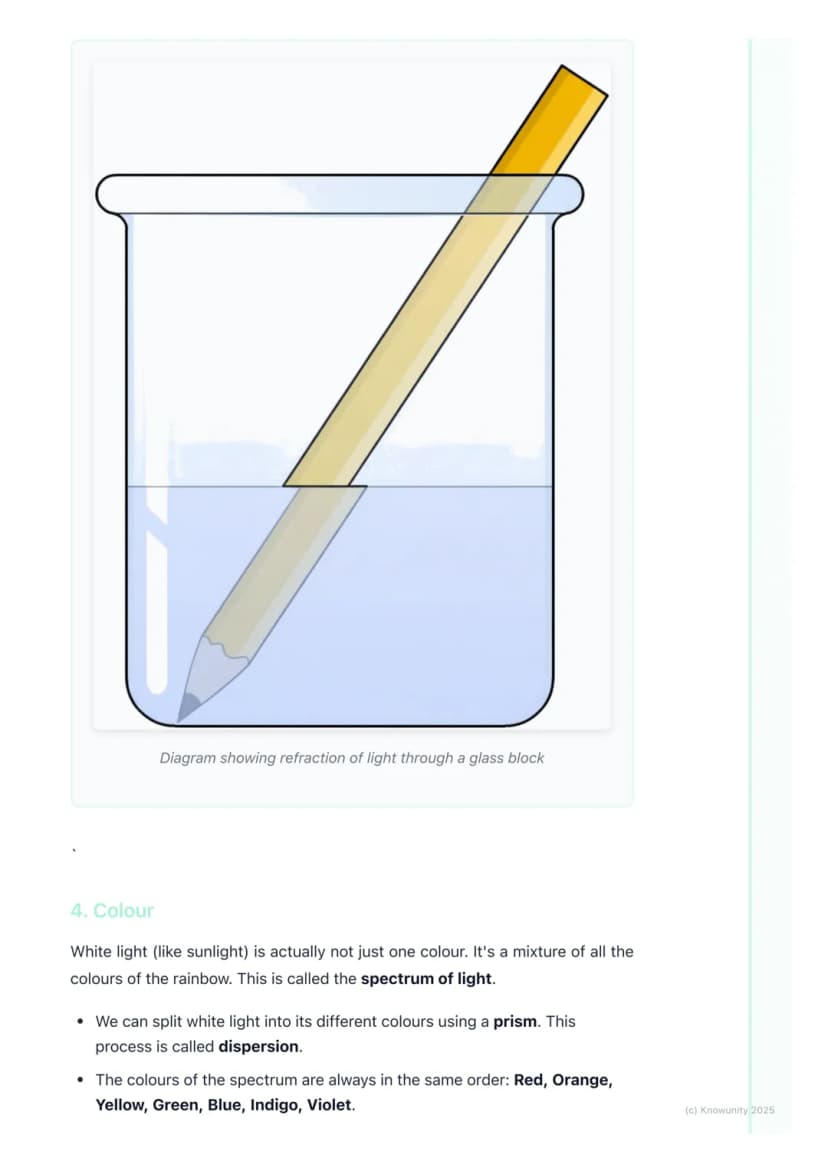
Refraction is the reason that straw in your drink looks wonky, and it happens because light changes speed when moving between different materials. When light slows down entering a denser material (like going from air into water), it bends towards the normal. When it speeds up entering a less dense material, it bends away from the normal.
This bending tricks your brain because your eyes assume light always travels in straight lines. So when light from the underwater part of that straw bends as it leaves the water, your brain traces it back in a straight line to the wrong position, making the straw appear bent at the water's surface.
You'll see refraction everywhere once you start looking for it - from swimming pools that look shallower than they really are, to glasses that help people see clearly by bending light in just the right way.
Key Point: Denser materials slow light down and bend it towards the normal; less dense materials speed it up and bend it away!
4
of 7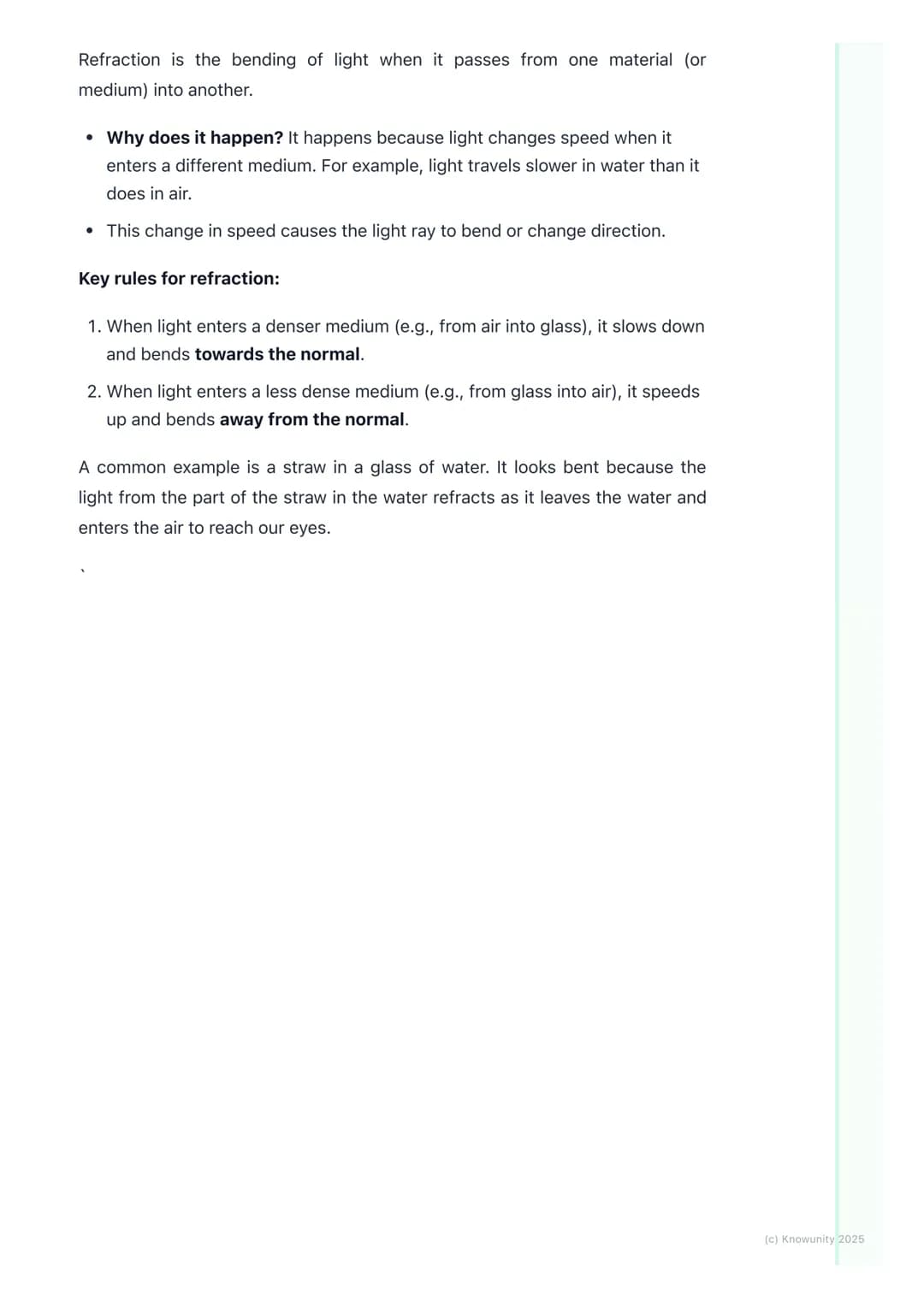
Colour and the Light Spectrum
Here's something brilliant: white light isn't actually white at all! It's a secret mixture of all the colours of the rainbow hiding in plain sight. You can reveal this hidden spectrum using a triangular piece of glass called a prism, which splits white light through a process called dispersion.
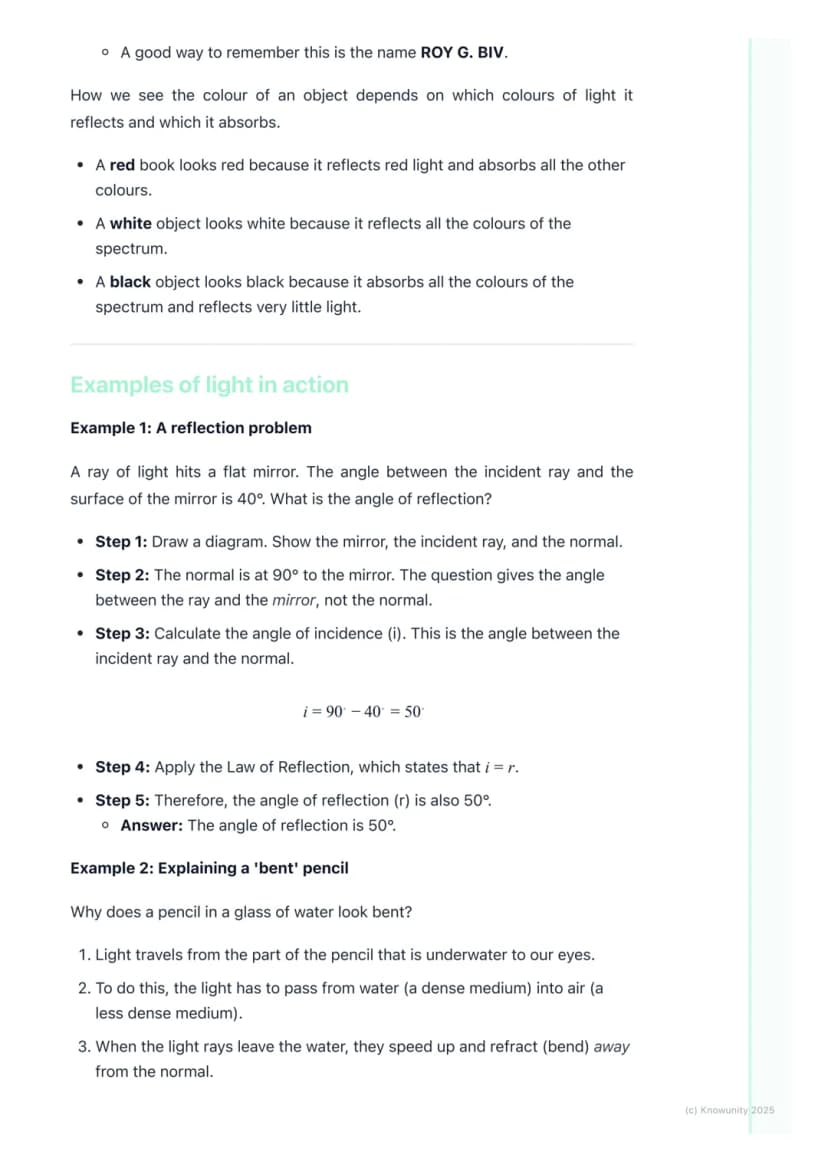
The colours always appear in the same order: Red, Orange, Yellow, Green, Blue, Indigo, Violet - remember it as ROY G. BIV. Each colour bends by a slightly different amount as it passes through the prism, which is why they separate out.
The colour you see when looking at any object is actually the colour it reflects back to your eyes. A red apple looks red because it reflects red light and absorbs all the other colours. White objects reflect everything, which is why they can look brilliant in sunlight. Black objects absorb almost everything, reflecting very little light back to you.
Think About It: If you shine red light on a blue object, it will look black because there's no blue light for it to reflect back to you!
5
of 7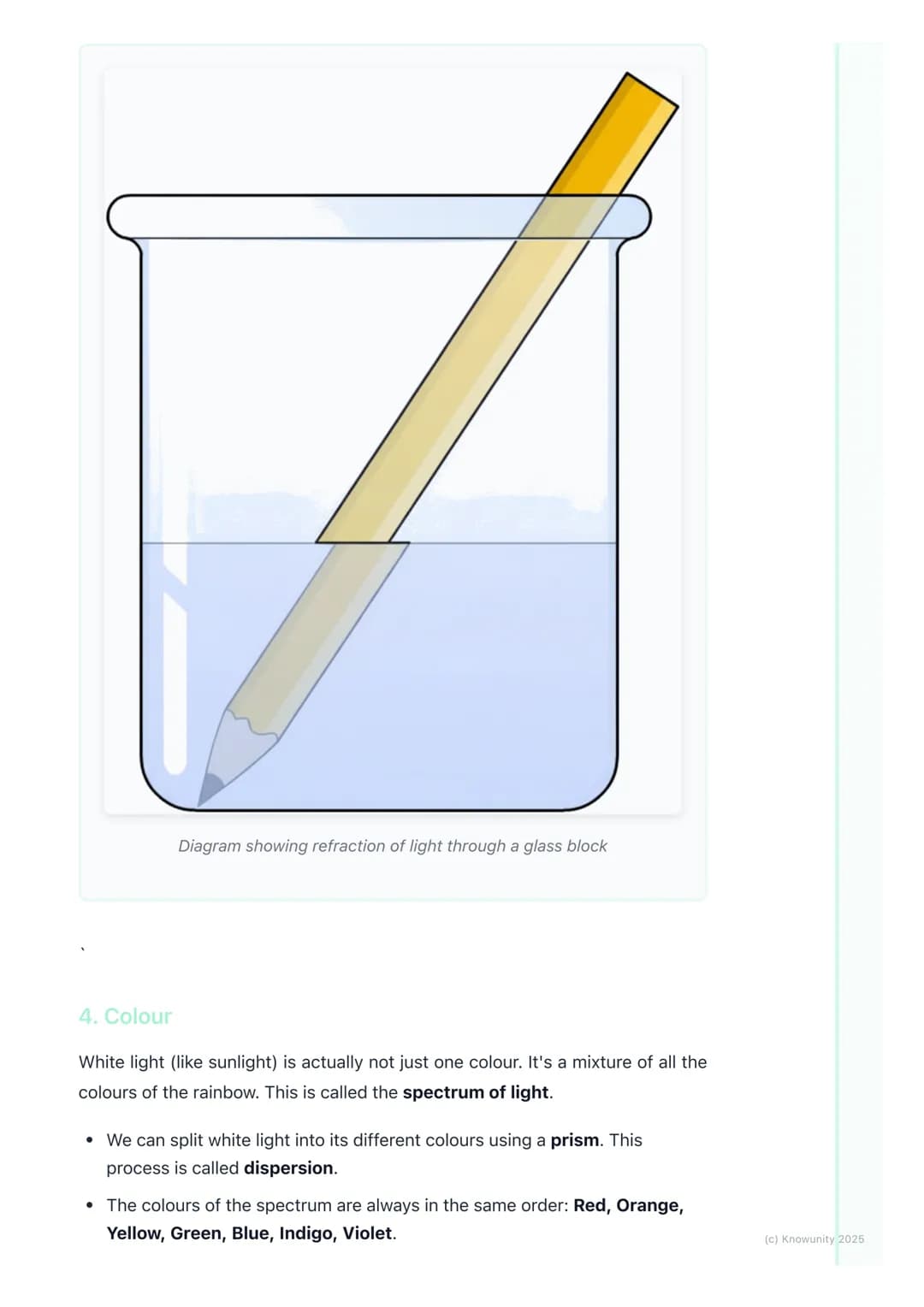
Solving Light Problems
When tackling reflection problems, always start by drawing a clear diagram with the normal line. If you're given the angle between the incident ray and the surface, remember to subtract it from 90° to find the angle from the normal. Then simply apply i = r (angle of incidence equals angle of reflection).
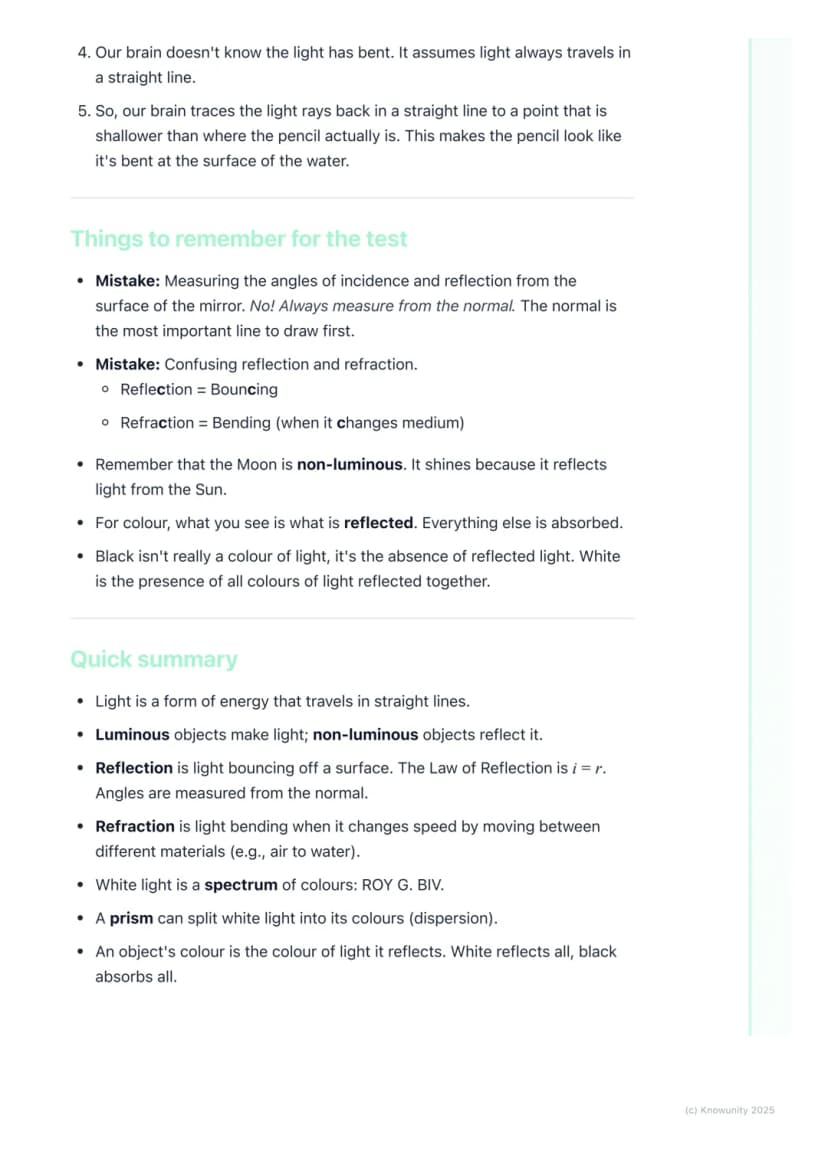
For refraction questions, focus on what happens when light changes medium. Moving into denser materials (air to water) bends light towards the normal, whilst moving to less dense materials (water to air) bends it away. This explains everyday observations like why swimming pools look shallower than they are.
Colour problems usually involve thinking about what gets reflected versus what gets absorbed. Remember that the colour you see is always what's being reflected - everything else disappears because it's absorbed by the object.
Exam Tip: Don't confuse reflection (bouncing) with refraction (bending when changing medium) - they're completely different processes!
6
of 7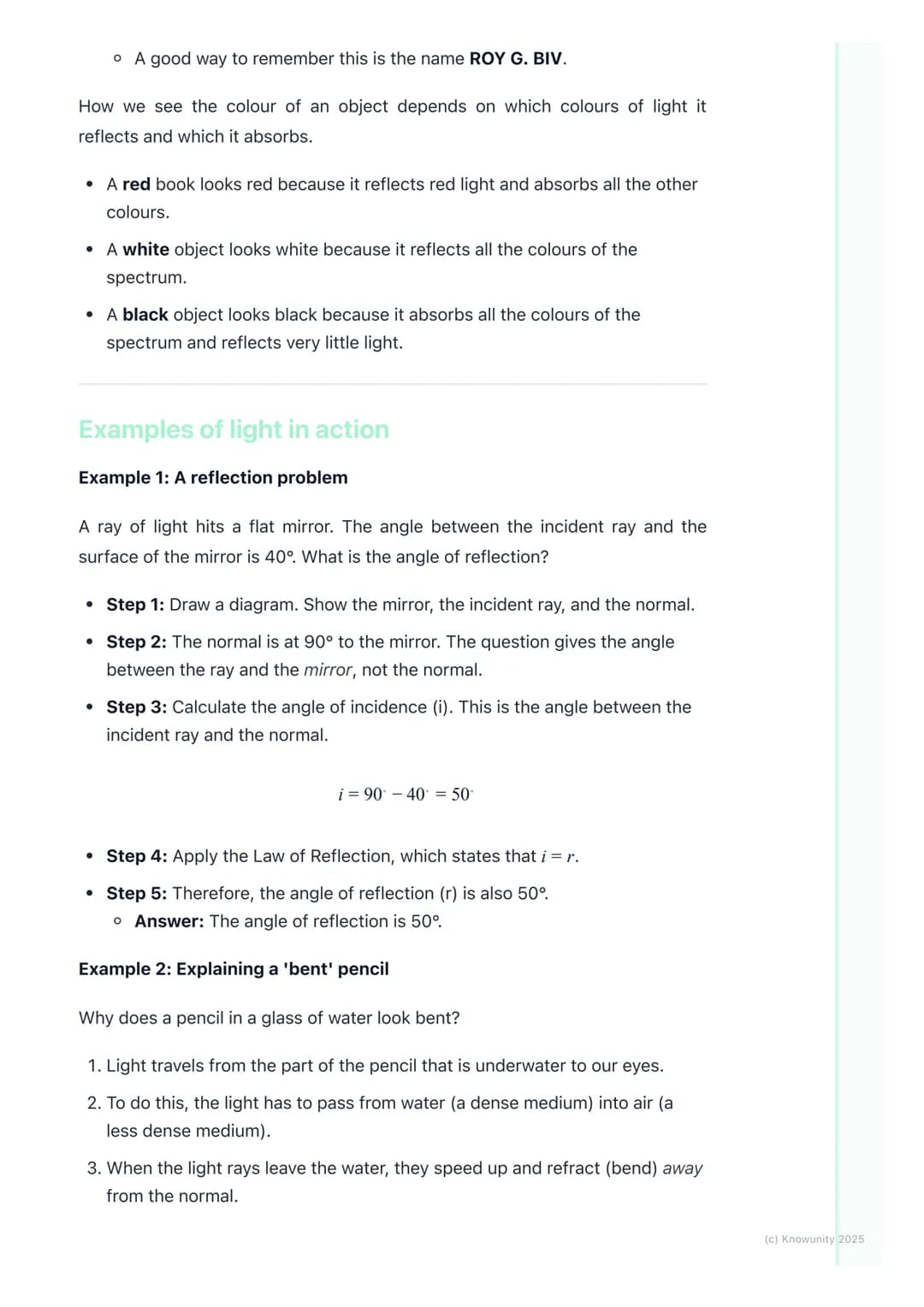
7
of 7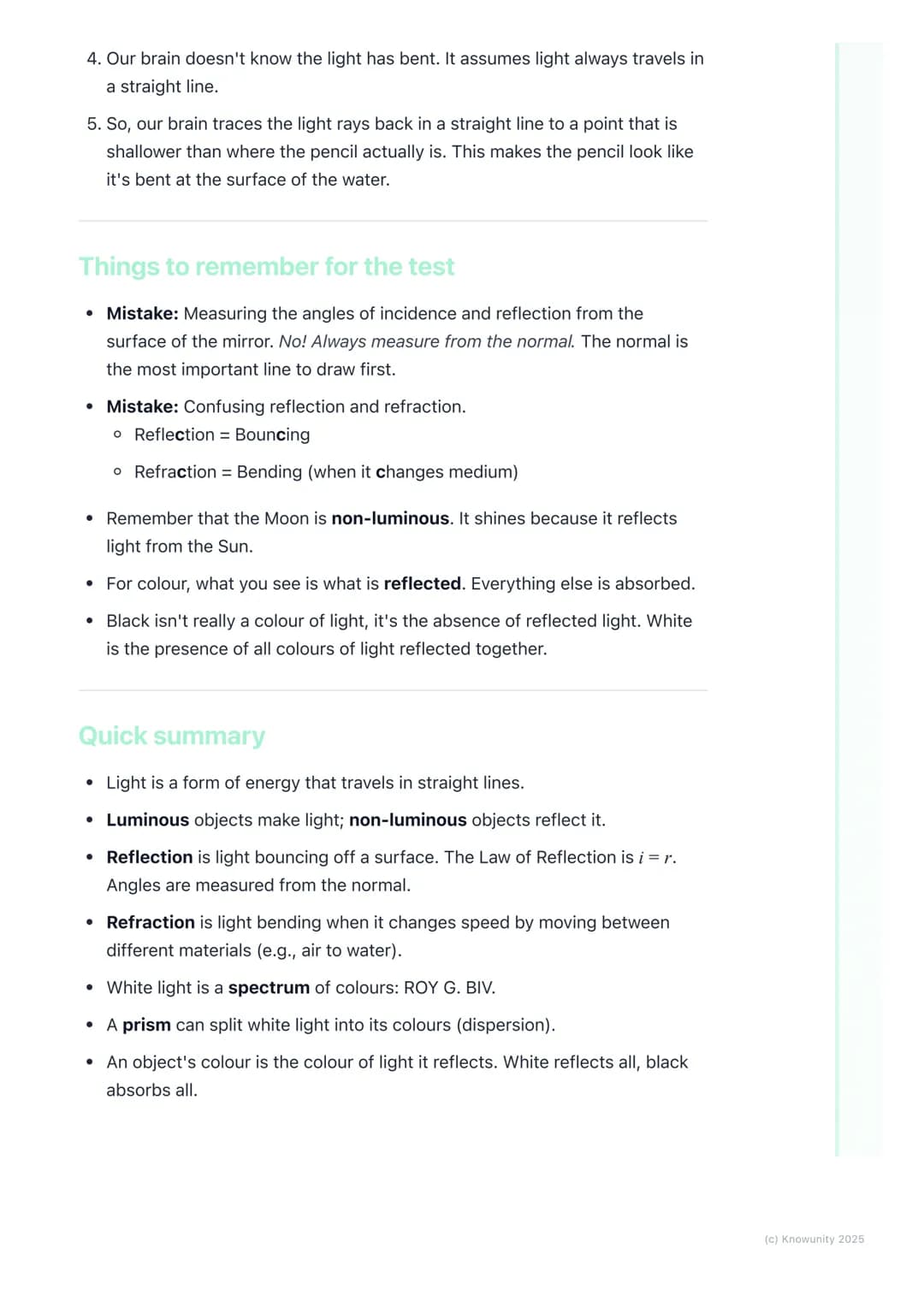
Pensávamos que não ias perguntar...
O que é o Companheiro de Aprendizagem com IA da Knowunity?
O nosso companheiro de aprendizagem com IA foi especificamente criado para as necessidades dos estudantes. Com base nos milhões de conteúdos que temos na plataforma, podemos fornecer respostas verdadeiramente significativas e relevantes para os estudantes. Mas não se trata apenas de respostas, o companheiro foca-se mais em guiar os estudantes através dos seus desafios diários de aprendizagem, com planos de estudo personalizados, quizzes ou conteúdos no chat e 100% de personalização baseada nas habilidades e desenvolvimentos do estudante.
Onde posso fazer o download da app Knowunity?
Pode descarregar a aplicação na Google Play Store e na Apple App Store.
Como posso receber o meu pagamento? Quanto posso ganhar?
Sim, tem acesso gratuito ao conteúdo da aplicação e ao nosso companheiro de IA. Para desbloquear determinadas funcionalidades da aplicação, pode adquirir o Knowunity Pro.
Conteúdos mais populares de Science
5ScienceHuman Reproductive System
A basic overview of the male and female reproductive systems, including their main structures and functions.
TY191
ScienceAtomic Structure and the Periodic Table
Students will learn about the structure of atoms, including protons, neutrons, and electrons, and how elements are organised and classified in the Periodic Table based on their electronic configuration and chemical properties.
5th Year41
ScienceJunior Cert Science Notes: The Cell
Notes on the Cell
3rd Year221
ScienceHuman Body Systems
An introduction to major human body systems such as the digestive, circulatory, respiratory, and nervous systems, understanding their basic functions.
2nd Year131
ScienceCells
Junior cert science cells summary
1st Year591
Conteúdos mais populares
9 Irish
IrishIrish oral questions and answers
Questions and answers for the leaving cert oral
5th Year4254
IrishIrish oral questions
Outline of oral questions
5th Year2055
 English
Key Quotes : Sive
Key Quotes and explanations: Sive
6th Year2822
IrishIníon- le hÁine Durkin
Aine Durkin’s poem, Iníon: Themes & summary
5th Year850
IrishIrish poetry 2027
Iníon + Dínit an Bhróin
5th Year1133
IrishLC HL notes- Iníon (poem)
Includes poem in English and Irish, theme, key words & phrases
5th Year2284
IrishGaeilge Grammar Office
All the basics you need to know on Irish grammar.
6th Year1013
EnglishCultural Context : Shawshank Redemption : Sive : Small Things Like These
Comparative Study : Cultural Context : Shawshank Redemption, Sive and Small Things Like These
6th Year1420
IrishAn Gaeilge Aiste
Irish Language essay
6th Year1290
Não encontra o que procura? Explore outras disciplinas.
Avaliações dos nossos utilizadores. Eles adoraram tudo — e tu também vais adorar.
4.6/5App Store
4.7/5Google Play
A App é muito fácil de usar e está nem organizada. Encontrei tudo o que estava à procura até agora e consegui aprender muito com as apresentações! Vou usar a app para um trabalho escolar! E claro que também me ajuda muito como inspiração.
João Sutilizador iOS
Esta app é realmente incrível. Há tantas anotações de estudo e ajuda [...]. A minha disciplina problemática é Francês, por exemplo, e a app tem muitas opções de ajuda. Graças a esta app, melhorei o meu Francês. Eu recomendo a qualquer pessoa.
Sara C.utilizadora Android
Uau, estou realmente impressionado. Acabei de experimentar o app porque o vi anunciado muitas vezes e fiquei absolutamente surpreso. Este app é A AJUDA que você quer para a escola e, acima de tudo, oferece tantas coisas, como exercícios e folhas de fatos, que têm sido MUITO úteis para mim pessoalmente.
Anautilizadora iOS
Science5 visualizações·Atualizado May 18, 2026·7 páginasUnderstanding Light and Its Optical Properties
Ever wondered why mirrors work, why straws look bent in water, or how we actually see colours? Light is the energy that makes all of this possible, and understanding how it behaves will help you make sense of the world... Mostrar mais
1
of 7Cadastre-se para ver o conteúdo. É grátis!
- Acesso a todos os documentos
- Melhore suas notas
- Junte-se a milhões de estudantes
Introduction to Light
Light is literally everywhere around you right now, and without it, you wouldn't be able to read this! It's a form of energy that travels incredibly fast and always moves in perfectly straight lines. This is exactly why you can't peek around corners without actually moving your head.
Everything you see falls into two categories: luminous objects (like the sun, light bulbs, or your phone screen) that create their own light, and non-luminous objects (like this page, your desk, or even the moon) that we only see because they bounce light from luminous sources into our eyes.
When light hits different materials, three things can happen. Transparent materials like clear glass let all light pass through cleanly. Translucent materials like frosted bathroom windows let some light through but scatter it so you can't see clearly. Opaque materials like walls block all light completely, which creates shadows behind them.
Quick Tip: Remember that shadows form because opaque objects block light's straight-line path - no bending allowed!
2
of 7Cadastre-se para ver o conteúdo. É grátis!
- Acesso a todos os documentos
- Melhore suas notas
- Junte-se a milhões de estudantes
Reflection: When Light Bounces
Reflection happens every time you look in a mirror, but it's actually occurring constantly all around you. Most objects you see aren't making light themselves - they're reflecting it into your eyes.
The Law of Reflection is your key rule here, and it's beautifully simple: the angle going in equals the angle coming out. When measuring these angles, always use the normal - an imaginary line drawn at 90° to the surface where the light hits.
There are two types of reflection you'll encounter. Specular reflection happens on smooth surfaces like mirrors, where all light rays bounce off in the same direction, giving you a clear image. Diffuse reflection occurs on rough surfaces like paper or clothing, where light scatters in all directions - this is why you can't see your reflection in a jumper!
Remember: Always measure angles from the normal, not from the surface itself - this is the most common mistake in reflection problems!
3
of 7Cadastre-se para ver o conteúdo. É grátis!
- Acesso a todos os documentos
- Melhore suas notas
- Junte-se a milhões de estudantes
Refraction: When Light Bends
Refraction is the reason that straw in your drink looks wonky, and it happens because light changes speed when moving between different materials. When light slows down entering a denser material (like going from air into water), it bends towards the normal. When it speeds up entering a less dense material, it bends away from the normal.
This bending tricks your brain because your eyes assume light always travels in straight lines. So when light from the underwater part of that straw bends as it leaves the water, your brain traces it back in a straight line to the wrong position, making the straw appear bent at the water's surface.
You'll see refraction everywhere once you start looking for it - from swimming pools that look shallower than they really are, to glasses that help people see clearly by bending light in just the right way.
Key Point: Denser materials slow light down and bend it towards the normal; less dense materials speed it up and bend it away!
4
of 7Cadastre-se para ver o conteúdo. É grátis!
- Acesso a todos os documentos
- Melhore suas notas
- Junte-se a milhões de estudantes
Colour and the Light Spectrum
Here's something brilliant: white light isn't actually white at all! It's a secret mixture of all the colours of the rainbow hiding in plain sight. You can reveal this hidden spectrum using a triangular piece of glass called a prism, which splits white light through a process called dispersion.
The colours always appear in the same order: Red, Orange, Yellow, Green, Blue, Indigo, Violet - remember it as ROY G. BIV. Each colour bends by a slightly different amount as it passes through the prism, which is why they separate out.
The colour you see when looking at any object is actually the colour it reflects back to your eyes. A red apple looks red because it reflects red light and absorbs all the other colours. White objects reflect everything, which is why they can look brilliant in sunlight. Black objects absorb almost everything, reflecting very little light back to you.
Think About It: If you shine red light on a blue object, it will look black because there's no blue light for it to reflect back to you!
5
of 7Cadastre-se para ver o conteúdo. É grátis!
- Acesso a todos os documentos
- Melhore suas notas
- Junte-se a milhões de estudantes
Solving Light Problems
When tackling reflection problems, always start by drawing a clear diagram with the normal line. If you're given the angle between the incident ray and the surface, remember to subtract it from 90° to find the angle from the normal. Then simply apply i = r (angle of incidence equals angle of reflection).
For refraction questions, focus on what happens when light changes medium. Moving into denser materials (air to water) bends light towards the normal, whilst moving to less dense materials (water to air) bends it away. This explains everyday observations like why swimming pools look shallower than they are.
Colour problems usually involve thinking about what gets reflected versus what gets absorbed. Remember that the colour you see is always what's being reflected - everything else disappears because it's absorbed by the object.
Exam Tip: Don't confuse reflection (bouncing) with refraction (bending when changing medium) - they're completely different processes!
6
of 7Cadastre-se para ver o conteúdo. É grátis!
- Acesso a todos os documentos
- Melhore suas notas
- Junte-se a milhões de estudantes
7
of 7Cadastre-se para ver o conteúdo. É grátis!
- Acesso a todos os documentos
- Melhore suas notas
- Junte-se a milhões de estudantes
Pensávamos que não ias perguntar...
O que é o Companheiro de Aprendizagem com IA da Knowunity?
O nosso companheiro de aprendizagem com IA foi especificamente criado para as necessidades dos estudantes. Com base nos milhões de conteúdos que temos na plataforma, podemos fornecer respostas verdadeiramente significativas e relevantes para os estudantes. Mas não se trata apenas de respostas, o companheiro foca-se mais em guiar os estudantes através dos seus desafios diários de aprendizagem, com planos de estudo personalizados, quizzes ou conteúdos no chat e 100% de personalização baseada nas habilidades e desenvolvimentos do estudante.
Onde posso fazer o download da app Knowunity?
Pode descarregar a aplicação na Google Play Store e na Apple App Store.
Como posso receber o meu pagamento? Quanto posso ganhar?
Sim, tem acesso gratuito ao conteúdo da aplicação e ao nosso companheiro de IA. Para desbloquear determinadas funcionalidades da aplicação, pode adquirir o Knowunity Pro.
Conteúdos mais populares de Science
5ScienceHuman Reproductive System
A basic overview of the male and female reproductive systems, including their main structures and functions.
TY191
ScienceAtomic Structure and the Periodic Table
Students will learn about the structure of atoms, including protons, neutrons, and electrons, and how elements are organised and classified in the Periodic Table based on their electronic configuration and chemical properties.
5th Year41
ScienceJunior Cert Science Notes: The Cell
Notes on the Cell
3rd Year221
ScienceHuman Body Systems
An introduction to major human body systems such as the digestive, circulatory, respiratory, and nervous systems, understanding their basic functions.
2nd Year131
ScienceCells
Junior cert science cells summary
1st Year591
Conteúdos mais populares
9IrishIrish oral questions and answers
Questions and answers for the leaving cert oral
5th Year4254
IrishIrish oral questions
Outline of oral questions
5th Year2055
EnglishKey Quotes : Sive
Key Quotes and explanations: Sive
6th Year2822
IrishIníon- le hÁine Durkin
Aine Durkin’s poem, Iníon: Themes & summary
5th Year850
IrishIrish poetry 2027
Iníon + Dínit an Bhróin
5th Year1133
IrishLC HL notes- Iníon (poem)
Includes poem in English and Irish, theme, key words & phrases
5th Year2284
IrishGaeilge Grammar Office
All the basics you need to know on Irish grammar.
6th Year1013
EnglishCultural Context : Shawshank Redemption : Sive : Small Things Like These
Comparative Study : Cultural Context : Shawshank Redemption, Sive and Small Things Like These
6th Year1420
IrishAn Gaeilge Aiste
Irish Language essay
6th Year1290
Não encontra o que procura? Explore outras disciplinas.
Avaliações dos nossos utilizadores. Eles adoraram tudo — e tu também vais adorar.
4.6/5App Store
4.7/5Google Play
A App é muito fácil de usar e está nem organizada. Encontrei tudo o que estava à procura até agora e consegui aprender muito com as apresentações! Vou usar a app para um trabalho escolar! E claro que também me ajuda muito como inspiração.
João Sutilizador iOS
Esta app é realmente incrível. Há tantas anotações de estudo e ajuda [...]. A minha disciplina problemática é Francês, por exemplo, e a app tem muitas opções de ajuda. Graças a esta app, melhorei o meu Francês. Eu recomendo a qualquer pessoa.
Sara C.utilizadora Android
Uau, estou realmente impressionado. Acabei de experimentar o app porque o vi anunciado muitas vezes e fiquei absolutamente surpreso. Este app é A AJUDA que você quer para a escola e, acima de tudo, oferece tantas coisas, como exercícios e folhas de fatos, que têm sido MUITO úteis para mim pessoalmente.
Anautilizadora iOS