
Ever wondered why you don't slip when you walk or... Mostrar mais
 Physics2 visualizações·Atualizado May 26, 2026·5 páginas
Understanding Friction: The Force Opposing Motion
1 / 5
1
of 5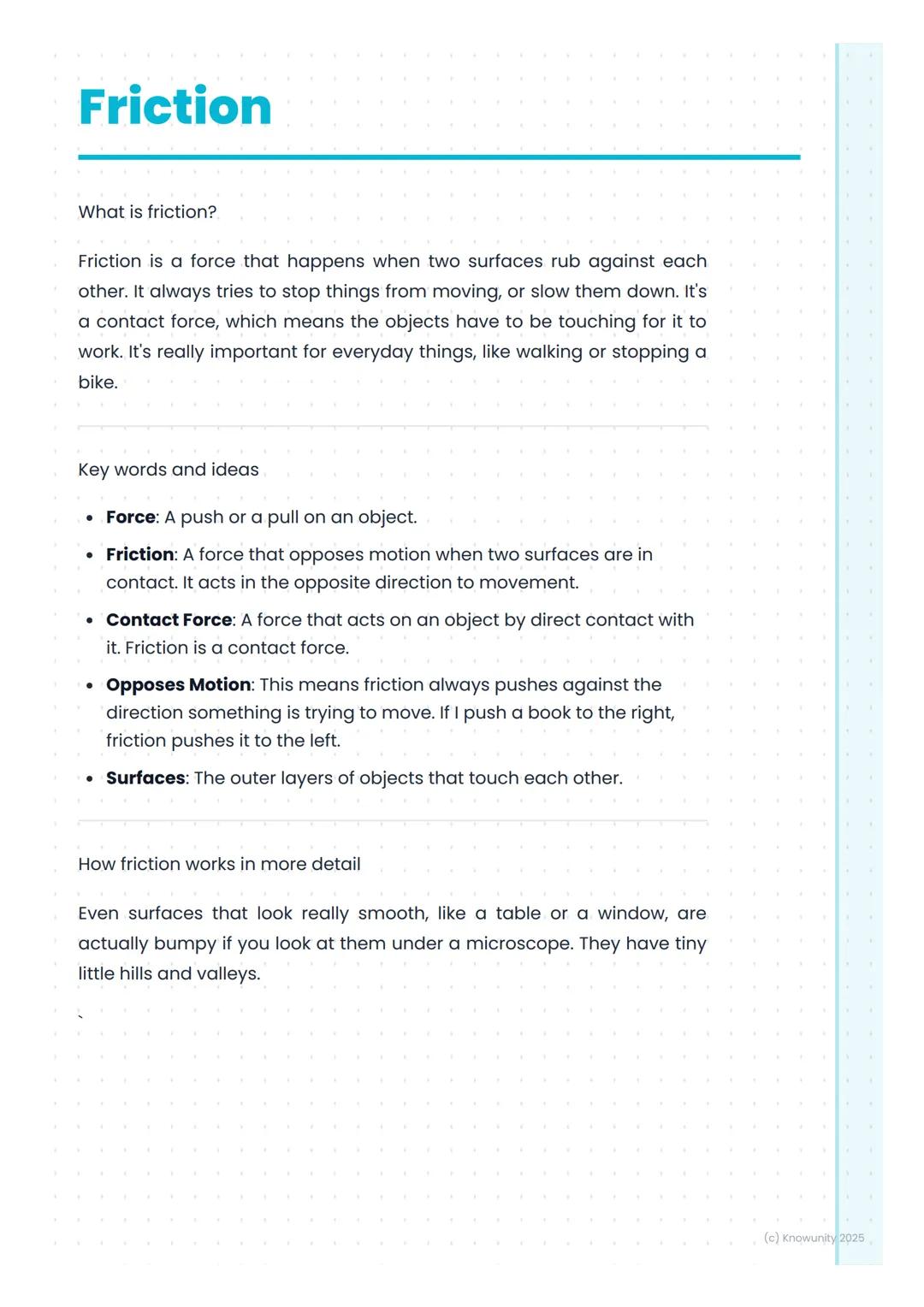
What is Friction?
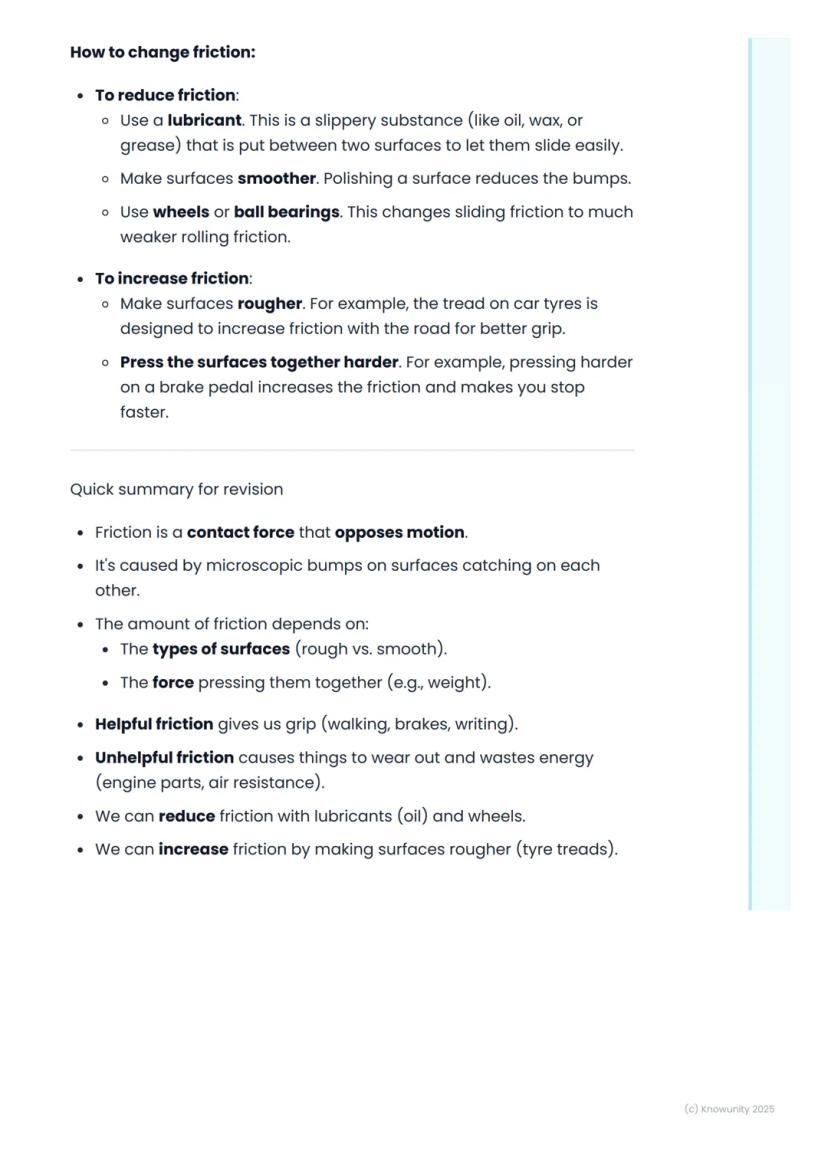
Friction is basically nature's way of putting the brakes on things. It's a contact force that happens when two surfaces touch and rub against each other, always trying to slow down or stop movement.
Think about it - without friction, you'd slide around like you're on ice all the time! It's the reason you can walk, write with a pencil, or stop your bike when you need to.
The key thing to remember is that friction always works in the opposite direction to movement. So if you're pushing a book to the right, friction pushes back to the left.
Remember This: Friction is a contact force - objects have to be touching for it to work!
2
of 5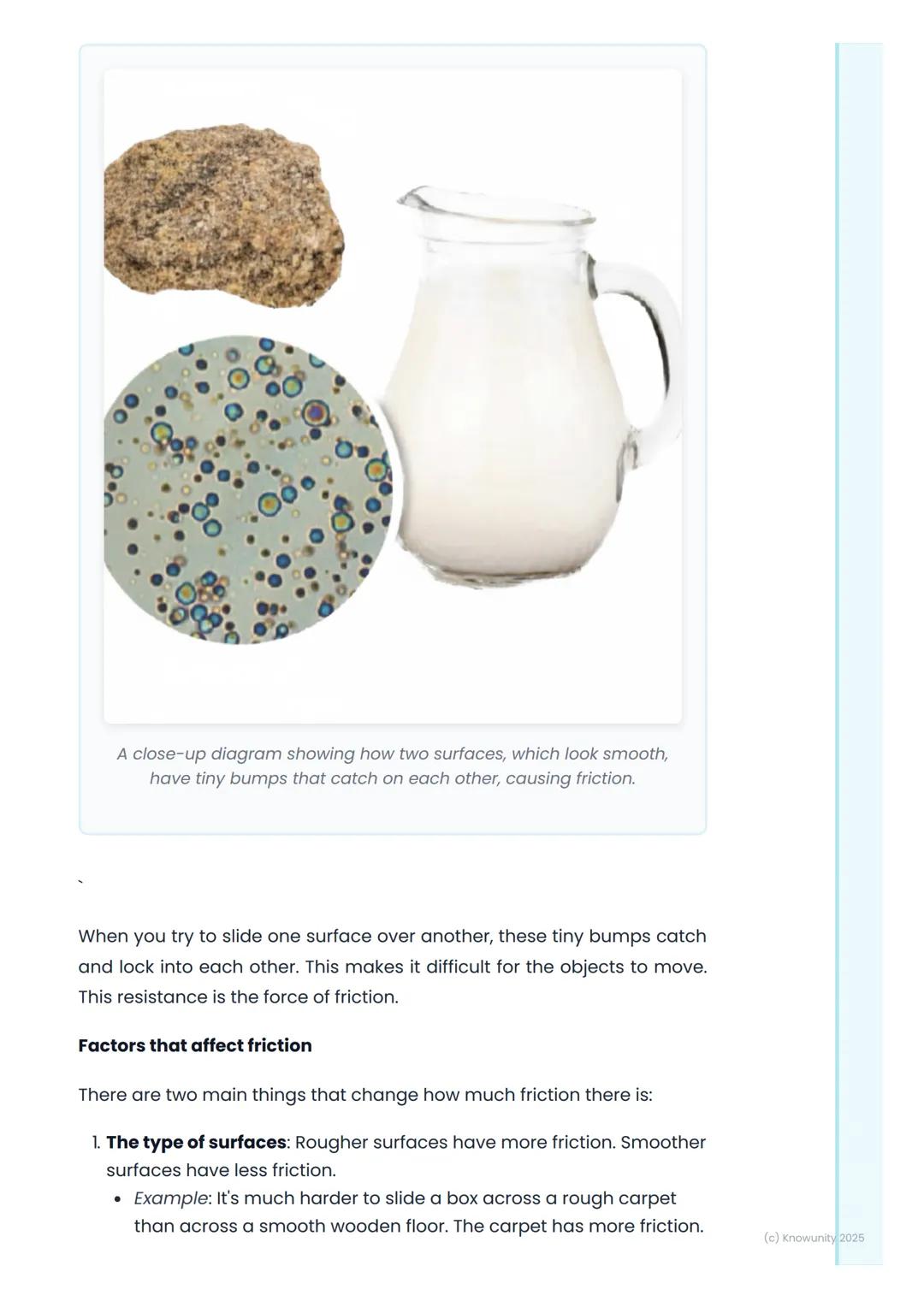
How Friction Actually Works
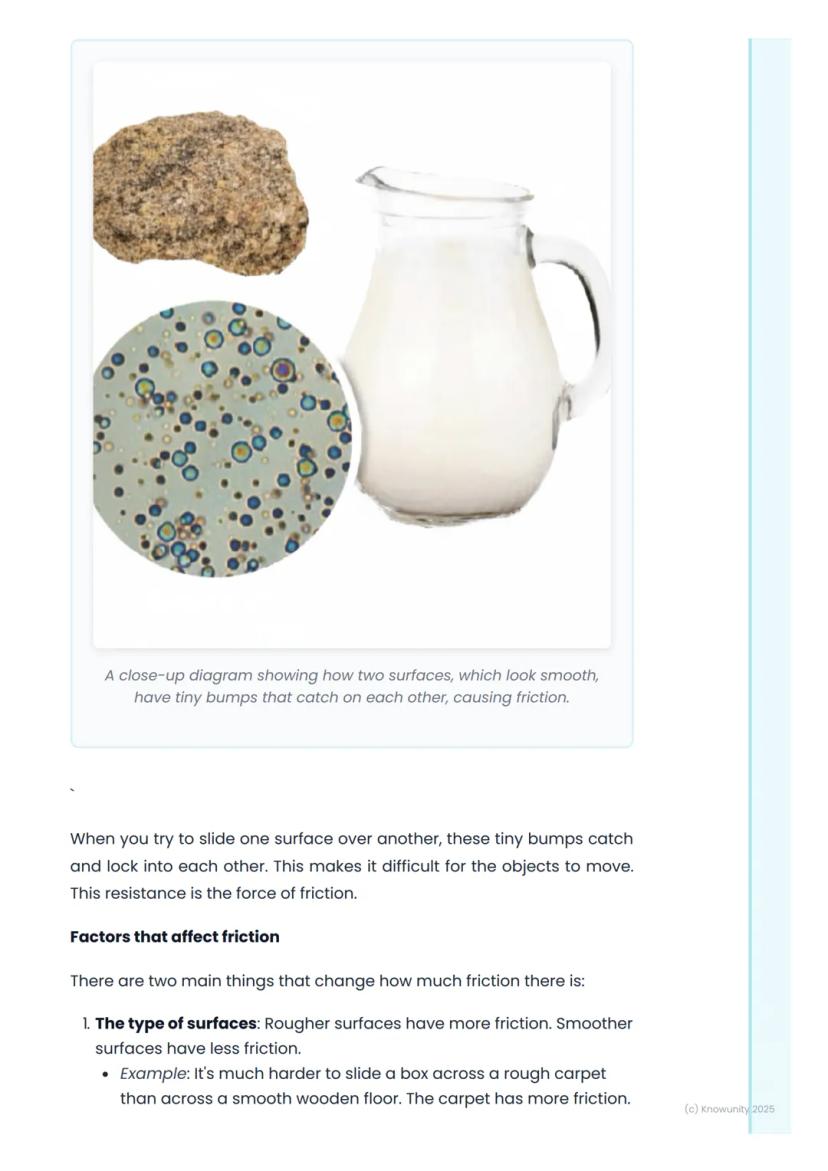
Here's something that might surprise you - even the smoothest surfaces aren't actually smooth at all! Under a microscope, everything looks like a mountain range with tiny bumps and valleys.
When you try to slide one surface over another, these microscopic bumps catch and lock into each other like tiny puzzle pieces. This creates resistance, which is what we feel as friction.
It's like trying to slide two pieces of velcro past each other - all those little hooks and loops catch on each other and make it difficult to move.
Think About It: Even a perfectly polished table has bumps smaller than you can see - that's why there's still some friction!
3
of 5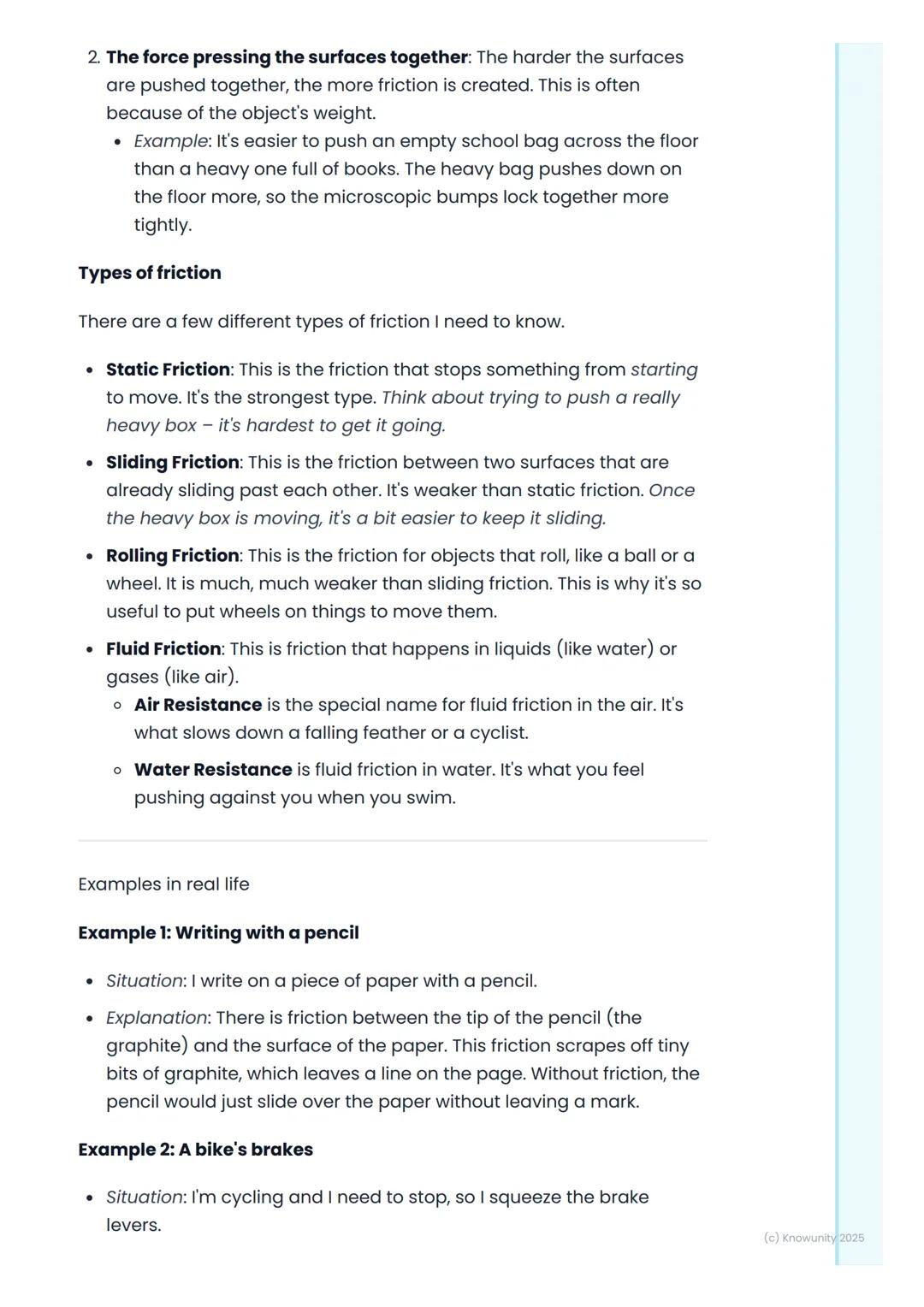
What Makes Friction Stronger or Weaker?
Two main things control how much friction you get between surfaces. First, surface texture makes a huge difference - rougher surfaces create more friction than smooth ones.
Try sliding a box across carpet versus a wooden floor, and you'll feel the difference immediately! The carpet grabs onto the box much more.
Second, weight matters. The harder surfaces are pressed together, the more those tiny bumps lock into each other. This is why a heavy school bag full of books is much harder to drag than an empty one.
Quick Test: Try pushing an empty wheelie bin versus a full one - the difference you feel is all about friction!
4
of 5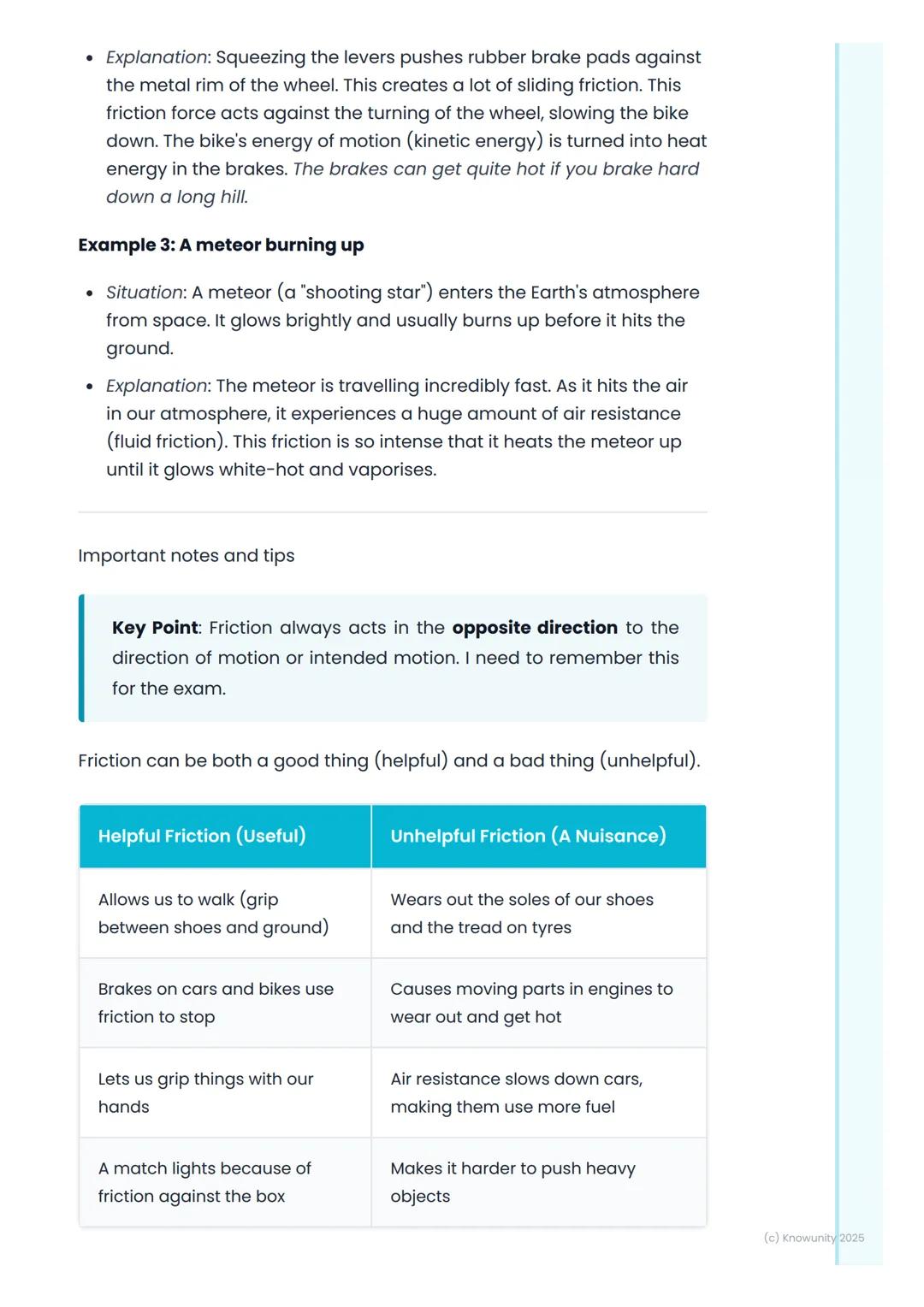
The Different Types of Friction
There are four main types of friction you need to know. Static friction is the strongest - it's what stops things from starting to move (like trying to push a heavy sofa).
Sliding friction happens when surfaces are already moving past each other. It's weaker than static friction, which is why it's easier to keep something moving than to start it moving.
Rolling friction is much weaker than sliding friction - that's why wheels are so brilliant for moving heavy things! Finally, fluid friction includes air resistance and water resistance, which slow down everything from falling leaves to swimming fish.
Real Example: This is why bike brakes work - they create sliding friction between the brake pads and wheel rim to slow you down!
5
of 5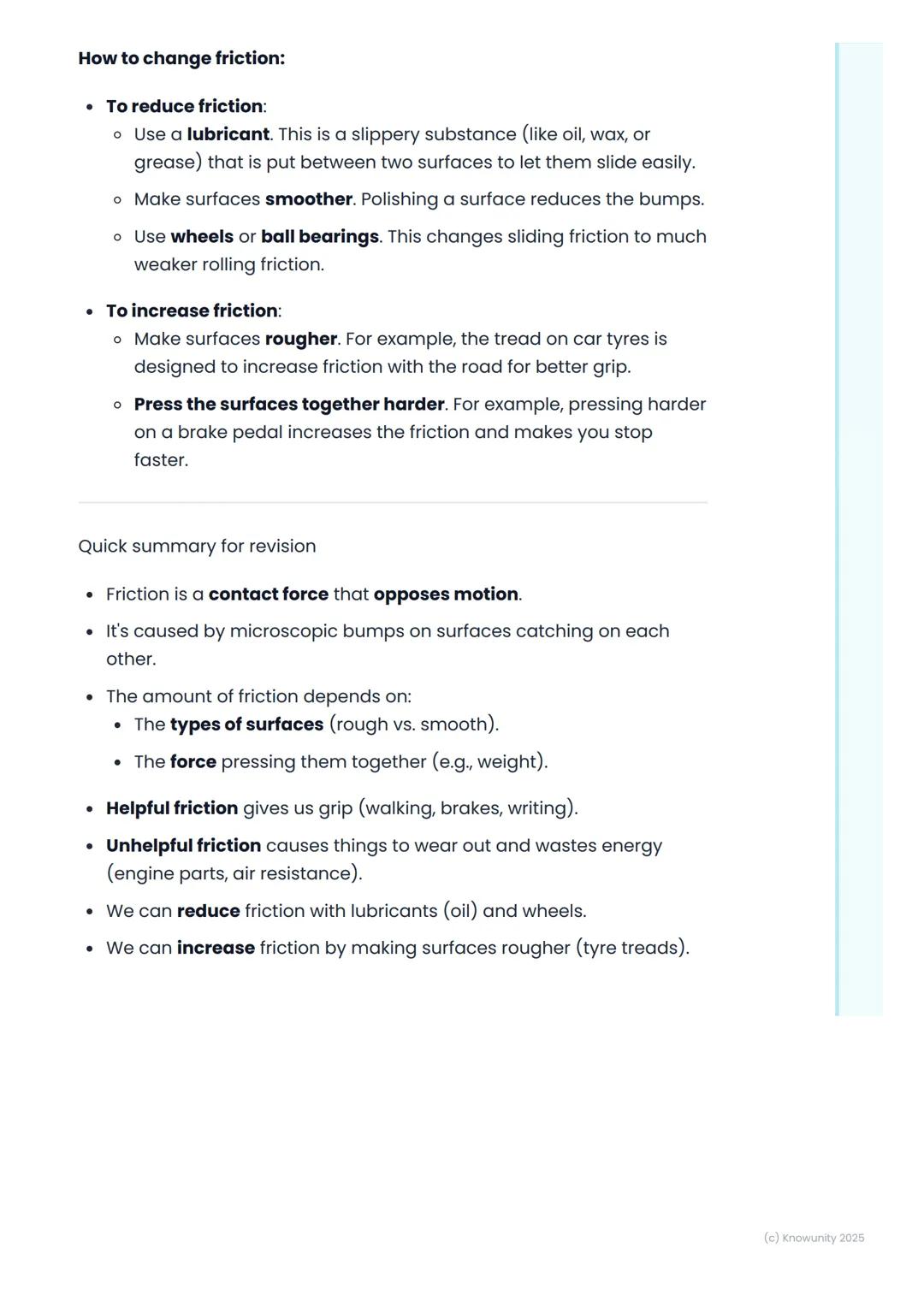
Friction in Action - Real Life Examples
Friction is everywhere in your daily life doing important jobs. When you write with a pencil, friction scrapes off tiny bits of graphite onto the paper - no friction means no writing!
Bike brakes use sliding friction to convert your movement energy into heat energy, which is why brakes get warm after heavy use. Even shooting stars are caused by friction - meteors heat up so much from air resistance that they glow white-hot.
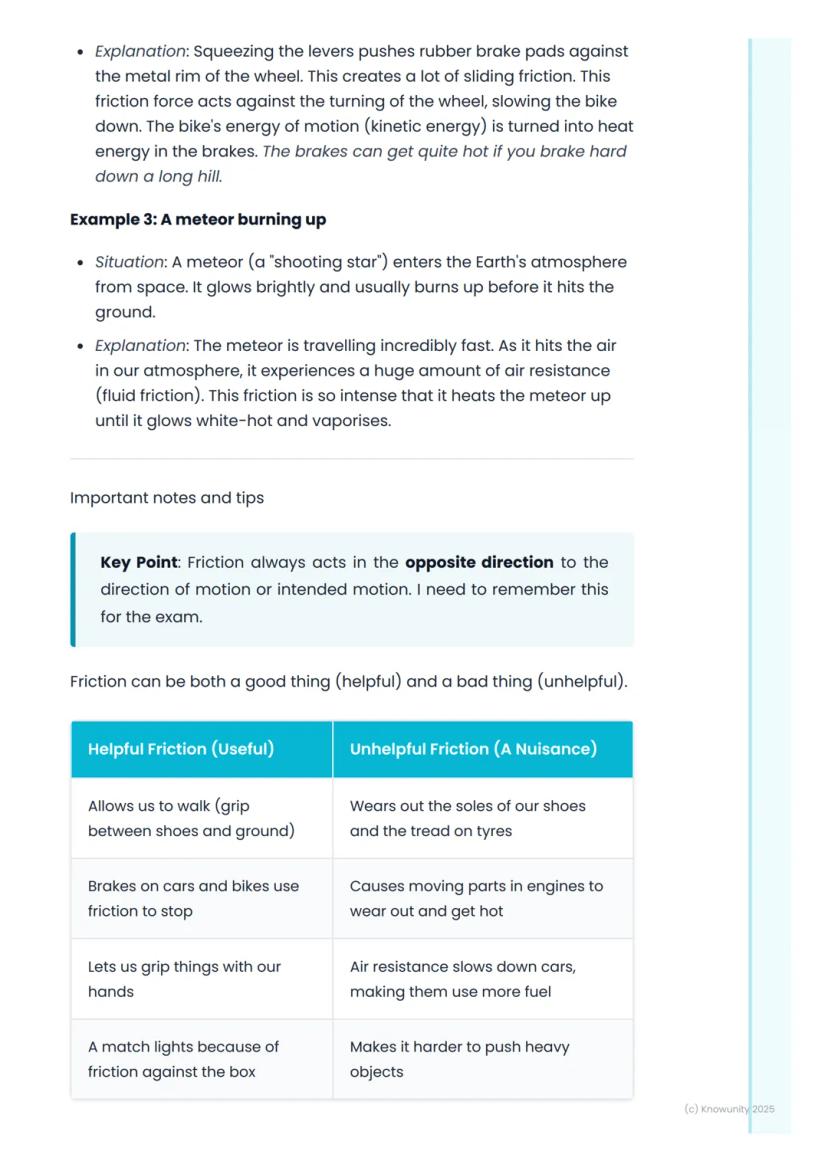
Sometimes friction is helpful (letting you walk without slipping), and sometimes it's annoying (wearing out your shoes and making cars use more fuel). You can reduce friction with lubricants like oil, or increase it by making surfaces rougher like car tyre treads.
Remember: Friction can be your friend (brakes, grip) or your enemy (wear and tear) - it all depends on the situation!
Pensávamos que não ias perguntar...
O que é o Companheiro de Aprendizagem com IA da Knowunity?
O nosso companheiro de aprendizagem com IA foi especificamente criado para as necessidades dos estudantes. Com base nos milhões de conteúdos que temos na plataforma, podemos fornecer respostas verdadeiramente significativas e relevantes para os estudantes. Mas não se trata apenas de respostas, o companheiro foca-se mais em guiar os estudantes através dos seus desafios diários de aprendizagem, com planos de estudo personalizados, quizzes ou conteúdos no chat e 100% de personalização baseada nas habilidades e desenvolvimentos do estudante.
Onde posso fazer o download da app Knowunity?
Pode descarregar a aplicação na Google Play Store e na Apple App Store.
Como posso receber o meu pagamento? Quanto posso ganhar?
Sim, tem acesso gratuito ao conteúdo da aplicação e ao nosso companheiro de IA. Para desbloquear determinadas funcionalidades da aplicação, pode adquirir o Knowunity Pro.
Conteúdos mais populares de Physics
3PhysicsBalanced and Unbalanced Forces
Students will explore how balanced forces result in no change in motion, while unbalanced forces cause an object to accelerate or change direction.
2nd Year421
PhysicsTypes of Forces
Students will identify common forces such as gravity (pulling objects down), friction (opposing motion), and air resistance (slowing objects in the air).
2nd Year460
PhysicsSpeed, Distance, and Time
Students will learn the basic concepts of speed, distance, and time, and how they relate to each other in describing motion.
2nd Year100
Conteúdos mais populares
9 Irish
IrishIrish oral questions and answers
Questions and answers for the leaving cert oral
5th Year4254
IrishIrish oral questions
Outline of oral questions
5th Year2055
IrishIníon- le hÁine Durkin
Aine Durkin’s poem, Iníon: Themes & summary
5th Year850
 English
Key Quotes : Sive
Key Quotes and explanations: Sive
6th Year2572
IrishIrish poetry 2027
Iníon + Dínit an Bhróin
5th Year1133
IrishLC HL notes- Iníon (poem)
Includes poem in English and Irish, theme, key words & phrases
5th Year2284
IrishGaeilge Grammar Office
All the basics you need to know on Irish grammar.
6th Year933
IrishMo Ghrá-sa (Idir Lúibíní)
Notes on mo ghrá-sa
5th Year350
IrishAn Gaeilge Aiste
Irish Language essay
6th Year1290
Não encontra o que procura? Explore outras disciplinas.
Avaliações dos nossos utilizadores. Eles adoraram tudo — e tu também vais adorar.
4.6/5App Store
4.7/5Google Play
A App é muito fácil de usar e está nem organizada. Encontrei tudo o que estava à procura até agora e consegui aprender muito com as apresentações! Vou usar a app para um trabalho escolar! E claro que também me ajuda muito como inspiração.
João Sutilizador iOS
Esta app é realmente incrível. Há tantas anotações de estudo e ajuda [...]. A minha disciplina problemática é Francês, por exemplo, e a app tem muitas opções de ajuda. Graças a esta app, melhorei o meu Francês. Eu recomendo a qualquer pessoa.
Sara C.utilizadora Android
Uau, estou realmente impressionado. Acabei de experimentar o app porque o vi anunciado muitas vezes e fiquei absolutamente surpreso. Este app é A AJUDA que você quer para a escola e, acima de tudo, oferece tantas coisas, como exercícios e folhas de fatos, que têm sido MUITO úteis para mim pessoalmente.
Anautilizadora iOS
Physics2 visualizações·Atualizado May 26, 2026·5 páginasUnderstanding Friction: The Force Opposing Motion
Ever wondered why you don't slip when you walk or how bike brakes actually work? It's all down to friction - one of the most important forces in physics that affects literally everything you do every day. Understanding friction will... Mostrar mais
1
of 5Cadastre-se para ver o conteúdo. É grátis!
- Acesso a todos os documentos
- Melhore suas notas
- Junte-se a milhões de estudantes
What is Friction?
Friction is basically nature's way of putting the brakes on things. It's a contact force that happens when two surfaces touch and rub against each other, always trying to slow down or stop movement.
Think about it - without friction, you'd slide around like you're on ice all the time! It's the reason you can walk, write with a pencil, or stop your bike when you need to.
The key thing to remember is that friction always works in the opposite direction to movement. So if you're pushing a book to the right, friction pushes back to the left.
Remember This: Friction is a contact force - objects have to be touching for it to work!
2
of 5Cadastre-se para ver o conteúdo. É grátis!
- Acesso a todos os documentos
- Melhore suas notas
- Junte-se a milhões de estudantes
How Friction Actually Works
Here's something that might surprise you - even the smoothest surfaces aren't actually smooth at all! Under a microscope, everything looks like a mountain range with tiny bumps and valleys.
When you try to slide one surface over another, these microscopic bumps catch and lock into each other like tiny puzzle pieces. This creates resistance, which is what we feel as friction.
It's like trying to slide two pieces of velcro past each other - all those little hooks and loops catch on each other and make it difficult to move.
Think About It: Even a perfectly polished table has bumps smaller than you can see - that's why there's still some friction!
3
of 5Cadastre-se para ver o conteúdo. É grátis!
- Acesso a todos os documentos
- Melhore suas notas
- Junte-se a milhões de estudantes
What Makes Friction Stronger or Weaker?
Two main things control how much friction you get between surfaces. First, surface texture makes a huge difference - rougher surfaces create more friction than smooth ones.
Try sliding a box across carpet versus a wooden floor, and you'll feel the difference immediately! The carpet grabs onto the box much more.
Second, weight matters. The harder surfaces are pressed together, the more those tiny bumps lock into each other. This is why a heavy school bag full of books is much harder to drag than an empty one.
Quick Test: Try pushing an empty wheelie bin versus a full one - the difference you feel is all about friction!
4
of 5Cadastre-se para ver o conteúdo. É grátis!
- Acesso a todos os documentos
- Melhore suas notas
- Junte-se a milhões de estudantes
The Different Types of Friction
There are four main types of friction you need to know. Static friction is the strongest - it's what stops things from starting to move (like trying to push a heavy sofa).
Sliding friction happens when surfaces are already moving past each other. It's weaker than static friction, which is why it's easier to keep something moving than to start it moving.
Rolling friction is much weaker than sliding friction - that's why wheels are so brilliant for moving heavy things! Finally, fluid friction includes air resistance and water resistance, which slow down everything from falling leaves to swimming fish.
Real Example: This is why bike brakes work - they create sliding friction between the brake pads and wheel rim to slow you down!
5
of 5Cadastre-se para ver o conteúdo. É grátis!
- Acesso a todos os documentos
- Melhore suas notas
- Junte-se a milhões de estudantes
Friction in Action - Real Life Examples
Friction is everywhere in your daily life doing important jobs. When you write with a pencil, friction scrapes off tiny bits of graphite onto the paper - no friction means no writing!
Bike brakes use sliding friction to convert your movement energy into heat energy, which is why brakes get warm after heavy use. Even shooting stars are caused by friction - meteors heat up so much from air resistance that they glow white-hot.
Sometimes friction is helpful (letting you walk without slipping), and sometimes it's annoying (wearing out your shoes and making cars use more fuel). You can reduce friction with lubricants like oil, or increase it by making surfaces rougher like car tyre treads.
Remember: Friction can be your friend (brakes, grip) or your enemy (wear and tear) - it all depends on the situation!
Pensávamos que não ias perguntar...
O que é o Companheiro de Aprendizagem com IA da Knowunity?
O nosso companheiro de aprendizagem com IA foi especificamente criado para as necessidades dos estudantes. Com base nos milhões de conteúdos que temos na plataforma, podemos fornecer respostas verdadeiramente significativas e relevantes para os estudantes. Mas não se trata apenas de respostas, o companheiro foca-se mais em guiar os estudantes através dos seus desafios diários de aprendizagem, com planos de estudo personalizados, quizzes ou conteúdos no chat e 100% de personalização baseada nas habilidades e desenvolvimentos do estudante.
Onde posso fazer o download da app Knowunity?
Pode descarregar a aplicação na Google Play Store e na Apple App Store.
Como posso receber o meu pagamento? Quanto posso ganhar?
Sim, tem acesso gratuito ao conteúdo da aplicação e ao nosso companheiro de IA. Para desbloquear determinadas funcionalidades da aplicação, pode adquirir o Knowunity Pro.
Conteúdos mais populares de Physics
3PhysicsBalanced and Unbalanced Forces
Students will explore how balanced forces result in no change in motion, while unbalanced forces cause an object to accelerate or change direction.
2nd Year421
PhysicsTypes of Forces
Students will identify common forces such as gravity (pulling objects down), friction (opposing motion), and air resistance (slowing objects in the air).
2nd Year460
PhysicsSpeed, Distance, and Time
Students will learn the basic concepts of speed, distance, and time, and how they relate to each other in describing motion.
2nd Year100
Conteúdos mais populares
9IrishIrish oral questions and answers
Questions and answers for the leaving cert oral
5th Year4254
IrishIrish oral questions
Outline of oral questions
5th Year2055
IrishIníon- le hÁine Durkin
Aine Durkin’s poem, Iníon: Themes & summary
5th Year850
EnglishKey Quotes : Sive
Key Quotes and explanations: Sive
6th Year2572
IrishIrish poetry 2027
Iníon + Dínit an Bhróin
5th Year1133
IrishLC HL notes- Iníon (poem)
Includes poem in English and Irish, theme, key words & phrases
5th Year2284
IrishGaeilge Grammar Office
All the basics you need to know on Irish grammar.
6th Year933
IrishMo Ghrá-sa (Idir Lúibíní)
Notes on mo ghrá-sa
5th Year350
IrishAn Gaeilge Aiste
Irish Language essay
6th Year1290
Não encontra o que procura? Explore outras disciplinas.
Avaliações dos nossos utilizadores. Eles adoraram tudo — e tu também vais adorar.
4.6/5App Store
4.7/5Google Play
A App é muito fácil de usar e está nem organizada. Encontrei tudo o que estava à procura até agora e consegui aprender muito com as apresentações! Vou usar a app para um trabalho escolar! E claro que também me ajuda muito como inspiração.
João Sutilizador iOS
Esta app é realmente incrível. Há tantas anotações de estudo e ajuda [...]. A minha disciplina problemática é Francês, por exemplo, e a app tem muitas opções de ajuda. Graças a esta app, melhorei o meu Francês. Eu recomendo a qualquer pessoa.
Sara C.utilizadora Android
Uau, estou realmente impressionado. Acabei de experimentar o app porque o vi anunciado muitas vezes e fiquei absolutamente surpreso. Este app é A AJUDA que você quer para a escola e, acima de tudo, oferece tantas coisas, como exercícios e folhas de fatos, que têm sido MUITO úteis para mim pessoalmente.
Anautilizadora iOS