
Ever wondered what makes your favourite songs so catchy? It's... Mostrar mais
 Music4 visualizações·Atualizado May 15, 2026·5 páginas
Understanding Beat and Rhythm in Music
1 / 5
1
of 5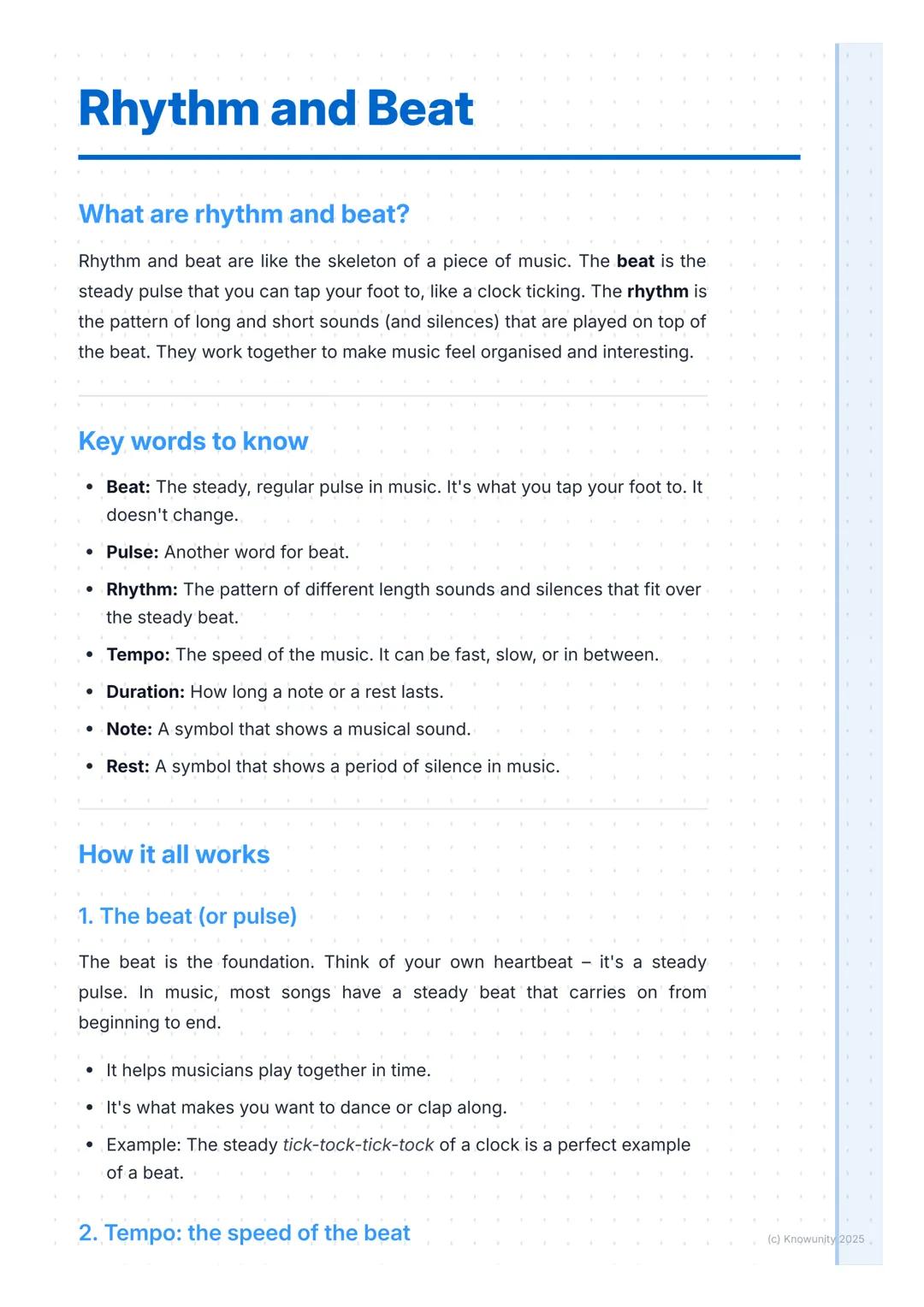
What Are Rhythm and Beat?
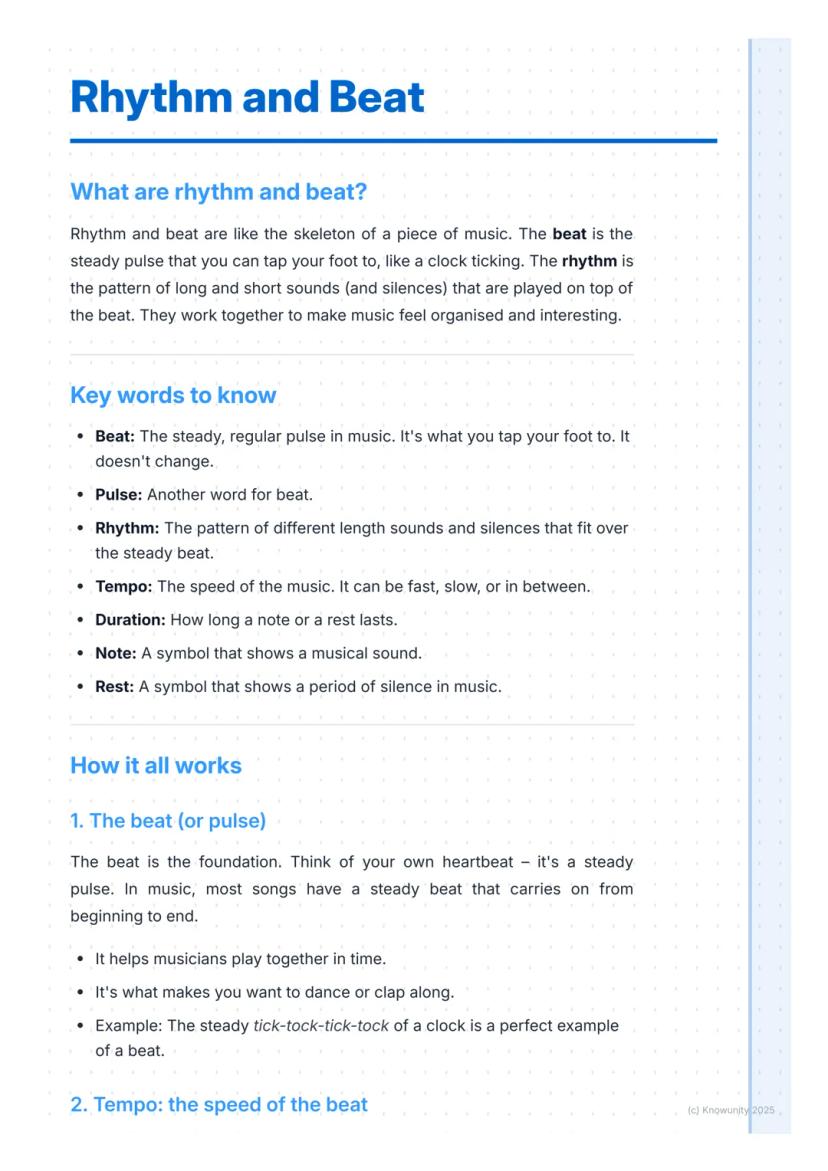
Think of music like a skeleton - the beat is the steady backbone that holds everything together, whilst the rhythm is the exciting pattern that dances on top. The beat is that steady pulse you naturally tap your foot to, just like a clock ticking away. It never changes and keeps everything organised.
Rhythm is much more interesting - it's the pattern of long and short sounds (plus the silences) that make each song unique. When you combine beat and rhythm, you get music that feels both steady and exciting at the same time.
Musicians use the beat to stay together when playing, which is why bands don't fall apart on stage! The pulse is just another word for beat, so don't get confused if you see both terms.
Quick Tip: Try listening to any song and tapping your foot - that steady tap is the beat, whilst everything else happening is the rhythm!
2
of 5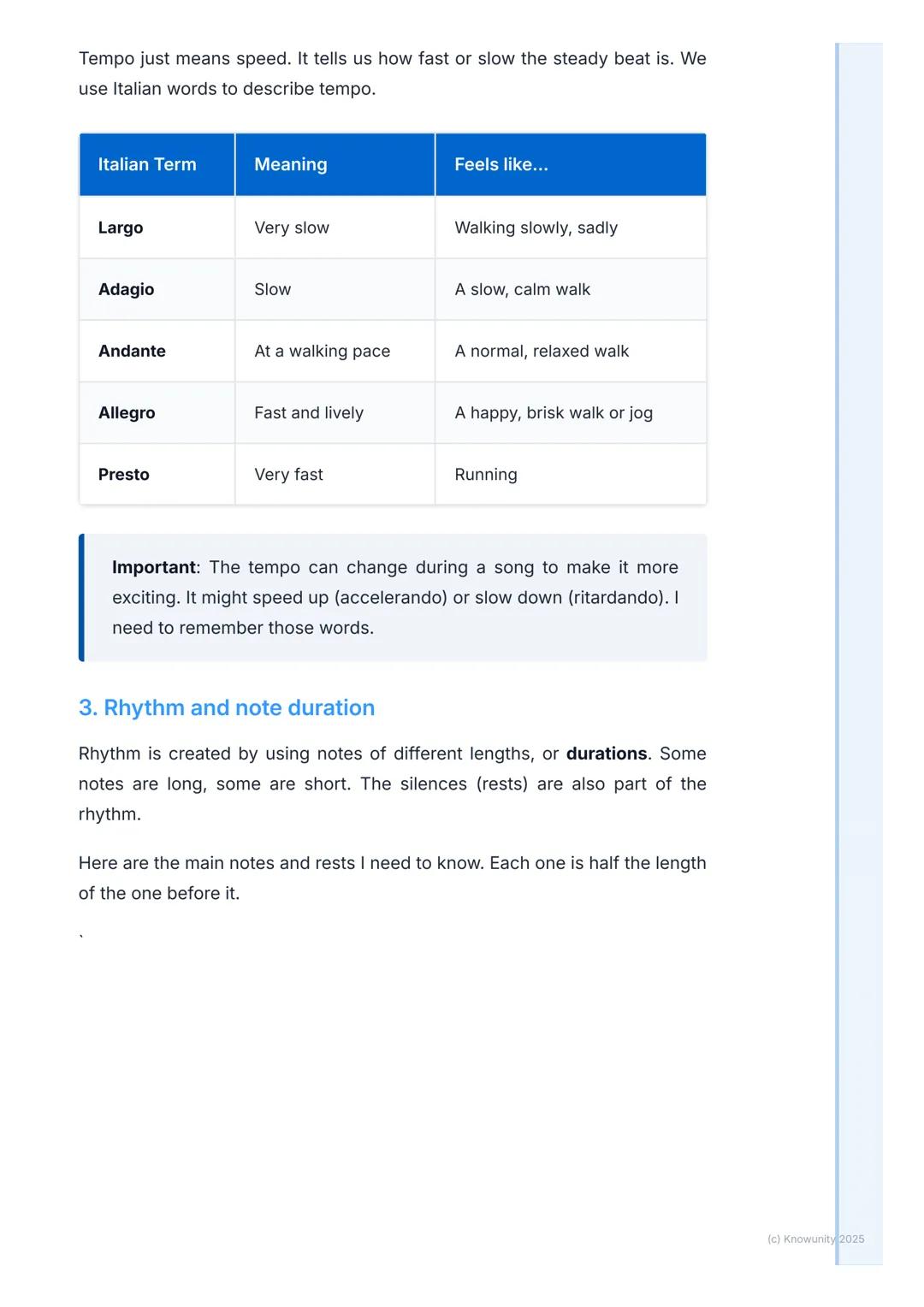
Understanding Tempo
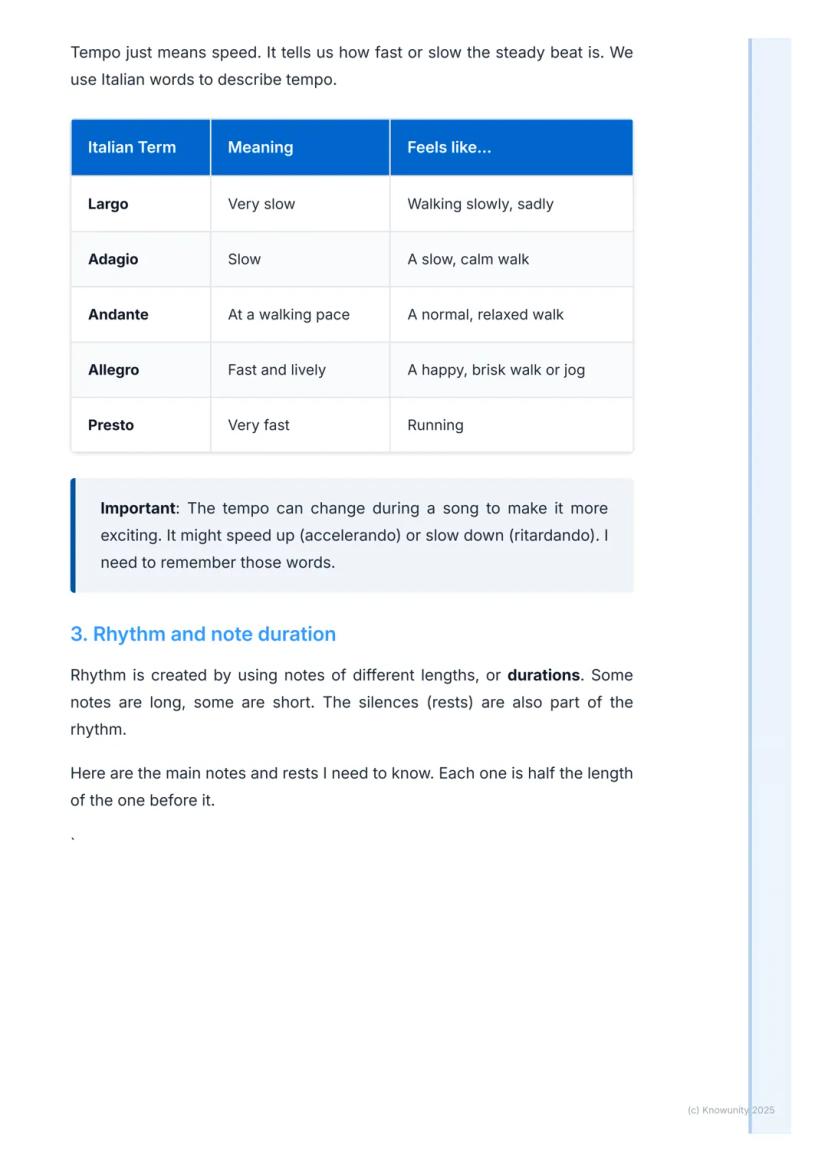
Tempo simply means how fast or slow the music goes. Musicians use fancy Italian words to describe different speeds, but they're actually quite logical once you think about them as different types of walking.
Largo means very slow - imagine walking sadly after losing a match. Adagio is slow like a calm, peaceful walk. Andante feels like your normal walking pace to school. Allegro is fast and lively, like rushing to meet your mates. Presto is super fast - basically running!
Here's the cool bit: tempo can change during a song to create excitement. When music speeds up, it's called accelerando. When it slows down, it's called ritardando. Think about how film music builds up during action scenes!
Remember This: Most Irish jigs are Allegro or Presto, whilst traditional ballads like "Molly Malone" are usually Andante or Adagio.
3
of 5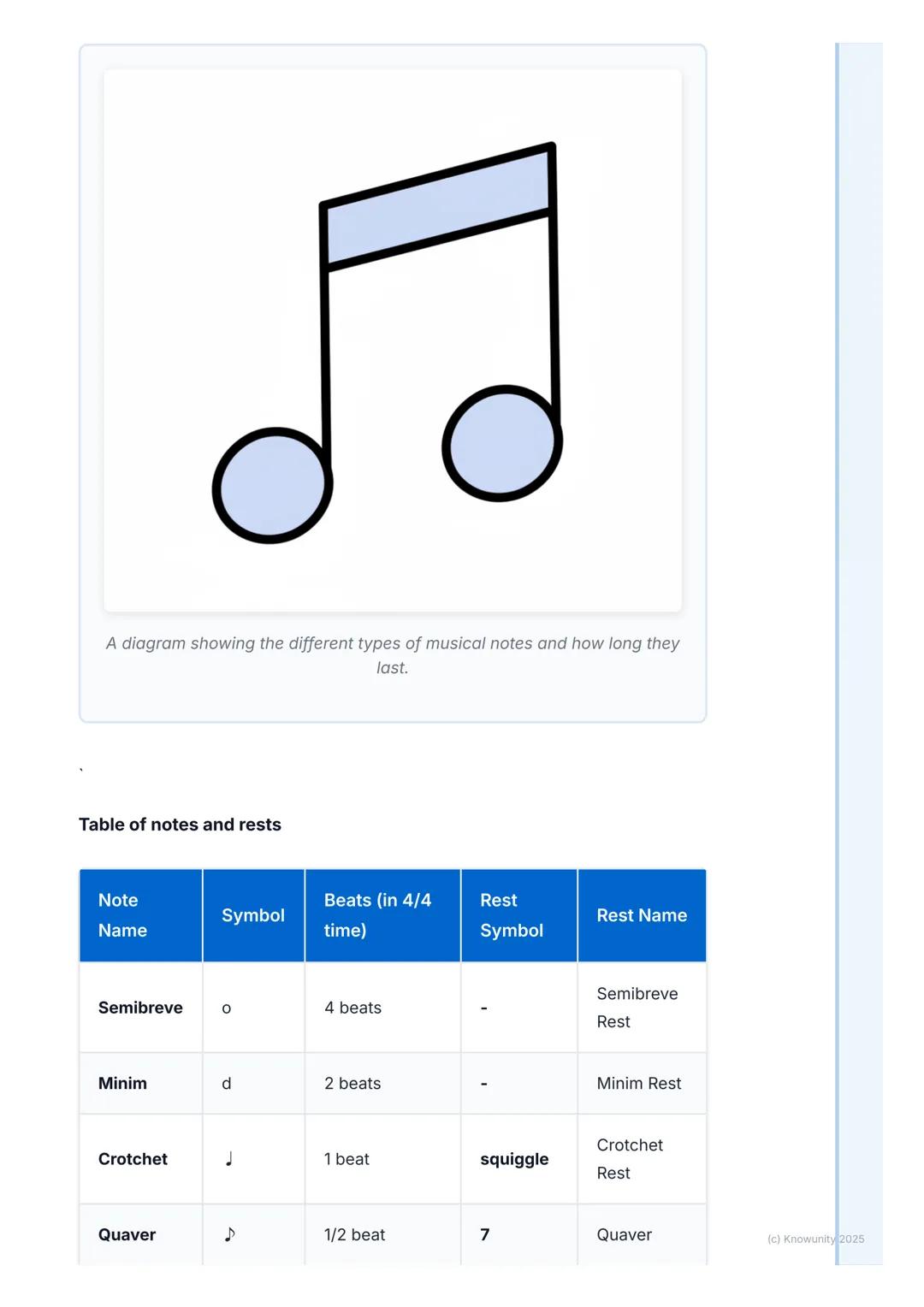
Note Values and Duration
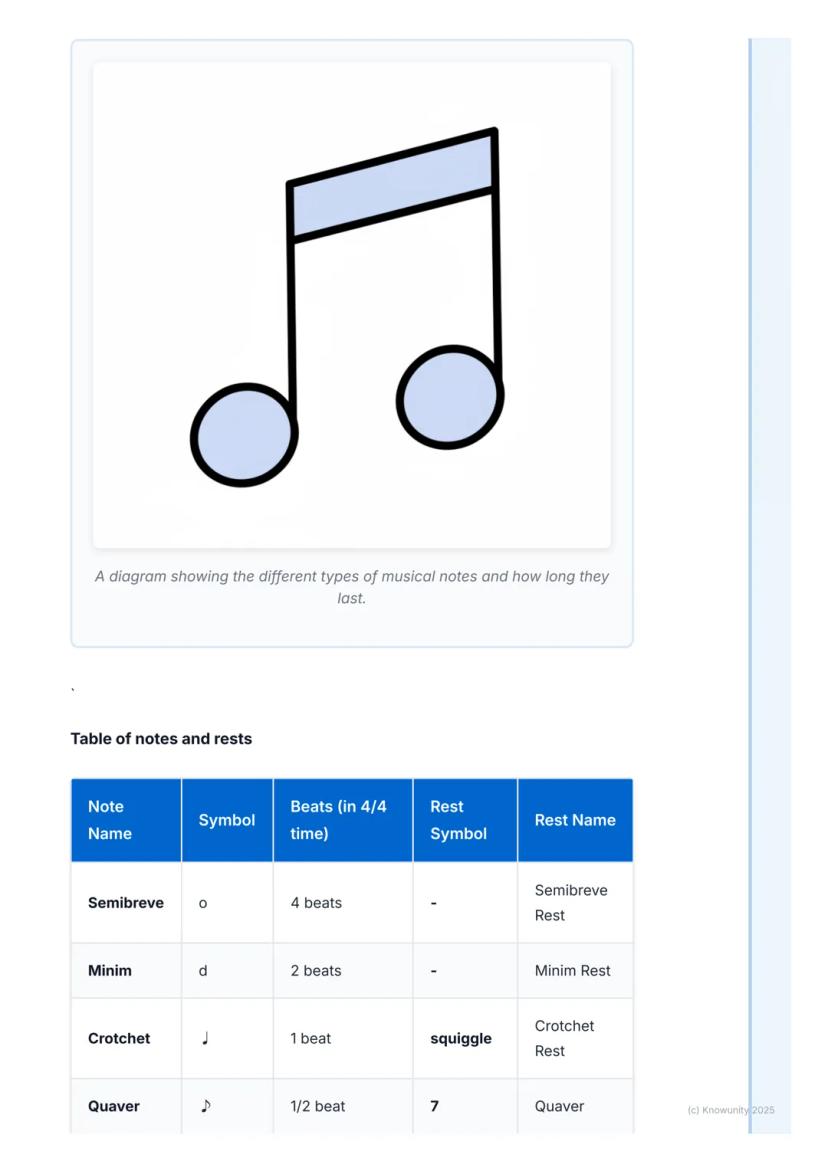
This is where rhythm gets its building blocks. Different notes last for different amounts of time - some are long, some are short. Think of it like a family tree where each note is exactly half the length of the one above it.
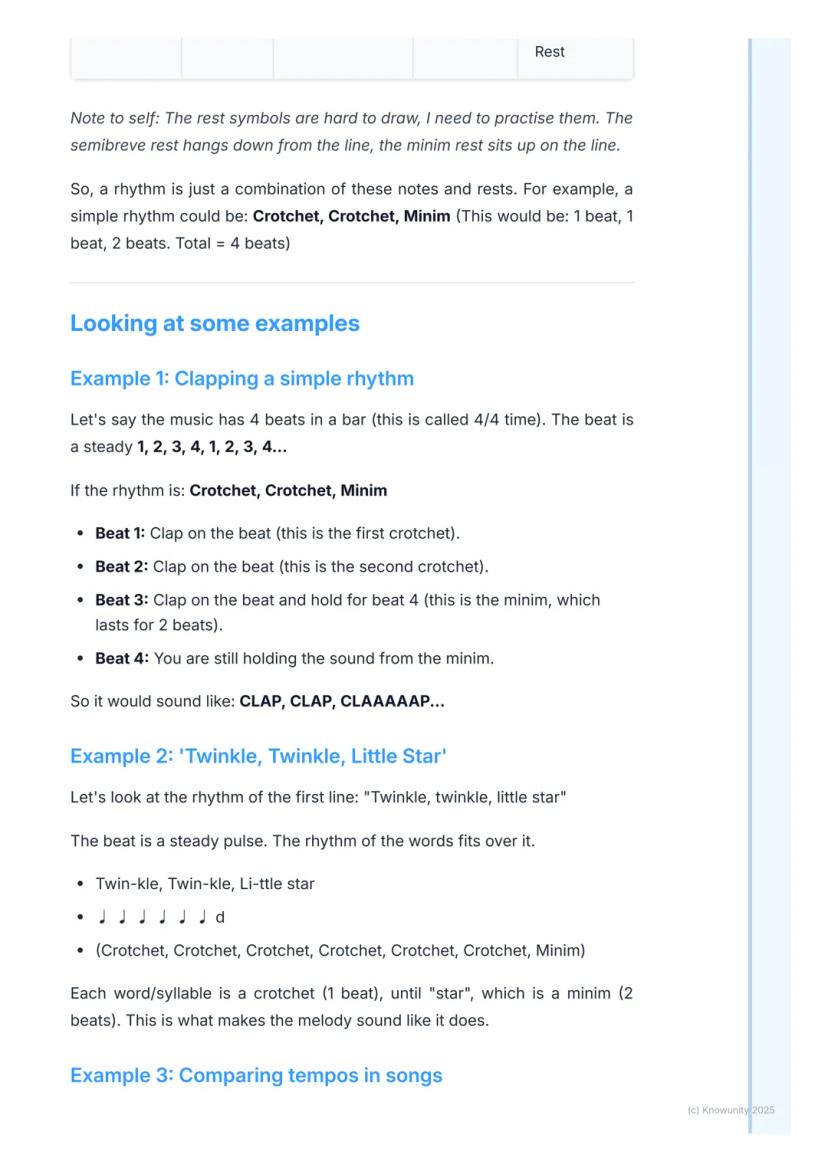
A semibreve lasts for 4 beats (the longest), a minim lasts for 2 beats, a crotchet lasts for 1 beat, and a quaver lasts for half a beat. It's like cutting a pizza in half, then in half again!
Rests are the silent gaps in music, and they're just as important as the notes themselves. Each note has a matching rest that lasts the same amount of time. The silences often make rhythms more interesting than constant noise would.
Memory Trick: Remember "1 semibreve = 2 minims = 4 crotchets = 8 quavers" - it's like a mathematical pattern that never changes!
4
of 5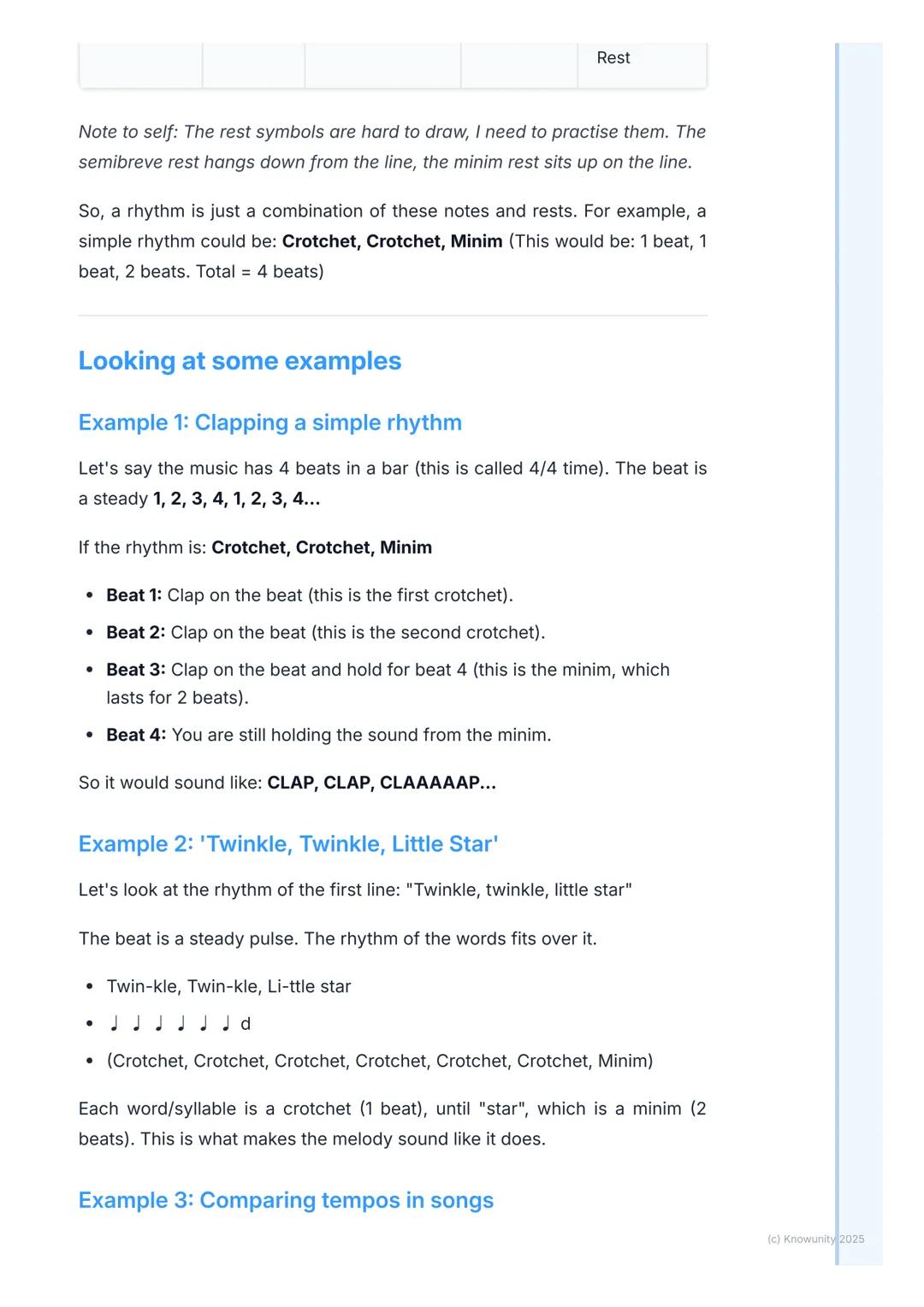
Putting It All Together
Let's see how this works with something you know. In "Twinkle, Twinkle, Little Star", each syllable gets one beat (crotchet), but "star" gets stretched out for two beats (minim). That's why it sounds complete at the end of the line.
When you're clapping rhythms, keep your foot tapping the steady beat whilst your hands clap the rhythm pattern. It's like patting your head and rubbing your stomach - tricky at first, but brilliant once you've got it!
Most popular music uses 4/4 time, which means there are 4 beats in each section (called a bar). Count along: 1, 2, 3, 4, 1, 2, 3, 4... and you'll hear how songs are organised into these groups.
Practice Tip: Try clapping simple patterns like "clap, clap, clap-hold-hold, clap" whilst keeping your foot tapping steadily - this builds your rhythm skills!
5
of 5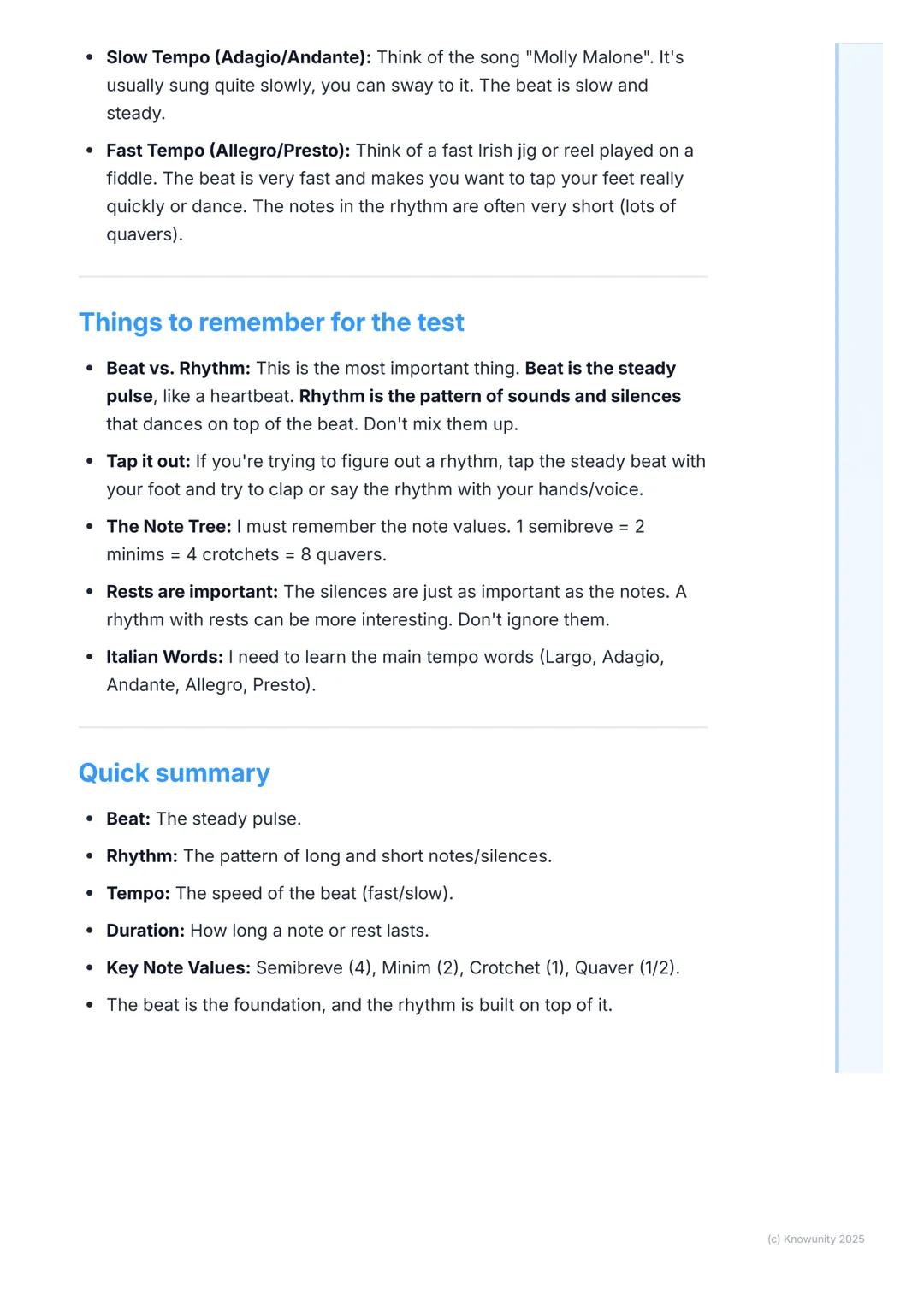
Test Success Tips
The most important thing to remember is that beat and rhythm are different. Beat = steady pulse (like your heartbeat), rhythm = the exciting pattern on top. Mix these up and you'll lose marks, so drill this difference into your brain!
For your exams, practice the note value relationships. Know that a semibreve equals 4 crotchets, and be able to work out simple rhythm patterns. The Italian tempo terms pop up regularly, so memorise Largo through to Presto.
Don't forget about rests - they're not just empty space, they're crucial parts of rhythms that create interest and breathing room. Many students ignore rests in exams and miss easy marks.
Exam Strategy: If you're stuck on a rhythm question, tap out the beat first, then work out where the sounds and silences fit over that steady pulse.
Pensávamos que não ias perguntar...
O que é o Companheiro de Aprendizagem com IA da Knowunity?
O nosso companheiro de aprendizagem com IA foi especificamente criado para as necessidades dos estudantes. Com base nos milhões de conteúdos que temos na plataforma, podemos fornecer respostas verdadeiramente significativas e relevantes para os estudantes. Mas não se trata apenas de respostas, o companheiro foca-se mais em guiar os estudantes através dos seus desafios diários de aprendizagem, com planos de estudo personalizados, quizzes ou conteúdos no chat e 100% de personalização baseada nas habilidades e desenvolvimentos do estudante.
Onde posso fazer o download da app Knowunity?
Pode descarregar a aplicação na Google Play Store e na Apple App Store.
Como posso receber o meu pagamento? Quanto posso ganhar?
Sim, tem acesso gratuito ao conteúdo da aplicação e ao nosso companheiro de IA. Para desbloquear determinadas funcionalidades da aplicação, pode adquirir o Knowunity Pro.
Conteúdos mais populares
9 Irish
IrishIrish oral questions and answers
Questions and answers for the leaving cert oral
5th Year4254
IrishIrish oral questions
Outline of oral questions
5th Year2055
IrishGaeilge Grammar Office
All the basics you need to know on Irish grammar.
6th Year863
 English
Key Quotes : Sive
Key Quotes and explanations: Sive
6th Year2161
IrishAn Gaeilge Aiste
Irish Language essay
6th Year1250
IrishIrish poetry 2027
Iníon + Dínit an Bhróin
5th Year1133
IrishMé Féin & Mo Chlann (Myself & My Family)
Students will learn vocabulary to describe themselves, their family members, and daily routines. This helps in personal introductions and discussions.
TY291
IrishLC HL notes- Iníon (poem)
Includes poem in English and Irish, theme, key words & phrases
5th Year2274
 Geography
Territory, economic activities in Paris basin
essay
6th Year80
Não encontra o que procura? Explore outras disciplinas.
Avaliações dos nossos utilizadores. Eles adoraram tudo — e tu também vais adorar.
4.6/5App Store
4.7/5Google Play
A App é muito fácil de usar e está nem organizada. Encontrei tudo o que estava à procura até agora e consegui aprender muito com as apresentações! Vou usar a app para um trabalho escolar! E claro que também me ajuda muito como inspiração.
João Sutilizador iOS
Esta app é realmente incrível. Há tantas anotações de estudo e ajuda [...]. A minha disciplina problemática é Francês, por exemplo, e a app tem muitas opções de ajuda. Graças a esta app, melhorei o meu Francês. Eu recomendo a qualquer pessoa.
Sara C.utilizadora Android
Uau, estou realmente impressionado. Acabei de experimentar o app porque o vi anunciado muitas vezes e fiquei absolutamente surpreso. Este app é A AJUDA que você quer para a escola e, acima de tudo, oferece tantas coisas, como exercícios e folhas de fatos, que têm sido MUITO úteis para mim pessoalmente.
Anautilizadora iOS
Music4 visualizações·Atualizado May 15, 2026·5 páginasUnderstanding Beat and Rhythm in Music
Ever wondered what makes your favourite songs so catchy? It's all about rhythm and beat - the musical elements that make you want to tap your feet and dance along. Understanding these concepts is like learning the secret language that... Mostrar mais
1
of 5Cadastre-se para ver o conteúdo. É grátis!
- Acesso a todos os documentos
- Melhore suas notas
- Junte-se a milhões de estudantes
What Are Rhythm and Beat?
Think of music like a skeleton - the beat is the steady backbone that holds everything together, whilst the rhythm is the exciting pattern that dances on top. The beat is that steady pulse you naturally tap your foot to, just like a clock ticking away. It never changes and keeps everything organised.
Rhythm is much more interesting - it's the pattern of long and short sounds (plus the silences) that make each song unique. When you combine beat and rhythm, you get music that feels both steady and exciting at the same time.
Musicians use the beat to stay together when playing, which is why bands don't fall apart on stage! The pulse is just another word for beat, so don't get confused if you see both terms.
Quick Tip: Try listening to any song and tapping your foot - that steady tap is the beat, whilst everything else happening is the rhythm!
2
of 5Cadastre-se para ver o conteúdo. É grátis!
- Acesso a todos os documentos
- Melhore suas notas
- Junte-se a milhões de estudantes
Understanding Tempo
Tempo simply means how fast or slow the music goes. Musicians use fancy Italian words to describe different speeds, but they're actually quite logical once you think about them as different types of walking.
Largo means very slow - imagine walking sadly after losing a match. Adagio is slow like a calm, peaceful walk. Andante feels like your normal walking pace to school. Allegro is fast and lively, like rushing to meet your mates. Presto is super fast - basically running!
Here's the cool bit: tempo can change during a song to create excitement. When music speeds up, it's called accelerando. When it slows down, it's called ritardando. Think about how film music builds up during action scenes!
Remember This: Most Irish jigs are Allegro or Presto, whilst traditional ballads like "Molly Malone" are usually Andante or Adagio.
3
of 5Cadastre-se para ver o conteúdo. É grátis!
- Acesso a todos os documentos
- Melhore suas notas
- Junte-se a milhões de estudantes
Note Values and Duration
This is where rhythm gets its building blocks. Different notes last for different amounts of time - some are long, some are short. Think of it like a family tree where each note is exactly half the length of the one above it.
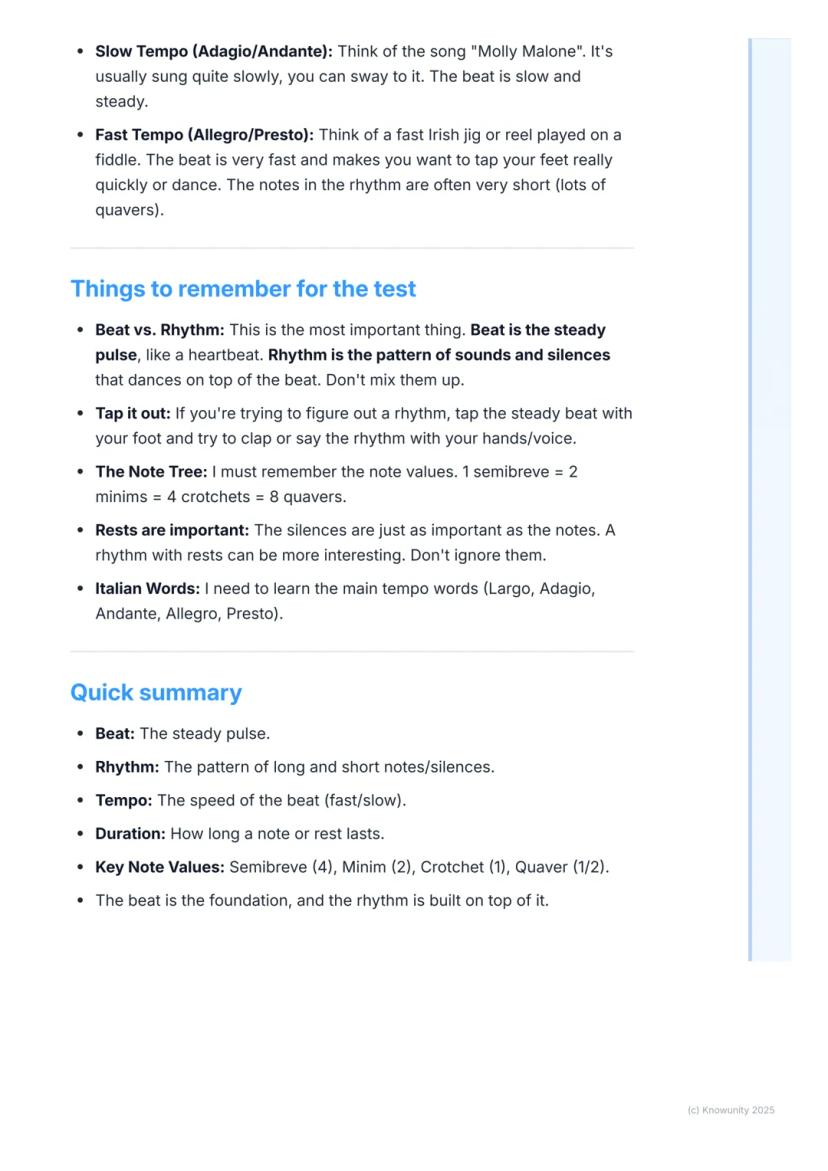
A semibreve lasts for 4 beats (the longest), a minim lasts for 2 beats, a crotchet lasts for 1 beat, and a quaver lasts for half a beat. It's like cutting a pizza in half, then in half again!
Rests are the silent gaps in music, and they're just as important as the notes themselves. Each note has a matching rest that lasts the same amount of time. The silences often make rhythms more interesting than constant noise would.
Memory Trick: Remember "1 semibreve = 2 minims = 4 crotchets = 8 quavers" - it's like a mathematical pattern that never changes!
4
of 5Cadastre-se para ver o conteúdo. É grátis!
- Acesso a todos os documentos
- Melhore suas notas
- Junte-se a milhões de estudantes
Putting It All Together
Let's see how this works with something you know. In "Twinkle, Twinkle, Little Star", each syllable gets one beat (crotchet), but "star" gets stretched out for two beats (minim). That's why it sounds complete at the end of the line.
When you're clapping rhythms, keep your foot tapping the steady beat whilst your hands clap the rhythm pattern. It's like patting your head and rubbing your stomach - tricky at first, but brilliant once you've got it!
Most popular music uses 4/4 time, which means there are 4 beats in each section (called a bar). Count along: 1, 2, 3, 4, 1, 2, 3, 4... and you'll hear how songs are organised into these groups.
Practice Tip: Try clapping simple patterns like "clap, clap, clap-hold-hold, clap" whilst keeping your foot tapping steadily - this builds your rhythm skills!
5
of 5Cadastre-se para ver o conteúdo. É grátis!
- Acesso a todos os documentos
- Melhore suas notas
- Junte-se a milhões de estudantes
Test Success Tips
The most important thing to remember is that beat and rhythm are different. Beat = steady pulse (like your heartbeat), rhythm = the exciting pattern on top. Mix these up and you'll lose marks, so drill this difference into your brain!
For your exams, practice the note value relationships. Know that a semibreve equals 4 crotchets, and be able to work out simple rhythm patterns. The Italian tempo terms pop up regularly, so memorise Largo through to Presto.
Don't forget about rests - they're not just empty space, they're crucial parts of rhythms that create interest and breathing room. Many students ignore rests in exams and miss easy marks.
Exam Strategy: If you're stuck on a rhythm question, tap out the beat first, then work out where the sounds and silences fit over that steady pulse.
Pensávamos que não ias perguntar...
O que é o Companheiro de Aprendizagem com IA da Knowunity?
O nosso companheiro de aprendizagem com IA foi especificamente criado para as necessidades dos estudantes. Com base nos milhões de conteúdos que temos na plataforma, podemos fornecer respostas verdadeiramente significativas e relevantes para os estudantes. Mas não se trata apenas de respostas, o companheiro foca-se mais em guiar os estudantes através dos seus desafios diários de aprendizagem, com planos de estudo personalizados, quizzes ou conteúdos no chat e 100% de personalização baseada nas habilidades e desenvolvimentos do estudante.
Onde posso fazer o download da app Knowunity?
Pode descarregar a aplicação na Google Play Store e na Apple App Store.
Como posso receber o meu pagamento? Quanto posso ganhar?
Sim, tem acesso gratuito ao conteúdo da aplicação e ao nosso companheiro de IA. Para desbloquear determinadas funcionalidades da aplicação, pode adquirir o Knowunity Pro.
Conteúdos mais populares
9IrishIrish oral questions and answers
Questions and answers for the leaving cert oral
5th Year4254
IrishIrish oral questions
Outline of oral questions
5th Year2055
IrishGaeilge Grammar Office
All the basics you need to know on Irish grammar.
6th Year863
EnglishKey Quotes : Sive
Key Quotes and explanations: Sive
6th Year2161
IrishAn Gaeilge Aiste
Irish Language essay
6th Year1250
IrishIrish poetry 2027
Iníon + Dínit an Bhróin
5th Year1133
IrishMé Féin & Mo Chlann (Myself & My Family)
Students will learn vocabulary to describe themselves, their family members, and daily routines. This helps in personal introductions and discussions.
TY291
IrishLC HL notes- Iníon (poem)
Includes poem in English and Irish, theme, key words & phrases
5th Year2274
GeographyTerritory, economic activities in Paris basin
essay
6th Year80
Não encontra o que procura? Explore outras disciplinas.
Avaliações dos nossos utilizadores. Eles adoraram tudo — e tu também vais adorar.
4.6/5App Store
4.7/5Google Play
A App é muito fácil de usar e está nem organizada. Encontrei tudo o que estava à procura até agora e consegui aprender muito com as apresentações! Vou usar a app para um trabalho escolar! E claro que também me ajuda muito como inspiração.
João Sutilizador iOS
Esta app é realmente incrível. Há tantas anotações de estudo e ajuda [...]. A minha disciplina problemática é Francês, por exemplo, e a app tem muitas opções de ajuda. Graças a esta app, melhorei o meu Francês. Eu recomendo a qualquer pessoa.
Sara C.utilizadora Android
Uau, estou realmente impressionado. Acabei de experimentar o app porque o vi anunciado muitas vezes e fiquei absolutamente surpreso. Este app é A AJUDA que você quer para a escola e, acima de tudo, oferece tantas coisas, como exercícios e folhas de fatos, que têm sido MUITO úteis para mim pessoalmente.
Anautilizadora iOS