
Ever wondered how to predict the odds of making a... Mostrar mais
 Mathematics11 visualizações·Atualizado May 9, 2026·5 páginas
Understanding Bernoulli Trials and Binomial Distribution
1 / 5
1
of 5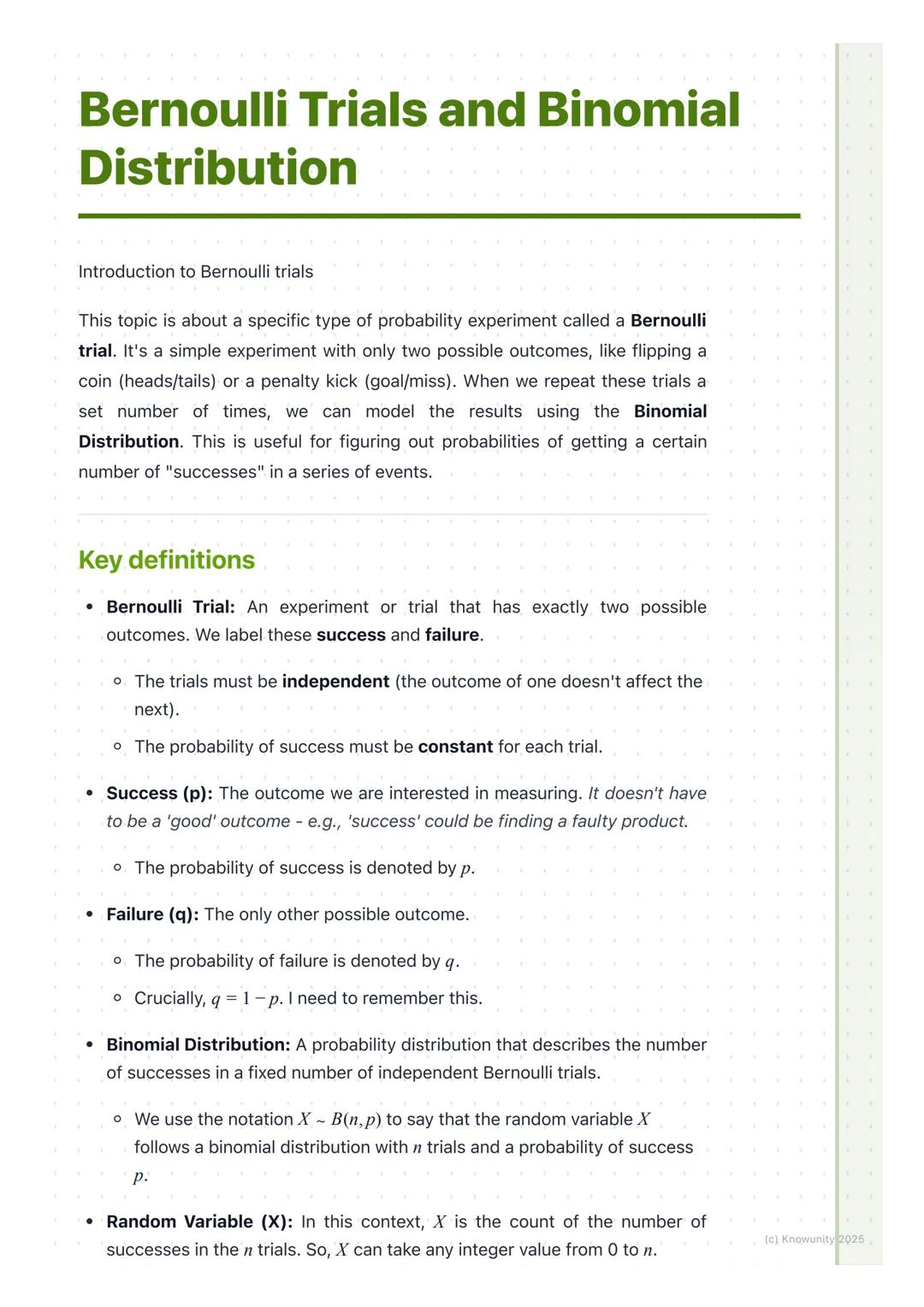
Introduction to Bernoulli Trials
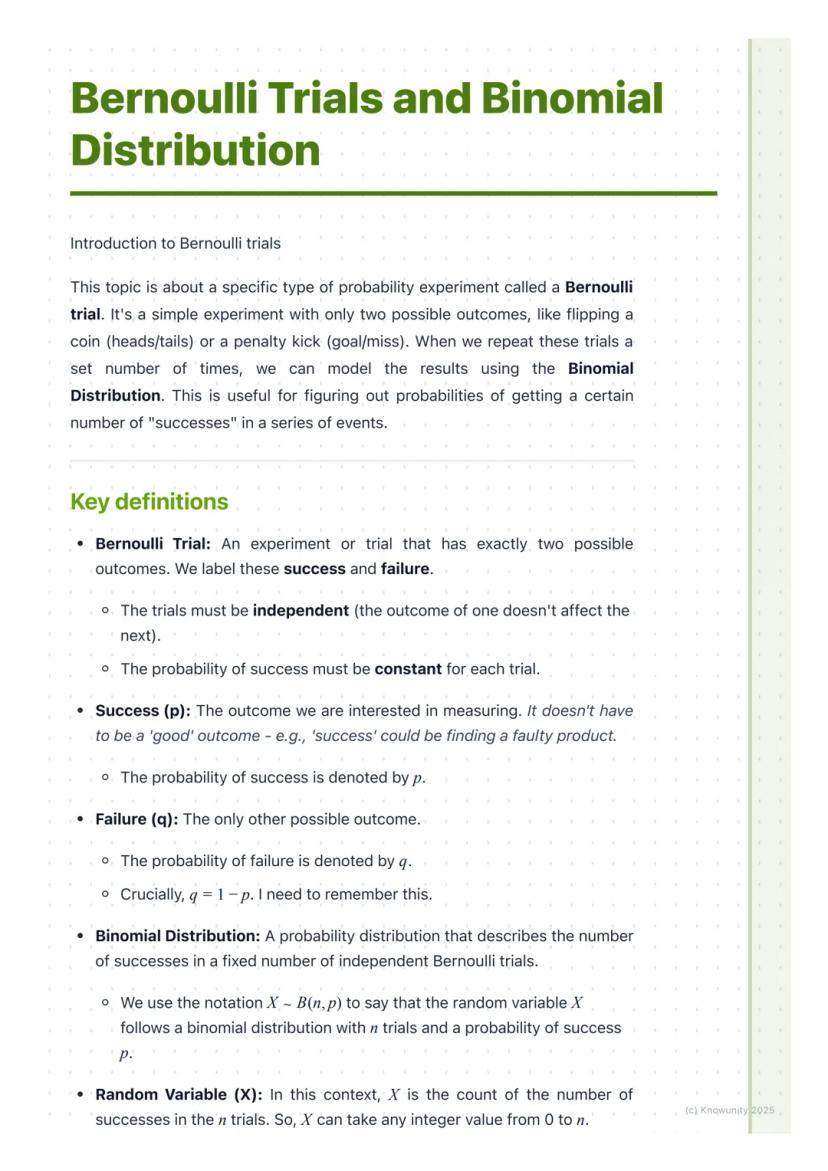
Think of any situation where there are only two possible outcomes - that's essentially what we're dealing with here. A Bernoulli trial is just a fancy name for an experiment with exactly two results: success or failure.
The beauty of this concept is its simplicity. Whether you're flipping coins, taking penalty kicks, or checking if products are faulty, the same mathematical principles apply. The key is that each trial must be independent (one result doesn't affect the next) and the probability of success stays constant throughout.
When we repeat these trials a fixed number of times, we can use the binomial distribution to work out probabilities. We write this as X ~ B(n,p), where n is the number of trials and p is the probability of success. Remember that the probability of failure is always q = 1-p - this formula shows up everywhere in exam questions.
Quick Tip: Success doesn't have to mean something good - it's just the outcome you're measuring. Finding a faulty product could be your 'success' in quality control!
2
of 5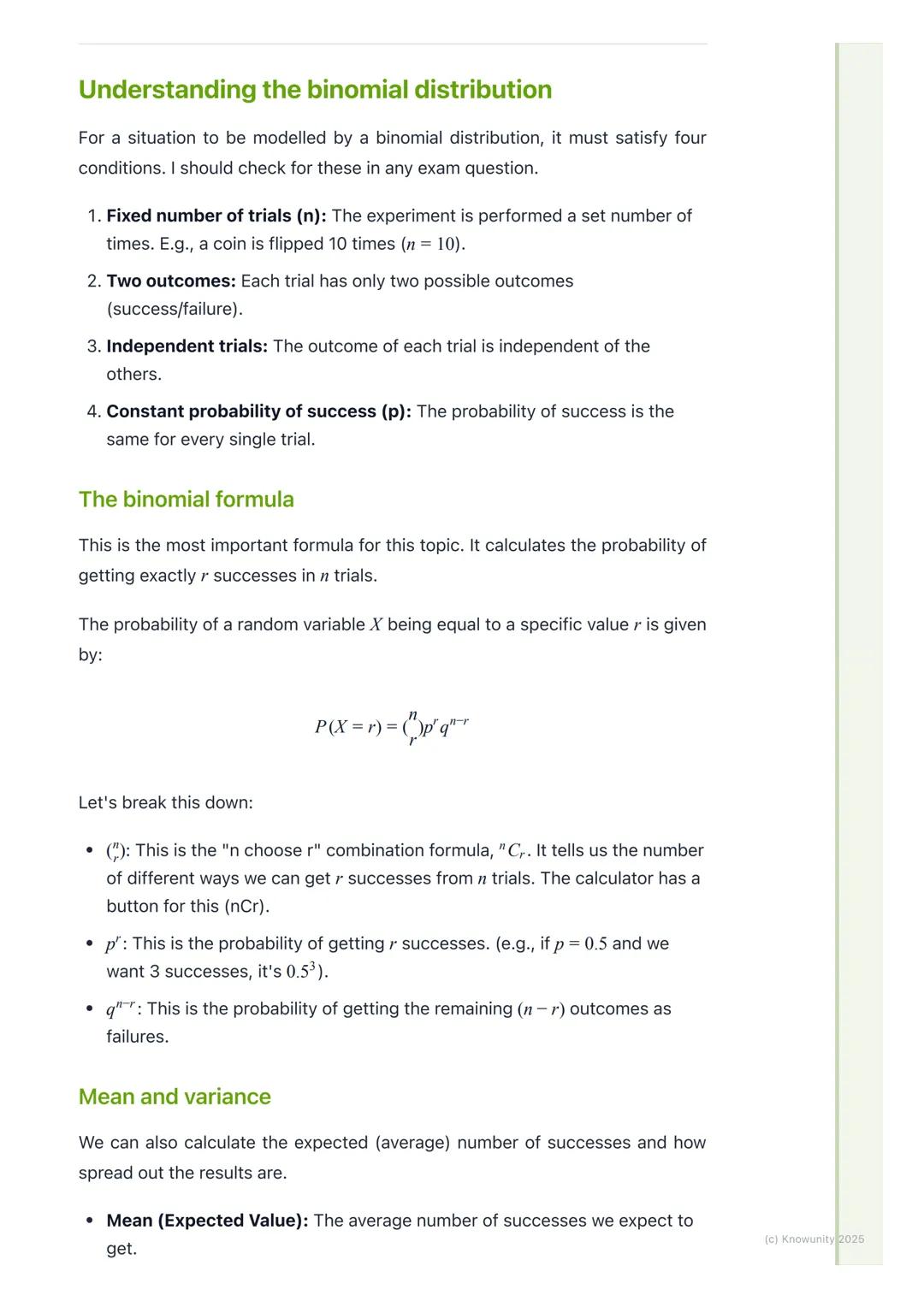
Understanding the Binomial Distribution
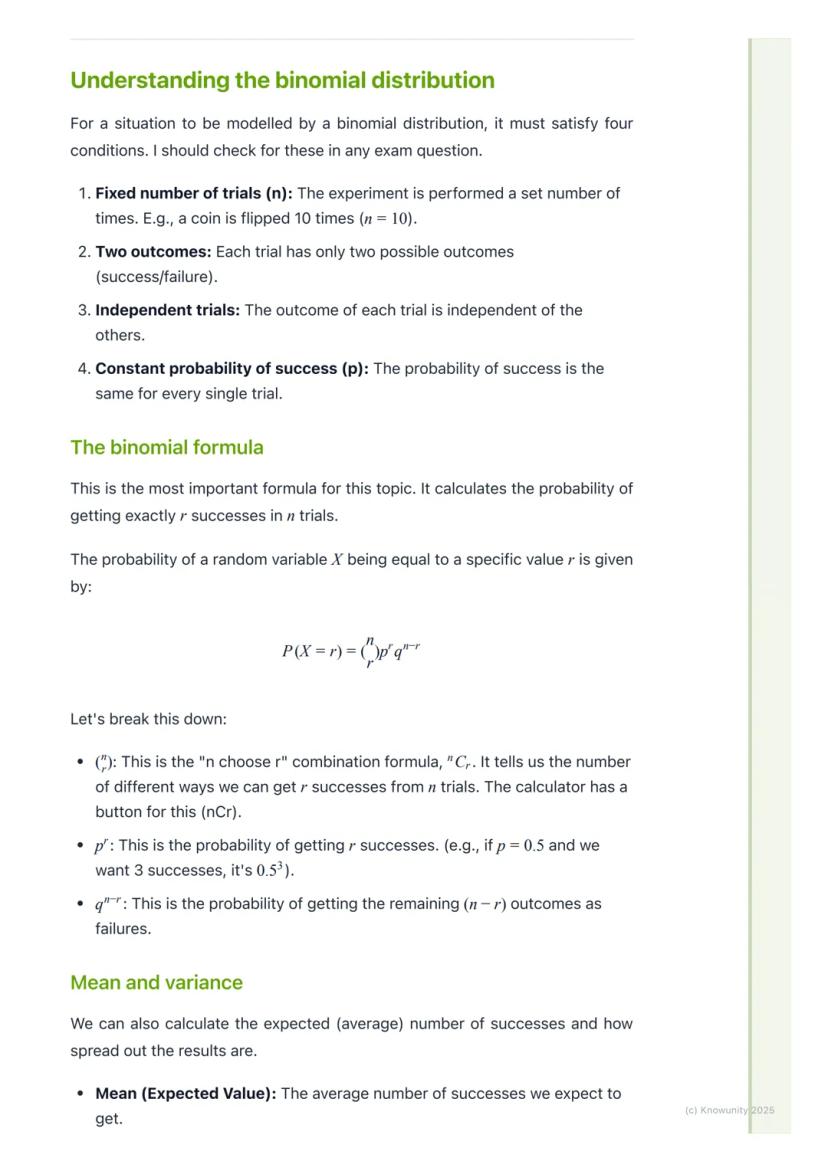
Before jumping into calculations, you need to check four essential conditions - think of them as your exam checklist. You need a fixed number of trials, exactly two possible outcomes, independent trials, and a constant probability of success.
The main formula you'll use is: P = (n choose r) × p^r × q^. This might look intimidating, but it breaks down logically. The combination part (n choose r) counts how many ways you can get r successes, whilst p^r gives the probability of those successes and q^ covers the remaining failures.
Your calculator will have an nCr button for combinations, making the maths much easier. The trickiest part is often interpreting the question correctly - make sure you understand what counts as 'success' before you start calculating.
Remember: Always verify all four conditions are met before using binomial distribution formulas - it's an easy way to lose marks if you skip this step!
3
of 5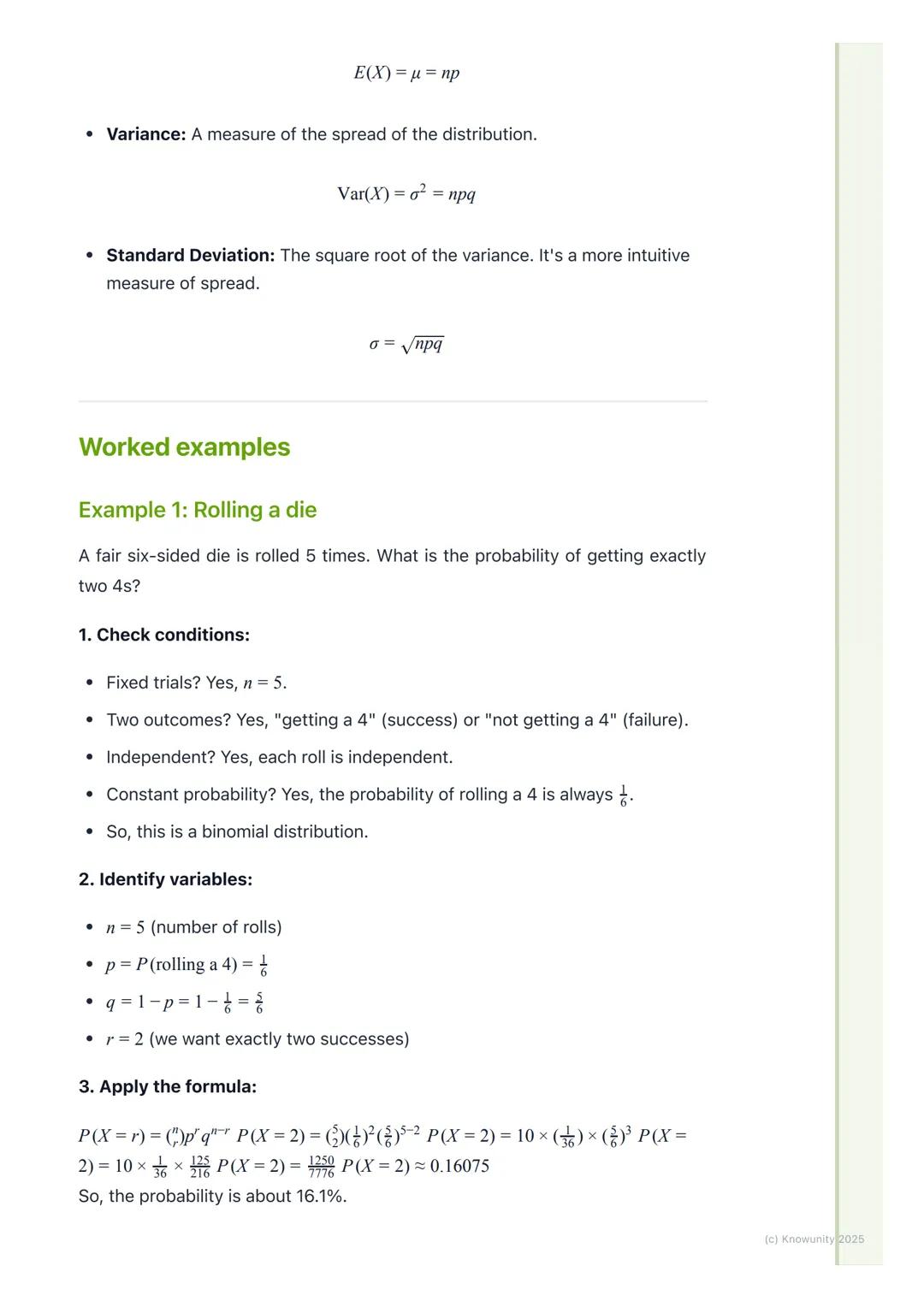
Mean, Variance and Worked Examples
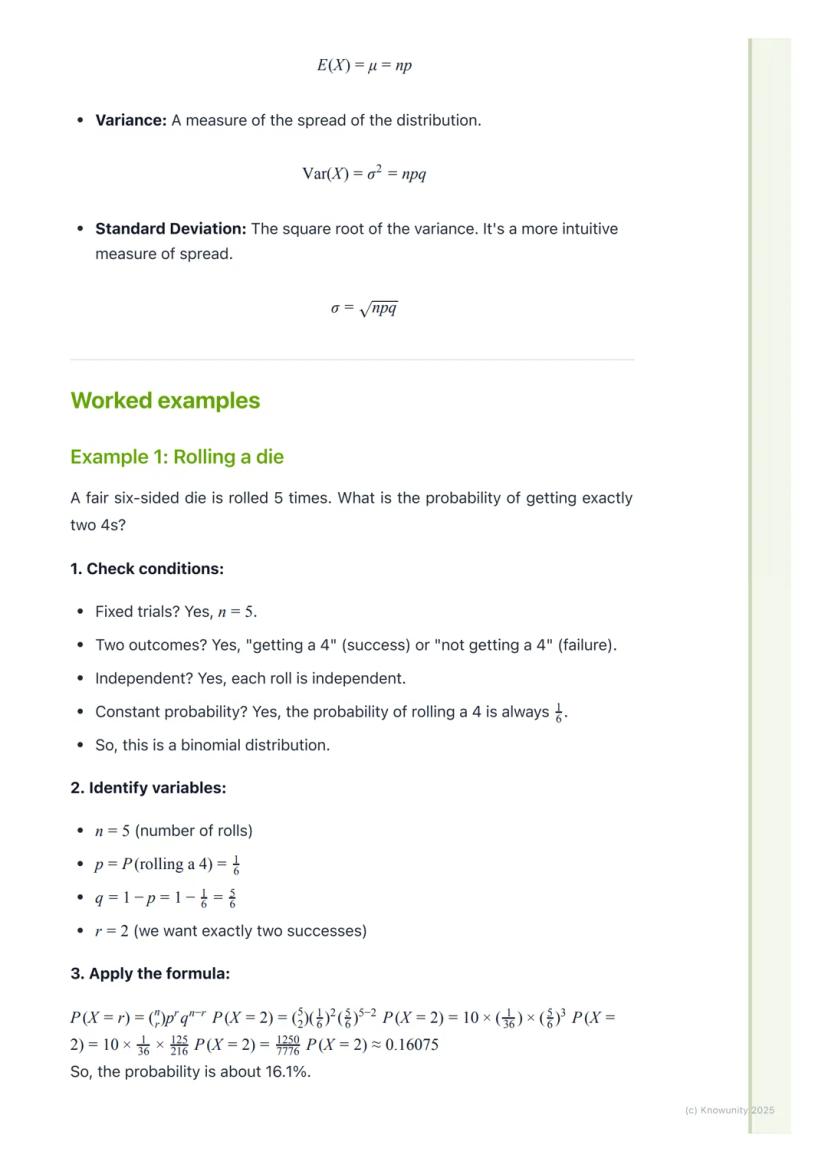
The expected value (mean) is simply E(X) = np, telling you the average number of successes you'd expect. The variance is npq, and taking its square root gives you the standard deviation - a measure of how spread out your results might be.
Let's work through a practical example. If you roll a die 5 times wanting exactly two 4s, you first check the conditions (all met), then identify your variables: n=5, p=1/6, q=5/6, r=2. Plugging into the formula gives you approximately 16.1%.
For more complex problems involving "at least" or "at most", you'll need to add up multiple probabilities. This is where careful reading becomes crucial - "at least 4" means P + P + P, whilst "fewer than 2" means P + P.
Pro Strategy: For questions like P(X≥2), sometimes it's quicker to calculate 1 - P(X<2), especially when n is large!
4
of 5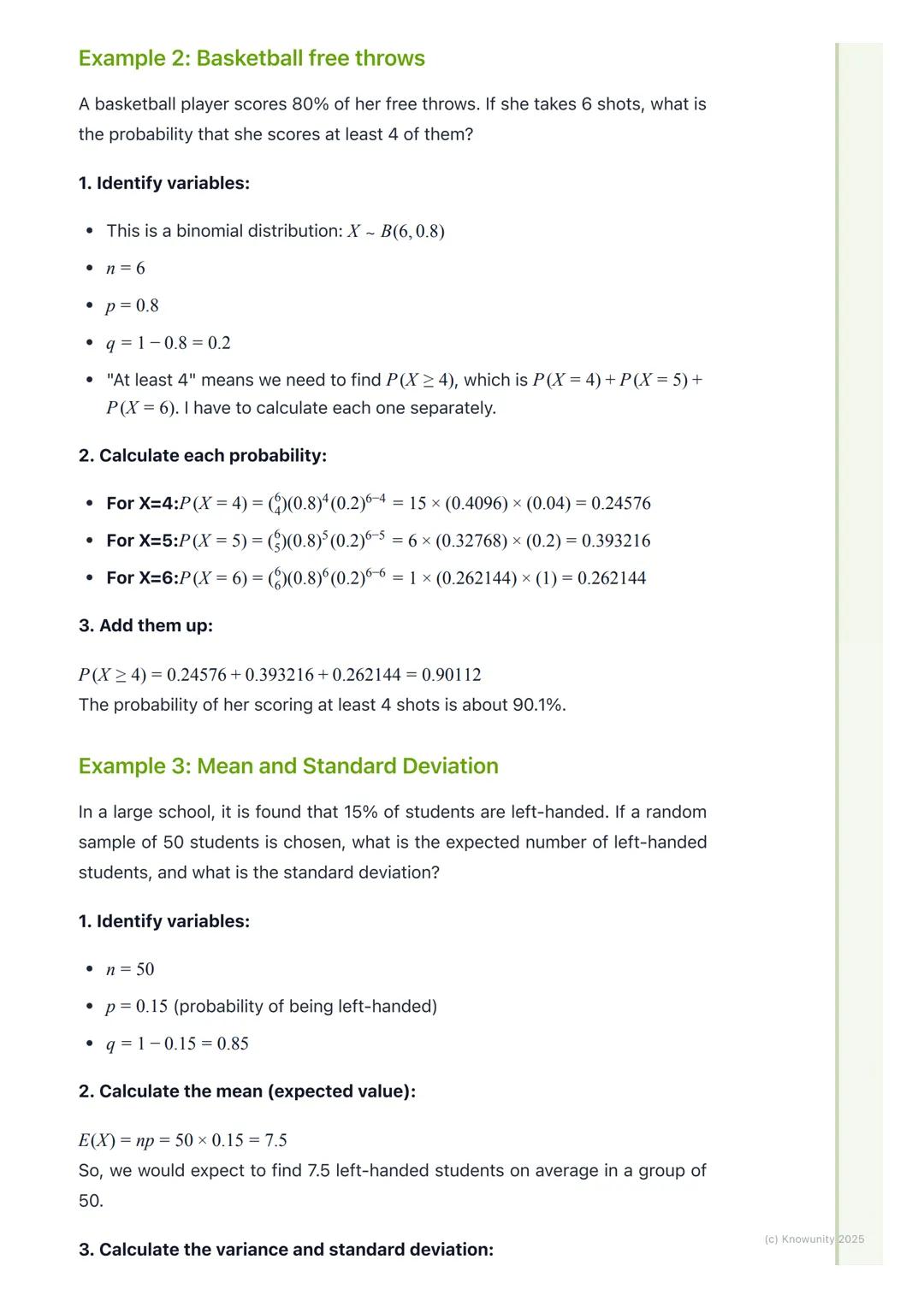
Basketball Free Throws Example
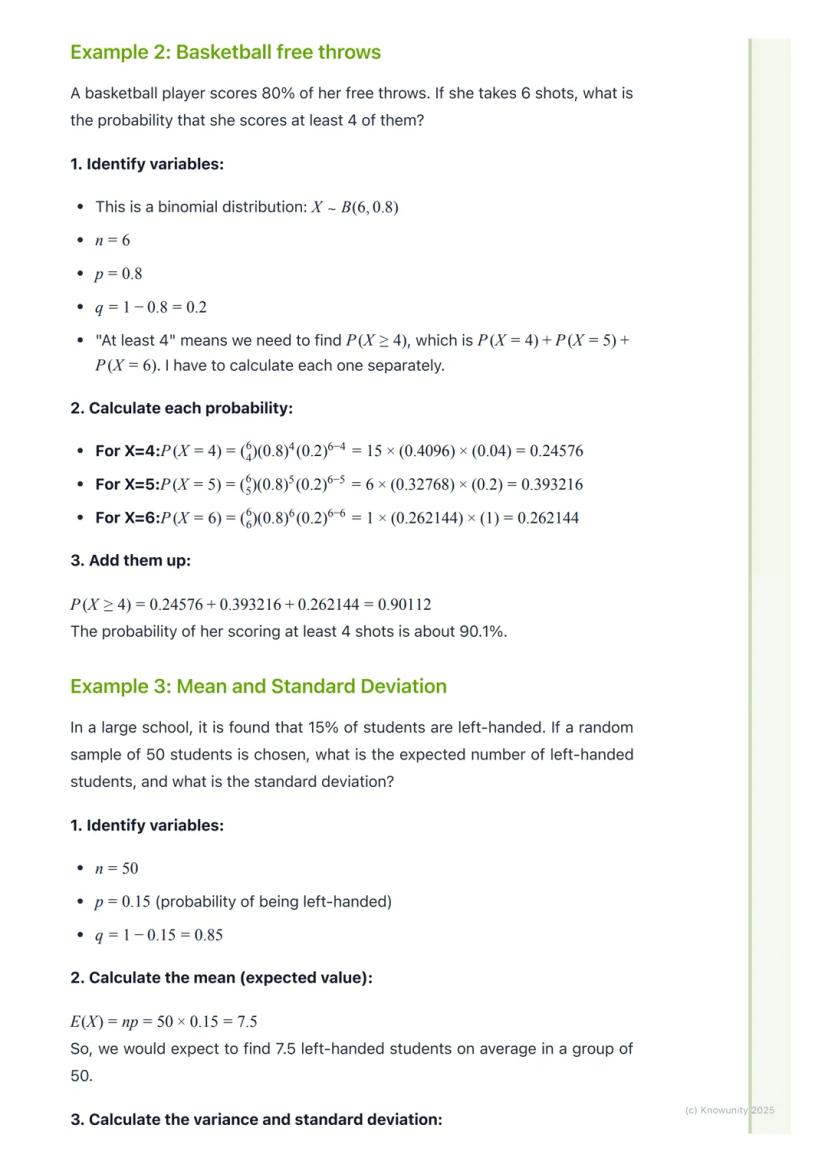
Here's a realistic scenario that shows how binomial distribution works in sports. A basketball player with an 80% success rate takes 6 shots - what's the probability she scores at least 4?
Setting up the problem: X ~ B(6, 0.8), so n=6, p=0.8, q=0.2. Since we want "at least 4", we calculate P + P + P separately. Each calculation follows the same pattern, just with different r values.
The results are P≈0.246, P≈0.393, and P≈0.262. Adding these gives approximately 90.1% - quite high odds for a skilled player.
This type of question often appears in exams because it tests multiple skills: recognising binomial conditions, handling "at least" language, and performing several calculations accurately.
Watch Out: Pay attention to words like "at least", "at most", "more than", and "fewer than" - they completely change which probabilities you need to calculate!
5
of 5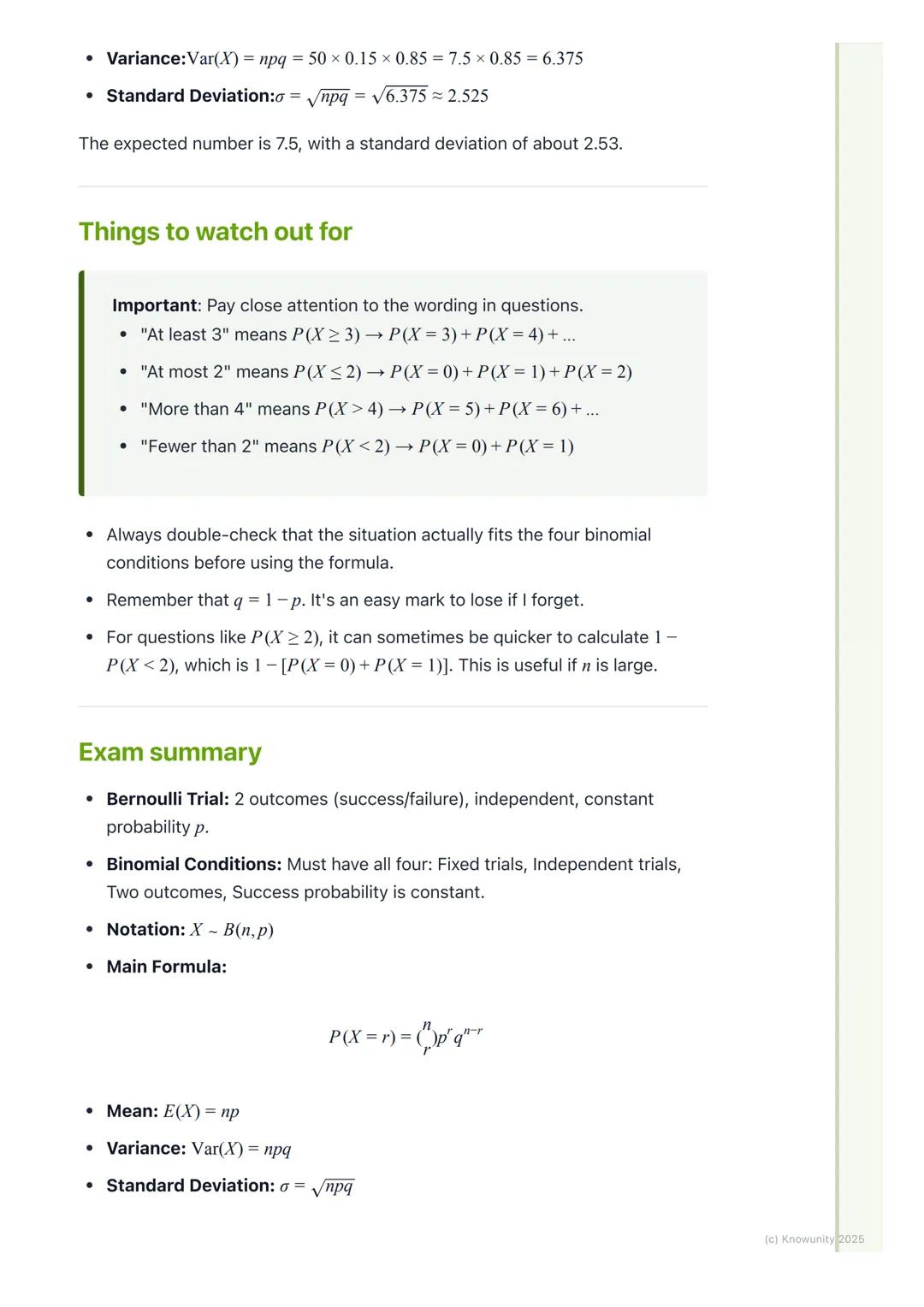
Calculating Expected Values and Exam Strategy
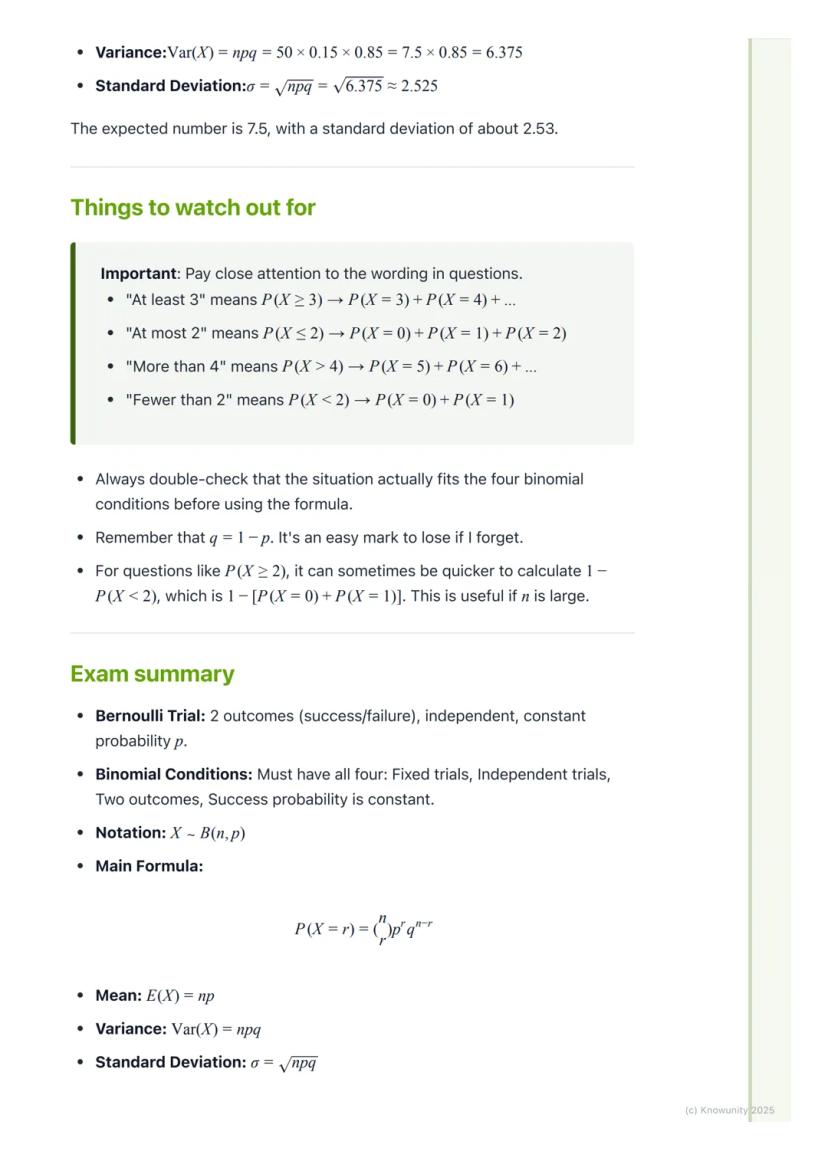
Let's tackle a mean and standard deviation problem to round out your understanding. With 50 students where 15% are left-handed, we expect E(X) = np = 7.5 left-handed students on average.
The variance is npq = 6.375, giving a standard deviation of approximately 2.53. These measures help you understand not just the average outcome, but how much variation you might see in practice.
For exam success, remember the key conditions and formulas. Always check that your situation fits all four binomial conditions before applying the formulas. Double-check that q = 1-p in your calculations, and be extra careful with probability language.
The essential formulas are: P = (n choose r) × p^r × q^, E(X) = np, Var(X) = npq, and σ = √(npq). Master these and you'll handle any binomial distribution question confidently.
Exam Success: Sometimes calculating 1 - P(X<k) is much faster than adding up many individual probabilities - always look for the most efficient approach!
Pensávamos que não ias perguntar...
O que é o Companheiro de Aprendizagem com IA da Knowunity?
O nosso companheiro de aprendizagem com IA foi especificamente criado para as necessidades dos estudantes. Com base nos milhões de conteúdos que temos na plataforma, podemos fornecer respostas verdadeiramente significativas e relevantes para os estudantes. Mas não se trata apenas de respostas, o companheiro foca-se mais em guiar os estudantes através dos seus desafios diários de aprendizagem, com planos de estudo personalizados, quizzes ou conteúdos no chat e 100% de personalização baseada nas habilidades e desenvolvimentos do estudante.
Onde posso fazer o download da app Knowunity?
Pode descarregar a aplicação na Google Play Store e na Apple App Store.
Como posso receber o meu pagamento? Quanto posso ganhar?
Sim, tem acesso gratuito ao conteúdo da aplicação e ao nosso companheiro de IA. Para desbloquear determinadas funcionalidades da aplicação, pode adquirir o Knowunity Pro.
Conteúdos mais populares de Mathematics
8MathematicsAlgebra 2
Algebra notes focusing on the factor theorem, completing the square, -b formula, graphs of polynomials
5th Year130
MathematicsSolving Equations
This section focuses on solving one-step and two-step linear equations to find the value of an unknown variable.
1st Year131
MathematicsAlgebra
Algebra
5th Year81
MathematicsNatural Numbers and Integers
Students will learn about positive whole numbers, zero, and negative whole numbers, and how to add, subtract, multiply, and divide them correctly.
1st Year131
MathematicsDifferential Calculus
Calculus is a topic that comes up nearly everywhere on your maths LC. This is just starter notes that could be useful end of 5th year or start of 6th year
5th Year271
MathematicsIntroduction to Probability
This topic introduces basic probability concepts, including calculating the probability of simple events and understanding the difference between experimental and theoretical probability.
2nd Year81
MathematicsData Collection and Types of Data
Students will learn about different types of data (qualitative, quantitative, discrete, continuous) and various methods for collecting primary and secondary data, including simple sampling.
2nd Year453
MathematicsMaths jc algebra
Maths jc
1st Year230
Conteúdos mais populares
9 Irish
IrishIrish oral questions and answers
Questions and answers for the leaving cert oral
5th Year4254
IrishIrish oral questions
Outline of oral questions
5th Year2055
IrishGaeilge Grammar Office
All the basics you need to know on Irish grammar.
6th Year883
 English
Key Quotes : Sive
Key Quotes and explanations: Sive
6th Year2191
IrishAn Gaeilge Aiste
Irish Language essay
6th Year1250
IrishIrish poetry 2027
Iníon + Dínit an Bhróin
5th Year1133
IrishMé Féin & Mo Chlann (Myself & My Family)
Students will learn vocabulary to describe themselves, their family members, and daily routines. This helps in personal introductions and discussions.
TY291
IrishLC HL notes- Iníon (poem)
Includes poem in English and Irish, theme, key words & phrases
5th Year2284
 Geography
Territory, economic activities in Paris basin
essay
6th Year80
Não encontra o que procura? Explore outras disciplinas.
Avaliações dos nossos utilizadores. Eles adoraram tudo — e tu também vais adorar.
4.6/5App Store
4.7/5Google Play
A App é muito fácil de usar e está nem organizada. Encontrei tudo o que estava à procura até agora e consegui aprender muito com as apresentações! Vou usar a app para um trabalho escolar! E claro que também me ajuda muito como inspiração.
João Sutilizador iOS
Esta app é realmente incrível. Há tantas anotações de estudo e ajuda [...]. A minha disciplina problemática é Francês, por exemplo, e a app tem muitas opções de ajuda. Graças a esta app, melhorei o meu Francês. Eu recomendo a qualquer pessoa.
Sara C.utilizadora Android
Uau, estou realmente impressionado. Acabei de experimentar o app porque o vi anunciado muitas vezes e fiquei absolutamente surpreso. Este app é A AJUDA que você quer para a escola e, acima de tudo, oferece tantas coisas, como exercícios e folhas de fatos, que têm sido MUITO úteis para mim pessoalmente.
Anautilizadora iOS
Mathematics11 visualizações·Atualizado May 9, 2026·5 páginasUnderstanding Bernoulli Trials and Binomial Distribution
Ever wondered how to predict the odds of making a certain number of free throws or getting heads in multiple coin flips? Bernoulli trials and the binomial distributiongive you the mathematical tools to solve these types of probability problems... Mostrar mais
1
of 5Cadastre-se para ver o conteúdo. É grátis!
- Acesso a todos os documentos
- Melhore suas notas
- Junte-se a milhões de estudantes
Introduction to Bernoulli Trials
Think of any situation where there are only two possible outcomes - that's essentially what we're dealing with here. A Bernoulli trial is just a fancy name for an experiment with exactly two results: success or failure.
The beauty of this concept is its simplicity. Whether you're flipping coins, taking penalty kicks, or checking if products are faulty, the same mathematical principles apply. The key is that each trial must be independent (one result doesn't affect the next) and the probability of success stays constant throughout.
When we repeat these trials a fixed number of times, we can use the binomial distribution to work out probabilities. We write this as X ~ B(n,p), where n is the number of trials and p is the probability of success. Remember that the probability of failure is always q = 1-p - this formula shows up everywhere in exam questions.
Quick Tip: Success doesn't have to mean something good - it's just the outcome you're measuring. Finding a faulty product could be your 'success' in quality control!
2
of 5Cadastre-se para ver o conteúdo. É grátis!
- Acesso a todos os documentos
- Melhore suas notas
- Junte-se a milhões de estudantes
Understanding the Binomial Distribution
Before jumping into calculations, you need to check four essential conditions - think of them as your exam checklist. You need a fixed number of trials, exactly two possible outcomes, independent trials, and a constant probability of success.
The main formula you'll use is: P = (n choose r) × p^r × q^. This might look intimidating, but it breaks down logically. The combination part (n choose r) counts how many ways you can get r successes, whilst p^r gives the probability of those successes and q^ covers the remaining failures.
Your calculator will have an nCr button for combinations, making the maths much easier. The trickiest part is often interpreting the question correctly - make sure you understand what counts as 'success' before you start calculating.
Remember: Always verify all four conditions are met before using binomial distribution formulas - it's an easy way to lose marks if you skip this step!
3
of 5Cadastre-se para ver o conteúdo. É grátis!
- Acesso a todos os documentos
- Melhore suas notas
- Junte-se a milhões de estudantes
Mean, Variance and Worked Examples
The expected value (mean) is simply E(X) = np, telling you the average number of successes you'd expect. The variance is npq, and taking its square root gives you the standard deviation - a measure of how spread out your results might be.
Let's work through a practical example. If you roll a die 5 times wanting exactly two 4s, you first check the conditions (all met), then identify your variables: n=5, p=1/6, q=5/6, r=2. Plugging into the formula gives you approximately 16.1%.
For more complex problems involving "at least" or "at most", you'll need to add up multiple probabilities. This is where careful reading becomes crucial - "at least 4" means P + P + P, whilst "fewer than 2" means P + P.
Pro Strategy: For questions like P(X≥2), sometimes it's quicker to calculate 1 - P(X<2), especially when n is large!
4
of 5Cadastre-se para ver o conteúdo. É grátis!
- Acesso a todos os documentos
- Melhore suas notas
- Junte-se a milhões de estudantes
Basketball Free Throws Example
Here's a realistic scenario that shows how binomial distribution works in sports. A basketball player with an 80% success rate takes 6 shots - what's the probability she scores at least 4?
Setting up the problem: X ~ B(6, 0.8), so n=6, p=0.8, q=0.2. Since we want "at least 4", we calculate P + P + P separately. Each calculation follows the same pattern, just with different r values.
The results are P≈0.246, P≈0.393, and P≈0.262. Adding these gives approximately 90.1% - quite high odds for a skilled player.
This type of question often appears in exams because it tests multiple skills: recognising binomial conditions, handling "at least" language, and performing several calculations accurately.
Watch Out: Pay attention to words like "at least", "at most", "more than", and "fewer than" - they completely change which probabilities you need to calculate!
5
of 5Cadastre-se para ver o conteúdo. É grátis!
- Acesso a todos os documentos
- Melhore suas notas
- Junte-se a milhões de estudantes
Calculating Expected Values and Exam Strategy
Let's tackle a mean and standard deviation problem to round out your understanding. With 50 students where 15% are left-handed, we expect E(X) = np = 7.5 left-handed students on average.
The variance is npq = 6.375, giving a standard deviation of approximately 2.53. These measures help you understand not just the average outcome, but how much variation you might see in practice.
For exam success, remember the key conditions and formulas. Always check that your situation fits all four binomial conditions before applying the formulas. Double-check that q = 1-p in your calculations, and be extra careful with probability language.
The essential formulas are: P = (n choose r) × p^r × q^, E(X) = np, Var(X) = npq, and σ = √(npq). Master these and you'll handle any binomial distribution question confidently.
Exam Success: Sometimes calculating 1 - P(X<k) is much faster than adding up many individual probabilities - always look for the most efficient approach!
Pensávamos que não ias perguntar...
O que é o Companheiro de Aprendizagem com IA da Knowunity?
O nosso companheiro de aprendizagem com IA foi especificamente criado para as necessidades dos estudantes. Com base nos milhões de conteúdos que temos na plataforma, podemos fornecer respostas verdadeiramente significativas e relevantes para os estudantes. Mas não se trata apenas de respostas, o companheiro foca-se mais em guiar os estudantes através dos seus desafios diários de aprendizagem, com planos de estudo personalizados, quizzes ou conteúdos no chat e 100% de personalização baseada nas habilidades e desenvolvimentos do estudante.
Onde posso fazer o download da app Knowunity?
Pode descarregar a aplicação na Google Play Store e na Apple App Store.
Como posso receber o meu pagamento? Quanto posso ganhar?
Sim, tem acesso gratuito ao conteúdo da aplicação e ao nosso companheiro de IA. Para desbloquear determinadas funcionalidades da aplicação, pode adquirir o Knowunity Pro.
Conteúdos mais populares de Mathematics
8MathematicsAlgebra 2
Algebra notes focusing on the factor theorem, completing the square, -b formula, graphs of polynomials
5th Year130
MathematicsSolving Equations
This section focuses on solving one-step and two-step linear equations to find the value of an unknown variable.
1st Year131
MathematicsAlgebra
Algebra
5th Year81
MathematicsNatural Numbers and Integers
Students will learn about positive whole numbers, zero, and negative whole numbers, and how to add, subtract, multiply, and divide them correctly.
1st Year131
MathematicsDifferential Calculus
Calculus is a topic that comes up nearly everywhere on your maths LC. This is just starter notes that could be useful end of 5th year or start of 6th year
5th Year271
MathematicsIntroduction to Probability
This topic introduces basic probability concepts, including calculating the probability of simple events and understanding the difference between experimental and theoretical probability.
2nd Year81
MathematicsData Collection and Types of Data
Students will learn about different types of data (qualitative, quantitative, discrete, continuous) and various methods for collecting primary and secondary data, including simple sampling.
2nd Year453
MathematicsMaths jc algebra
Maths jc
1st Year230
Conteúdos mais populares
9IrishIrish oral questions and answers
Questions and answers for the leaving cert oral
5th Year4254
IrishIrish oral questions
Outline of oral questions
5th Year2055
IrishGaeilge Grammar Office
All the basics you need to know on Irish grammar.
6th Year883
EnglishKey Quotes : Sive
Key Quotes and explanations: Sive
6th Year2191
IrishAn Gaeilge Aiste
Irish Language essay
6th Year1250
IrishIrish poetry 2027
Iníon + Dínit an Bhróin
5th Year1133
IrishMé Féin & Mo Chlann (Myself & My Family)
Students will learn vocabulary to describe themselves, their family members, and daily routines. This helps in personal introductions and discussions.
TY291
IrishLC HL notes- Iníon (poem)
Includes poem in English and Irish, theme, key words & phrases
5th Year2284
GeographyTerritory, economic activities in Paris basin
essay
6th Year80
Não encontra o que procura? Explore outras disciplinas.
Avaliações dos nossos utilizadores. Eles adoraram tudo — e tu também vais adorar.
4.6/5App Store
4.7/5Google Play
A App é muito fácil de usar e está nem organizada. Encontrei tudo o que estava à procura até agora e consegui aprender muito com as apresentações! Vou usar a app para um trabalho escolar! E claro que também me ajuda muito como inspiração.
João Sutilizador iOS
Esta app é realmente incrível. Há tantas anotações de estudo e ajuda [...]. A minha disciplina problemática é Francês, por exemplo, e a app tem muitas opções de ajuda. Graças a esta app, melhorei o meu Francês. Eu recomendo a qualquer pessoa.
Sara C.utilizadora Android
Uau, estou realmente impressionado. Acabei de experimentar o app porque o vi anunciado muitas vezes e fiquei absolutamente surpreso. Este app é A AJUDA que você quer para a escola e, acima de tudo, oferece tantas coisas, como exercícios e folhas de fatos, que têm sido MUITO úteis para mim pessoalmente.
Anautilizadora iOS