
The Irish future tense (an aimsir fháistineach) is your tool... Mostrar mais
 Irish5 visualizações·Atualizado Jun 4, 2026·5 páginas
Learn About An Aimsir Fháistineach: Forming Future Tense in Irish
1 / 5
1
of 5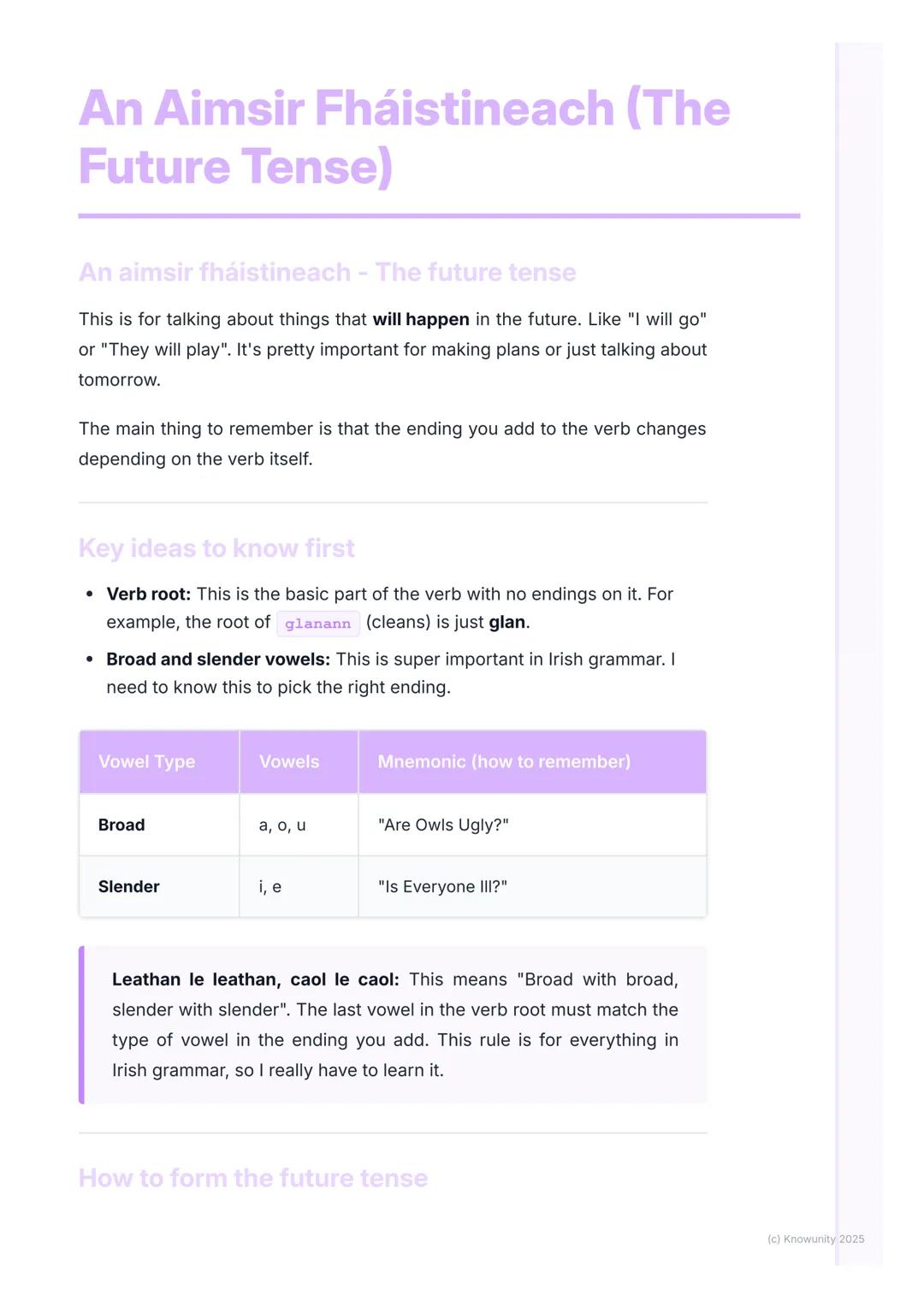
An Aimsir Fháistineach - Getting Started
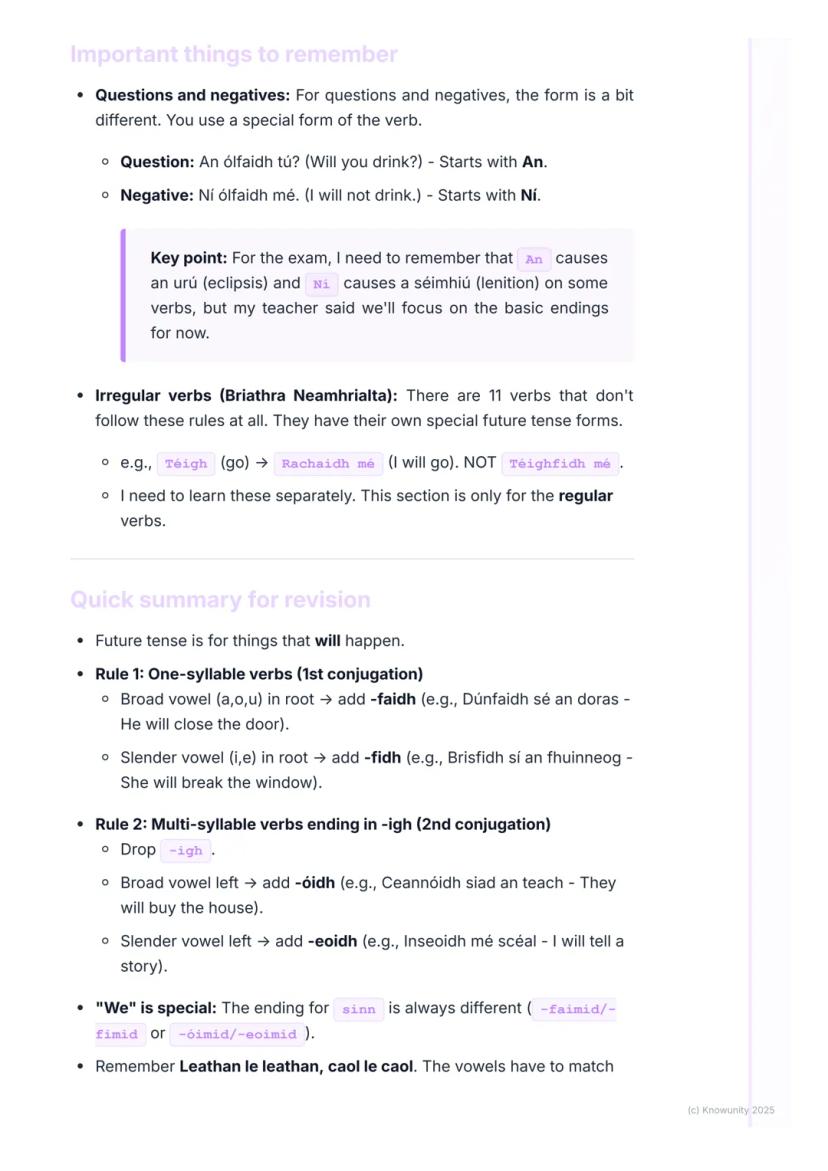
Think of the future tense as your planning language - it's how you say "I will go" or "they will play" in Irish. The trick is knowing which ending to stick on your verb, and that depends on the vowels inside it.
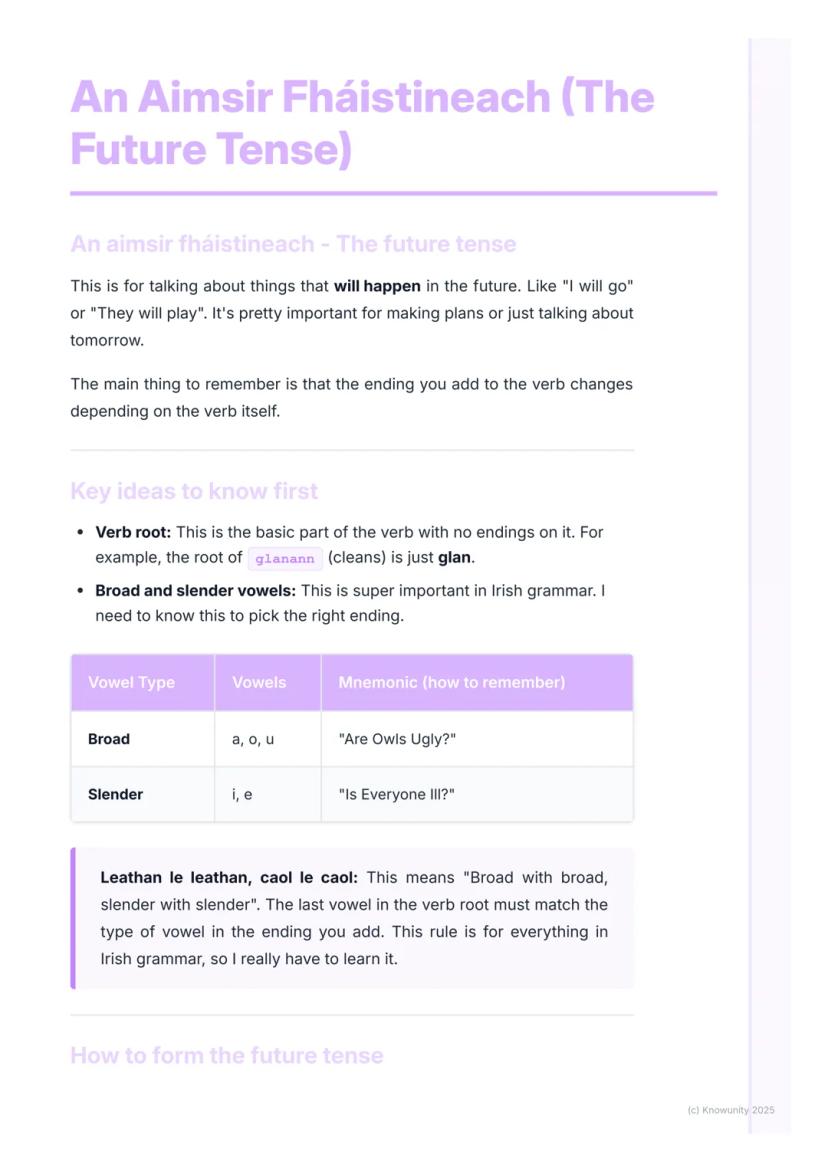
Before diving in, you need to master broad and slender vowels. Broad vowels are a, o, u (remember: "Are Owls Ugly?") and slender vowels are i, e ("Is Everyone Ill?"). This matters because of the golden rule: leathan le leathan, caol le caol - broad with broad, slender with slender.
The verb root is your starting point - it's the basic form without any endings. For example, glanann (cleans) has the root glan. Once you've got your root, check its last vowel to decide which ending fits.
Quick tip: Master the vowel types first - they're used throughout Irish grammar, not just the future tense!
2
of 5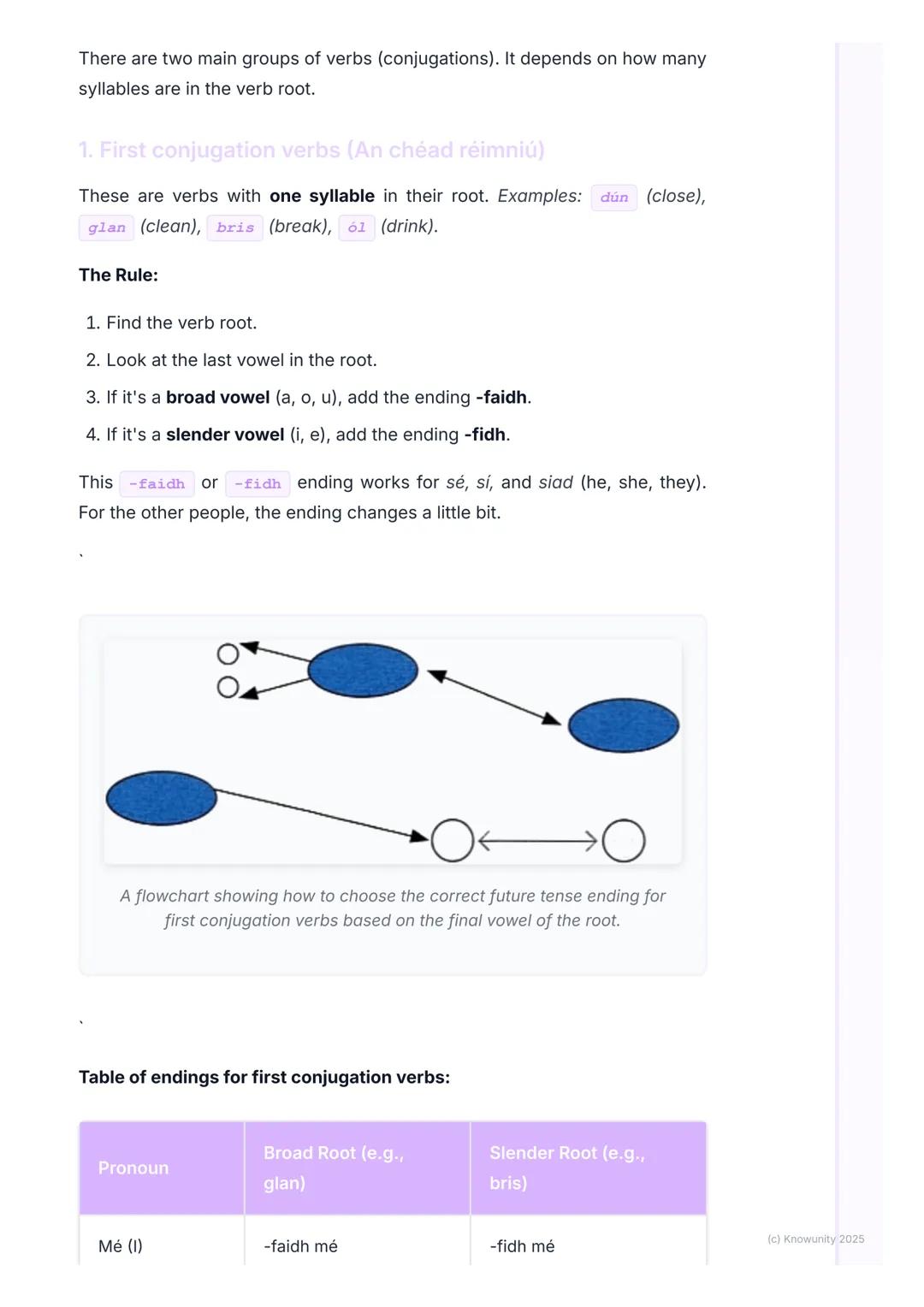
First Conjugation Verbs - The One-Syllable Gang
First conjugation verbs have just one syllable in their root - words like dún (close), glan (clean), bris (break), and ól (drink). These are actually the easiest once you get the pattern.
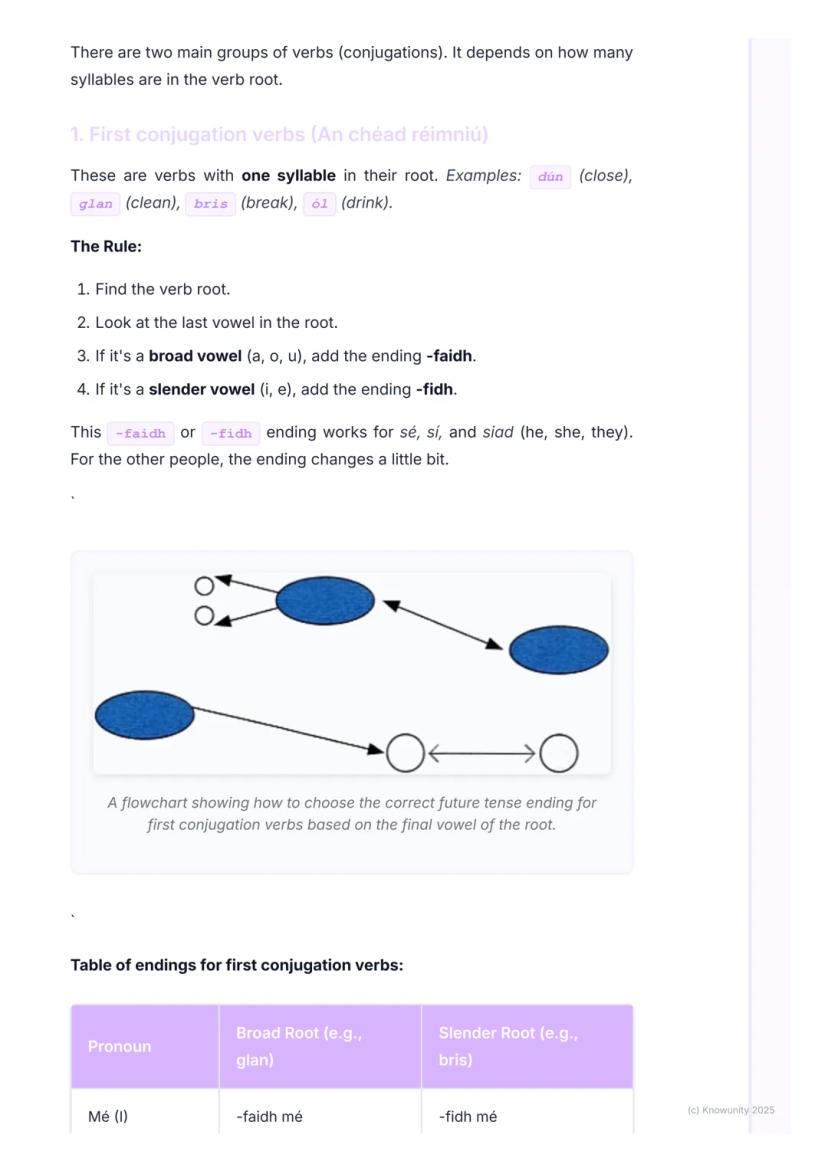
Here's the system: if your verb root ends with a broad vowel (a, o, u), you add -faidh. If it ends with a slender vowel (i, e), you add -fidh. So glan becomes glanfaidh and bris becomes brisfidh.
The endings work perfectly for sé, sí, and siad (he, she, they). For other pronouns like mé and tú, you just add the pronoun after: glanfaidh mé, glanfaidh tú. The only special case is sinn (we) - it gets its own endings: -faimid for broad roots and -fimid for slender ones.
Remember: The broad/slender rule applies to every single verb - there are no exceptions here!
3
of 5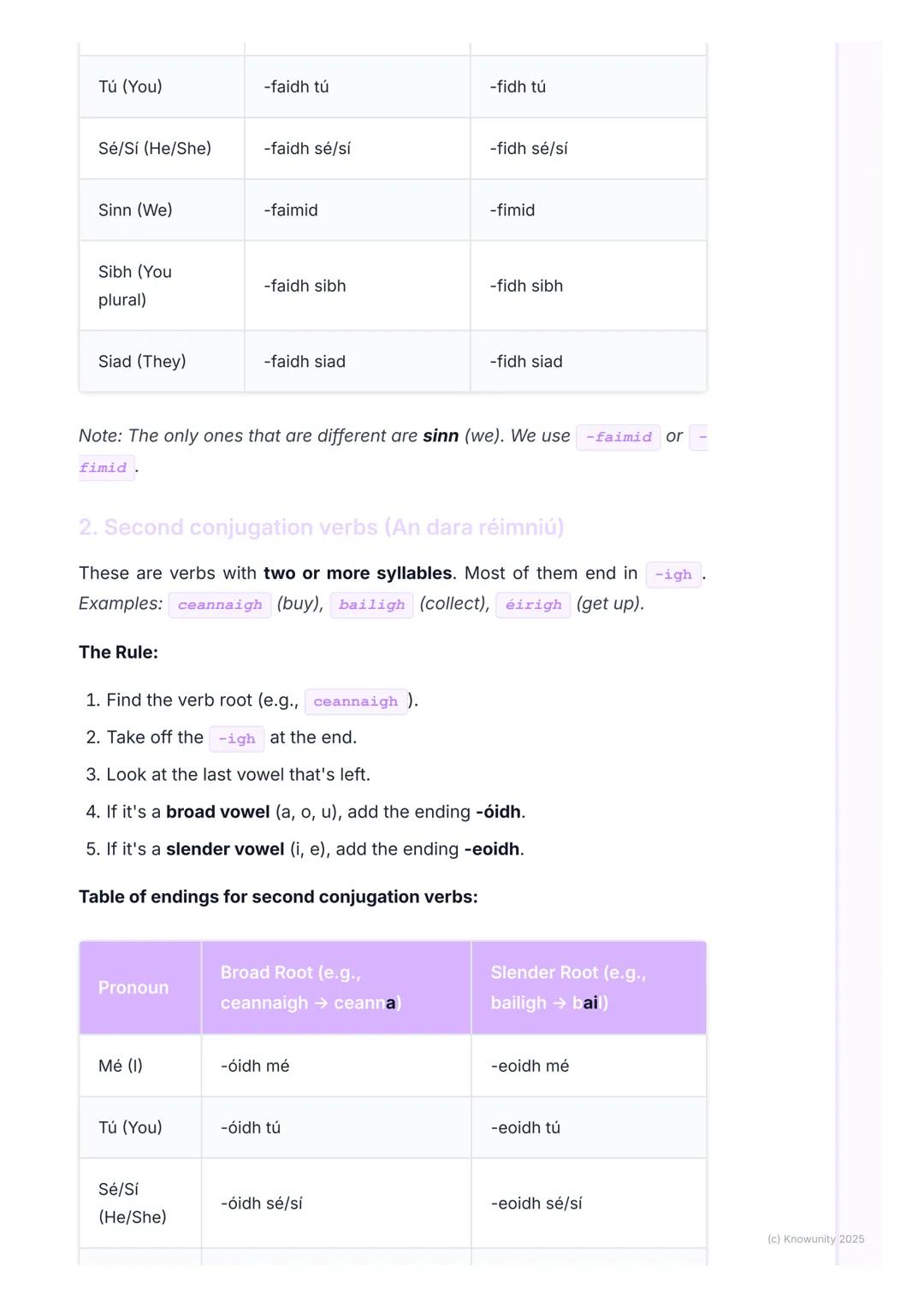
Second Conjugation Verbs - The Multi-Syllable Squad
Second conjugation verbs have two or more syllables and usually end in -igh. Think ceannaigh (buy), bailigh (collect), or éirigh (get up) - they're longer words that need a different approach.
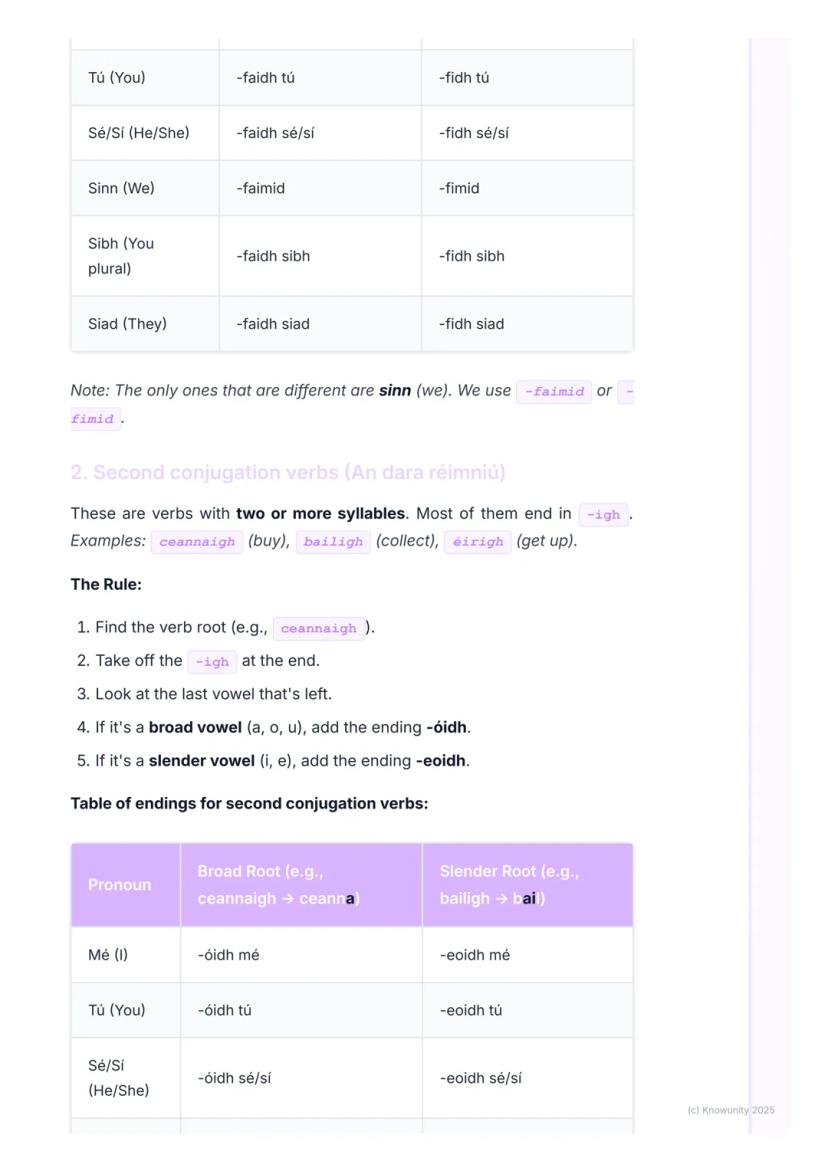
The process is straightforward: chop off the -igh ending first. Then check what vowel you're left with at the end. If it's broad (a, o, u), add -óidh. If it's slender (i, e), add -eoidh.
So ceannaigh loses its -igh to become ceanna (ending in broad 'a'), then gets -óidh to make ceannóidh. Bailigh becomes bail (ending in slender 'i'), then gets -eoidh to make baileoidh.
Just like first conjugation, sinn (we) is special again. It uses -óimid for broad roots and -eoimid for slender ones instead of the regular endings.
Pro tip: Most verbs you'll meet ending in -igh follow this pattern - it's more common than you might think!
4
of 5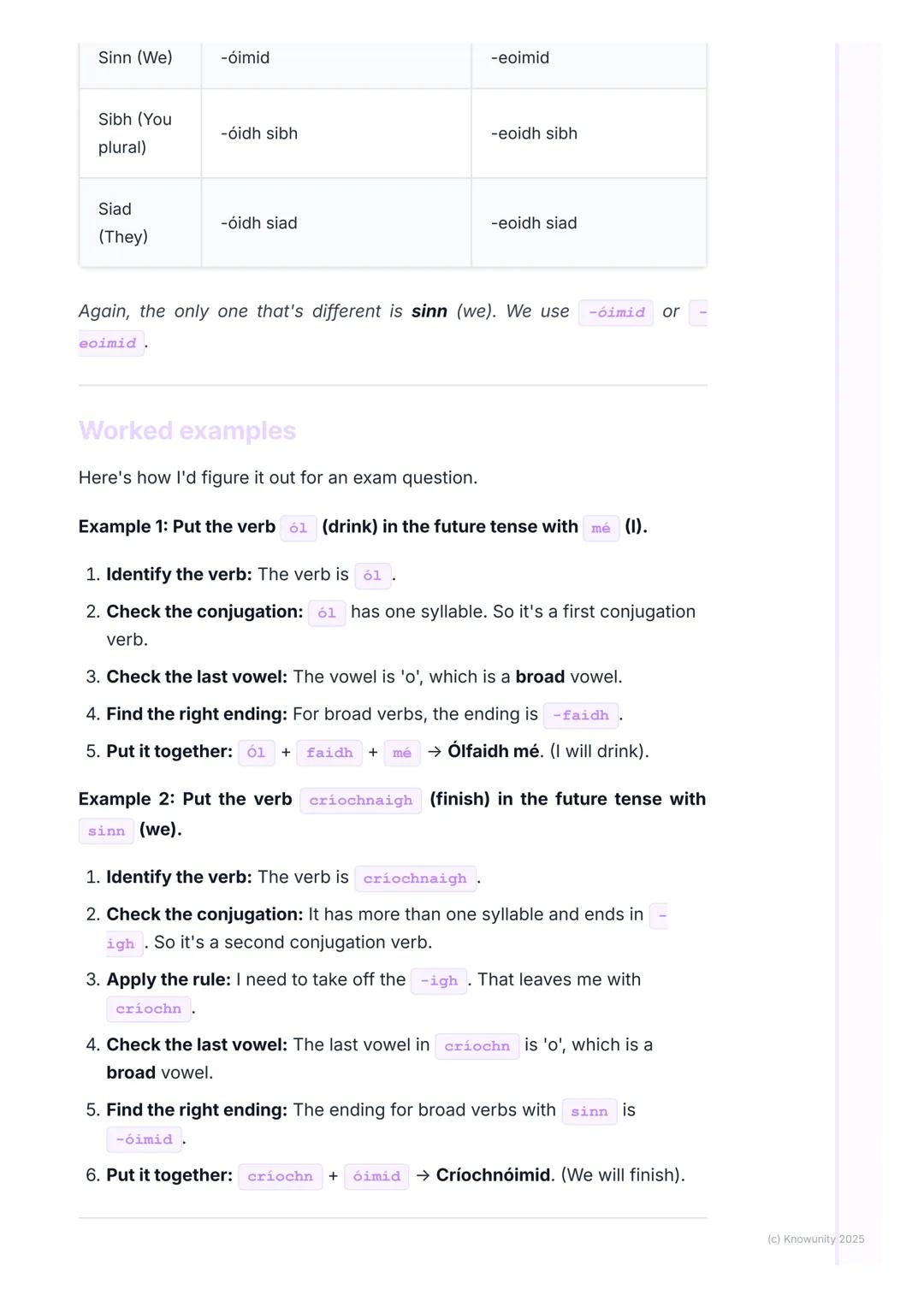
Working Through Examples
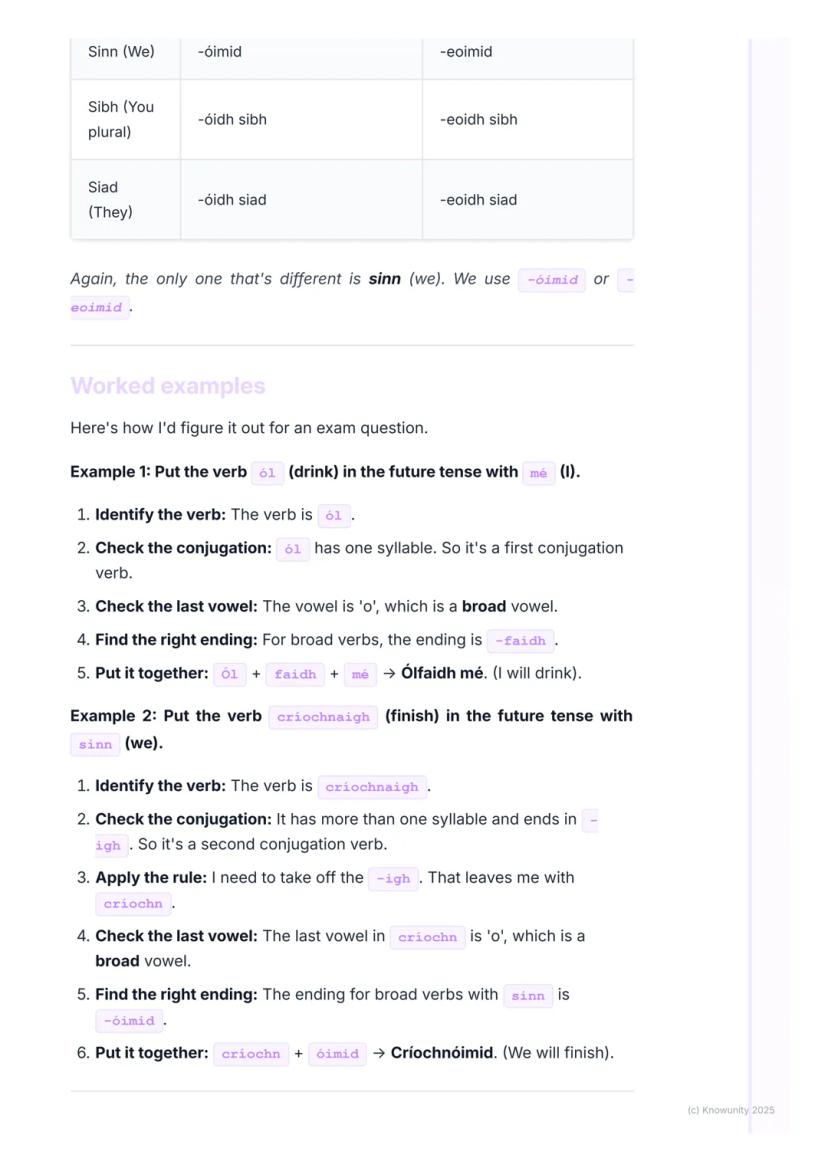
Let's tackle some exam-style questions to see how this works in practice. Take ól (drink) with mé (I) - it's one syllable, so it's first conjugation. The 'o' is broad, so we add -faidh: ólfaidh mé (I will drink).
For something trickier, try críochnaigh (finish) with sinn (we). It's multi-syllable and ends in -igh, so it's second conjugation. Drop the -igh to get críochn, which ends in broad 'o'. Since it's sinn, we use -óimid: críochnóimid (we will finish).
The key is taking it step by step: identify the conjugation type, find the root, check the vowel type, pick the right ending. Once you've done a few, the pattern becomes automatic.
Questions and negatives change things slightly - they start with An (will...?) or Ní (will not...), but the verb endings stay the same. An ólfaidh tú? (Will you drink?) and Ní ólfaidh mé (I will not drink).
Exam hack: Always identify conjugation type first - it saves you from mixing up the ending patterns!
5
of 5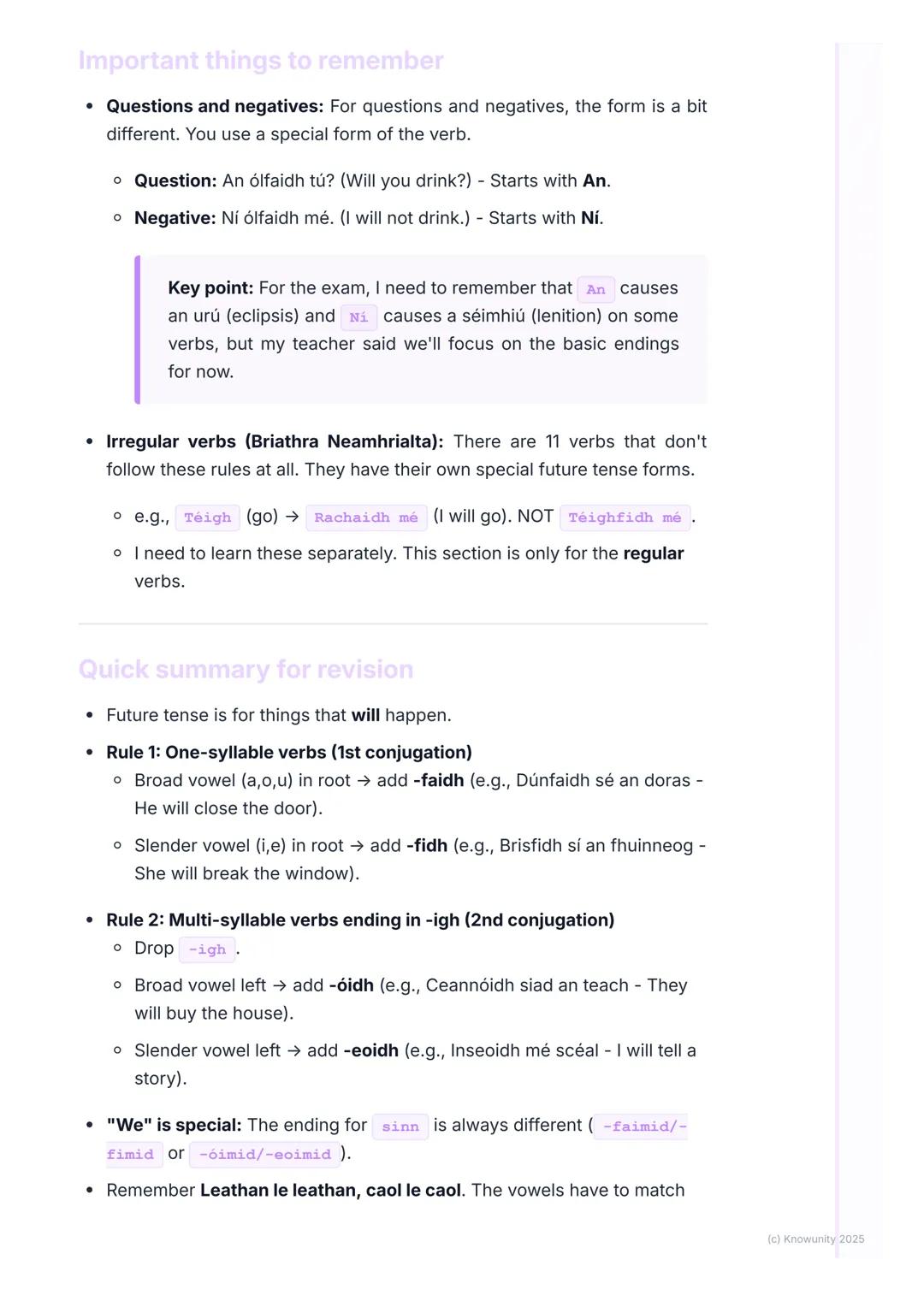
Quick Revision Summary
You've got two main patterns to remember. First conjugation : broad vowel gets -faidh, slender vowel gets -fidh. Second conjugation : drop the -igh, then broad gets -óidh, slender gets -eoidh.
The pronoun sinn (we) always gets special treatment with its own endings: -faimid/-fimid for first conjugation, -óimid/-eoimid for second conjugation. Every other pronoun just tags along after the main verb form.
Remember that irregular verbs like téigh (go) completely ignore these rules - téigh becomes rachaidh mé (I will go), not téighfidh mé. You'll need to learn those 11 irregular verbs separately.
The leathan le leathan, caol le caol rule is your safety net - if your vowels don't match up, you've made a mistake somewhere. This future tense system works for the vast majority of Irish verbs once you've mastered the basics.
Final reminder: Practice with regular verbs first - once these patterns are automatic, irregular verbs become much easier to handle!
Pensávamos que não ias perguntar...
O que é o Companheiro de Aprendizagem com IA da Knowunity?
O nosso companheiro de aprendizagem com IA foi especificamente criado para as necessidades dos estudantes. Com base nos milhões de conteúdos que temos na plataforma, podemos fornecer respostas verdadeiramente significativas e relevantes para os estudantes. Mas não se trata apenas de respostas, o companheiro foca-se mais em guiar os estudantes através dos seus desafios diários de aprendizagem, com planos de estudo personalizados, quizzes ou conteúdos no chat e 100% de personalização baseada nas habilidades e desenvolvimentos do estudante.
Onde posso fazer o download da app Knowunity?
Pode descarregar a aplicação na Google Play Store e na Apple App Store.
Como posso receber o meu pagamento? Quanto posso ganhar?
Sim, tem acesso gratuito ao conteúdo da aplicação e ao nosso companheiro de IA. Para desbloquear determinadas funcionalidades da aplicação, pode adquirir o Knowunity Pro.
Conteúdos mais populares de Irish
9Conteúdos mais populares
9Não encontra o que procura? Explore outras disciplinas.
Avaliações dos nossos utilizadores. Eles adoraram tudo — e tu também vais adorar.
4.6/5App Store
4.7/5Google Play
A App é muito fácil de usar e está nem organizada. Encontrei tudo o que estava à procura até agora e consegui aprender muito com as apresentações! Vou usar a app para um trabalho escolar! E claro que também me ajuda muito como inspiração.
João Sutilizador iOS
Esta app é realmente incrível. Há tantas anotações de estudo e ajuda [...]. A minha disciplina problemática é Francês, por exemplo, e a app tem muitas opções de ajuda. Graças a esta app, melhorei o meu Francês. Eu recomendo a qualquer pessoa.
Sara C.utilizadora Android
Uau, estou realmente impressionado. Acabei de experimentar o app porque o vi anunciado muitas vezes e fiquei absolutamente surpreso. Este app é A AJUDA que você quer para a escola e, acima de tudo, oferece tantas coisas, como exercícios e folhas de fatos, que têm sido MUITO úteis para mim pessoalmente.
Anautilizadora iOS
Irish5 visualizações·Atualizado Jun 4, 2026·5 páginasLearn About An Aimsir Fháistineach: Forming Future Tense in Irish
The Irish future tense (an aimsir fháistineach) is your tool for talking about things that will happen - from tomorrow's plans to next year's goals. It's built on a simple system of adding specific endings to verb roots, but you... Mostrar mais
1
of 5Cadastre-se para ver o conteúdo. É grátis!
- Acesso a todos os documentos
- Melhore suas notas
- Junte-se a milhões de estudantes
An Aimsir Fháistineach - Getting Started
Think of the future tense as your planning language - it's how you say "I will go" or "they will play" in Irish. The trick is knowing which ending to stick on your verb, and that depends on the vowels inside it.
Before diving in, you need to master broad and slender vowels. Broad vowels are a, o, u (remember: "Are Owls Ugly?") and slender vowels are i, e ("Is Everyone Ill?"). This matters because of the golden rule: leathan le leathan, caol le caol - broad with broad, slender with slender.
The verb root is your starting point - it's the basic form without any endings. For example, glanann (cleans) has the root glan. Once you've got your root, check its last vowel to decide which ending fits.
Quick tip: Master the vowel types first - they're used throughout Irish grammar, not just the future tense!
2
of 5Cadastre-se para ver o conteúdo. É grátis!
- Acesso a todos os documentos
- Melhore suas notas
- Junte-se a milhões de estudantes
First Conjugation Verbs - The One-Syllable Gang
First conjugation verbs have just one syllable in their root - words like dún (close), glan (clean), bris (break), and ól (drink). These are actually the easiest once you get the pattern.
Here's the system: if your verb root ends with a broad vowel (a, o, u), you add -faidh. If it ends with a slender vowel (i, e), you add -fidh. So glan becomes glanfaidh and bris becomes brisfidh.
The endings work perfectly for sé, sí, and siad (he, she, they). For other pronouns like mé and tú, you just add the pronoun after: glanfaidh mé, glanfaidh tú. The only special case is sinn (we) - it gets its own endings: -faimid for broad roots and -fimid for slender ones.
Remember: The broad/slender rule applies to every single verb - there are no exceptions here!
3
of 5Cadastre-se para ver o conteúdo. É grátis!
- Acesso a todos os documentos
- Melhore suas notas
- Junte-se a milhões de estudantes
Second Conjugation Verbs - The Multi-Syllable Squad
Second conjugation verbs have two or more syllables and usually end in -igh. Think ceannaigh (buy), bailigh (collect), or éirigh (get up) - they're longer words that need a different approach.
The process is straightforward: chop off the -igh ending first. Then check what vowel you're left with at the end. If it's broad (a, o, u), add -óidh. If it's slender (i, e), add -eoidh.
So ceannaigh loses its -igh to become ceanna (ending in broad 'a'), then gets -óidh to make ceannóidh. Bailigh becomes bail (ending in slender 'i'), then gets -eoidh to make baileoidh.
Just like first conjugation, sinn (we) is special again. It uses -óimid for broad roots and -eoimid for slender ones instead of the regular endings.
Pro tip: Most verbs you'll meet ending in -igh follow this pattern - it's more common than you might think!
4
of 5Cadastre-se para ver o conteúdo. É grátis!
- Acesso a todos os documentos
- Melhore suas notas
- Junte-se a milhões de estudantes
Working Through Examples
Let's tackle some exam-style questions to see how this works in practice. Take ól (drink) with mé (I) - it's one syllable, so it's first conjugation. The 'o' is broad, so we add -faidh: ólfaidh mé (I will drink).
For something trickier, try críochnaigh (finish) with sinn (we). It's multi-syllable and ends in -igh, so it's second conjugation. Drop the -igh to get críochn, which ends in broad 'o'. Since it's sinn, we use -óimid: críochnóimid (we will finish).
The key is taking it step by step: identify the conjugation type, find the root, check the vowel type, pick the right ending. Once you've done a few, the pattern becomes automatic.
Questions and negatives change things slightly - they start with An (will...?) or Ní (will not...), but the verb endings stay the same. An ólfaidh tú? (Will you drink?) and Ní ólfaidh mé (I will not drink).
Exam hack: Always identify conjugation type first - it saves you from mixing up the ending patterns!
5
of 5Cadastre-se para ver o conteúdo. É grátis!
- Acesso a todos os documentos
- Melhore suas notas
- Junte-se a milhões de estudantes
Quick Revision Summary
You've got two main patterns to remember. First conjugation : broad vowel gets -faidh, slender vowel gets -fidh. Second conjugation : drop the -igh, then broad gets -óidh, slender gets -eoidh.
The pronoun sinn (we) always gets special treatment with its own endings: -faimid/-fimid for first conjugation, -óimid/-eoimid for second conjugation. Every other pronoun just tags along after the main verb form.
Remember that irregular verbs like téigh (go) completely ignore these rules - téigh becomes rachaidh mé (I will go), not téighfidh mé. You'll need to learn those 11 irregular verbs separately.
The leathan le leathan, caol le caol rule is your safety net - if your vowels don't match up, you've made a mistake somewhere. This future tense system works for the vast majority of Irish verbs once you've mastered the basics.
Final reminder: Practice with regular verbs first - once these patterns are automatic, irregular verbs become much easier to handle!
Pensávamos que não ias perguntar...
O que é o Companheiro de Aprendizagem com IA da Knowunity?
O nosso companheiro de aprendizagem com IA foi especificamente criado para as necessidades dos estudantes. Com base nos milhões de conteúdos que temos na plataforma, podemos fornecer respostas verdadeiramente significativas e relevantes para os estudantes. Mas não se trata apenas de respostas, o companheiro foca-se mais em guiar os estudantes através dos seus desafios diários de aprendizagem, com planos de estudo personalizados, quizzes ou conteúdos no chat e 100% de personalização baseada nas habilidades e desenvolvimentos do estudante.
Onde posso fazer o download da app Knowunity?
Pode descarregar a aplicação na Google Play Store e na Apple App Store.
Como posso receber o meu pagamento? Quanto posso ganhar?
Sim, tem acesso gratuito ao conteúdo da aplicação e ao nosso companheiro de IA. Para desbloquear determinadas funcionalidades da aplicação, pode adquirir o Knowunity Pro.
Conteúdos mais populares de Irish
9Conteúdos mais populares
9Não encontra o que procura? Explore outras disciplinas.
Avaliações dos nossos utilizadores. Eles adoraram tudo — e tu também vais adorar.
4.6/5App Store
4.7/5Google Play
A App é muito fácil de usar e está nem organizada. Encontrei tudo o que estava à procura até agora e consegui aprender muito com as apresentações! Vou usar a app para um trabalho escolar! E claro que também me ajuda muito como inspiração.
João Sutilizador iOS
Esta app é realmente incrível. Há tantas anotações de estudo e ajuda [...]. A minha disciplina problemática é Francês, por exemplo, e a app tem muitas opções de ajuda. Graças a esta app, melhorei o meu Francês. Eu recomendo a qualquer pessoa.
Sara C.utilizadora Android
Uau, estou realmente impressionado. Acabei de experimentar o app porque o vi anunciado muitas vezes e fiquei absolutamente surpreso. Este app é A AJUDA que você quer para a escola e, acima de tudo, oferece tantas coisas, como exercícios e folhas de fatos, que têm sido MUITO úteis para mim pessoalmente.
Anautilizadora iOS