
Ever wondered how Ireland nearly exploded into civil war just...
 History11 visualizações·Atualizado May 28, 2026·5 páginas
Impact of Home Rule Crisis and WWI on Ireland
1 / 5
1
of 5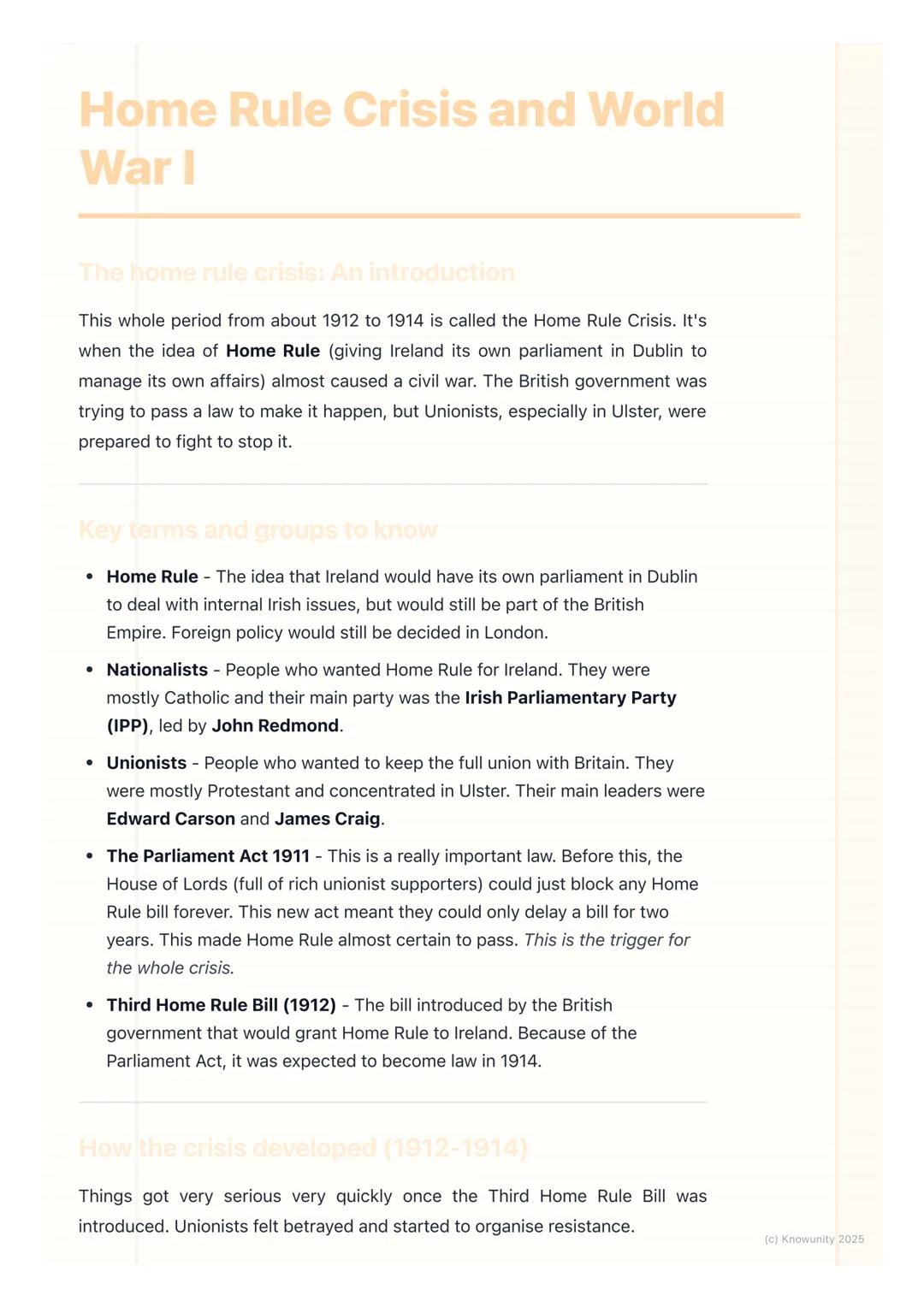
The Home Rule Crisis: An Introduction
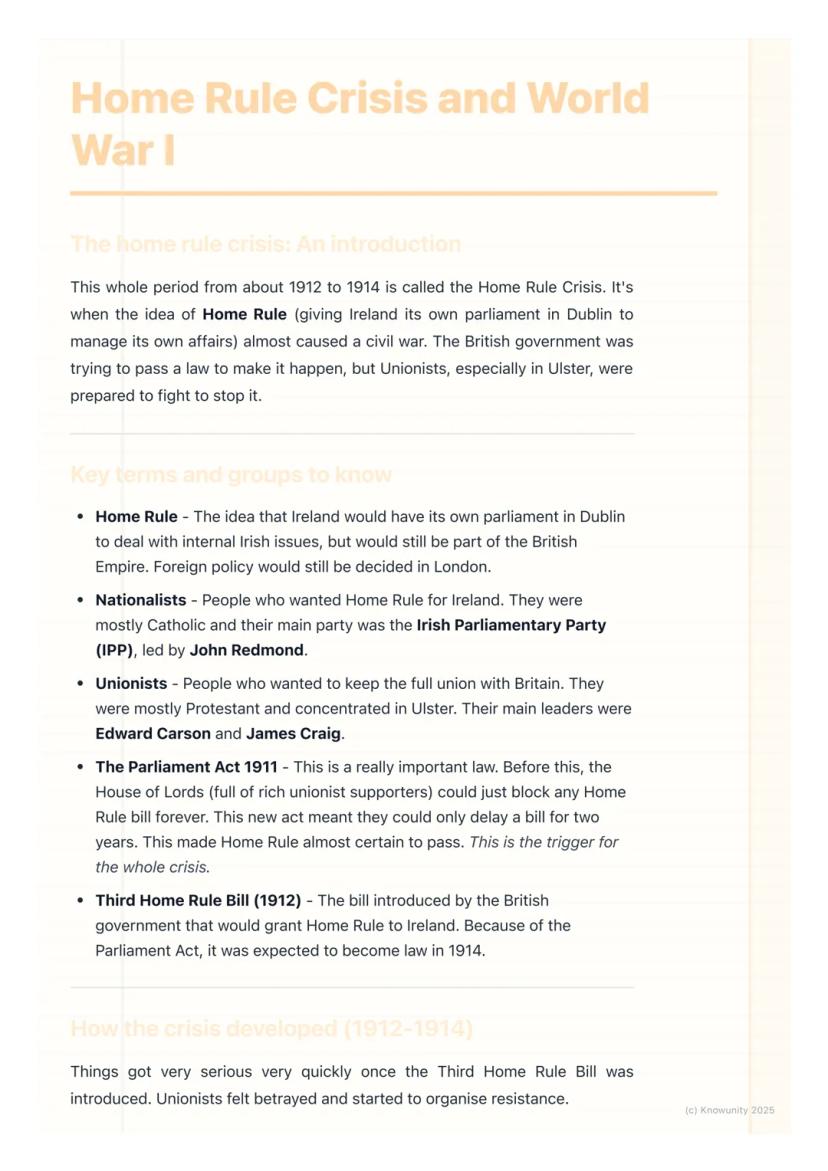
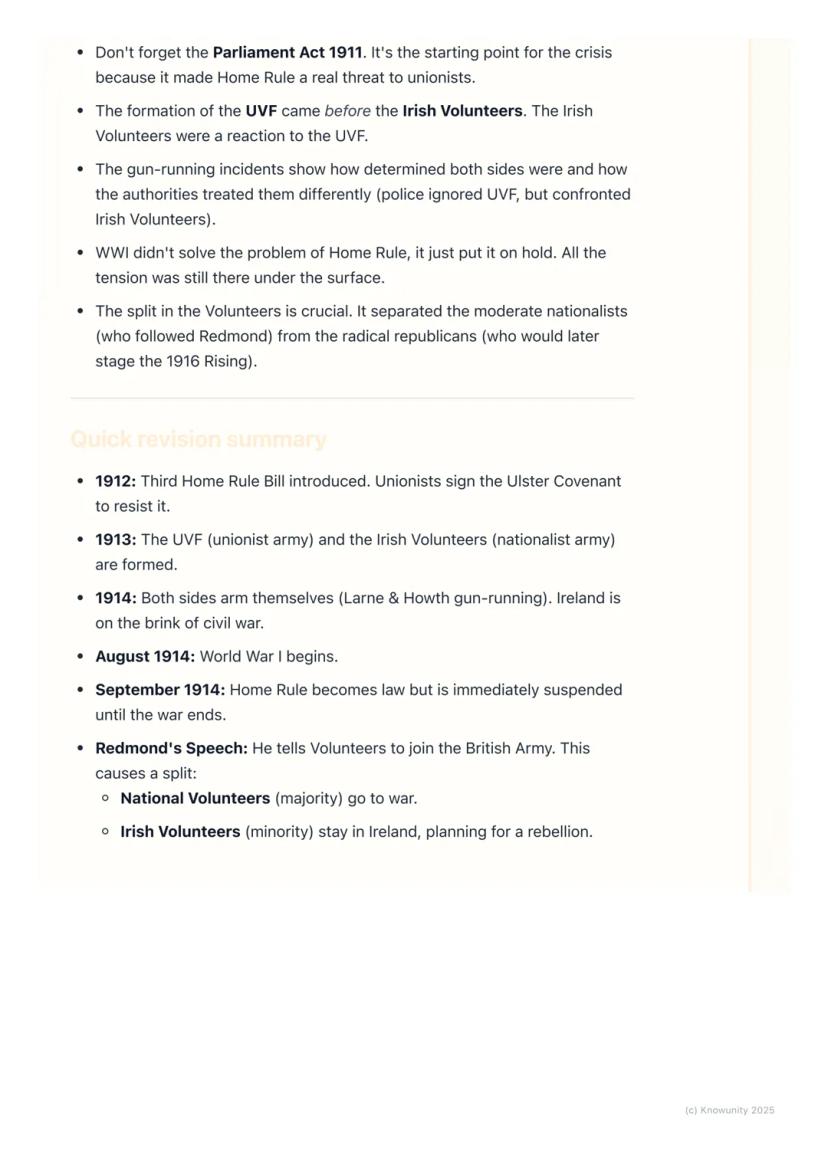
Think of this period as Ireland's "almost civil war" moment. Home Rule meant Ireland would get its own parliament in Dublin to handle local affairs, whilst still staying part of the British Empire. Sounds reasonable, right? Not if you were a Unionist who saw this as the first step towards breaking up the United Kingdom.
The Parliament Act of 1911 changed everything. Before this law, the House of Lords could block Home Rule bills forever. Now they could only delay them for two years. This made Home Rule almost inevitable, which terrified Unionists and triggered the entire crisis.
Two main groups faced off: Nationalists (mostly Catholics who wanted Home Rule, led by John Redmond's Irish Parliamentary Party) and Unionists (mostly Protestants who wanted to keep the full union with Britain, led by Edward Carson and James Craig).
Remember: The Parliament Act 1911 is your starting point for understanding why this crisis happened when it did.
2
of 5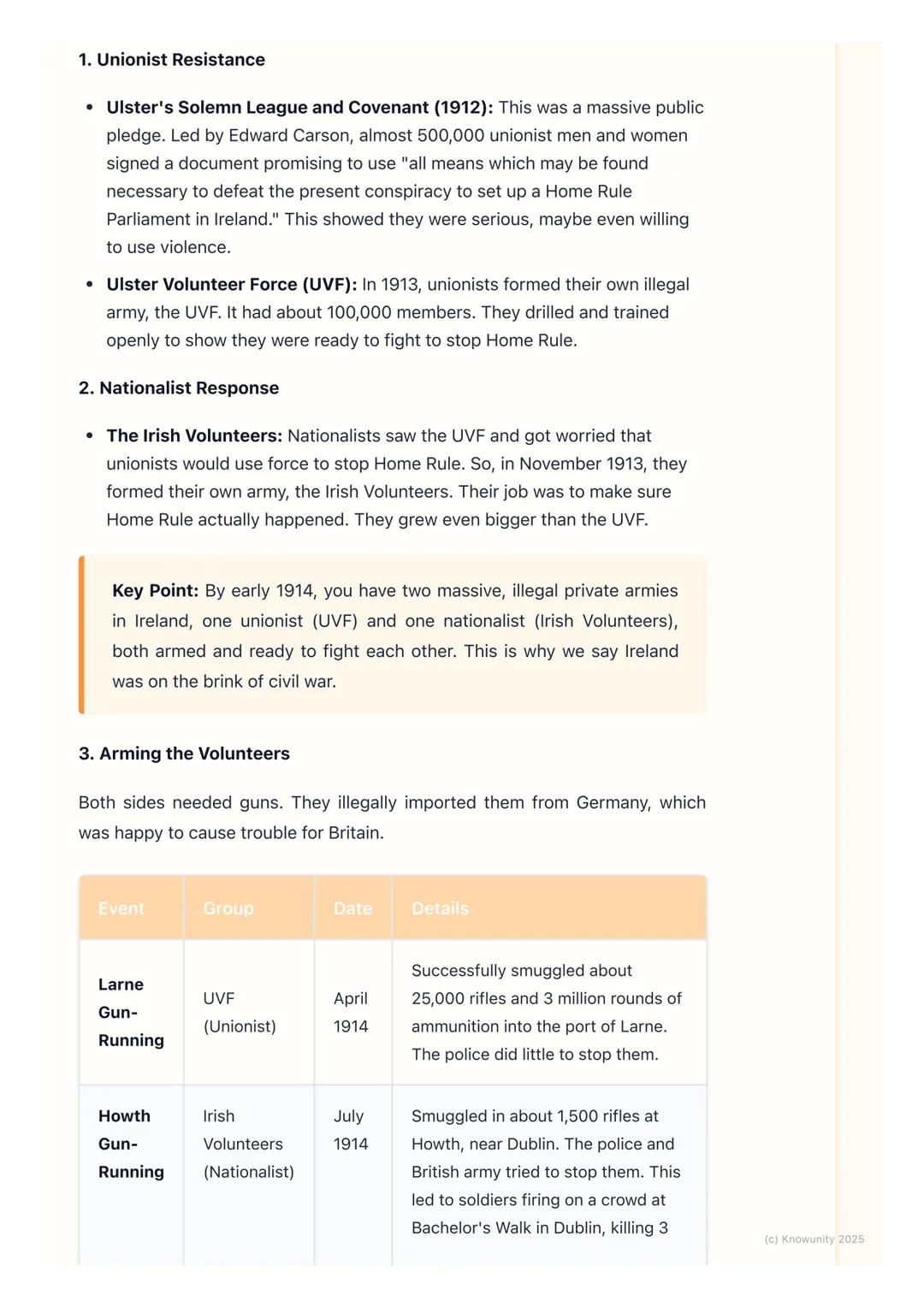
Unionist Resistance and Private Armies
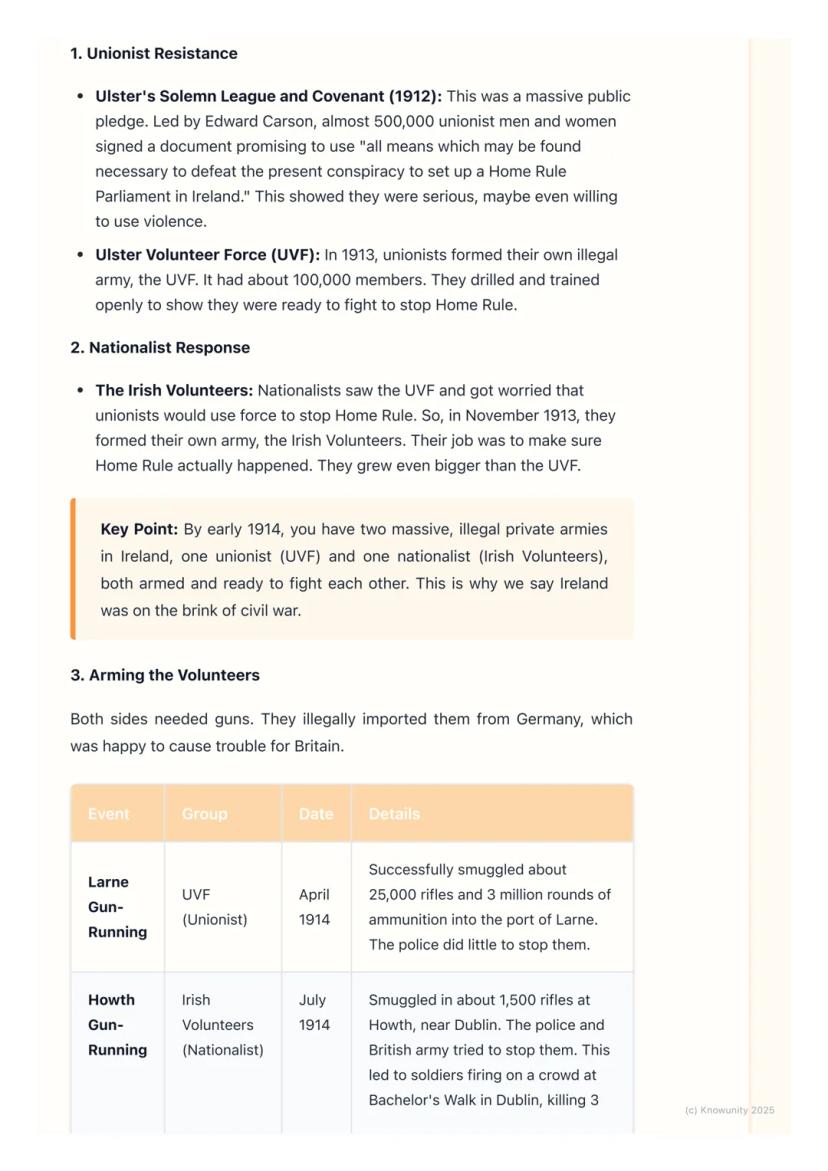
When the Third Home Rule Bill was introduced in 1912, Unionists didn't just complain - they organised massive resistance. The Ulster Solemn League and Covenant saw almost 500,000 people pledge to use "all means necessary" to defeat Home Rule. That's code for "we're willing to fight."
By 1913, they'd formed the Ulster Volunteer Force (UVF) - essentially a private army of 100,000 men who drilled openly and prepared for war. Nationalists couldn't ignore this threat, so they created their own force called the Irish Volunteers in November 1913. This group actually grew larger than the UVF.
Both sides needed weapons, so they illegally imported guns from Germany. The UVF successfully landed weapons at Larne in April 1914 with no police interference. When the Irish Volunteers tried the same at Howth in July 1914, British troops confronted them and later fired on Dublin crowds, killing three civilians.
Key Point: By early 1914, you had two massive illegal armies ready to fight each other - this is why people say Ireland was on the brink of civil war.
3
of 5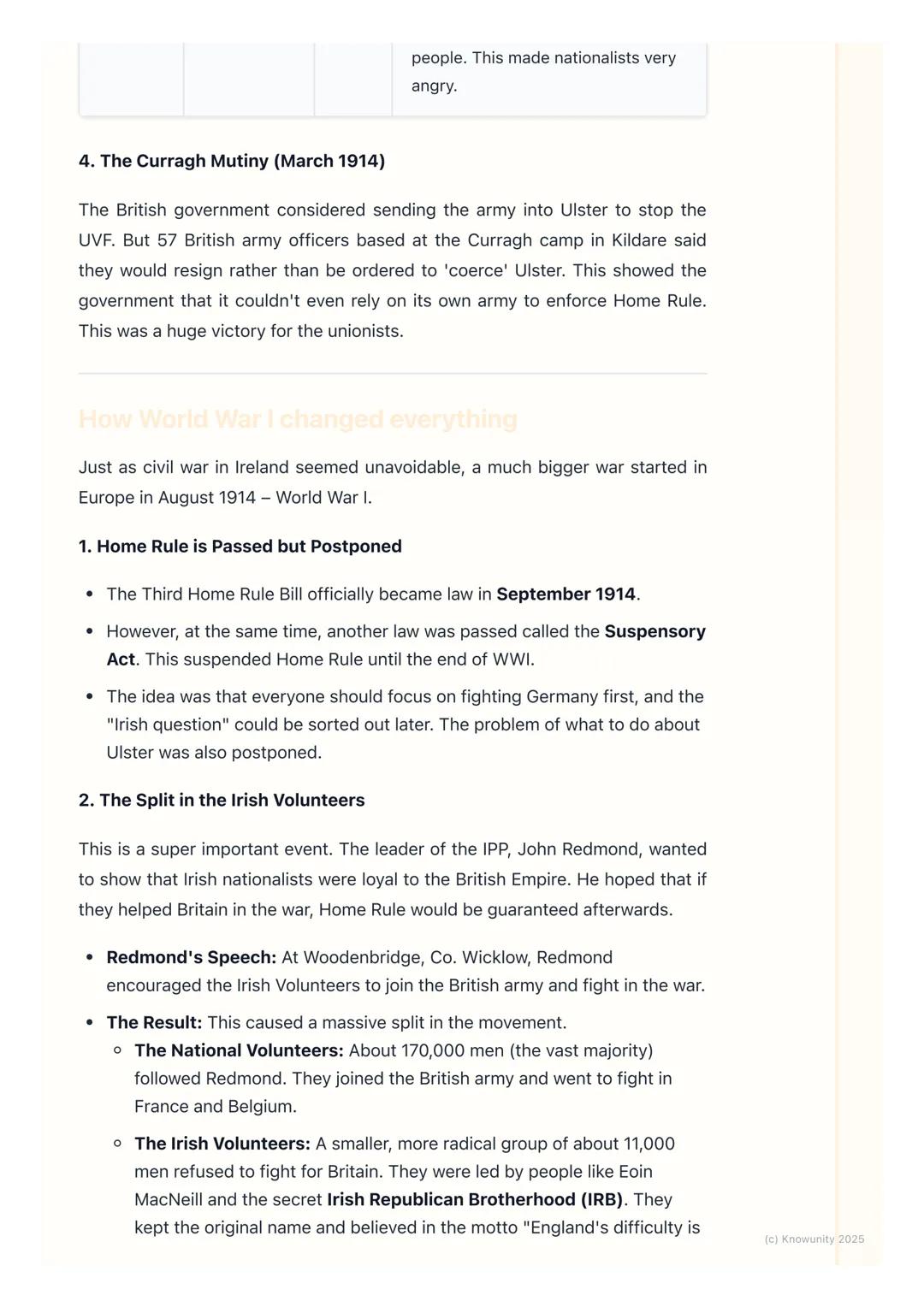
The Curragh Mutiny and World War I Changes Everything
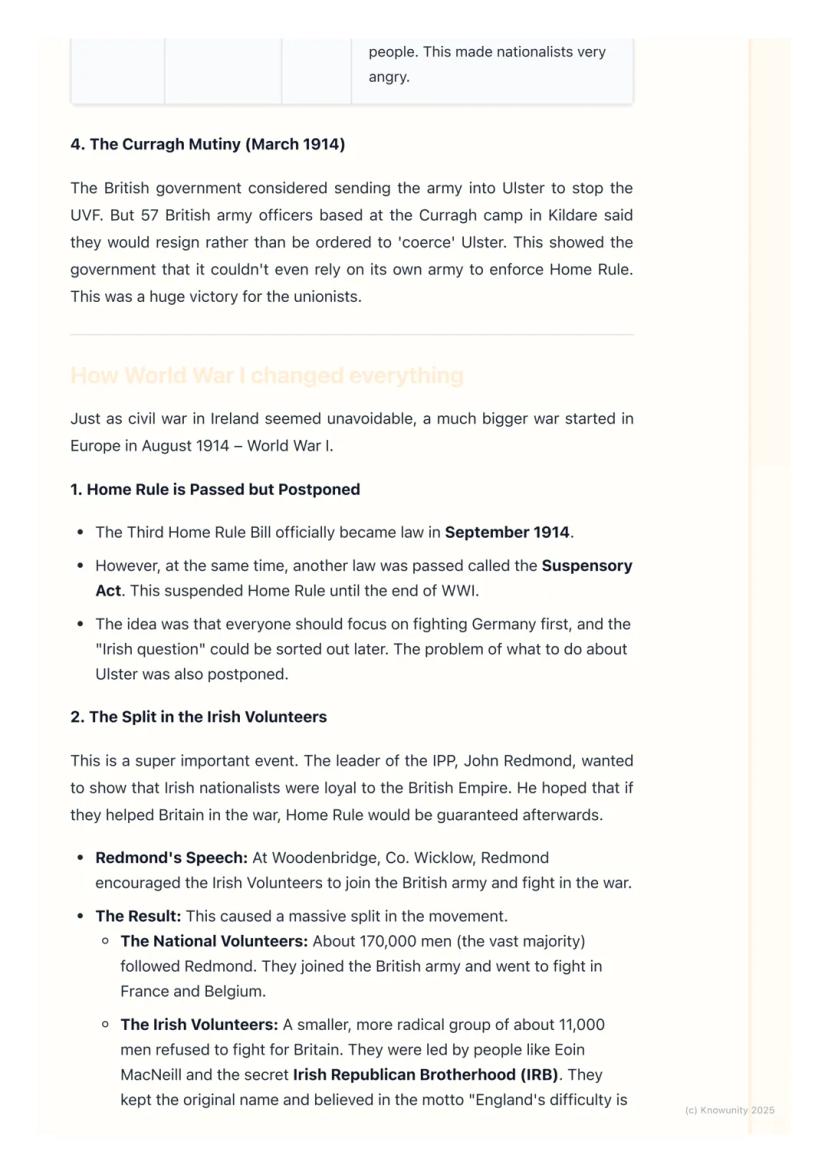
The Curragh Mutiny in March 1914 showed just how serious things had become. When the British government considered sending troops to Ulster to stop the UVF, 57 British army officers said they'd rather resign than fight Unionists. The government couldn't even trust its own army!
Then World War I erupted in August 1914, completely changing the game. The Third Home Rule Bill became law in September 1914, but the Suspensory Act immediately put it on hold until the war ended. Everyone was supposed to focus on fighting Germany first.
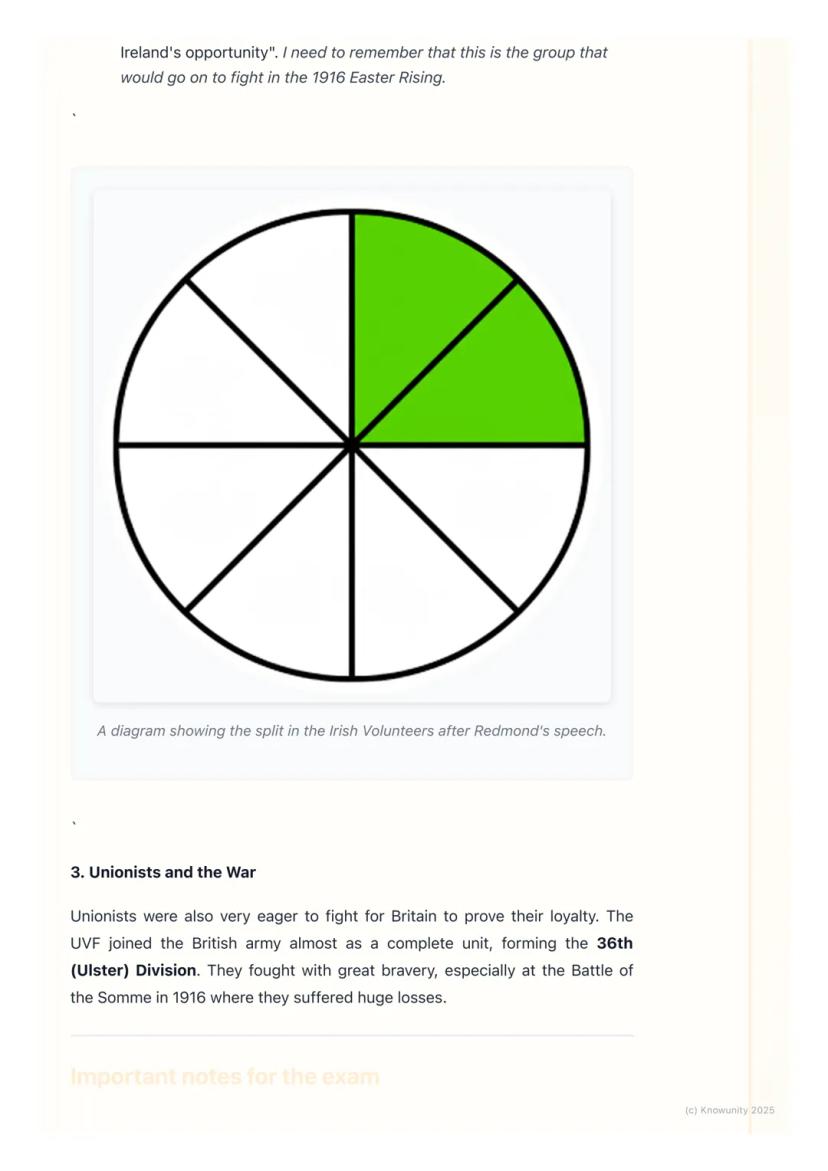
John Redmond's speech at Woodenbridge caused a massive split in Irish nationalism. He encouraged Irish Volunteers to join the British army, believing this loyalty would guarantee Home Rule after the war. About 170,000 men followed him, becoming the National Volunteers who went to fight in France and Belgium.
However, around 11,000 more radical members refused and kept the name Irish Volunteers. Led by people like Eoin MacNeill and the secret Irish Republican Brotherhood, they believed "England's difficulty is Ireland's opportunity."
Crucial Detail: This smaller group of Irish Volunteers would become the force that launched the 1916 Easter Rising.
4
of 5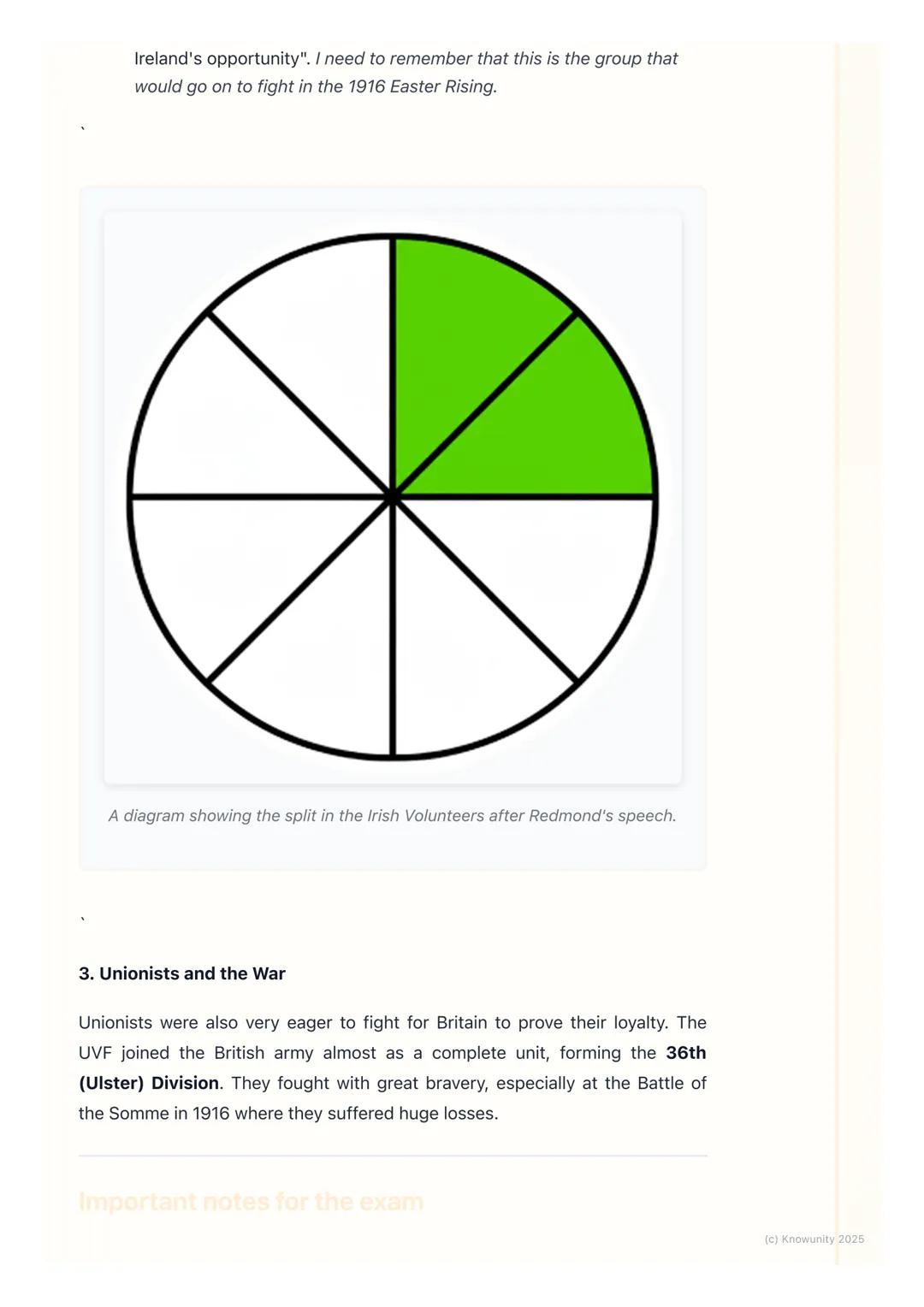
Unionists at War and Long-term Consequences
Unionists were equally eager to prove their loyalty to Britain. The UVF essentially became the 36th (Ulster) Division of the British Army. They fought with incredible bravery, especially at the Battle of the Somme in 1916, where they suffered devastating casualties whilst proving their British credentials.
World War I didn't solve Ireland's problems - it just pressed the pause button. All the tensions from the Home Rule Crisis remained bubbling under the surface. The partition question (what to do about Ulster) was still unresolved.
The split between moderate nationalists who supported the war effort and radical republicans who opposed it created the conditions for the 1916 Rising. Whilst most nationalist men were fighting in France, a small but determined group stayed behind, planning rebellion.
Exam Tip: Remember that WWI postponed Home Rule but didn't solve the underlying conflict - it actually made things more complicated by dividing Irish nationalism.
The crisis showed that both communities were willing to use violence to achieve their goals, setting a dangerous precedent for later conflicts in Irish history.
5
of 5
Pensávamos que não ias perguntar...
O que é o Companheiro de Aprendizagem com IA da Knowunity?
O nosso companheiro de aprendizagem com IA foi especificamente criado para as necessidades dos estudantes. Com base nos milhões de conteúdos que temos na plataforma, podemos fornecer respostas verdadeiramente significativas e relevantes para os estudantes. Mas não se trata apenas de respostas, o companheiro foca-se mais em guiar os estudantes através dos seus desafios diários de aprendizagem, com planos de estudo personalizados, quizzes ou conteúdos no chat e 100% de personalização baseada nas habilidades e desenvolvimentos do estudante.
Onde posso fazer o download da app Knowunity?
Pode descarregar a aplicação na Google Play Store e na Apple App Store.
Como posso receber o meu pagamento? Quanto posso ganhar?
Sim, tem acesso gratuito ao conteúdo da aplicação e ao nosso companheiro de IA. Para desbloquear determinadas funcionalidades da aplicação, pode adquirir o Knowunity Pro.
Conteúdos mais populares de History
9Conteúdos mais populares
9Não encontra o que procura? Explore outras disciplinas.
Avaliações dos nossos utilizadores. Eles adoraram tudo — e tu também vais adorar.
4.6/5App Store
4.7/5Google Play
A App é muito fácil de usar e está nem organizada. Encontrei tudo o que estava à procura até agora e consegui aprender muito com as apresentações! Vou usar a app para um trabalho escolar! E claro que também me ajuda muito como inspiração.
João Sutilizador iOS
Esta app é realmente incrível. Há tantas anotações de estudo e ajuda [...]. A minha disciplina problemática é Francês, por exemplo, e a app tem muitas opções de ajuda. Graças a esta app, melhorei o meu Francês. Eu recomendo a qualquer pessoa.
Sara C.utilizadora Android
Uau, estou realmente impressionado. Acabei de experimentar o app porque o vi anunciado muitas vezes e fiquei absolutamente surpreso. Este app é A AJUDA que você quer para a escola e, acima de tudo, oferece tantas coisas, como exercícios e folhas de fatos, que têm sido MUITO úteis para mim pessoalmente.
Anautilizadora iOS
History11 visualizações·Atualizado May 28, 2026·5 páginasImpact of Home Rule Crisis and WWI on Ireland
Ever wondered how Ireland nearly exploded into civil war just before World War I? The Home Rule Crisis from 1912-1914 was when Britain tried to give Ireland its own parliament, but Unionists in Ulster were prepared to fight to stop...
1
of 5
Cadastre-se para ver o conteúdo. É grátis!
- Acesso a todos os documentos
- Melhore suas notas
- Junte-se a milhões de estudantes
The Home Rule Crisis: An Introduction
Think of this period as Ireland's "almost civil war" moment. Home Rule meant Ireland would get its own parliament in Dublin to handle local affairs, whilst still staying part of the British Empire. Sounds reasonable, right? Not if you were a Unionist who saw this as the first step towards breaking up the United Kingdom.
The Parliament Act of 1911 changed everything. Before this law, the House of Lords could block Home Rule bills forever. Now they could only delay them for two years. This made Home Rule almost inevitable, which terrified Unionists and triggered the entire crisis.
Two main groups faced off: Nationalists (mostly Catholics who wanted Home Rule, led by John Redmond's Irish Parliamentary Party) and Unionists (mostly Protestants who wanted to keep the full union with Britain, led by Edward Carson and James Craig).
Remember: The Parliament Act 1911 is your starting point for understanding why this crisis happened when it did.
2
of 5Cadastre-se para ver o conteúdo. É grátis!
- Acesso a todos os documentos
- Melhore suas notas
- Junte-se a milhões de estudantes
Unionist Resistance and Private Armies
When the Third Home Rule Bill was introduced in 1912, Unionists didn't just complain - they organised massive resistance. The Ulster Solemn League and Covenant saw almost 500,000 people pledge to use "all means necessary" to defeat Home Rule. That's code for "we're willing to fight."
By 1913, they'd formed the Ulster Volunteer Force (UVF) - essentially a private army of 100,000 men who drilled openly and prepared for war. Nationalists couldn't ignore this threat, so they created their own force called the Irish Volunteers in November 1913. This group actually grew larger than the UVF.
Both sides needed weapons, so they illegally imported guns from Germany. The UVF successfully landed weapons at Larne in April 1914 with no police interference. When the Irish Volunteers tried the same at Howth in July 1914, British troops confronted them and later fired on Dublin crowds, killing three civilians.
Key Point: By early 1914, you had two massive illegal armies ready to fight each other - this is why people say Ireland was on the brink of civil war.
3
of 5Cadastre-se para ver o conteúdo. É grátis!
- Acesso a todos os documentos
- Melhore suas notas
- Junte-se a milhões de estudantes
The Curragh Mutiny and World War I Changes Everything
The Curragh Mutiny in March 1914 showed just how serious things had become. When the British government considered sending troops to Ulster to stop the UVF, 57 British army officers said they'd rather resign than fight Unionists. The government couldn't even trust its own army!
Then World War I erupted in August 1914, completely changing the game. The Third Home Rule Bill became law in September 1914, but the Suspensory Act immediately put it on hold until the war ended. Everyone was supposed to focus on fighting Germany first.
John Redmond's speech at Woodenbridge caused a massive split in Irish nationalism. He encouraged Irish Volunteers to join the British army, believing this loyalty would guarantee Home Rule after the war. About 170,000 men followed him, becoming the National Volunteers who went to fight in France and Belgium.
However, around 11,000 more radical members refused and kept the name Irish Volunteers. Led by people like Eoin MacNeill and the secret Irish Republican Brotherhood, they believed "England's difficulty is Ireland's opportunity."
Crucial Detail: This smaller group of Irish Volunteers would become the force that launched the 1916 Easter Rising.
4
of 5Cadastre-se para ver o conteúdo. É grátis!
- Acesso a todos os documentos
- Melhore suas notas
- Junte-se a milhões de estudantes
Unionists at War and Long-term Consequences
Unionists were equally eager to prove their loyalty to Britain. The UVF essentially became the 36th (Ulster) Division of the British Army. They fought with incredible bravery, especially at the Battle of the Somme in 1916, where they suffered devastating casualties whilst proving their British credentials.
World War I didn't solve Ireland's problems - it just pressed the pause button. All the tensions from the Home Rule Crisis remained bubbling under the surface. The partition question (what to do about Ulster) was still unresolved.
The split between moderate nationalists who supported the war effort and radical republicans who opposed it created the conditions for the 1916 Rising. Whilst most nationalist men were fighting in France, a small but determined group stayed behind, planning rebellion.
Exam Tip: Remember that WWI postponed Home Rule but didn't solve the underlying conflict - it actually made things more complicated by dividing Irish nationalism.
The crisis showed that both communities were willing to use violence to achieve their goals, setting a dangerous precedent for later conflicts in Irish history.
5
of 5Cadastre-se para ver o conteúdo. É grátis!
- Acesso a todos os documentos
- Melhore suas notas
- Junte-se a milhões de estudantes
Pensávamos que não ias perguntar...
O que é o Companheiro de Aprendizagem com IA da Knowunity?
O nosso companheiro de aprendizagem com IA foi especificamente criado para as necessidades dos estudantes. Com base nos milhões de conteúdos que temos na plataforma, podemos fornecer respostas verdadeiramente significativas e relevantes para os estudantes. Mas não se trata apenas de respostas, o companheiro foca-se mais em guiar os estudantes através dos seus desafios diários de aprendizagem, com planos de estudo personalizados, quizzes ou conteúdos no chat e 100% de personalização baseada nas habilidades e desenvolvimentos do estudante.
Onde posso fazer o download da app Knowunity?
Pode descarregar a aplicação na Google Play Store e na Apple App Store.
Como posso receber o meu pagamento? Quanto posso ganhar?
Sim, tem acesso gratuito ao conteúdo da aplicação e ao nosso companheiro de IA. Para desbloquear determinadas funcionalidades da aplicação, pode adquirir o Knowunity Pro.
Conteúdos mais populares de History
9Conteúdos mais populares
9Não encontra o que procura? Explore outras disciplinas.
Avaliações dos nossos utilizadores. Eles adoraram tudo — e tu também vais adorar.
4.6/5App Store
4.7/5Google Play
A App é muito fácil de usar e está nem organizada. Encontrei tudo o que estava à procura até agora e consegui aprender muito com as apresentações! Vou usar a app para um trabalho escolar! E claro que também me ajuda muito como inspiração.
João Sutilizador iOS
Esta app é realmente incrível. Há tantas anotações de estudo e ajuda [...]. A minha disciplina problemática é Francês, por exemplo, e a app tem muitas opções de ajuda. Graças a esta app, melhorei o meu Francês. Eu recomendo a qualquer pessoa.
Sara C.utilizadora Android
Uau, estou realmente impressionado. Acabei de experimentar o app porque o vi anunciado muitas vezes e fiquei absolutamente surpreso. Este app é A AJUDA que você quer para a escola e, acima de tudo, oferece tantas coisas, como exercícios e folhas de fatos, que têm sido MUITO úteis para mim pessoalmente.
Anautilizadora iOS