
Ever wondered why it's always raining in Cork but sunny... Mostrar mais
 Geography2 visualizações·Atualizado Jun 7, 2026·10 páginas
Understanding Earth's Atmosphere and Weather
1 / 10
1
of 10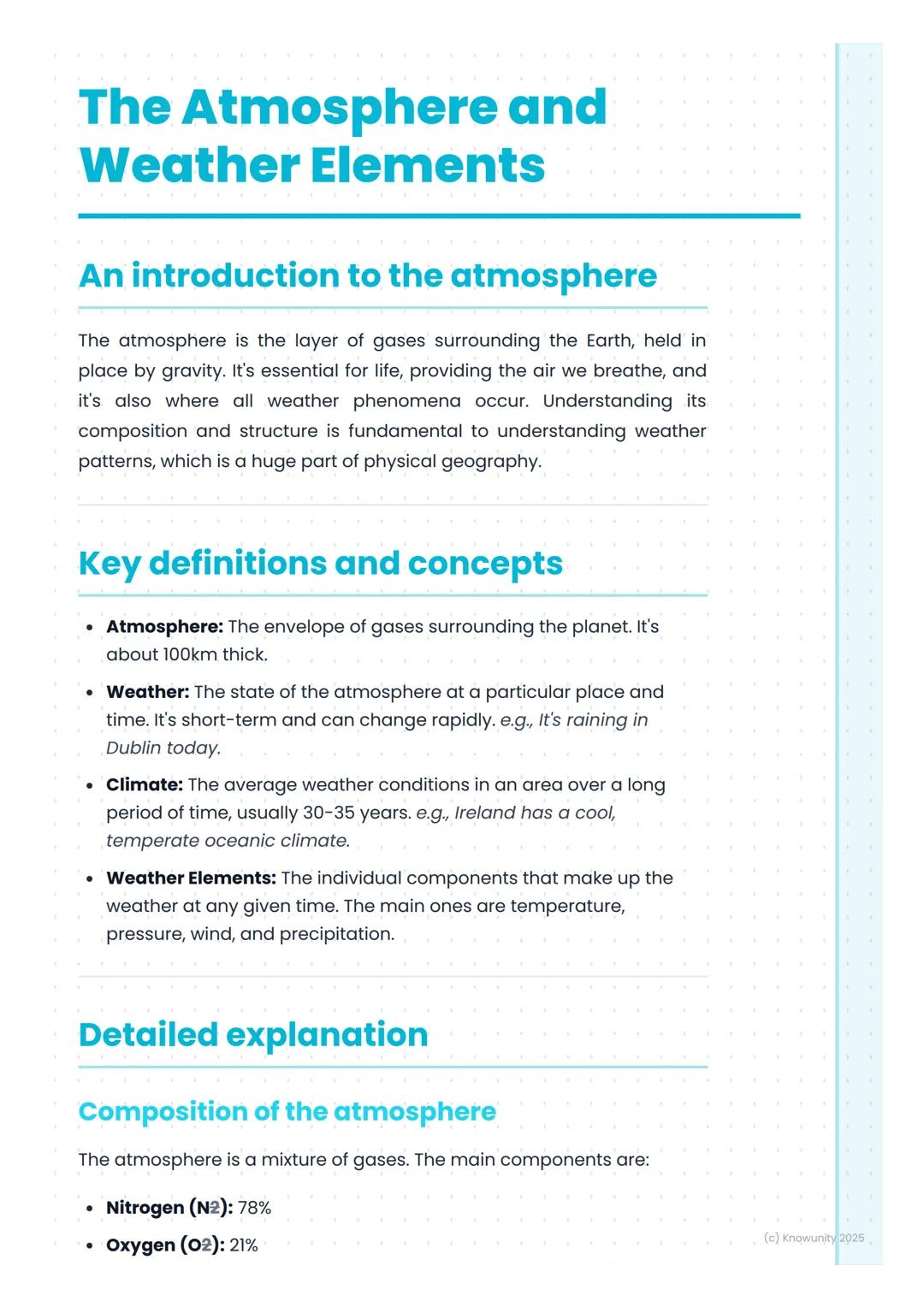
The Atmosphere Basics
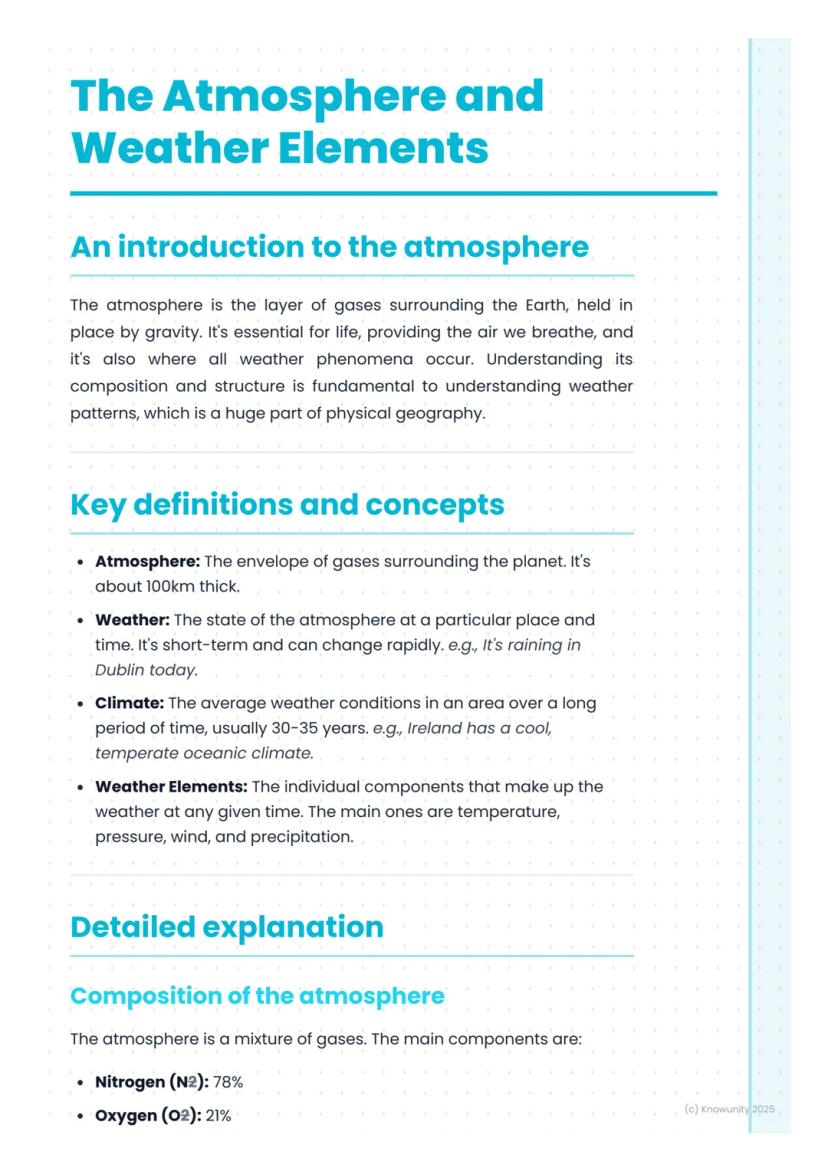
The atmosphere is essentially a 100km-thick layer of gases that keeps us alive and creates all our weather. Think of it as Earth's protective bubble that's constantly moving and changing.
Here's what you're breathing: 78% nitrogen, 21% oxygen, and just 1% of other gases including water vapour. That tiny bit of water vapour might seem insignificant, but it's responsible for every cloud, raindrop, and snowflake you've ever seen.
Weather is what's happening right now - like today's downpour in Dublin. Climate is the long-term average over 30+ years - like Ireland's famously wet reputation. Don't mix these up in your exams!
Quick Tip: Weather elements (temperature, pressure, wind, precipitation) are the building blocks of every weather forecast you check.
2
of 10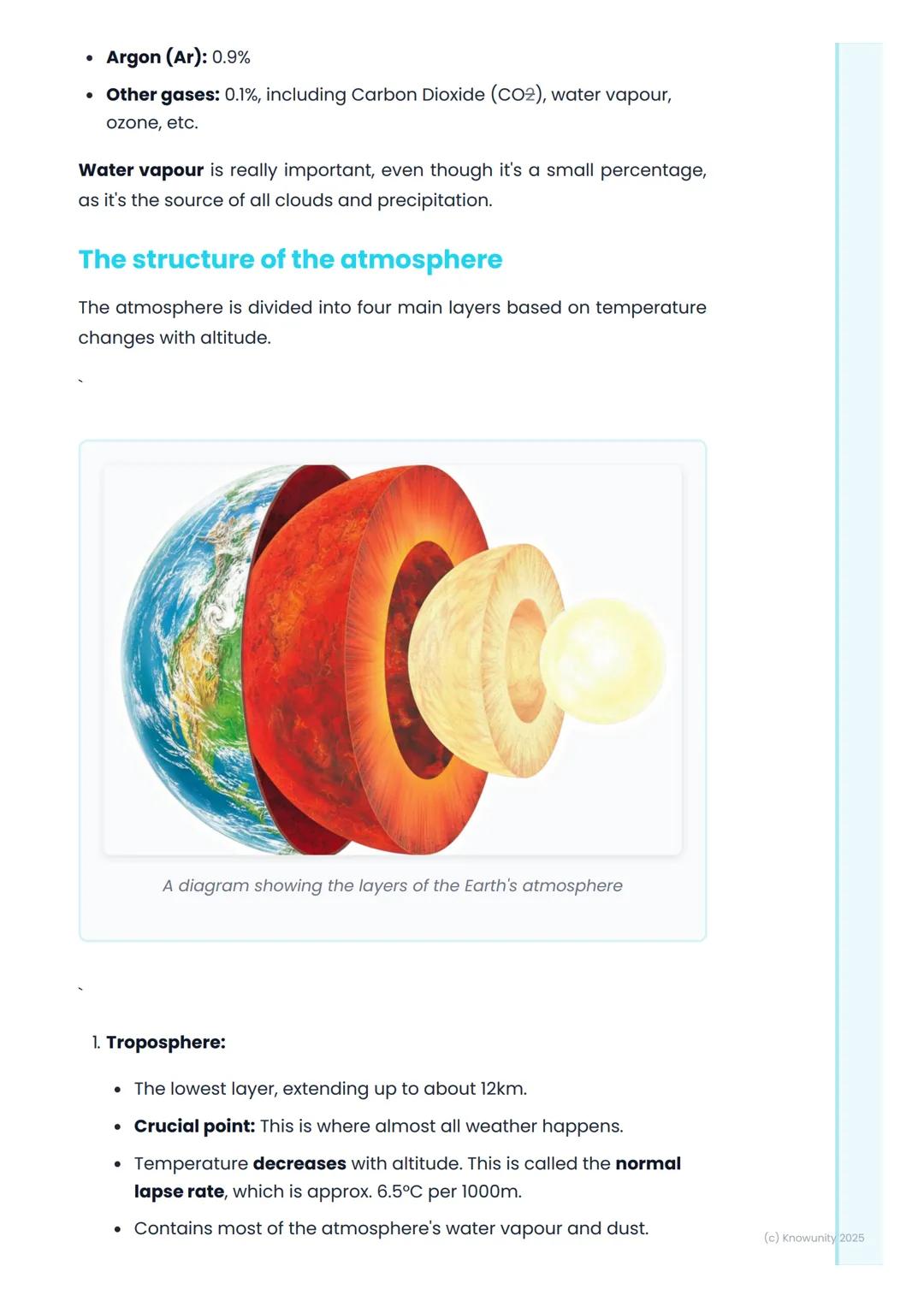
Atmospheric Layers
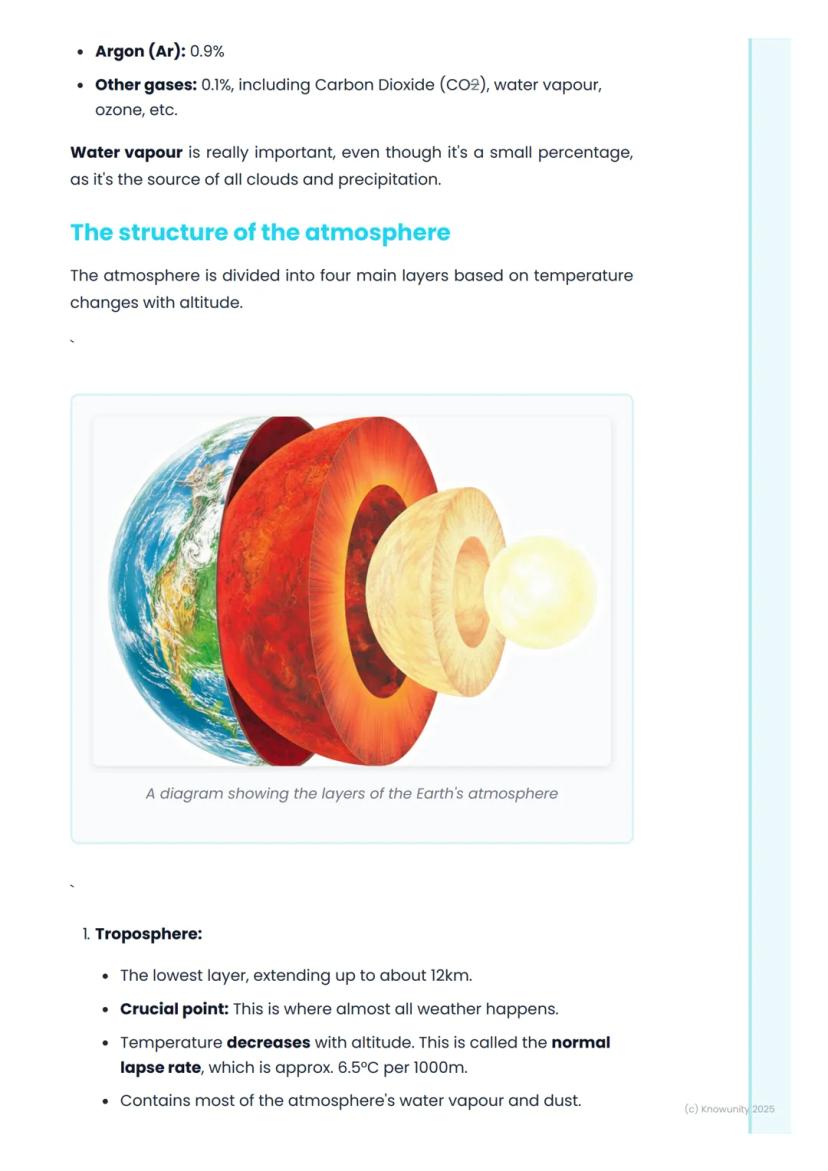
The atmosphere has four main layers, but you really need to know the first two. Here's a handy memory trick: The Sun Makes Things hot (Troposphere, Stratosphere, Mesosphere, Thermosphere).
The troposphere is where all the action happens - it's only 12km thick but contains virtually all our weather. Temperature drops as you go higher (about 6.5°C per 1000m), which explains why Carrauntoohil is always colder than sea level.
The stratosphere sits above it, containing the crucial ozone layer that blocks harmful UV rays. Unlike the troposphere, temperature actually increases with height here because ozone absorbs solar radiation.
Exam Focus: The troposphere is your priority - almost every weather question relates to this bottom layer.
3
of 10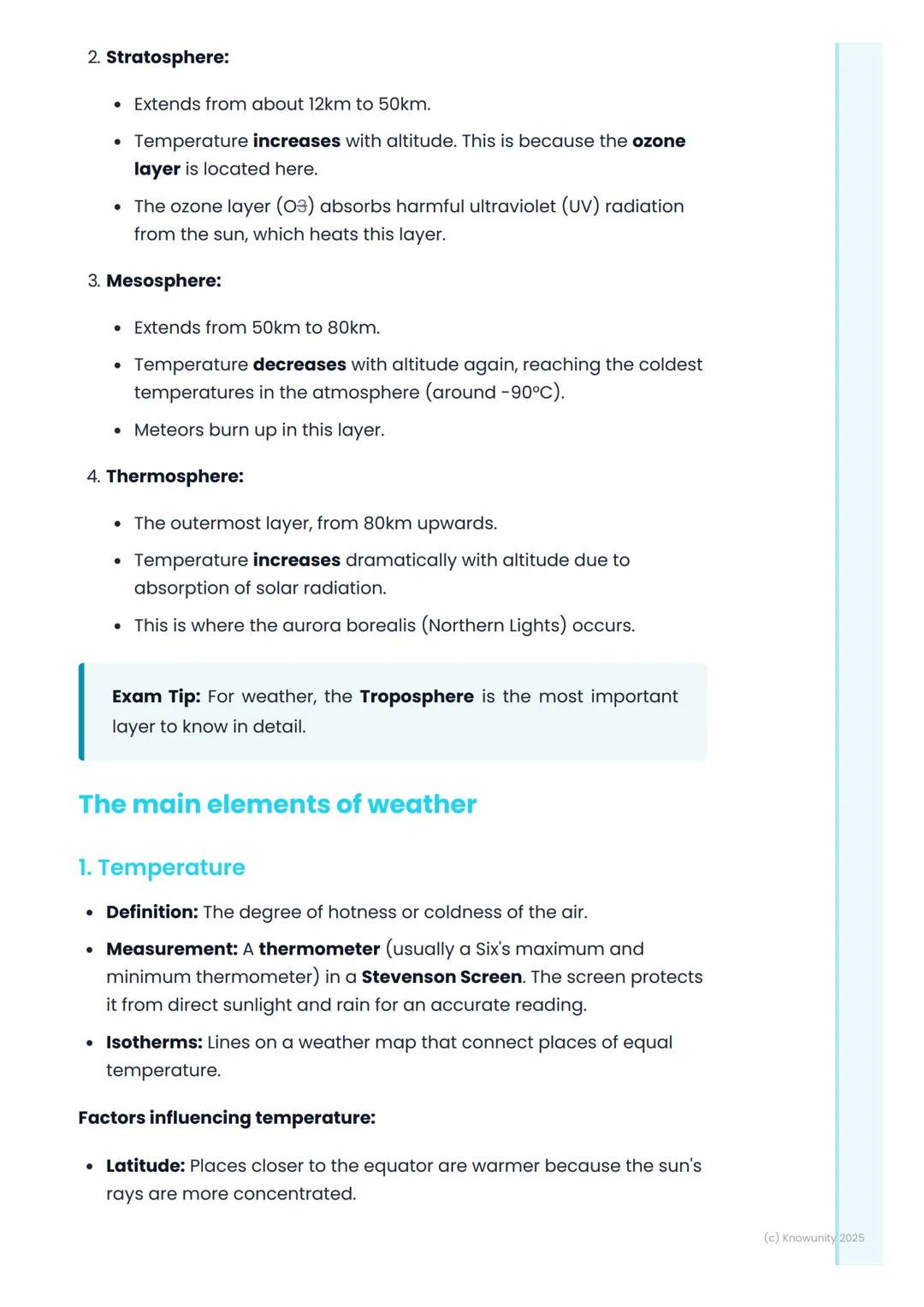
Temperature and Pressure
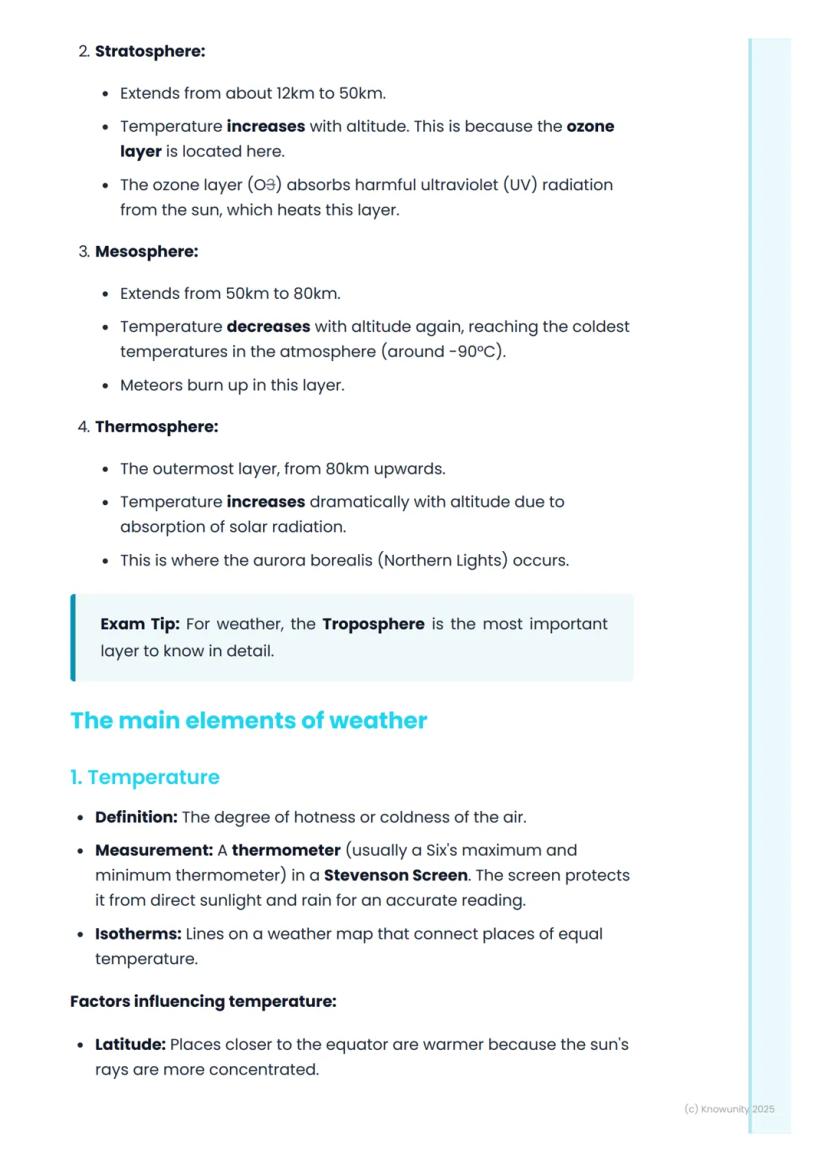
Temperature is measured using thermometers in Stevenson Screens (those white boxes you see at weather stations). Four main factors affect temperature: how close you are to the equator, your height above sea level, distance from the sea, and which way slopes face.
Ireland's coast stays milder year-round thanks to the sea's slow heating and cooling - that's why Galway has cooler summers but warmer winters than inland Athlone.
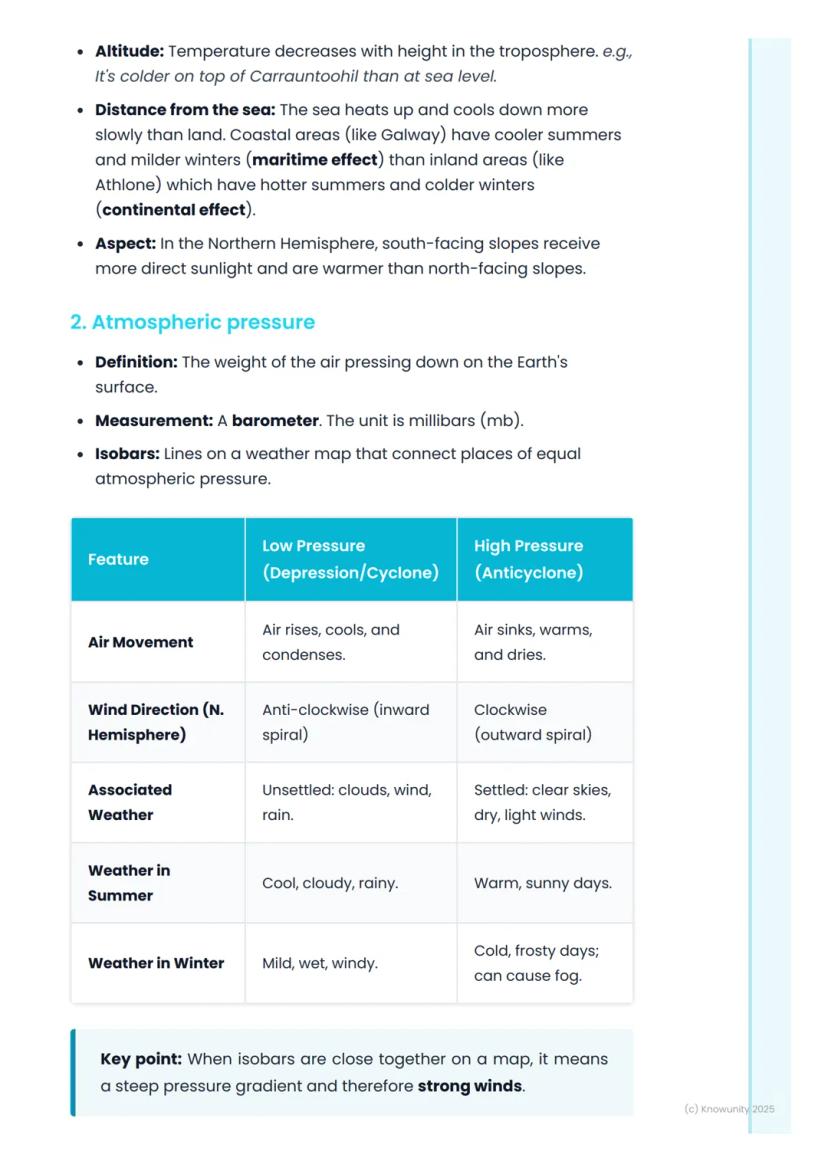
Atmospheric pressure is the weight of air pressing down on you, measured in millibars. Low pressure (depressions) means air is rising, cooling, and forming clouds - hello, rainy day! High pressure (anticyclones) means air is sinking and warming - cue the sunny weather.
Map Reading: When isobars (pressure lines) are squashed together, expect strong winds. Spread apart means light winds.
4
of 10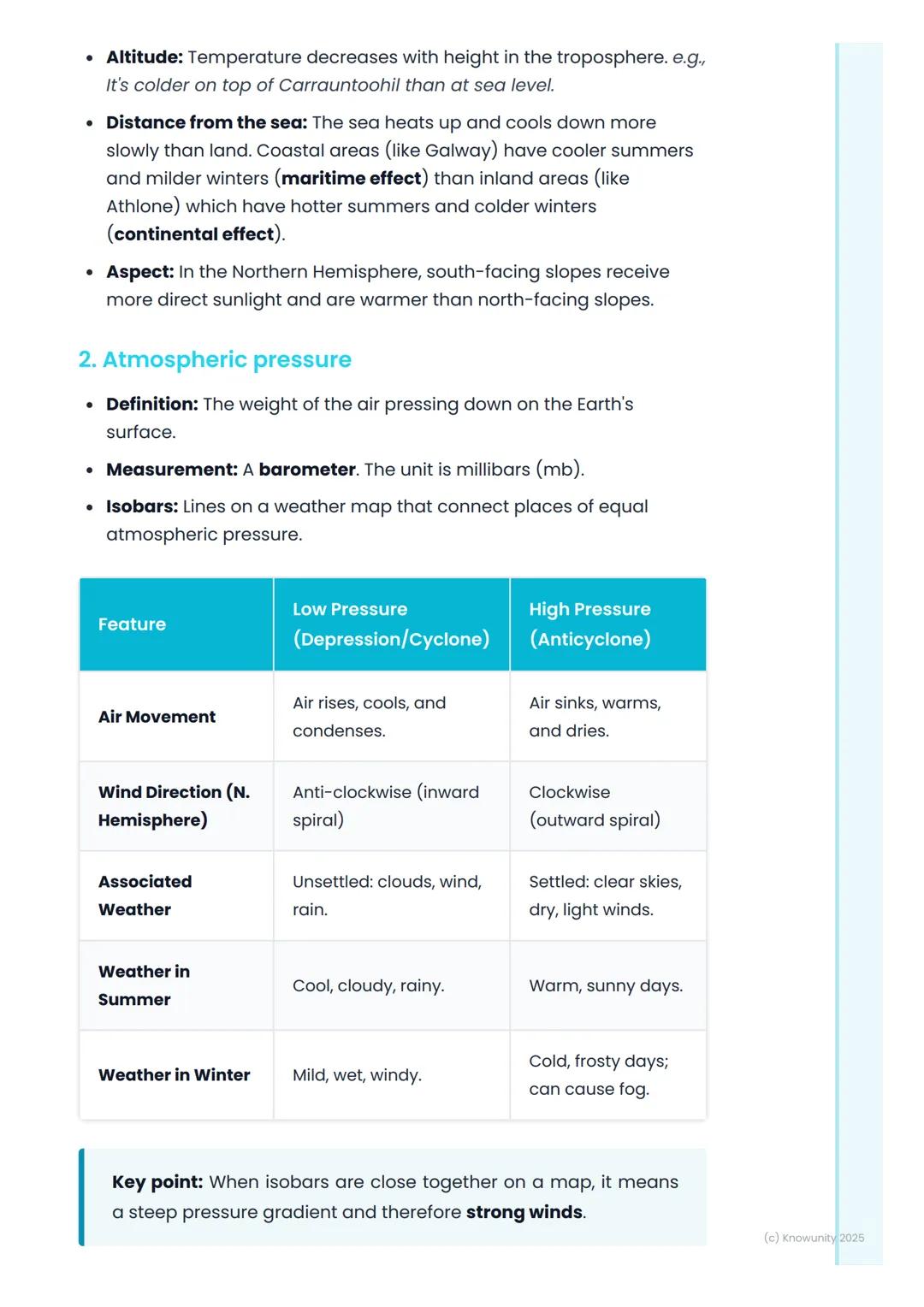
Wind and Weather Patterns
Wind is simply air rushing from high pressure to low pressure areas. In Ireland, our prevailing winds are South-Westerlies - they bring all that Atlantic moisture that keeps our grass so green!
Due to Earth's rotation, winds curve to the right in the Northern Hemisphere (called the Coriolis effect). This is why low-pressure systems spin anti-clockwise and high-pressure systems spin clockwise.
When you see a weather map, look for the 'L' and 'H' symbols. An 'L' means expect clouds, wind, and rain. An 'H' means settled, clear conditions - though in winter, this can bring frost and fog.
Wind Direction: Remember, winds are named from where they're coming from, not where they're going!
5
of 10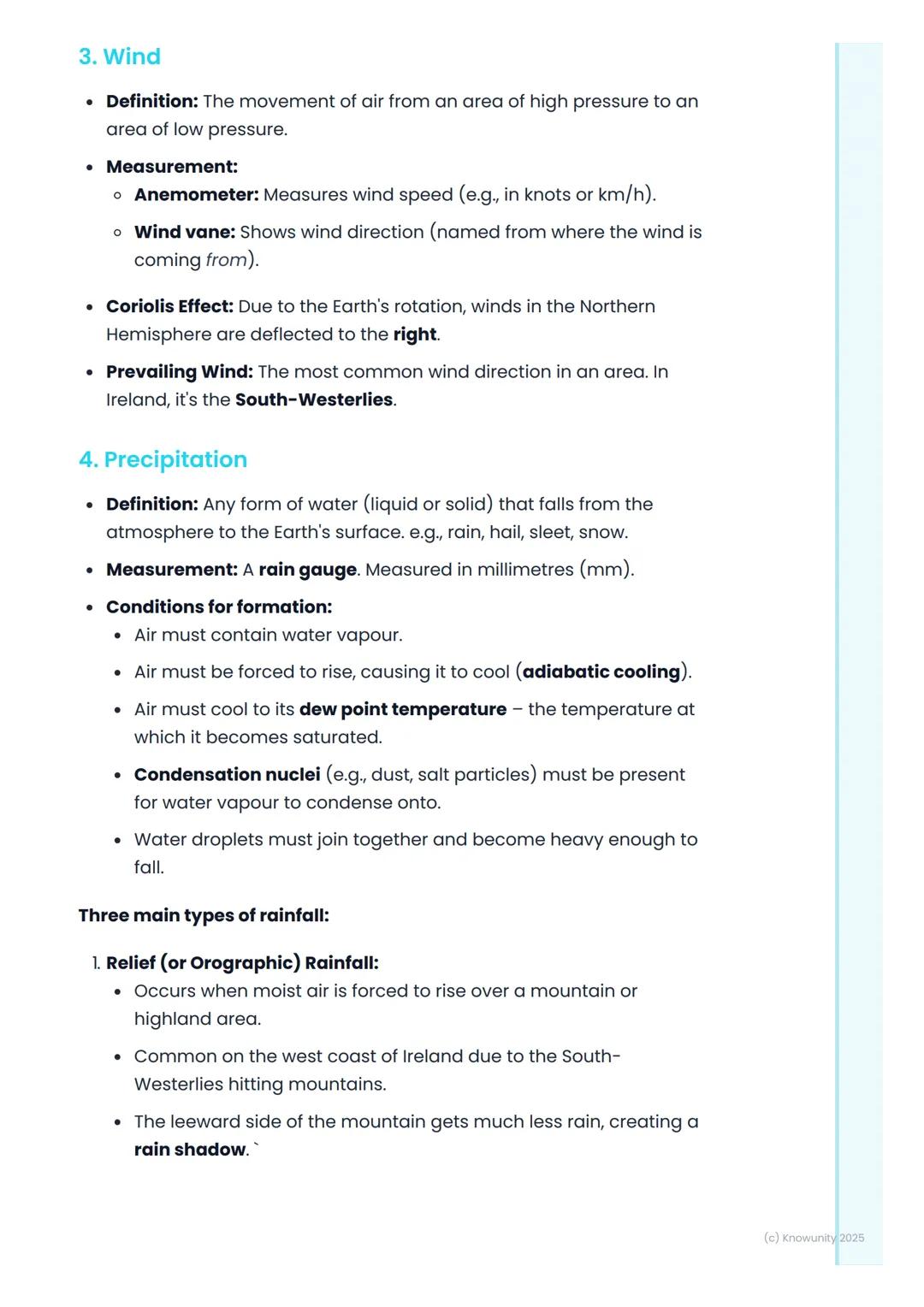
Rainfall Types
For precipitation to form, you need moist air that's forced to rise and cool to its dew point (saturation temperature). There are three main types you'll encounter in Ireland.
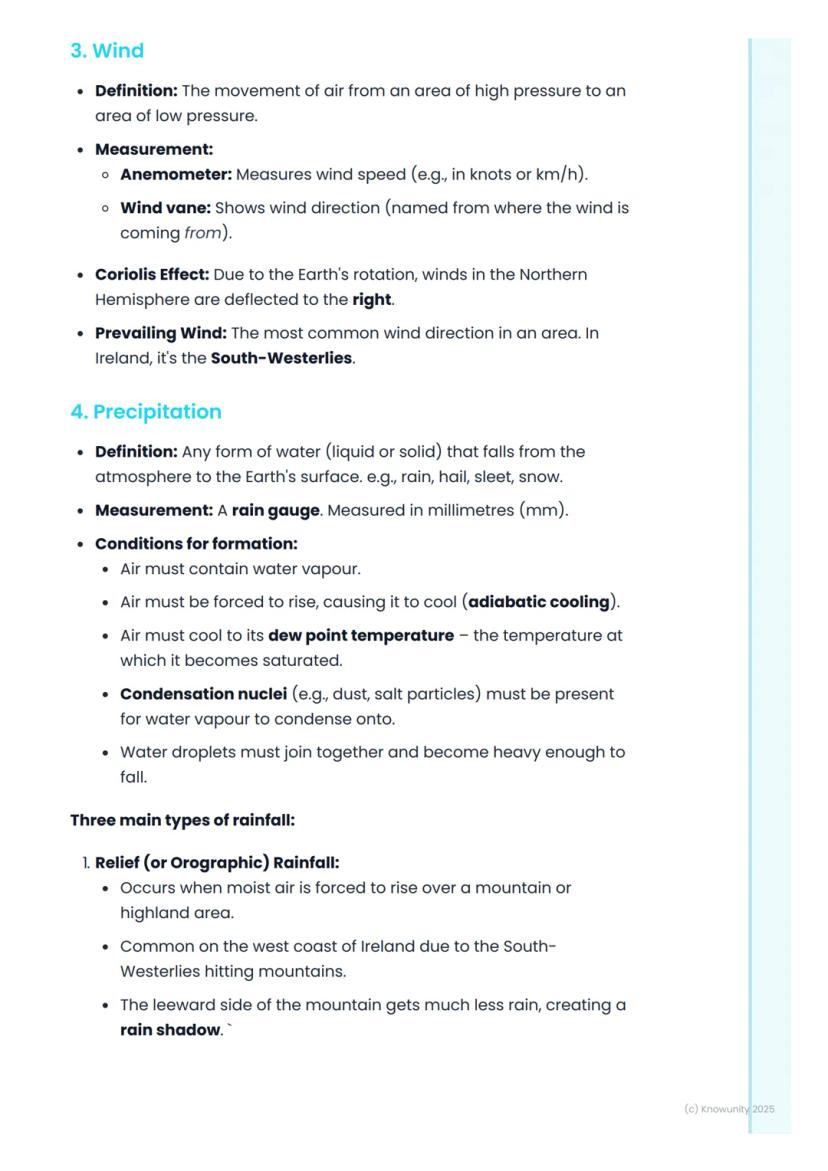
Relief rainfall happens when our South-Westerly winds hit western mountains like the MacGillycuddy's Reeks. The air is forced upwards, cools, and dumps heavy rain on the western slopes. This creates a rain shadow effect - which is why Dublin gets less than 750mm of rain yearly while Valentia Island gets over 1400mm.
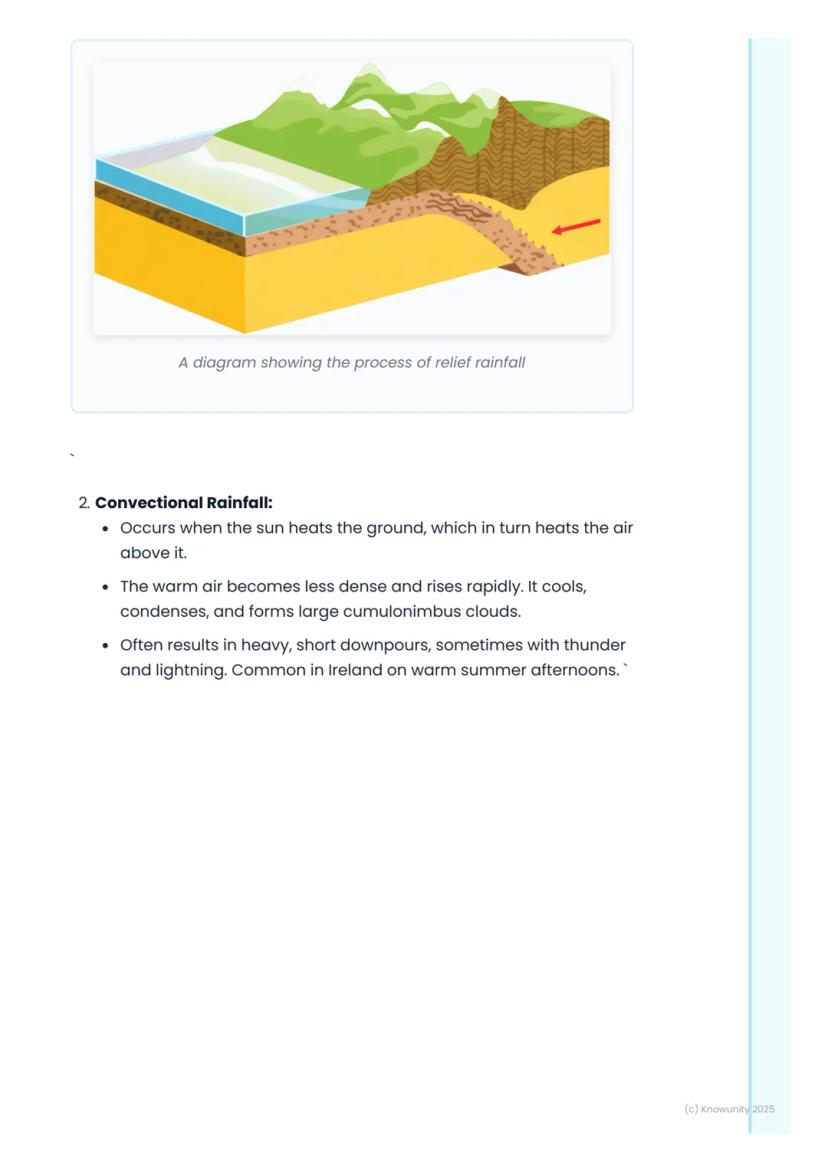
Convectional rainfall occurs on hot summer afternoons when heated ground causes air to rise rapidly, forming towering cumulonimbus clouds. These create those sudden heavy downpours with thunder and lightning.
Ireland's Reality: Most of our rain is frontal rainfall from Atlantic depressions - those weather systems that seem to queue up to soak us!
6
of 10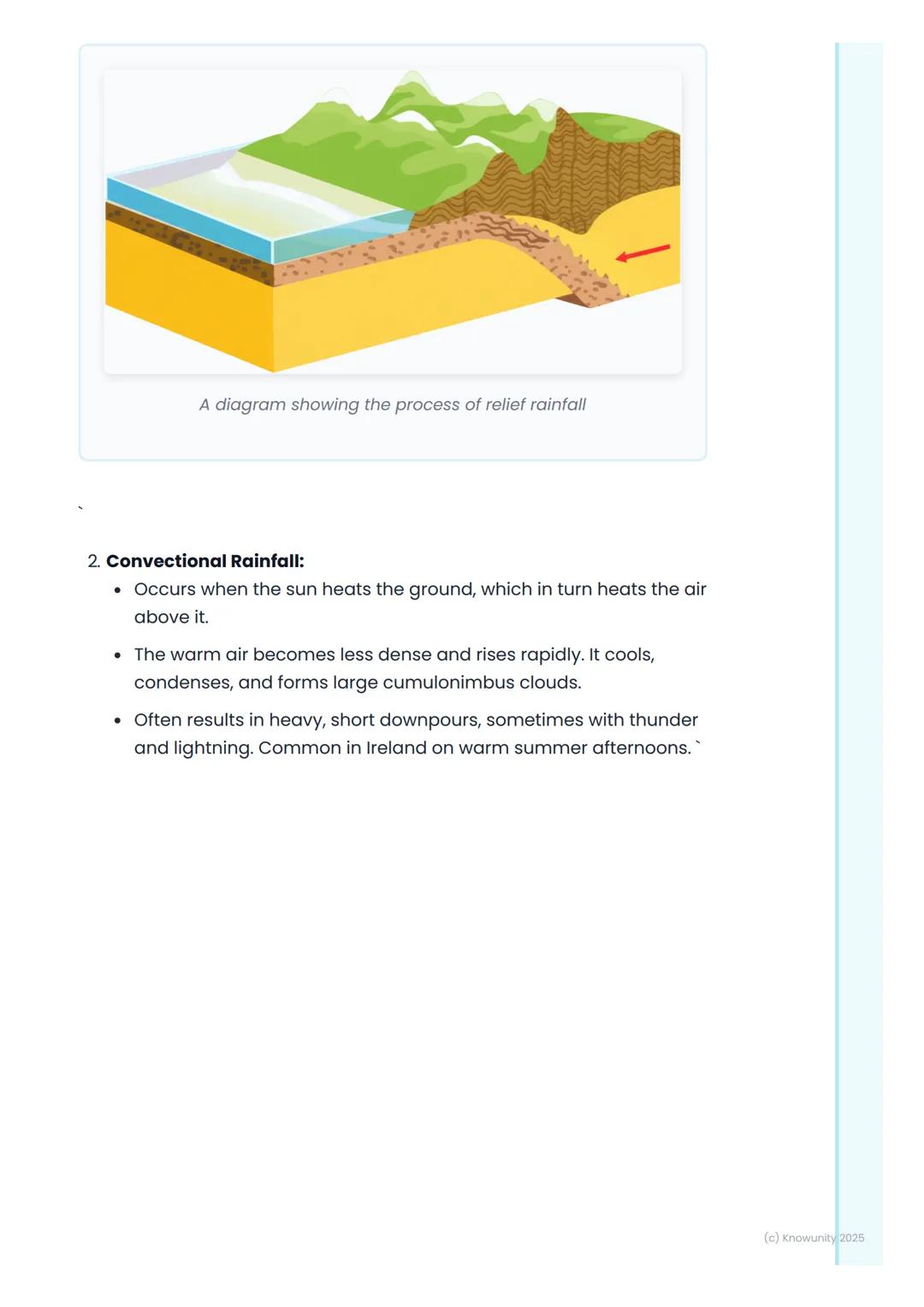
Frontal Systems and Depressions
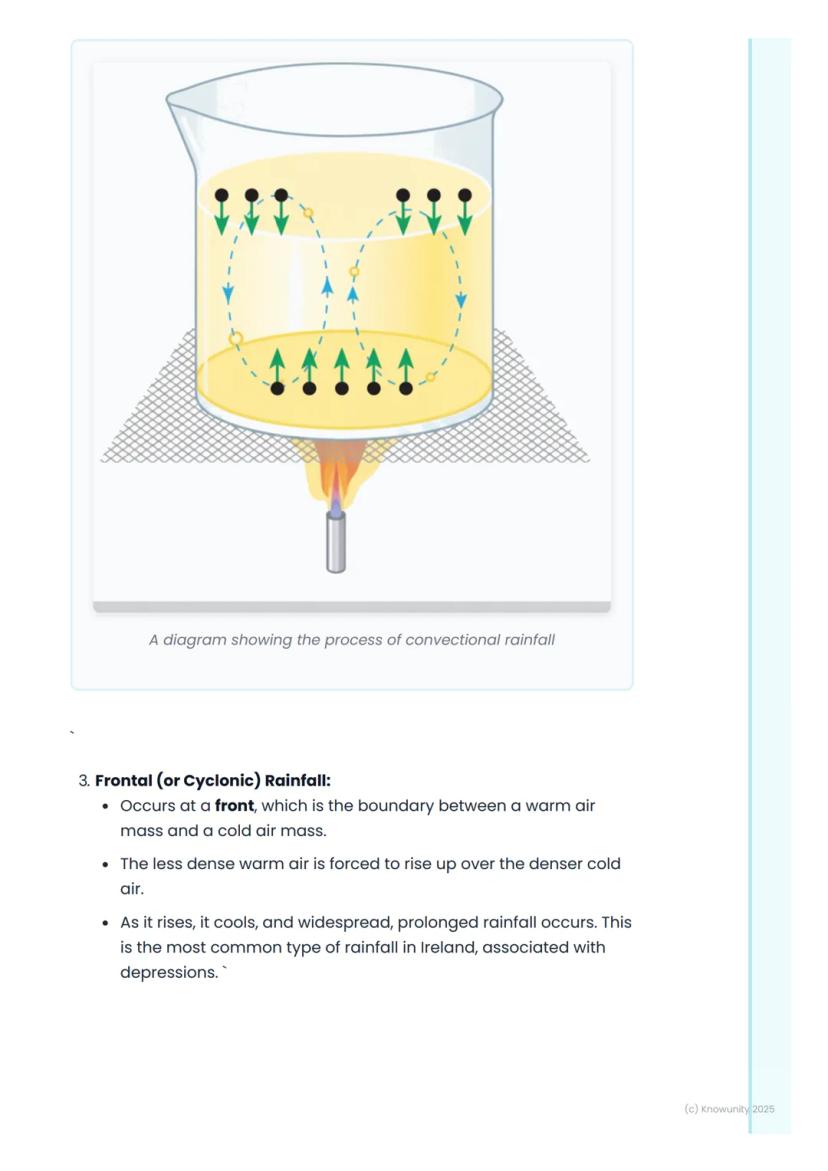
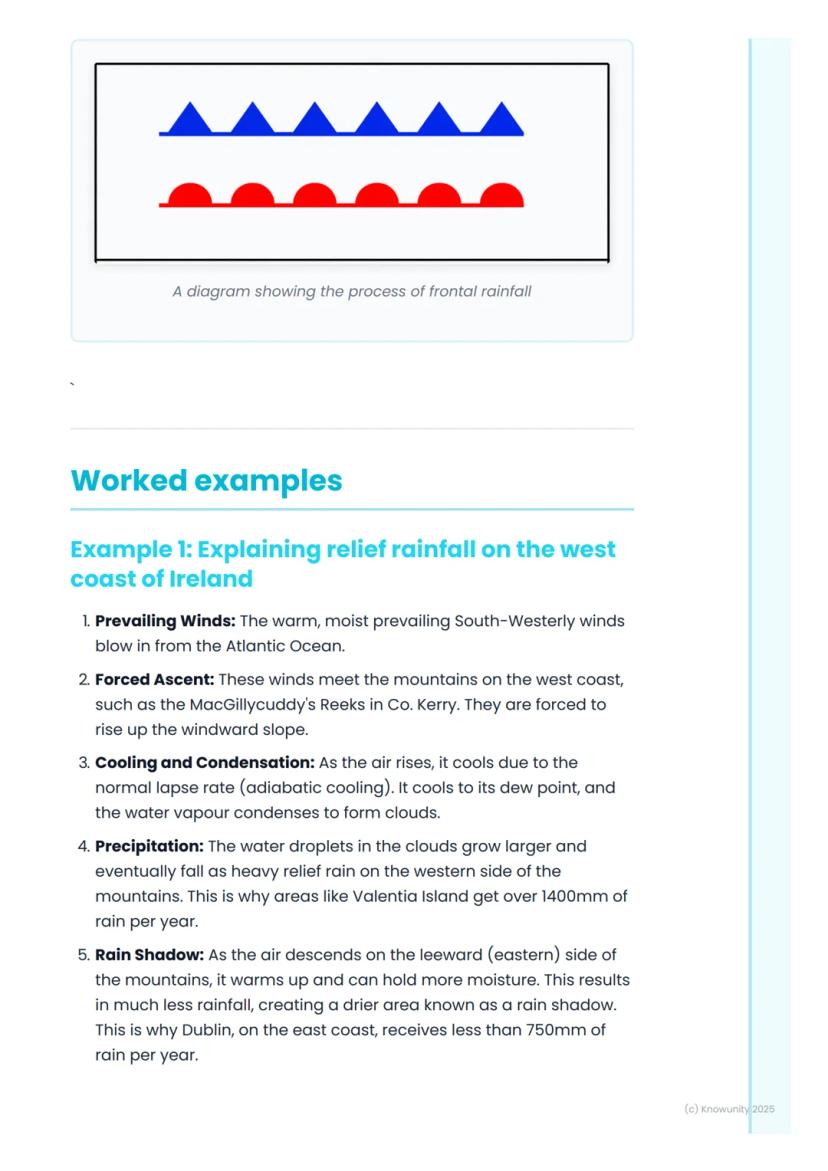
Frontal rainfall is Ireland's specialty - it happens when warm and cold air masses meet at weather fronts. The lighter warm air is forced upwards over the denser cold air, creating widespread, prolonged rainfall.
When a depression passes over Ireland, you'll experience a predictable sequence. First, the warm front approaches with falling pressure, high clouds, and steady light rain. Then comes the warm sector with higher temperatures and broken cloud.
Next, the cold front arrives like nature's drama queen - pressure rises sharply, massive dark clouds form, and you get a short burst of very heavy rain, possibly with hail and thunder. Finally, behind the cold front, temperatures drop, pressure continues rising, and you get those classic Irish "bright spells and showers."
Weather Watching: Cold fronts move faster than warm fronts, which is why they eventually catch up and create more complex weather systems.
7
of 10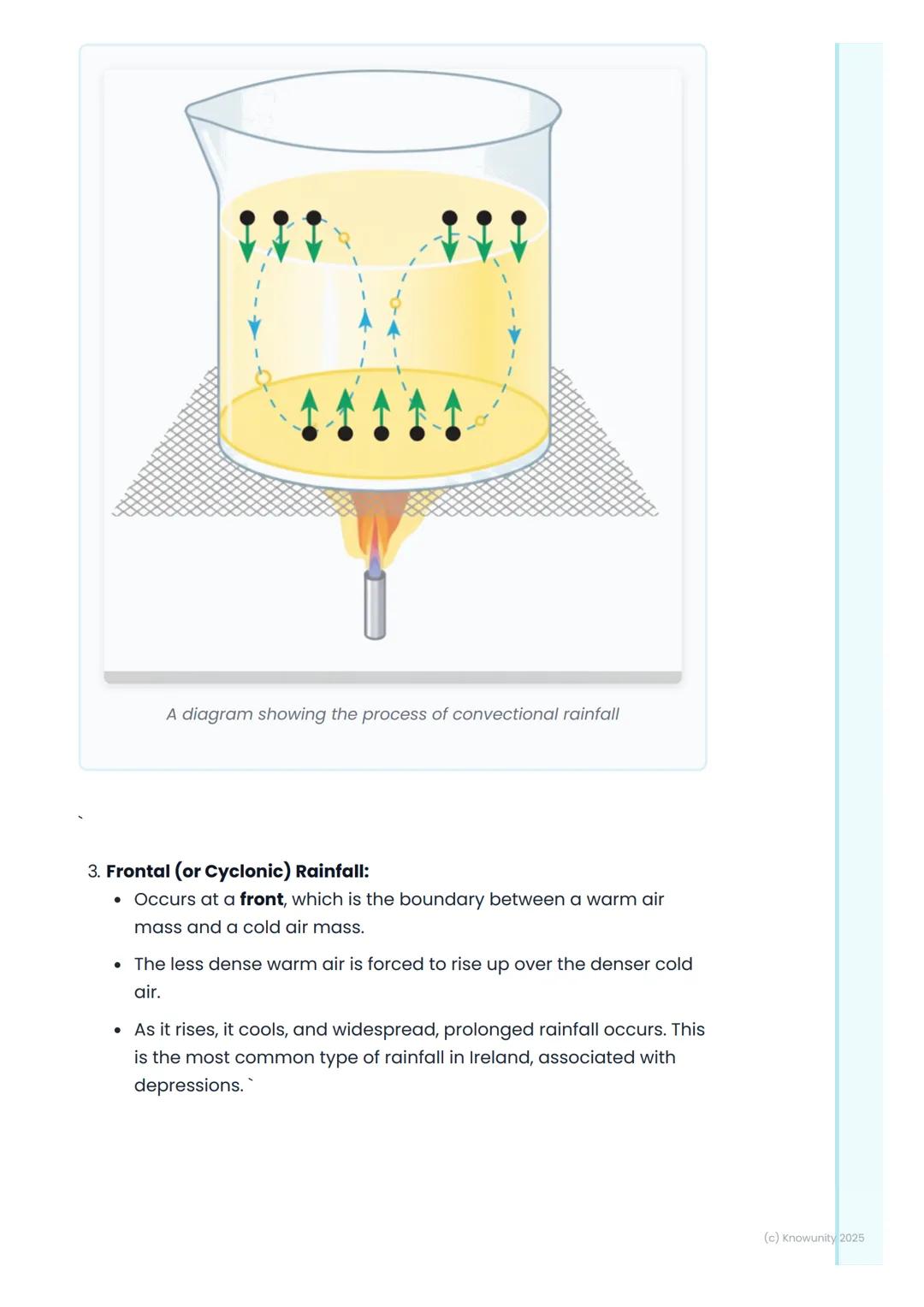
8
of 10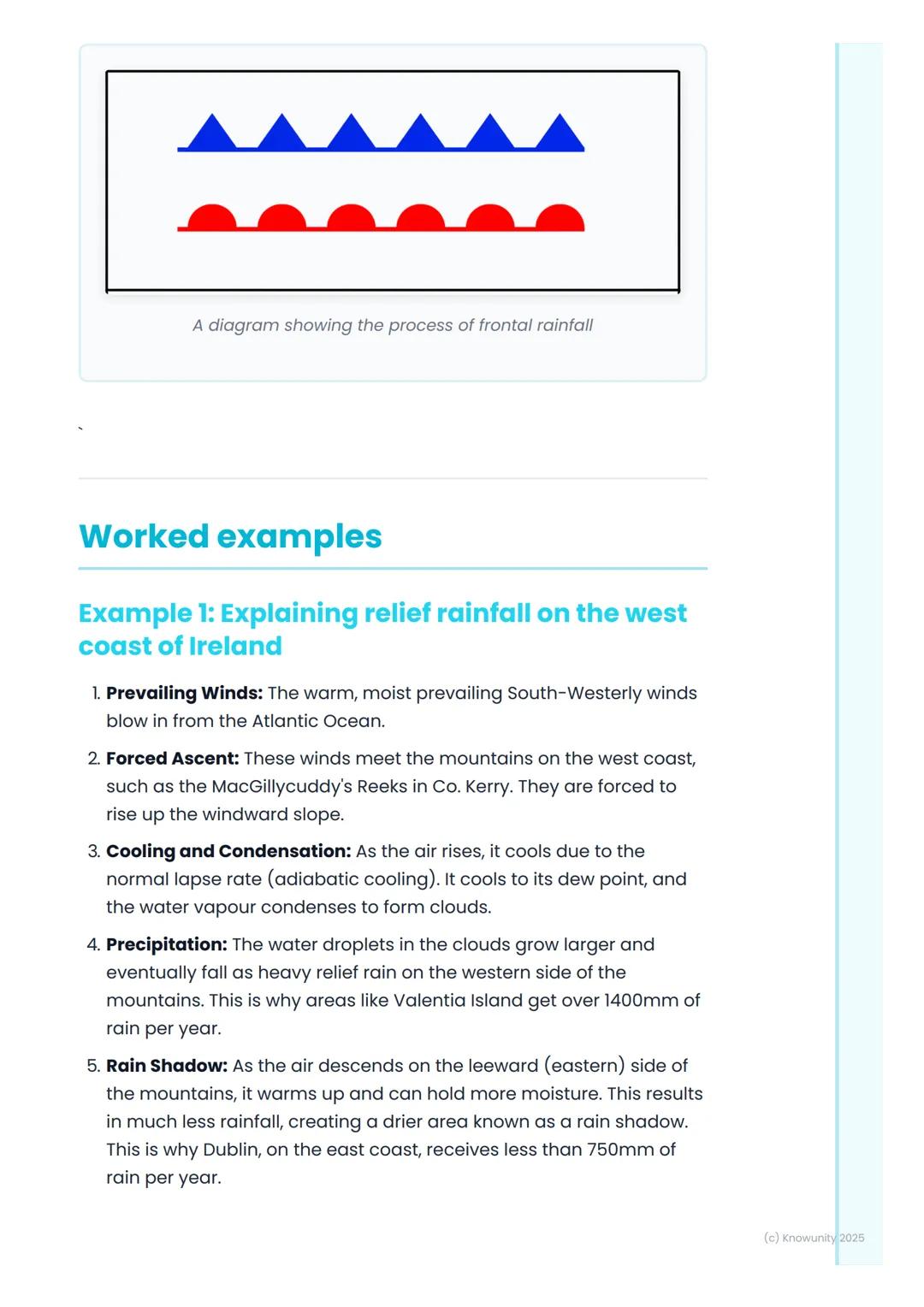
9
of 10
10
of 10
Pensávamos que não ias perguntar...
O que é o Companheiro de Aprendizagem com IA da Knowunity?
O nosso companheiro de aprendizagem com IA foi especificamente criado para as necessidades dos estudantes. Com base nos milhões de conteúdos que temos na plataforma, podemos fornecer respostas verdadeiramente significativas e relevantes para os estudantes. Mas não se trata apenas de respostas, o companheiro foca-se mais em guiar os estudantes através dos seus desafios diários de aprendizagem, com planos de estudo personalizados, quizzes ou conteúdos no chat e 100% de personalização baseada nas habilidades e desenvolvimentos do estudante.
Onde posso fazer o download da app Knowunity?
Pode descarregar a aplicação na Google Play Store e na Apple App Store.
Como posso receber o meu pagamento? Quanto posso ganhar?
Sim, tem acesso gratuito ao conteúdo da aplicação e ao nosso companheiro de IA. Para desbloquear determinadas funcionalidades da aplicação, pode adquirir o Knowunity Pro.
Conteúdos mais populares de Geography
9GeographyGeography notes on rocks
Includes types of rocks,uses of rocks, case studies
1st Year341
GeographyEarthquakes revision notes
Notes on earthquakes with diagrams
1st Year110
GeographyPopulation Change and Migration
This covers factors that cause populations to grow or shrink, including birth rates, death rates, and the reasons people migrate.
2nd Year90
GeographyRock notes geography
Geography
5th Year250
GeographyThe sea
Jc Geography
1st Year230
GeographyGeography notes On the sea
Includes costal erosion, sea cliffs, longshore drift etc.
1st Year160
GeographyInside the Earth
Students will learn about the basic layers of the Earth: the crust, mantle, and core, understanding that our planet is made up of different parts.
1st Year51
GeographyGeography notes on glaciation
Includes diagrams, erosion, deposition, transportation
1st Year210
GeographyGeography notes on weather
Includes instruments, diagrams, how to read weather
1st Year120
Conteúdos mais populares
9 Irish
IrishIrish oral questions and answers
Questions and answers for the leaving cert oral
5th Year4264
 English
Key Quotes : Sive
Key Quotes and explanations: Sive
6th Year2842
IrishIrish oral questions
Outline of oral questions
5th Year2055
IrishIníon- le hÁine Durkin
Aine Durkin’s poem, Iníon: Themes & summary
5th Year850
IrishIrish poetry 2027
Iníon + Dínit an Bhróin
5th Year1133
IrishLC HL notes- Iníon (poem)
Includes poem in English and Irish, theme, key words & phrases
5th Year2284
EnglishCultural Context : Shawshank Redemption : Sive : Small Things Like These
Comparative Study : Cultural Context : Shawshank Redemption, Sive and Small Things Like These
6th Year1430
IrishMo Ghrá-sa (Idir Lúibíní)
Notes on mo ghrá-sa
5th Year380
IrishAn Gaeilge Aiste
Irish Language essay
6th Year1320
Não encontra o que procura? Explore outras disciplinas.
Avaliações dos nossos utilizadores. Eles adoraram tudo — e tu também vais adorar.
4.6/5App Store
4.7/5Google Play
A App é muito fácil de usar e está nem organizada. Encontrei tudo o que estava à procura até agora e consegui aprender muito com as apresentações! Vou usar a app para um trabalho escolar! E claro que também me ajuda muito como inspiração.
João Sutilizador iOS
Esta app é realmente incrível. Há tantas anotações de estudo e ajuda [...]. A minha disciplina problemática é Francês, por exemplo, e a app tem muitas opções de ajuda. Graças a esta app, melhorei o meu Francês. Eu recomendo a qualquer pessoa.
Sara C.utilizadora Android
Uau, estou realmente impressionado. Acabei de experimentar o app porque o vi anunciado muitas vezes e fiquei absolutamente surpreso. Este app é A AJUDA que você quer para a escola e, acima de tudo, oferece tantas coisas, como exercícios e folhas de fatos, que têm sido MUITO úteis para mim pessoalmente.
Anautilizadora iOS
Geography2 visualizações·Atualizado Jun 7, 2026·10 páginasUnderstanding Earth's Atmosphere and Weather
Ever wondered why it's always raining in Cork but sunny in Dublin, or why it's freezing on top of a mountain even in summer? The atmosphere is like Earth's protective blanket, and understanding how it works is the key to... Mostrar mais
1
of 10Cadastre-se para ver o conteúdo. É grátis!
- Acesso a todos os documentos
- Melhore suas notas
- Junte-se a milhões de estudantes
The Atmosphere Basics
The atmosphere is essentially a 100km-thick layer of gases that keeps us alive and creates all our weather. Think of it as Earth's protective bubble that's constantly moving and changing.
Here's what you're breathing: 78% nitrogen, 21% oxygen, and just 1% of other gases including water vapour. That tiny bit of water vapour might seem insignificant, but it's responsible for every cloud, raindrop, and snowflake you've ever seen.
Weather is what's happening right now - like today's downpour in Dublin. Climate is the long-term average over 30+ years - like Ireland's famously wet reputation. Don't mix these up in your exams!
Quick Tip: Weather elements (temperature, pressure, wind, precipitation) are the building blocks of every weather forecast you check.
2
of 10Cadastre-se para ver o conteúdo. É grátis!
- Acesso a todos os documentos
- Melhore suas notas
- Junte-se a milhões de estudantes
Atmospheric Layers
The atmosphere has four main layers, but you really need to know the first two. Here's a handy memory trick: The Sun Makes Things hot (Troposphere, Stratosphere, Mesosphere, Thermosphere).
The troposphere is where all the action happens - it's only 12km thick but contains virtually all our weather. Temperature drops as you go higher (about 6.5°C per 1000m), which explains why Carrauntoohil is always colder than sea level.
The stratosphere sits above it, containing the crucial ozone layer that blocks harmful UV rays. Unlike the troposphere, temperature actually increases with height here because ozone absorbs solar radiation.
Exam Focus: The troposphere is your priority - almost every weather question relates to this bottom layer.
3
of 10Cadastre-se para ver o conteúdo. É grátis!
- Acesso a todos os documentos
- Melhore suas notas
- Junte-se a milhões de estudantes
Temperature and Pressure
Temperature is measured using thermometers in Stevenson Screens (those white boxes you see at weather stations). Four main factors affect temperature: how close you are to the equator, your height above sea level, distance from the sea, and which way slopes face.
Ireland's coast stays milder year-round thanks to the sea's slow heating and cooling - that's why Galway has cooler summers but warmer winters than inland Athlone.
Atmospheric pressure is the weight of air pressing down on you, measured in millibars. Low pressure (depressions) means air is rising, cooling, and forming clouds - hello, rainy day! High pressure (anticyclones) means air is sinking and warming - cue the sunny weather.
Map Reading: When isobars (pressure lines) are squashed together, expect strong winds. Spread apart means light winds.
4
of 10Cadastre-se para ver o conteúdo. É grátis!
- Acesso a todos os documentos
- Melhore suas notas
- Junte-se a milhões de estudantes
Wind and Weather Patterns
Wind is simply air rushing from high pressure to low pressure areas. In Ireland, our prevailing winds are South-Westerlies - they bring all that Atlantic moisture that keeps our grass so green!
Due to Earth's rotation, winds curve to the right in the Northern Hemisphere (called the Coriolis effect). This is why low-pressure systems spin anti-clockwise and high-pressure systems spin clockwise.
When you see a weather map, look for the 'L' and 'H' symbols. An 'L' means expect clouds, wind, and rain. An 'H' means settled, clear conditions - though in winter, this can bring frost and fog.
Wind Direction: Remember, winds are named from where they're coming from, not where they're going!
5
of 10Cadastre-se para ver o conteúdo. É grátis!
- Acesso a todos os documentos
- Melhore suas notas
- Junte-se a milhões de estudantes
Rainfall Types
For precipitation to form, you need moist air that's forced to rise and cool to its dew point (saturation temperature). There are three main types you'll encounter in Ireland.
Relief rainfall happens when our South-Westerly winds hit western mountains like the MacGillycuddy's Reeks. The air is forced upwards, cools, and dumps heavy rain on the western slopes. This creates a rain shadow effect - which is why Dublin gets less than 750mm of rain yearly while Valentia Island gets over 1400mm.
Convectional rainfall occurs on hot summer afternoons when heated ground causes air to rise rapidly, forming towering cumulonimbus clouds. These create those sudden heavy downpours with thunder and lightning.
Ireland's Reality: Most of our rain is frontal rainfall from Atlantic depressions - those weather systems that seem to queue up to soak us!
6
of 10Cadastre-se para ver o conteúdo. É grátis!
- Acesso a todos os documentos
- Melhore suas notas
- Junte-se a milhões de estudantes
Frontal Systems and Depressions
Frontal rainfall is Ireland's specialty - it happens when warm and cold air masses meet at weather fronts. The lighter warm air is forced upwards over the denser cold air, creating widespread, prolonged rainfall.
When a depression passes over Ireland, you'll experience a predictable sequence. First, the warm front approaches with falling pressure, high clouds, and steady light rain. Then comes the warm sector with higher temperatures and broken cloud.
Next, the cold front arrives like nature's drama queen - pressure rises sharply, massive dark clouds form, and you get a short burst of very heavy rain, possibly with hail and thunder. Finally, behind the cold front, temperatures drop, pressure continues rising, and you get those classic Irish "bright spells and showers."
Weather Watching: Cold fronts move faster than warm fronts, which is why they eventually catch up and create more complex weather systems.
7
of 10Cadastre-se para ver o conteúdo. É grátis!
- Acesso a todos os documentos
- Melhore suas notas
- Junte-se a milhões de estudantes
8
of 10Cadastre-se para ver o conteúdo. É grátis!
- Acesso a todos os documentos
- Melhore suas notas
- Junte-se a milhões de estudantes
9
of 10Cadastre-se para ver o conteúdo. É grátis!
- Acesso a todos os documentos
- Melhore suas notas
- Junte-se a milhões de estudantes
10
of 10Cadastre-se para ver o conteúdo. É grátis!
- Acesso a todos os documentos
- Melhore suas notas
- Junte-se a milhões de estudantes
Pensávamos que não ias perguntar...
O que é o Companheiro de Aprendizagem com IA da Knowunity?
O nosso companheiro de aprendizagem com IA foi especificamente criado para as necessidades dos estudantes. Com base nos milhões de conteúdos que temos na plataforma, podemos fornecer respostas verdadeiramente significativas e relevantes para os estudantes. Mas não se trata apenas de respostas, o companheiro foca-se mais em guiar os estudantes através dos seus desafios diários de aprendizagem, com planos de estudo personalizados, quizzes ou conteúdos no chat e 100% de personalização baseada nas habilidades e desenvolvimentos do estudante.
Onde posso fazer o download da app Knowunity?
Pode descarregar a aplicação na Google Play Store e na Apple App Store.
Como posso receber o meu pagamento? Quanto posso ganhar?
Sim, tem acesso gratuito ao conteúdo da aplicação e ao nosso companheiro de IA. Para desbloquear determinadas funcionalidades da aplicação, pode adquirir o Knowunity Pro.
Conteúdos mais populares de Geography
9GeographyGeography notes on rocks
Includes types of rocks,uses of rocks, case studies
1st Year341
GeographyEarthquakes revision notes
Notes on earthquakes with diagrams
1st Year110
GeographyPopulation Change and Migration
This covers factors that cause populations to grow or shrink, including birth rates, death rates, and the reasons people migrate.
2nd Year90
GeographyRock notes geography
Geography
5th Year250
GeographyThe sea
Jc Geography
1st Year230
GeographyGeography notes On the sea
Includes costal erosion, sea cliffs, longshore drift etc.
1st Year160
GeographyInside the Earth
Students will learn about the basic layers of the Earth: the crust, mantle, and core, understanding that our planet is made up of different parts.
1st Year51
GeographyGeography notes on glaciation
Includes diagrams, erosion, deposition, transportation
1st Year210
GeographyGeography notes on weather
Includes instruments, diagrams, how to read weather
1st Year120
Conteúdos mais populares
9IrishIrish oral questions and answers
Questions and answers for the leaving cert oral
5th Year4264
EnglishKey Quotes : Sive
Key Quotes and explanations: Sive
6th Year2842
IrishIrish oral questions
Outline of oral questions
5th Year2055
IrishIníon- le hÁine Durkin
Aine Durkin’s poem, Iníon: Themes & summary
5th Year850
IrishIrish poetry 2027
Iníon + Dínit an Bhróin
5th Year1133
IrishLC HL notes- Iníon (poem)
Includes poem in English and Irish, theme, key words & phrases
5th Year2284
EnglishCultural Context : Shawshank Redemption : Sive : Small Things Like These
Comparative Study : Cultural Context : Shawshank Redemption, Sive and Small Things Like These
6th Year1430
IrishMo Ghrá-sa (Idir Lúibíní)
Notes on mo ghrá-sa
5th Year380
IrishAn Gaeilge Aiste
Irish Language essay
6th Year1320
Não encontra o que procura? Explore outras disciplinas.
Avaliações dos nossos utilizadores. Eles adoraram tudo — e tu também vais adorar.
4.6/5App Store
4.7/5Google Play
A App é muito fácil de usar e está nem organizada. Encontrei tudo o que estava à procura até agora e consegui aprender muito com as apresentações! Vou usar a app para um trabalho escolar! E claro que também me ajuda muito como inspiração.
João Sutilizador iOS
Esta app é realmente incrível. Há tantas anotações de estudo e ajuda [...]. A minha disciplina problemática é Francês, por exemplo, e a app tem muitas opções de ajuda. Graças a esta app, melhorei o meu Francês. Eu recomendo a qualquer pessoa.
Sara C.utilizadora Android
Uau, estou realmente impressionado. Acabei de experimentar o app porque o vi anunciado muitas vezes e fiquei absolutamente surpreso. Este app é A AJUDA que você quer para a escola e, acima de tudo, oferece tantas coisas, como exercícios e folhas de fatos, que têm sido MUITO úteis para mim pessoalmente.
Anautilizadora iOS