
Ever wonder why earthquakes happen or how mountains form? It's...
 Geography19 visualizações·Atualizado Jun 13, 2026·5 páginas
Understanding Plate Tectonics for Beginners
1 / 5
1
of 5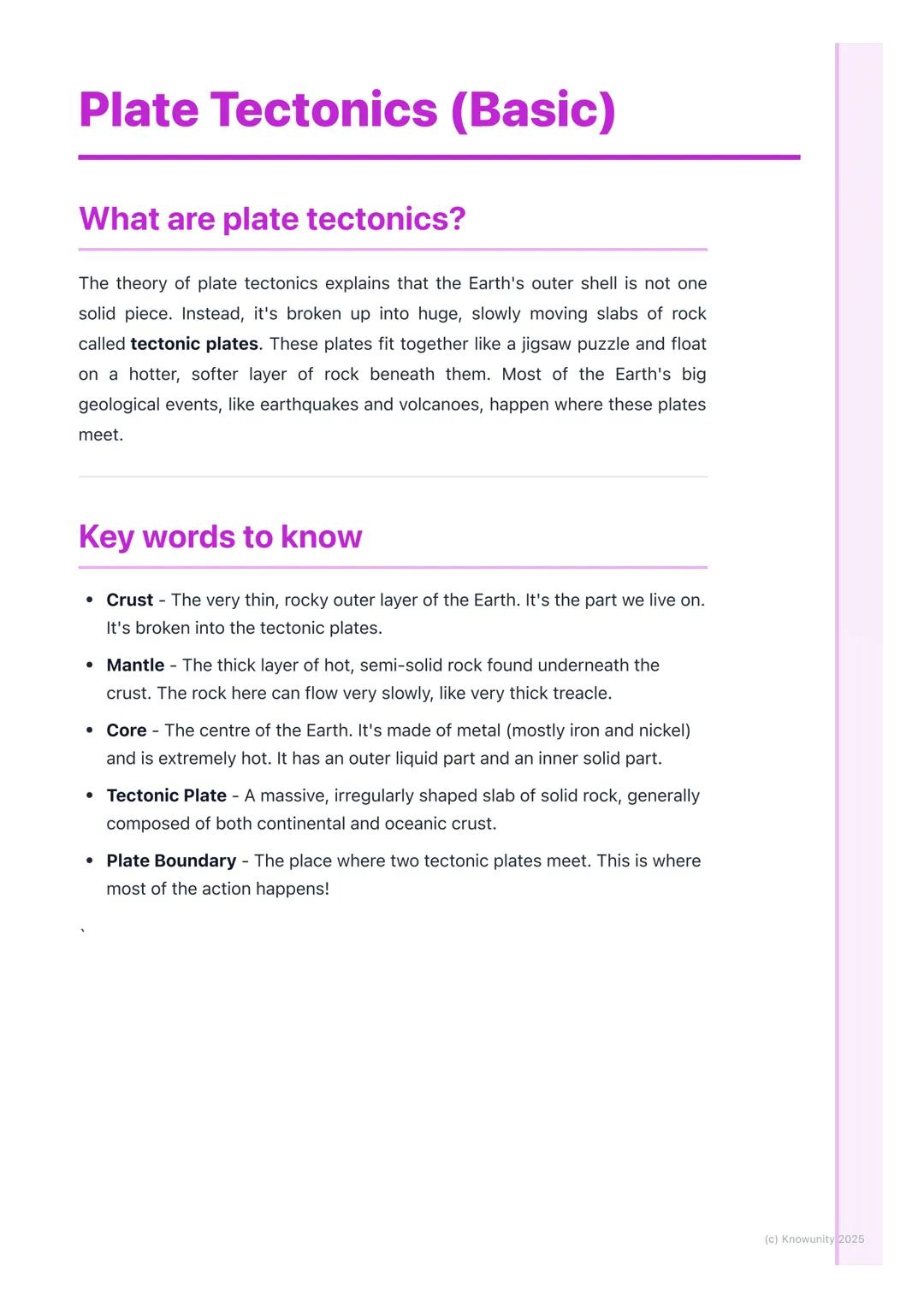
What Are Plate Tectonics?
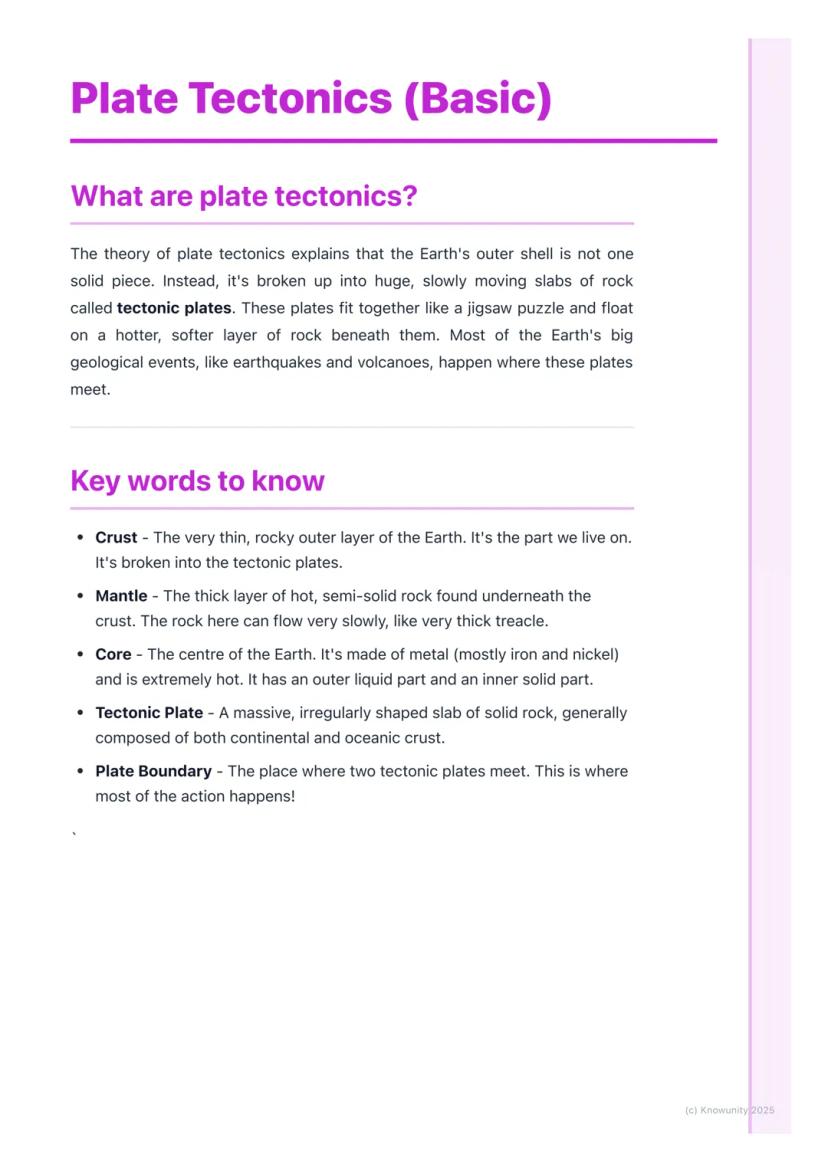
Think of the Earth's surface like a cracked eggshell that's slowly moving about. The theory of plate tectonics explains that our planet's outer layer isn't one solid piece - it's broken into huge slabs of rock called tectonic plates that fit together like a jigsaw puzzle.
These plates float on top of a much hotter, softer layer of rock underneath. Most of the dramatic stuff that happens on Earth - earthquakes, volcanoes, and mountain building - occurs where these plates bump into each other at plate boundaries.
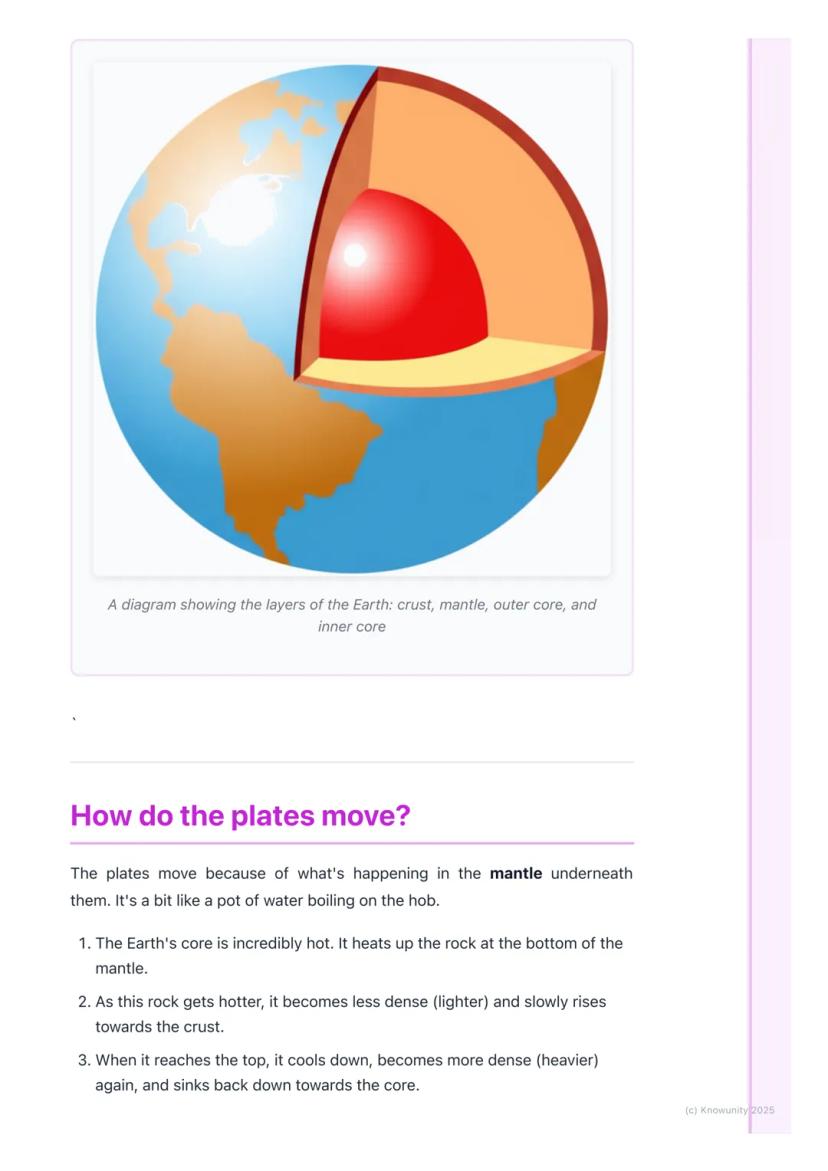
You'll need to know some key terms for your exams. The crust is the thin rocky layer we live on, whilst the mantle underneath is made of hot, flowing rock that moves like very thick treacle. At the centre lies the core, which is incredibly hot and made mostly of iron and nickel.
Quick Tip: Remember that tectonic plates are made up of pieces of the crust, not the other way around - don't mix these up in your exam!
2
of 5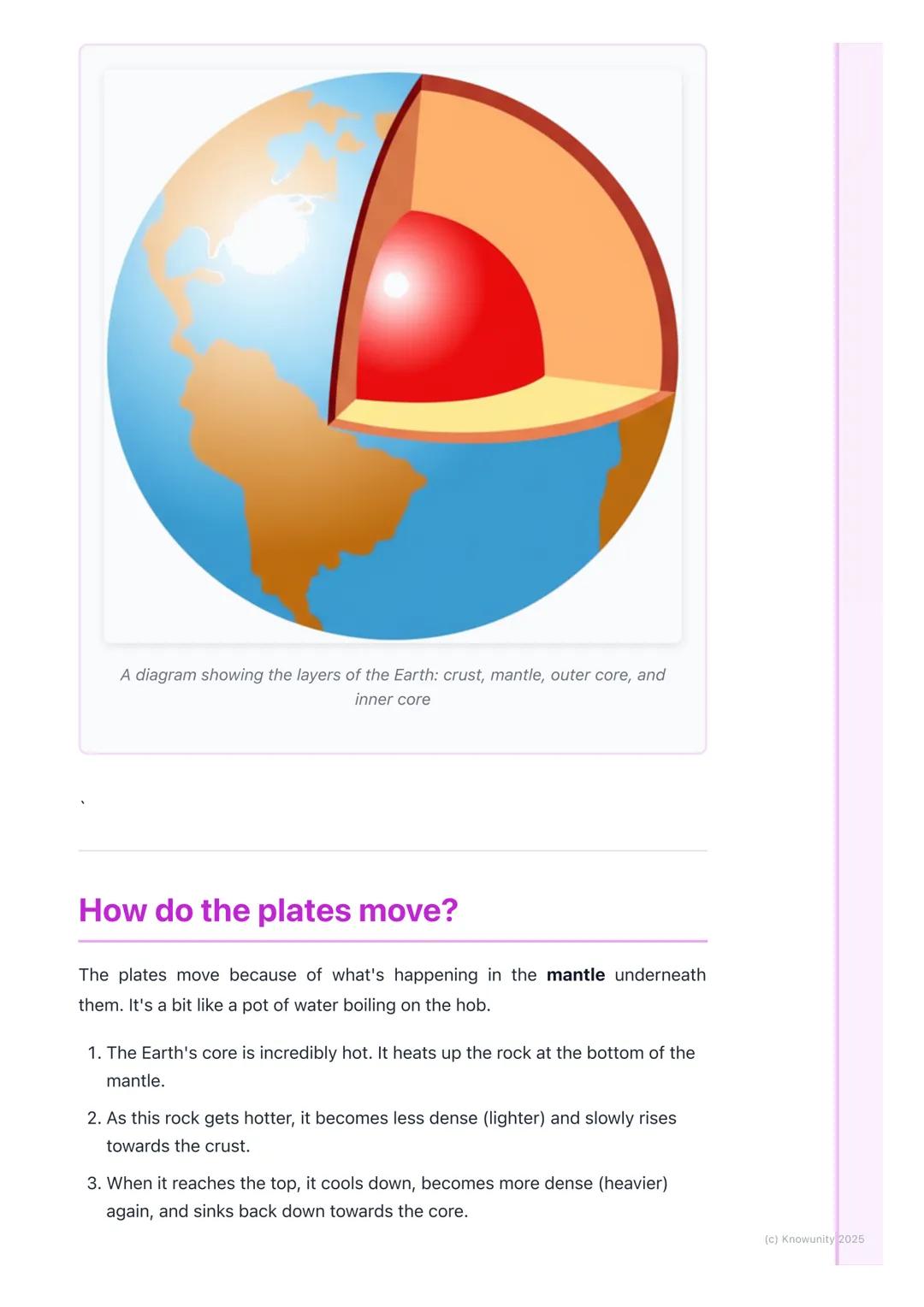
How Do the Plates Actually Move?
The secret to plate movement lies deep underground in the mantle. Picture a pot of soup slowly bubbling on the hob - that's basically what's happening beneath our feet!
The Earth's core is absolutely scorching hot, which heats up the rock at the bottom of the mantle. This heated rock becomes lighter and slowly rises towards the surface. When it reaches the top, it cools down, becomes heavier, and sinks back down again.
This continuous cycle of heating, rising, cooling, and sinking creates convection currents. These currents act like massive underground conveyor belts that drag the tectonic plates along with them. The whole process is dead slow though - plates only move a few centimetres per year, about the same speed your fingernails grow!
Remember: We can't feel this movement day-to-day, but over millions of years it creates mountains and moves entire continents around.
3
of 5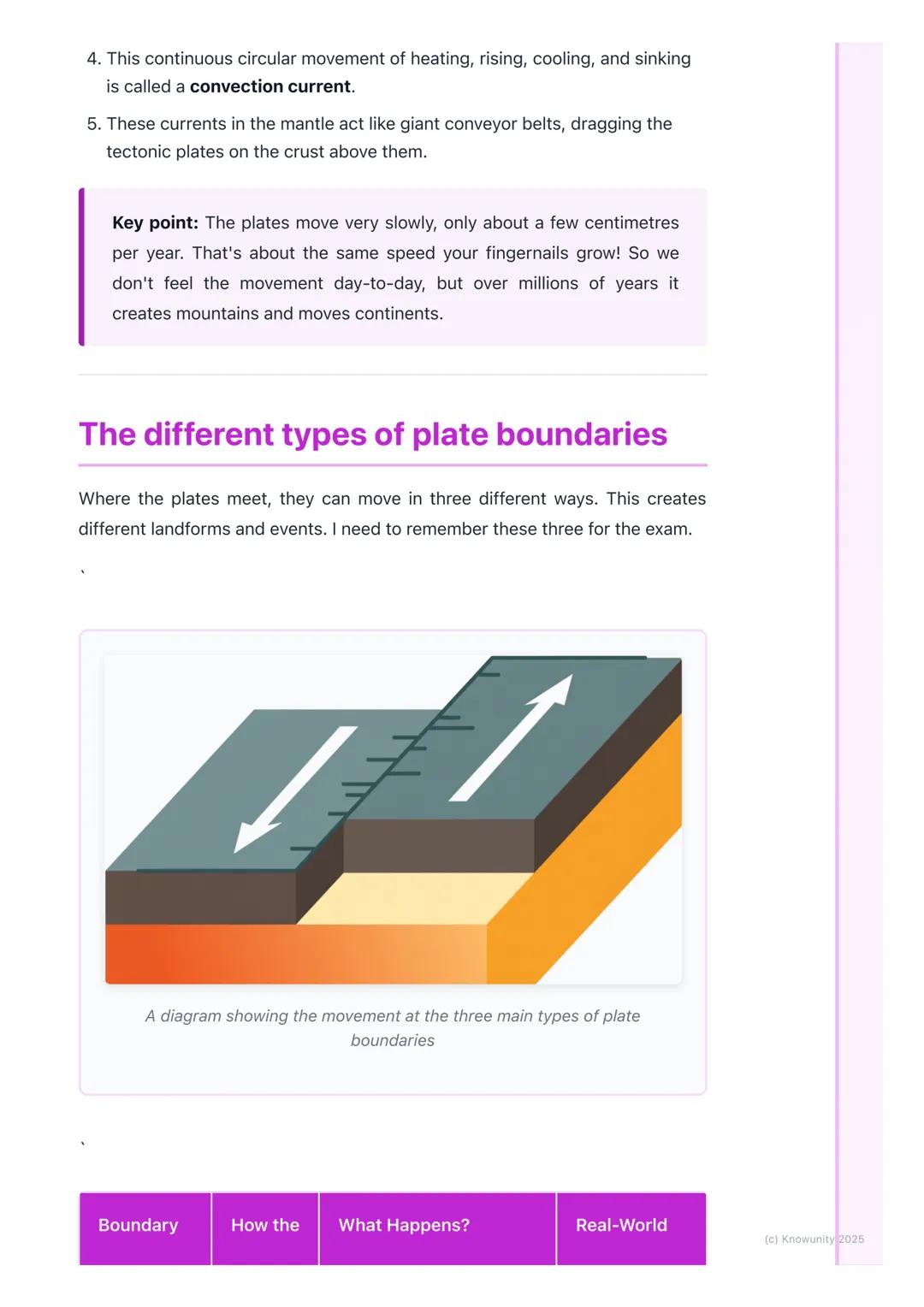
The Three Types of Plate Boundaries
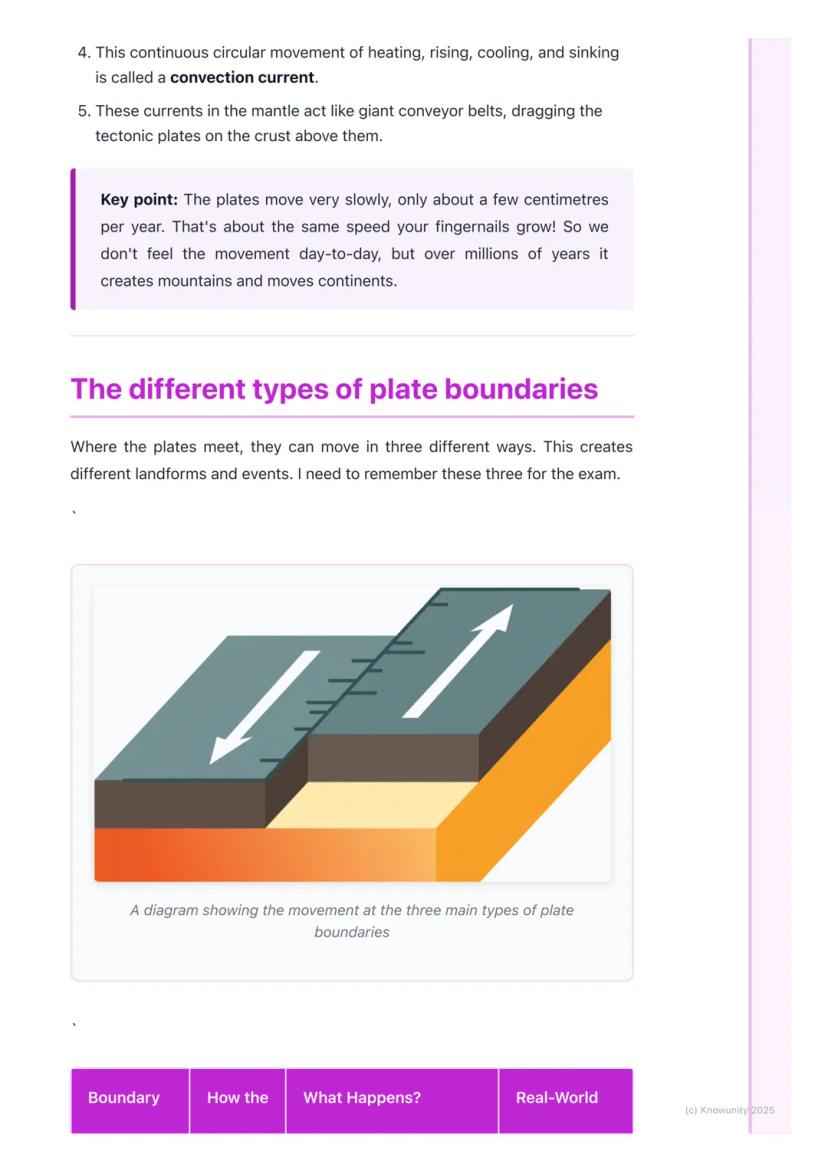
Where tectonic plates meet, they can move in three different ways, and each creates different geological features. You'll definitely need to know these for your exams!
Convergent boundaries happen when plates crash into each other. One plate might slide under the other, or they might crumple up to form massive mountain ranges like the Himalayas. These collisions often cause earthquakes and create volcanoes too.
Divergent boundaries occur when plates move away from each other. Hot magma from the mantle rises up to fill the gap, creating new crust and often forming underwater mountain chains called mid-ocean ridges. Iceland sits right on top of the Mid-Atlantic Ridge!
Transform boundaries are where plates slide past each other sideways. The plates often get stuck, building up pressure until they suddenly slip and release enormous amounts of energy as earthquakes. The San Andreas Fault in California is a famous example.
Exam Tip: Use arrows to remember the movements - convergent (→←), divergent (←→), and transform (↑↓).
4
of 5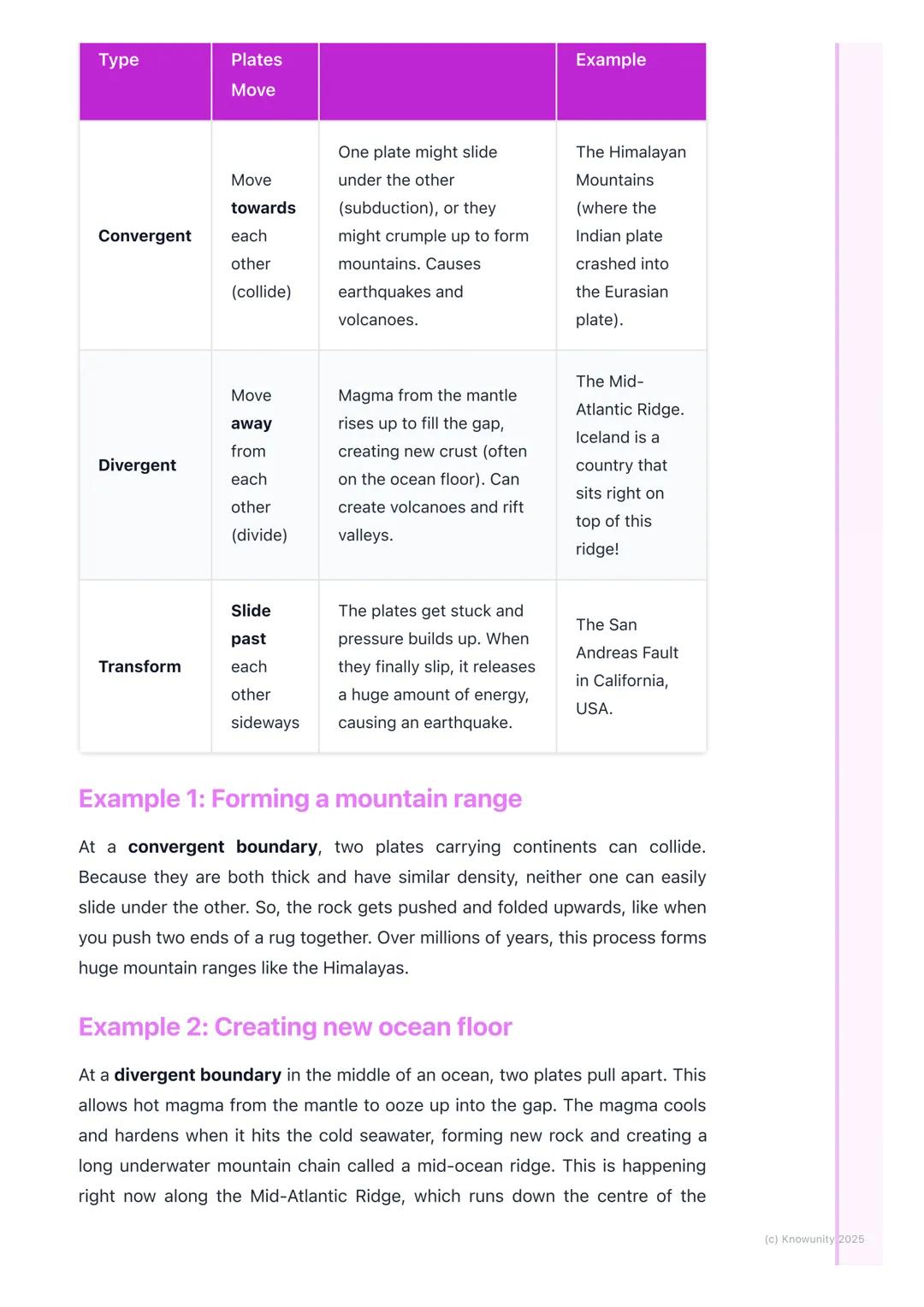
Real-World Examples You Should Know
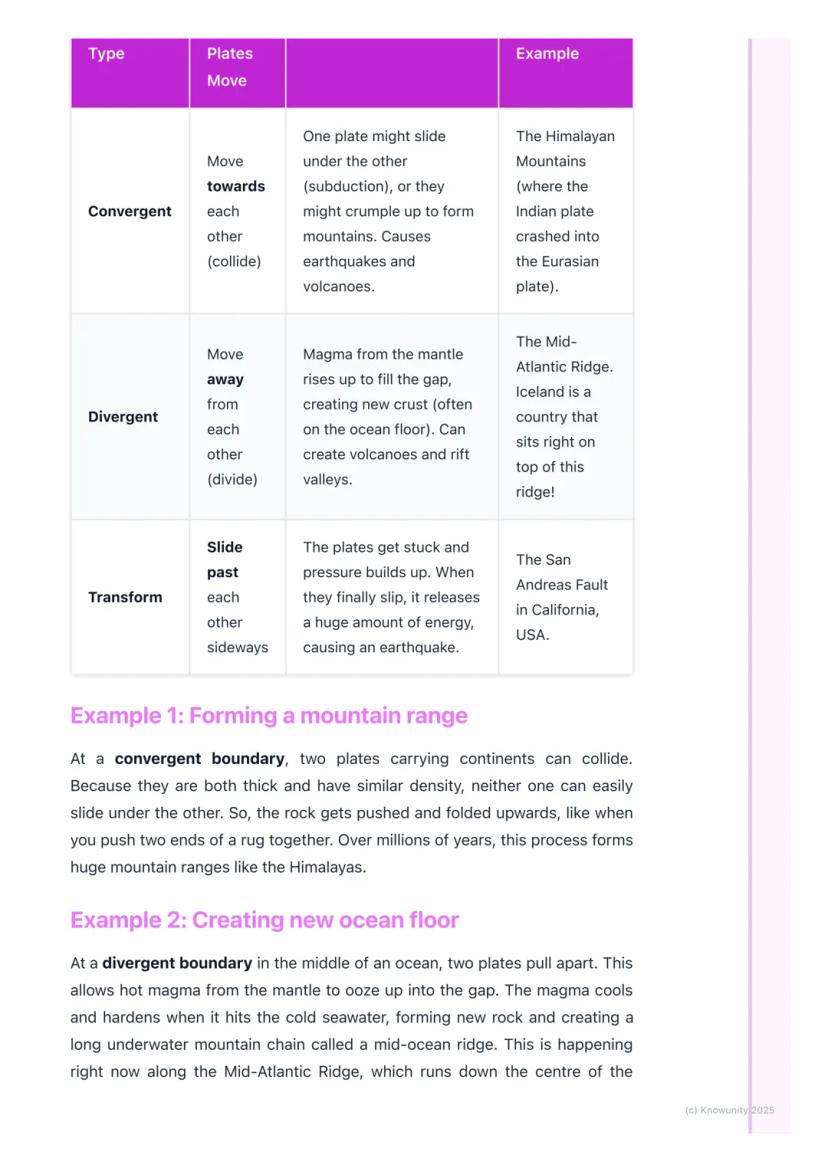
Let's look at how these boundaries work in practice. When two plates carrying continents collide at a convergent boundary, neither can easily slide under the other because they're both thick and similar in density. Instead, the rock gets pushed and folded upwards like when you push both ends of a rug together, creating massive mountain ranges over millions of years.
At divergent boundaries in the ocean, something completely different happens. As two plates pull apart, hot magma from the mantle oozes up into the gap. When this magma hits the cold seawater, it cools and hardens to form new rock, creating underwater mountain chains called mid-ocean ridges.
This process is happening right now along the Mid-Atlantic Ridge, which runs down the centre of the Atlantic Ocean. It's literally pushing North America and Europe further apart each year! This is how new ocean floor gets created.
Cool Fact: Ireland sits safely in the middle of the Eurasian Plate, which is why we don't get major earthquakes or active volcanoes - the nearest plate boundary is the Mid-Atlantic Ridge.
5
of 5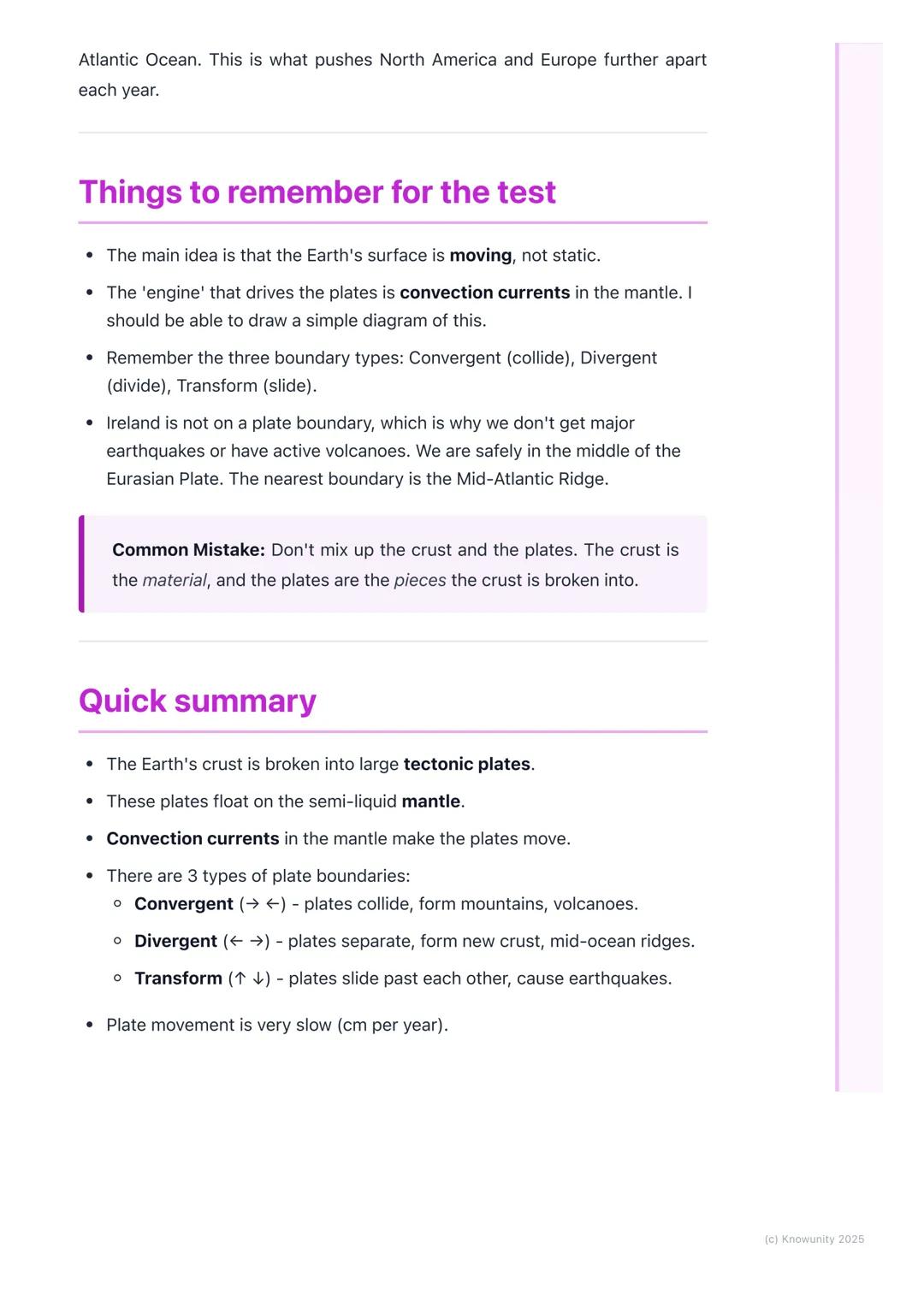
Key Points for Your Exam
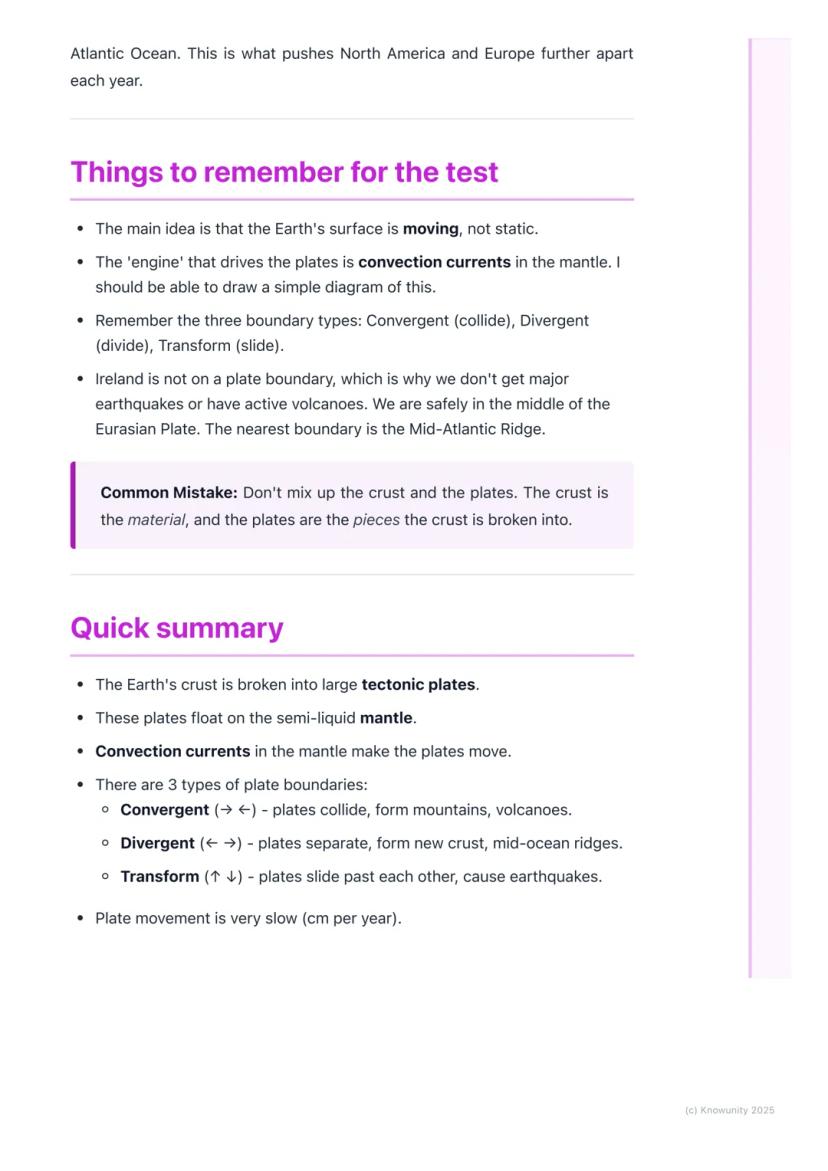
The most important thing to remember is that the Earth's surface is constantly moving, not static like it appears to us. The 'engine' that drives this movement is convection currents in the mantle - make sure you can draw a simple diagram showing hot rock rising and cool rock sinking.
You absolutely must know the three boundary types and what happens at each one. Convergent boundaries create mountains and volcanoes when plates collide. Divergent boundaries form new crust and mid-ocean ridges when plates separate. Transform boundaries cause earthquakes when plates slide past each other.
Don't forget that plate movement is incredibly slow - just a few centimetres per year. However, over millions of years, this slow movement has shaped our entire planet, creating the continents, oceans, and mountain ranges we see today.
Common Mistake: Remember that the crust is the material, and the plates are the pieces the crust is broken into - don't mix these up in your answers!
Pensávamos que não ias perguntar...
O que é o Companheiro de Aprendizagem com IA da Knowunity?
O nosso companheiro de aprendizagem com IA foi especificamente criado para as necessidades dos estudantes. Com base nos milhões de conteúdos que temos na plataforma, podemos fornecer respostas verdadeiramente significativas e relevantes para os estudantes. Mas não se trata apenas de respostas, o companheiro foca-se mais em guiar os estudantes através dos seus desafios diários de aprendizagem, com planos de estudo personalizados, quizzes ou conteúdos no chat e 100% de personalização baseada nas habilidades e desenvolvimentos do estudante.
Onde posso fazer o download da app Knowunity?
Pode descarregar a aplicação na Google Play Store e na Apple App Store.
Como posso receber o meu pagamento? Quanto posso ganhar?
Sim, tem acesso gratuito ao conteúdo da aplicação e ao nosso companheiro de IA. Para desbloquear determinadas funcionalidades da aplicação, pode adquirir o Knowunity Pro.
Conteúdos mais populares de Geography
9GeographyGeography notes on rocks
Includes types of rocks,uses of rocks, case studies
1st Year341
GeographyEarthquakes revision notes
Notes on earthquakes with diagrams
1st Year110
GeographyPopulation Change and Migration
This covers factors that cause populations to grow or shrink, including birth rates, death rates, and the reasons people migrate.
2nd Year90
GeographyRock notes geography
Geography
5th Year250
GeographyThe sea
Jc Geography
1st Year230
GeographyGeography notes On the sea
Includes costal erosion, sea cliffs, longshore drift etc.
1st Year160
GeographyInside the Earth
Students will learn about the basic layers of the Earth: the crust, mantle, and core, understanding that our planet is made up of different parts.
1st Year51
GeographyGeography notes on glaciation
Includes diagrams, erosion, deposition, transportation
1st Year210
GeographyGeography notes on weather
Includes instruments, diagrams, how to read weather
1st Year120
Conteúdos mais populares
9 Irish
IrishIrish oral questions and answers
Questions and answers for the leaving cert oral
5th Year4264
 English
Key Quotes : Sive
Key Quotes and explanations: Sive
6th Year2842
IrishIrish oral questions
Outline of oral questions
5th Year2055
IrishIníon- le hÁine Durkin
Aine Durkin’s poem, Iníon: Themes & summary
5th Year890
IrishIrish poetry 2027
Iníon + Dínit an Bhróin
5th Year1153
IrishLC HL notes- Iníon (poem)
Includes poem in English and Irish, theme, key words & phrases
5th Year2304
EnglishCultural Context : Shawshank Redemption : Sive : Small Things Like These
Comparative Study : Cultural Context : Shawshank Redemption, Sive and Small Things Like These
6th Year1430
IrishMo Ghrá-sa (Idir Lúibíní)
Notes on mo ghrá-sa
5th Year380
IrishAn Gaeilge Aiste
Irish Language essay
6th Year1320
Não encontra o que procura? Explore outras disciplinas.
Avaliações dos nossos utilizadores. Eles adoraram tudo — e tu também vais adorar.
4.6/5App Store
4.7/5Google Play
A App é muito fácil de usar e está nem organizada. Encontrei tudo o que estava à procura até agora e consegui aprender muito com as apresentações! Vou usar a app para um trabalho escolar! E claro que também me ajuda muito como inspiração.
João Sutilizador iOS
Esta app é realmente incrível. Há tantas anotações de estudo e ajuda [...]. A minha disciplina problemática é Francês, por exemplo, e a app tem muitas opções de ajuda. Graças a esta app, melhorei o meu Francês. Eu recomendo a qualquer pessoa.
Sara C.utilizadora Android
Uau, estou realmente impressionado. Acabei de experimentar o app porque o vi anunciado muitas vezes e fiquei absolutamente surpreso. Este app é A AJUDA que você quer para a escola e, acima de tudo, oferece tantas coisas, como exercícios e folhas de fatos, que têm sido MUITO úteis para mim pessoalmente.
Anautilizadora iOS
Geography19 visualizações·Atualizado Jun 13, 2026·5 páginasUnderstanding Plate Tectonics for Beginners
Ever wonder why earthquakes happen or how mountains form? It's all down to the fact that the ground beneath your feet isn't as solid as you think! The Earth's outer layer is actually broken into massive, slow-moving pieces called tectonic...
1
of 5
Cadastre-se para ver o conteúdo. É grátis!
- Acesso a todos os documentos
- Melhore suas notas
- Junte-se a milhões de estudantes
What Are Plate Tectonics?
Think of the Earth's surface like a cracked eggshell that's slowly moving about. The theory of plate tectonics explains that our planet's outer layer isn't one solid piece - it's broken into huge slabs of rock called tectonic plates that fit together like a jigsaw puzzle.
These plates float on top of a much hotter, softer layer of rock underneath. Most of the dramatic stuff that happens on Earth - earthquakes, volcanoes, and mountain building - occurs where these plates bump into each other at plate boundaries.
You'll need to know some key terms for your exams. The crust is the thin rocky layer we live on, whilst the mantle underneath is made of hot, flowing rock that moves like very thick treacle. At the centre lies the core, which is incredibly hot and made mostly of iron and nickel.
Quick Tip: Remember that tectonic plates are made up of pieces of the crust, not the other way around - don't mix these up in your exam!
2
of 5Cadastre-se para ver o conteúdo. É grátis!
- Acesso a todos os documentos
- Melhore suas notas
- Junte-se a milhões de estudantes
How Do the Plates Actually Move?
The secret to plate movement lies deep underground in the mantle. Picture a pot of soup slowly bubbling on the hob - that's basically what's happening beneath our feet!
The Earth's core is absolutely scorching hot, which heats up the rock at the bottom of the mantle. This heated rock becomes lighter and slowly rises towards the surface. When it reaches the top, it cools down, becomes heavier, and sinks back down again.
This continuous cycle of heating, rising, cooling, and sinking creates convection currents. These currents act like massive underground conveyor belts that drag the tectonic plates along with them. The whole process is dead slow though - plates only move a few centimetres per year, about the same speed your fingernails grow!
Remember: We can't feel this movement day-to-day, but over millions of years it creates mountains and moves entire continents around.
3
of 5Cadastre-se para ver o conteúdo. É grátis!
- Acesso a todos os documentos
- Melhore suas notas
- Junte-se a milhões de estudantes
The Three Types of Plate Boundaries
Where tectonic plates meet, they can move in three different ways, and each creates different geological features. You'll definitely need to know these for your exams!
Convergent boundaries happen when plates crash into each other. One plate might slide under the other, or they might crumple up to form massive mountain ranges like the Himalayas. These collisions often cause earthquakes and create volcanoes too.
Divergent boundaries occur when plates move away from each other. Hot magma from the mantle rises up to fill the gap, creating new crust and often forming underwater mountain chains called mid-ocean ridges. Iceland sits right on top of the Mid-Atlantic Ridge!
Transform boundaries are where plates slide past each other sideways. The plates often get stuck, building up pressure until they suddenly slip and release enormous amounts of energy as earthquakes. The San Andreas Fault in California is a famous example.
Exam Tip: Use arrows to remember the movements - convergent (→←), divergent (←→), and transform (↑↓).
4
of 5Cadastre-se para ver o conteúdo. É grátis!
- Acesso a todos os documentos
- Melhore suas notas
- Junte-se a milhões de estudantes
Real-World Examples You Should Know
Let's look at how these boundaries work in practice. When two plates carrying continents collide at a convergent boundary, neither can easily slide under the other because they're both thick and similar in density. Instead, the rock gets pushed and folded upwards like when you push both ends of a rug together, creating massive mountain ranges over millions of years.
At divergent boundaries in the ocean, something completely different happens. As two plates pull apart, hot magma from the mantle oozes up into the gap. When this magma hits the cold seawater, it cools and hardens to form new rock, creating underwater mountain chains called mid-ocean ridges.
This process is happening right now along the Mid-Atlantic Ridge, which runs down the centre of the Atlantic Ocean. It's literally pushing North America and Europe further apart each year! This is how new ocean floor gets created.
Cool Fact: Ireland sits safely in the middle of the Eurasian Plate, which is why we don't get major earthquakes or active volcanoes - the nearest plate boundary is the Mid-Atlantic Ridge.
5
of 5Cadastre-se para ver o conteúdo. É grátis!
- Acesso a todos os documentos
- Melhore suas notas
- Junte-se a milhões de estudantes
Key Points for Your Exam
The most important thing to remember is that the Earth's surface is constantly moving, not static like it appears to us. The 'engine' that drives this movement is convection currents in the mantle - make sure you can draw a simple diagram showing hot rock rising and cool rock sinking.
You absolutely must know the three boundary types and what happens at each one. Convergent boundaries create mountains and volcanoes when plates collide. Divergent boundaries form new crust and mid-ocean ridges when plates separate. Transform boundaries cause earthquakes when plates slide past each other.
Don't forget that plate movement is incredibly slow - just a few centimetres per year. However, over millions of years, this slow movement has shaped our entire planet, creating the continents, oceans, and mountain ranges we see today.
Common Mistake: Remember that the crust is the material, and the plates are the pieces the crust is broken into - don't mix these up in your answers!
Pensávamos que não ias perguntar...
O que é o Companheiro de Aprendizagem com IA da Knowunity?
O nosso companheiro de aprendizagem com IA foi especificamente criado para as necessidades dos estudantes. Com base nos milhões de conteúdos que temos na plataforma, podemos fornecer respostas verdadeiramente significativas e relevantes para os estudantes. Mas não se trata apenas de respostas, o companheiro foca-se mais em guiar os estudantes através dos seus desafios diários de aprendizagem, com planos de estudo personalizados, quizzes ou conteúdos no chat e 100% de personalização baseada nas habilidades e desenvolvimentos do estudante.
Onde posso fazer o download da app Knowunity?
Pode descarregar a aplicação na Google Play Store e na Apple App Store.
Como posso receber o meu pagamento? Quanto posso ganhar?
Sim, tem acesso gratuito ao conteúdo da aplicação e ao nosso companheiro de IA. Para desbloquear determinadas funcionalidades da aplicação, pode adquirir o Knowunity Pro.
Conteúdos mais populares de Geography
9GeographyGeography notes on rocks
Includes types of rocks,uses of rocks, case studies
1st Year341
GeographyEarthquakes revision notes
Notes on earthquakes with diagrams
1st Year110
GeographyPopulation Change and Migration
This covers factors that cause populations to grow or shrink, including birth rates, death rates, and the reasons people migrate.
2nd Year90
GeographyRock notes geography
Geography
5th Year250
GeographyThe sea
Jc Geography
1st Year230
GeographyGeography notes On the sea
Includes costal erosion, sea cliffs, longshore drift etc.
1st Year160
GeographyInside the Earth
Students will learn about the basic layers of the Earth: the crust, mantle, and core, understanding that our planet is made up of different parts.
1st Year51
GeographyGeography notes on glaciation
Includes diagrams, erosion, deposition, transportation
1st Year210
GeographyGeography notes on weather
Includes instruments, diagrams, how to read weather
1st Year120
Conteúdos mais populares
9IrishIrish oral questions and answers
Questions and answers for the leaving cert oral
5th Year4264
EnglishKey Quotes : Sive
Key Quotes and explanations: Sive
6th Year2842
IrishIrish oral questions
Outline of oral questions
5th Year2055
IrishIníon- le hÁine Durkin
Aine Durkin’s poem, Iníon: Themes & summary
5th Year890
IrishIrish poetry 2027
Iníon + Dínit an Bhróin
5th Year1153
IrishLC HL notes- Iníon (poem)
Includes poem in English and Irish, theme, key words & phrases
5th Year2304
EnglishCultural Context : Shawshank Redemption : Sive : Small Things Like These
Comparative Study : Cultural Context : Shawshank Redemption, Sive and Small Things Like These
6th Year1430
IrishMo Ghrá-sa (Idir Lúibíní)
Notes on mo ghrá-sa
5th Year380
IrishAn Gaeilge Aiste
Irish Language essay
6th Year1320
Não encontra o que procura? Explore outras disciplinas.
Avaliações dos nossos utilizadores. Eles adoraram tudo — e tu também vais adorar.
4.6/5App Store
4.7/5Google Play
A App é muito fácil de usar e está nem organizada. Encontrei tudo o que estava à procura até agora e consegui aprender muito com as apresentações! Vou usar a app para um trabalho escolar! E claro que também me ajuda muito como inspiração.
João Sutilizador iOS
Esta app é realmente incrível. Há tantas anotações de estudo e ajuda [...]. A minha disciplina problemática é Francês, por exemplo, e a app tem muitas opções de ajuda. Graças a esta app, melhorei o meu Francês. Eu recomendo a qualquer pessoa.
Sara C.utilizadora Android
Uau, estou realmente impressionado. Acabei de experimentar o app porque o vi anunciado muitas vezes e fiquei absolutamente surpreso. Este app é A AJUDA que você quer para a escola e, acima de tudo, oferece tantas coisas, como exercícios e folhas de fatos, que têm sido MUITO úteis para mim pessoalmente.
Anautilizadora iOS