
Ever wondered why bridges aren't made of glass or why... Mostrar mais
 Engineering
 Irish
Irish English
Cadastre-se para ver o conteúdoÉ grátis!
Acesso a todos os documentos
Melhore suas notas
Junte-se a milhões de estudantes
Knowunity AI
Disciplinas
Triangle Congruence and Similarity Theorems
Triangle Properties and Classification
Linear Equations and Graphs
Geometric Angle Relationships
Trigonometric Functions and Identities
Equation Solving Techniques
Circle Geometry Fundamentals
Division Operations and Methods
Basic Differentiation Rules
Exponent and Logarithm Properties
Mostrar todos os tópicos
Human Organ Systems
Reproductive Cell Cycles
Biological Sciences Subdisciplines
Cellular Energy Metabolism
Autotrophic Energy Processes
Inheritance Patterns and Principles
Biomolecular Structure and Organization
Cell Cycle and Division Mechanics
Cellular Organization and Development
Biological Structural Organization
Mostrar todos os tópicos
Chemical Sciences and Applications
Atomic Structure and Composition
Molecular Electron Structure Representation
Atomic Electron Behavior
Matter Properties and Water
Mole Concept and Calculations
Gas Laws and Behavior
Periodic Table Organization
Chemical Thermodynamics Fundamentals
Chemical Bond Types and Properties
Mostrar todos os tópicos
European Renaissance and Enlightenment
European Cultural Movements 800-1920
American Revolution Era 1763-1797
American Civil War 1861-1865
Global Imperial Systems
Mongol and Chinese Dynasties
U.S. Presidents and World Leaders
Historical Sources and Documentation
World Wars Era and Impact
World Religious Systems
Mostrar todos os tópicos
Classic and Contemporary Novels
Literary Character Analysis
Rhetorical Theory and Practice
Classic Literary Narratives
Reading Analysis and Interpretation
Narrative Structure and Techniques
English Language Components
Influential English-Language Authors
Basic Sentence Structure
Narrative Voice and Perspective
Mostrar todos os tópicos
2
•
Atualizado Apr 30, 2026
•
Ever wondered why bridges aren't made of glass or why... Mostrar mais
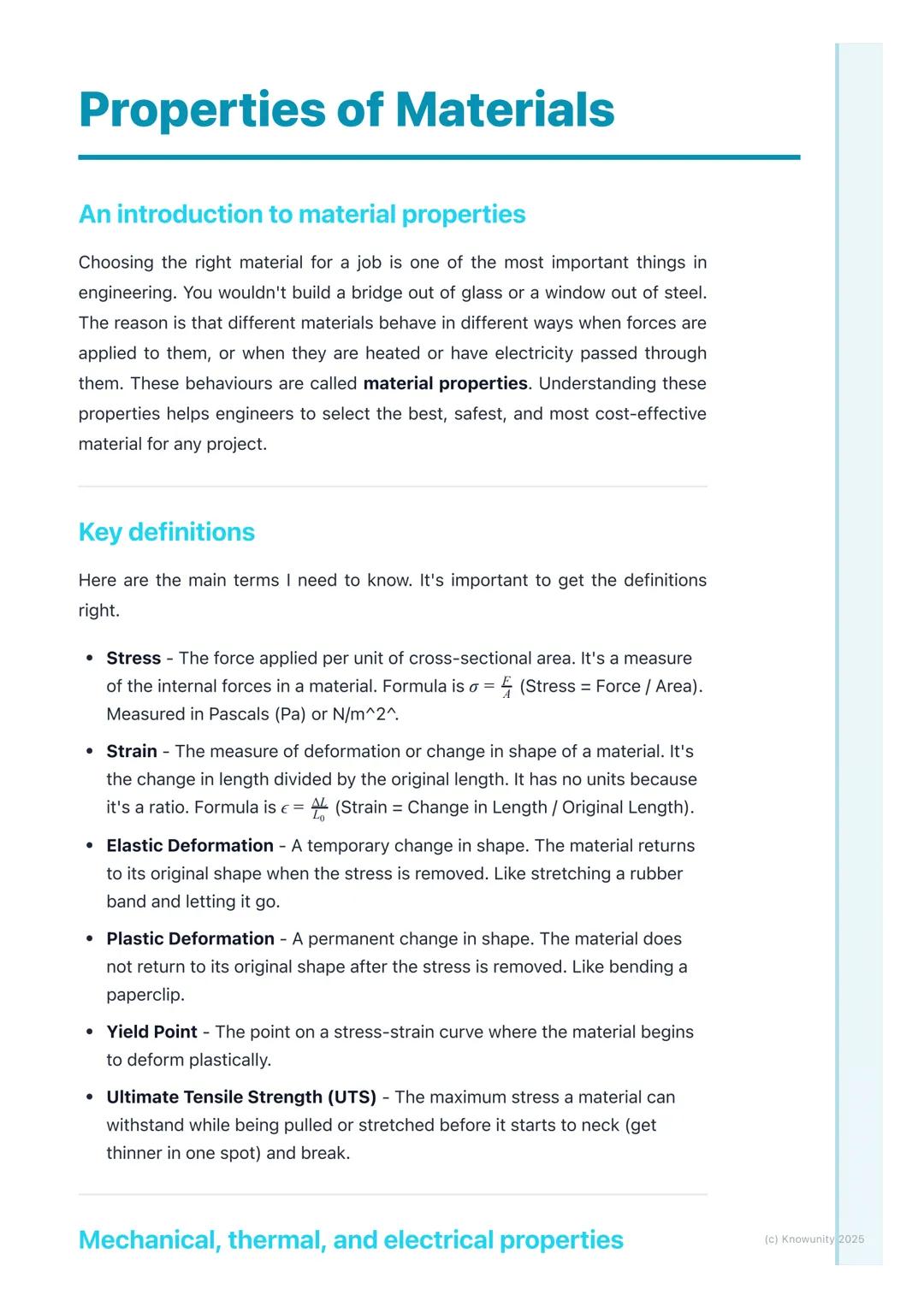
Before diving into specific properties, you need to grasp a few key concepts that form the foundation of materials science. Stress is the force applied per unit area , measured in Pascals. Think of it as how much pressure you're putting on a material.
Strain is how much a material deforms compared to its original size . Unlike stress, strain has no units because it's just a ratio. These two concepts work together to describe how materials respond to forces.
Materials can undergo two types of deformation. Elastic deformation is temporary - like stretching a rubber band that snaps back. Plastic deformation is permanent - like bending a paperclip that stays bent. The yield point marks where elastic becomes plastic, whilst ultimate tensile strength shows the maximum stress before breaking.
Key Insight: Understanding stress and strain is crucial for predicting how any material will behave under real-world conditions.
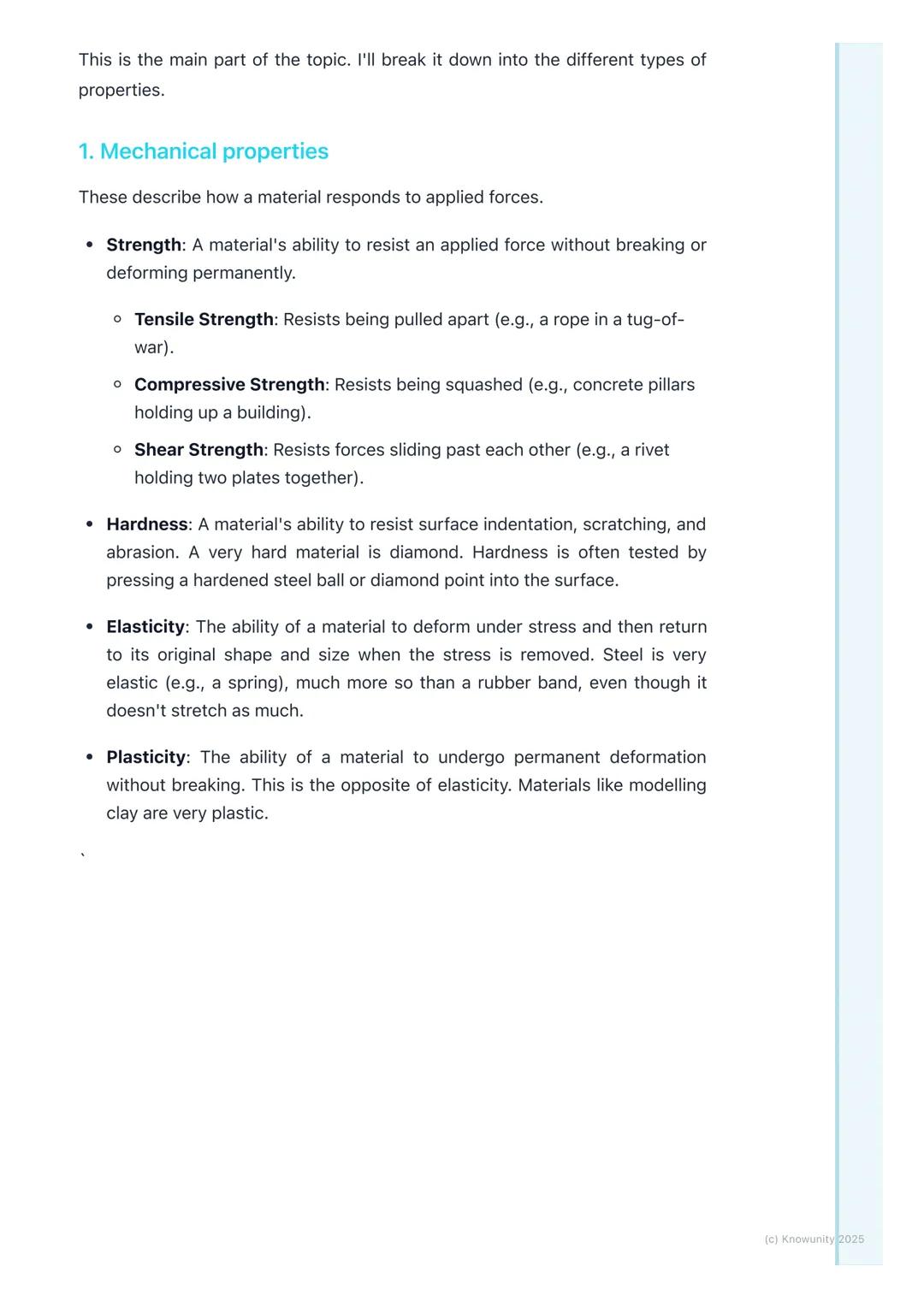
Mechanical properties determine how materials respond to different types of forces, making them essential for engineering applications. Strength describes a material's ability to resist applied forces without breaking or permanently deforming.
There are three main types of strength to remember. Tensile strength resists pulling forces , compressive strength resists crushing forces (concrete pillars), and shear strength resists sliding forces (rivets holding plates together).
Hardness measures resistance to surface damage like scratching or denting - diamond tops this scale. Elasticity allows materials to return to their original shape after deformation, whilst plasticity enables permanent reshaping without breaking.
Don't confuse ductility (ability to be drawn into wires) with malleability (ability to be hammered into sheets). Copper wire demonstrates ductility, whilst aluminium foil shows malleability.
Study Tip: Remember "Ductile = Drawn" and "Malleable = Moulded" to keep these properties straight.
The stress-strain curve is your roadmap for understanding material behaviour under load. The straight portion represents the elastic region where deformation is temporary. After the yield point, you enter the plastic region where changes become permanent.
Toughness combines strength and ductility - it's a material's ability to absorb energy before fracturing. Wrought iron exemplifies toughness, which is why it was perfect for ship anchors. Brittleness sits at the opposite end, describing materials that fracture suddenly with minimal deformation.
Glass and ceramics are classic brittle materials - they simply snap without warning. This brittleness makes them unsuitable for applications requiring impact resistance, despite their impressive compressive strength.
Understanding these properties helps predict failure modes. Tough materials bend and absorb energy before breaking, giving warning signs. Brittle materials fail catastrophically without notice.
Real-World Application: Engineers choose tough materials for safety-critical applications where sudden failure could be dangerous.
Thermal properties describe how materials respond to temperature changes. Thermal conductivity determines how well heat flows through a material - metals like copper excel here, making them perfect for saucepans and radiators.
Materials with low thermal conductivity act as insulators. Wood, plastic, and fibreglass keep heat from transferring, which is why saucepan handles use these materials. Thermal expansion causes materials to change size with temperature - large bridges need expansion joints to prevent buckling in summer heat.
Electrical properties govern how materials interact with electricity. Conductors like copper and silver allow current to flow easily, making them ideal for wiring. Insulators like rubber and plastic resist current flow, providing essential safety in electrical applications.
Semiconductors like silicon sit between conductors and insulators. Their unique properties enable all modern electronics - your phone's processor relies entirely on semiconductor behaviour.
Connect the Dots: The same copper used in electrical wiring also appears in cookware because it conducts both electricity and heat exceptionally well.
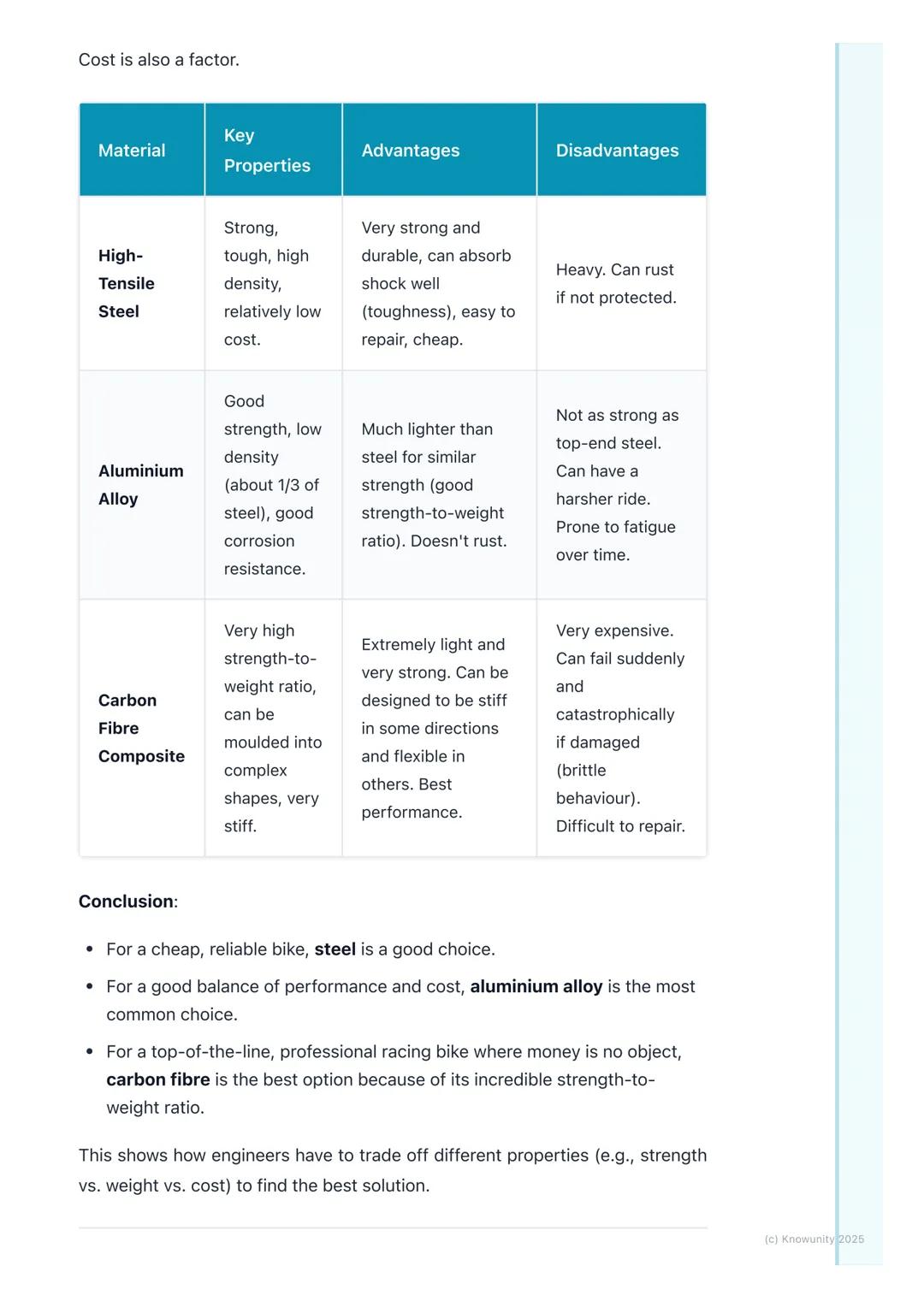
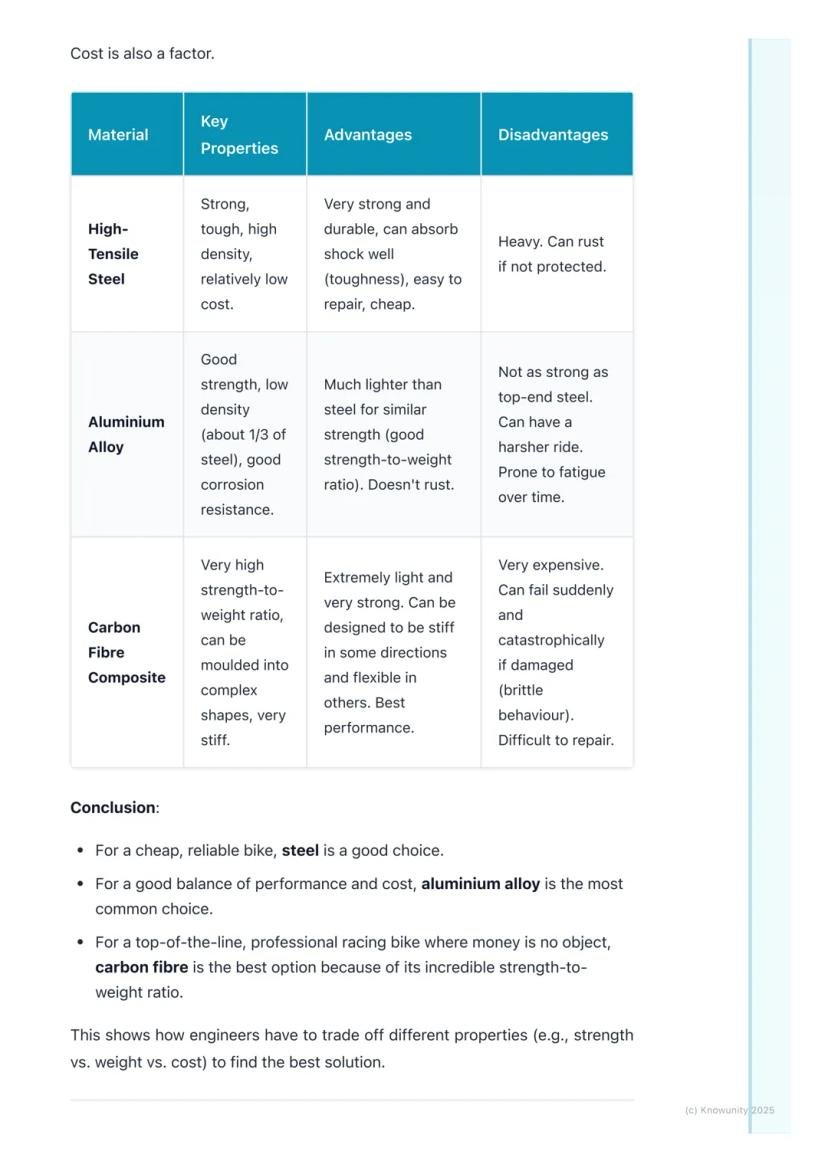
Real engineering involves balancing multiple properties to find the best solution. Consider designing a racing bicycle frame where you need high strength, low weight, and good stiffness whilst managing costs.
High-tensile steel offers excellent strength and toughness at low cost. It's durable, absorbs shock well, and repairs easily. However, steel's high density makes it heavy, and it can rust without protection.
Aluminium alloy provides the best balance for most applications. With about one-third the density of steel but similar strength, it offers an excellent strength-to-weight ratio. It doesn't rust either, though it may provide a harsher ride and can suffer fatigue over time.
Carbon fibre composite represents the premium choice. Its exceptional strength-to-weight ratio and ability to be moulded into complex shapes make it perfect for professional racing. The trade-offs include high cost, brittle failure modes, and difficult repairs.
Engineering Reality: The "best" material depends entirely on your priorities - there's no universal winner.
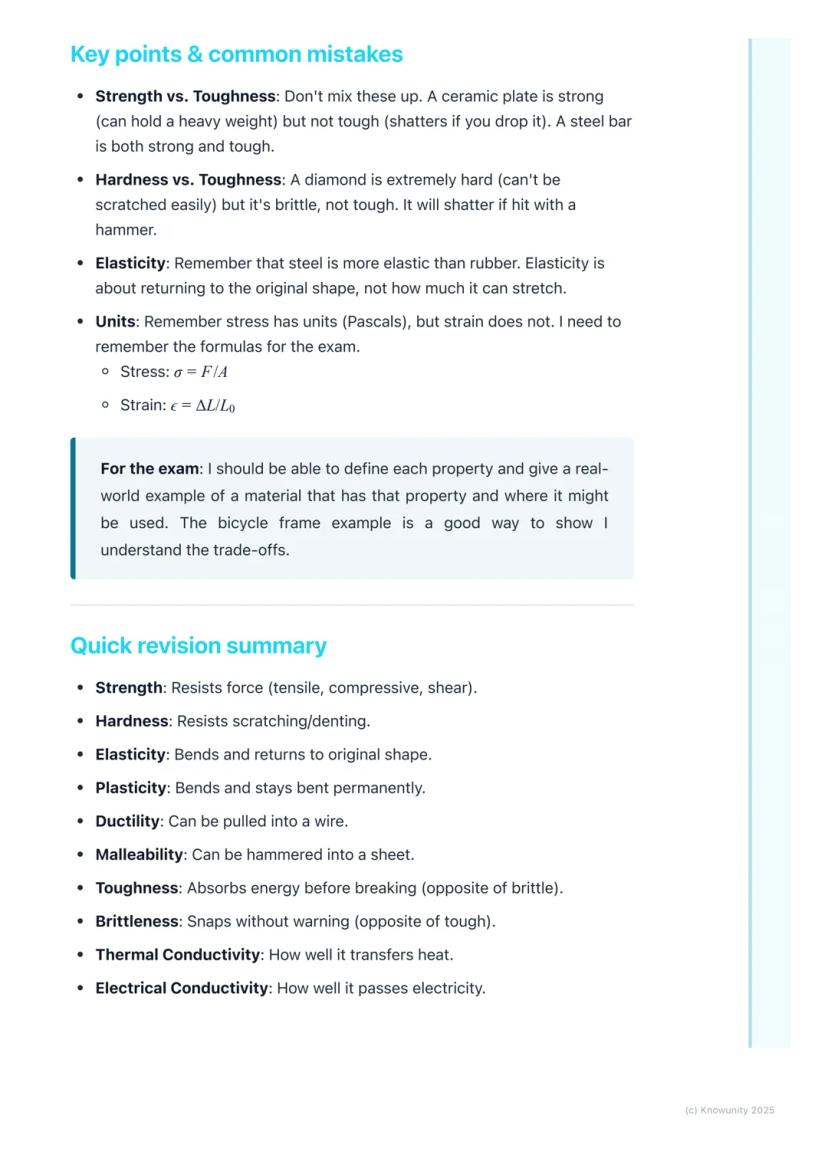
Understanding the differences between similar-sounding properties prevents costly mistakes. Strength versus toughness often confuses students - a ceramic plate can support heavy weight (strong) but shatters when dropped (not tough). Steel bars are both strong and tough.
Hardness versus toughness creates another common mix-up. Diamond is incredibly hard but brittle (shatters easily). Don't assume hard materials are tough. Elasticity also trips up students - steel is more elastic than rubber because elasticity measures the ability to return to original shape, not how much something stretches.
For calculations, remember that stress has units (Pascals) whilst strain is unitless. The formulas σ = F/A and ε = ΔL/L₀ are essential for solving problems.
Master these key properties for quick revision: strength (resists force), hardness (resists scratching), elasticity (returns to shape), plasticity (permanent deformation), ductility , malleability , toughness (energy absorption), brittleness (sudden failure), thermal conductivity (heat transfer), and electrical conductivity (current flow).
Exam Success: Practice identifying real-world examples of each property and explain why specific materials are chosen for particular applications.
O nosso companheiro de aprendizagem com IA foi especificamente criado para as necessidades dos estudantes. Com base nos milhões de conteúdos que temos na plataforma, podemos fornecer respostas verdadeiramente significativas e relevantes para os estudantes. Mas não se trata apenas de respostas, o companheiro foca-se mais em guiar os estudantes através dos seus desafios diários de aprendizagem, com planos de estudo personalizados, quizzes ou conteúdos no chat e 100% de personalização baseada nas habilidades e desenvolvimentos do estudante.
Pode descarregar a aplicação na Google Play Store e na Apple App Store.
Sim, tem acesso gratuito ao conteúdo da aplicação e ao nosso companheiro de IA. Para desbloquear determinadas funcionalidades da aplicação, pode adquirir o Knowunity Pro.
App Store
Google Play
A App é muito fácil de usar e está nem organizada. Encontrei tudo o que estava à procura até agora e consegui aprender muito com as apresentações! Vou usar a app para um trabalho escolar! E claro que também me ajuda muito como inspiração.
João S
utilizador iOS
Esta app é realmente incrível. Há tantas anotações de estudo e ajuda [...]. A minha disciplina problemática é Francês, por exemplo, e a app tem muitas opções de ajuda. Graças a esta app, melhorei o meu Francês. Eu recomendo a qualquer pessoa.
Sara C.
utilizadora Android
Uau, estou realmente impressionado. Acabei de experimentar o app porque o vi anunciado muitas vezes e fiquei absolutamente surpreso. Este app é A AJUDA que você quer para a escola e, acima de tudo, oferece tantas coisas, como exercícios e folhas de fatos, que têm sido MUITO úteis para mim pessoalmente.
Ana
utilizadora iOS
Eu costumava ter dificuldade para completar os meus trabalhos a tempo até descobrir a Knowunity, que não só facilita o upload do meu próprio conteúdo, mas também oferece ótimos resumos que tornam o meu trabalho mais rápido e eficiente.
Tomás R
utilizador iOS
Sempre foi um desafio encontrar todas as informações importantes para os meus trabalhos – desde que comecei a usar a Knowunity, posso simplesmente fazer upload do meu conteúdo e aproveitar os resumos dos outros, o que me ajuda muito com a organização.
Luísa M
utilizadora Android
Eu frequentemente sentia que não tinha uma visão geral suficiente ao estudar, mas desde que comecei a usar o Knowunity, isso não acontece mais – faço upload do meu conteúdo e encontro sempre resumos úteis na plataforma, o que torna meu aprendizado muito mais fácil.
David F
utilizador iOS
O app é simplesmente incrível! Só preciso digitar o tema na barra de pesquisa e recebo a resposta super rápido. Não preciso assistir 10 vídeos no YouTube para entender algo, então economizo meu tempo. Super recomendo!
Marco O
utilizador Android
Na escola eu era péssimo em matemática, mas graças ao app, estou me saindo melhor agora. Sou muito grato por vocês terem criado o app.
André B
utilizador Android
Costumava ser muito difícil reunir todas as informações para minhas apresentações. Mas desde que comecei a usar o Knowunity, só preciso de carregar os meus apontamentos e encontrar resumos incríveis de outros - isso torna meu estudo muito mais eficiente!
Júlia S
utilizadora Android
Estava constantemente stressado com todo o material de estudo, mas desde que comecei a usar a Knowunity, carrego as minhas coisas e vejo os resumos dos outros - isto ajuda-me a gerir tudo melhor e é muito menos stressante.
Marco B
utilizador iOS
OS QUESTIONÁRIOS E CARTÕES DE ESTUDO SÃO TÃO ÚTEIS E ADORO A IA DA Knowunity. TAMBÉM É LITERALMENTE COMO O CHATGPT MAS MAIS INTELIGENTE!! AJUDOU-ME ATÉ COM OS MEUS PROBLEMAS DE RÍMEL!! ASSIM COMO COM AS MINHAS CADEIRAS A SÉRIO! OBVIO 😍😁😲🤑💗✨🎀😮
Sarah L
utilizadora Android
Eu costumava passar horas no Google à procura de materiais escolares, mas agora só carrego as minhas coisas na Knowunity e vejo os resumos dos outros - sinto-me muito mais confiante quando me preparo para testes.
Paulo T
utilizador iOS
A App é muito fácil de usar e está nem organizada. Encontrei tudo o que estava à procura até agora e consegui aprender muito com as apresentações! Vou usar a app para um trabalho escolar! E claro que também me ajuda muito como inspiração.
João S
utilizador iOS
Esta app é realmente incrível. Há tantas anotações de estudo e ajuda [...]. A minha disciplina problemática é Francês, por exemplo, e a app tem muitas opções de ajuda. Graças a esta app, melhorei o meu Francês. Eu recomendo a qualquer pessoa.
Sara C.
utilizadora Android
Uau, estou realmente impressionado. Acabei de experimentar o app porque o vi anunciado muitas vezes e fiquei absolutamente surpreso. Este app é A AJUDA que você quer para a escola e, acima de tudo, oferece tantas coisas, como exercícios e folhas de fatos, que têm sido MUITO úteis para mim pessoalmente.
Ana
utilizadora iOS
Eu costumava ter dificuldade para completar os meus trabalhos a tempo até descobrir a Knowunity, que não só facilita o upload do meu próprio conteúdo, mas também oferece ótimos resumos que tornam o meu trabalho mais rápido e eficiente.
Tomás R
utilizador iOS
Sempre foi um desafio encontrar todas as informações importantes para os meus trabalhos – desde que comecei a usar a Knowunity, posso simplesmente fazer upload do meu conteúdo e aproveitar os resumos dos outros, o que me ajuda muito com a organização.
Luísa M
utilizadora Android
Eu frequentemente sentia que não tinha uma visão geral suficiente ao estudar, mas desde que comecei a usar o Knowunity, isso não acontece mais – faço upload do meu conteúdo e encontro sempre resumos úteis na plataforma, o que torna meu aprendizado muito mais fácil.
David F
utilizador iOS
O app é simplesmente incrível! Só preciso digitar o tema na barra de pesquisa e recebo a resposta super rápido. Não preciso assistir 10 vídeos no YouTube para entender algo, então economizo meu tempo. Super recomendo!
Marco O
utilizador Android
Na escola eu era péssimo em matemática, mas graças ao app, estou me saindo melhor agora. Sou muito grato por vocês terem criado o app.
André B
utilizador Android
Costumava ser muito difícil reunir todas as informações para minhas apresentações. Mas desde que comecei a usar o Knowunity, só preciso de carregar os meus apontamentos e encontrar resumos incríveis de outros - isso torna meu estudo muito mais eficiente!
Júlia S
utilizadora Android
Estava constantemente stressado com todo o material de estudo, mas desde que comecei a usar a Knowunity, carrego as minhas coisas e vejo os resumos dos outros - isto ajuda-me a gerir tudo melhor e é muito menos stressante.
Marco B
utilizador iOS
OS QUESTIONÁRIOS E CARTÕES DE ESTUDO SÃO TÃO ÚTEIS E ADORO A IA DA Knowunity. TAMBÉM É LITERALMENTE COMO O CHATGPT MAS MAIS INTELIGENTE!! AJUDOU-ME ATÉ COM OS MEUS PROBLEMAS DE RÍMEL!! ASSIM COMO COM AS MINHAS CADEIRAS A SÉRIO! OBVIO 😍😁😲🤑💗✨🎀😮
Sarah L
utilizadora Android
Eu costumava passar horas no Google à procura de materiais escolares, mas agora só carrego as minhas coisas na Knowunity e vejo os resumos dos outros - sinto-me muito mais confiante quando me preparo para testes.
Paulo T
utilizador iOS
Ever wondered why bridges aren't made of glass or why electrical wires use copper instead of plastic? The secret lies in understanding material properties- the specific ways different materials behave when forces, heat, or electricity are applied to them.... Mostrar mais
Acesso a todos os documentos
Melhore suas notas
Junte-se a milhões de estudantes
Before diving into specific properties, you need to grasp a few key concepts that form the foundation of materials science. Stress is the force applied per unit area , measured in Pascals. Think of it as how much pressure you're putting on a material.
Strain is how much a material deforms compared to its original size . Unlike stress, strain has no units because it's just a ratio. These two concepts work together to describe how materials respond to forces.
Materials can undergo two types of deformation. Elastic deformation is temporary - like stretching a rubber band that snaps back. Plastic deformation is permanent - like bending a paperclip that stays bent. The yield point marks where elastic becomes plastic, whilst ultimate tensile strength shows the maximum stress before breaking.
Key Insight: Understanding stress and strain is crucial for predicting how any material will behave under real-world conditions.
Acesso a todos os documentos
Melhore suas notas
Junte-se a milhões de estudantes
Mechanical properties determine how materials respond to different types of forces, making them essential for engineering applications. Strength describes a material's ability to resist applied forces without breaking or permanently deforming.
There are three main types of strength to remember. Tensile strength resists pulling forces , compressive strength resists crushing forces (concrete pillars), and shear strength resists sliding forces (rivets holding plates together).
Hardness measures resistance to surface damage like scratching or denting - diamond tops this scale. Elasticity allows materials to return to their original shape after deformation, whilst plasticity enables permanent reshaping without breaking.
Don't confuse ductility (ability to be drawn into wires) with malleability (ability to be hammered into sheets). Copper wire demonstrates ductility, whilst aluminium foil shows malleability.
Study Tip: Remember "Ductile = Drawn" and "Malleable = Moulded" to keep these properties straight.
Acesso a todos os documentos
Melhore suas notas
Junte-se a milhões de estudantes
The stress-strain curve is your roadmap for understanding material behaviour under load. The straight portion represents the elastic region where deformation is temporary. After the yield point, you enter the plastic region where changes become permanent.
Toughness combines strength and ductility - it's a material's ability to absorb energy before fracturing. Wrought iron exemplifies toughness, which is why it was perfect for ship anchors. Brittleness sits at the opposite end, describing materials that fracture suddenly with minimal deformation.
Glass and ceramics are classic brittle materials - they simply snap without warning. This brittleness makes them unsuitable for applications requiring impact resistance, despite their impressive compressive strength.
Understanding these properties helps predict failure modes. Tough materials bend and absorb energy before breaking, giving warning signs. Brittle materials fail catastrophically without notice.
Real-World Application: Engineers choose tough materials for safety-critical applications where sudden failure could be dangerous.
Acesso a todos os documentos
Melhore suas notas
Junte-se a milhões de estudantes
Thermal properties describe how materials respond to temperature changes. Thermal conductivity determines how well heat flows through a material - metals like copper excel here, making them perfect for saucepans and radiators.
Materials with low thermal conductivity act as insulators. Wood, plastic, and fibreglass keep heat from transferring, which is why saucepan handles use these materials. Thermal expansion causes materials to change size with temperature - large bridges need expansion joints to prevent buckling in summer heat.
Electrical properties govern how materials interact with electricity. Conductors like copper and silver allow current to flow easily, making them ideal for wiring. Insulators like rubber and plastic resist current flow, providing essential safety in electrical applications.
Semiconductors like silicon sit between conductors and insulators. Their unique properties enable all modern electronics - your phone's processor relies entirely on semiconductor behaviour.
Connect the Dots: The same copper used in electrical wiring also appears in cookware because it conducts both electricity and heat exceptionally well.
Acesso a todos os documentos
Melhore suas notas
Junte-se a milhões de estudantes
Real engineering involves balancing multiple properties to find the best solution. Consider designing a racing bicycle frame where you need high strength, low weight, and good stiffness whilst managing costs.
High-tensile steel offers excellent strength and toughness at low cost. It's durable, absorbs shock well, and repairs easily. However, steel's high density makes it heavy, and it can rust without protection.
Aluminium alloy provides the best balance for most applications. With about one-third the density of steel but similar strength, it offers an excellent strength-to-weight ratio. It doesn't rust either, though it may provide a harsher ride and can suffer fatigue over time.
Carbon fibre composite represents the premium choice. Its exceptional strength-to-weight ratio and ability to be moulded into complex shapes make it perfect for professional racing. The trade-offs include high cost, brittle failure modes, and difficult repairs.
Engineering Reality: The "best" material depends entirely on your priorities - there's no universal winner.
Acesso a todos os documentos
Melhore suas notas
Junte-se a milhões de estudantes
Understanding the differences between similar-sounding properties prevents costly mistakes. Strength versus toughness often confuses students - a ceramic plate can support heavy weight (strong) but shatters when dropped (not tough). Steel bars are both strong and tough.
Hardness versus toughness creates another common mix-up. Diamond is incredibly hard but brittle (shatters easily). Don't assume hard materials are tough. Elasticity also trips up students - steel is more elastic than rubber because elasticity measures the ability to return to original shape, not how much something stretches.
For calculations, remember that stress has units (Pascals) whilst strain is unitless. The formulas σ = F/A and ε = ΔL/L₀ are essential for solving problems.
Master these key properties for quick revision: strength (resists force), hardness (resists scratching), elasticity (returns to shape), plasticity (permanent deformation), ductility , malleability , toughness (energy absorption), brittleness (sudden failure), thermal conductivity (heat transfer), and electrical conductivity (current flow).
Exam Success: Practice identifying real-world examples of each property and explain why specific materials are chosen for particular applications.
O nosso companheiro de aprendizagem com IA foi especificamente criado para as necessidades dos estudantes. Com base nos milhões de conteúdos que temos na plataforma, podemos fornecer respostas verdadeiramente significativas e relevantes para os estudantes. Mas não se trata apenas de respostas, o companheiro foca-se mais em guiar os estudantes através dos seus desafios diários de aprendizagem, com planos de estudo personalizados, quizzes ou conteúdos no chat e 100% de personalização baseada nas habilidades e desenvolvimentos do estudante.
Pode descarregar a aplicação na Google Play Store e na Apple App Store.
Sim, tem acesso gratuito ao conteúdo da aplicação e ao nosso companheiro de IA. Para desbloquear determinadas funcionalidades da aplicação, pode adquirir o Knowunity Pro.
0
Ferramentas Inteligentes NOVO
Transforma estes apontamentos em: ✓ 50+ Questões de Prática ✓ Cartões de Estudo Interactivos ✓ Exame Simulado Completo ✓ Esquemas de Ensaio
App Store
Google Play
A App é muito fácil de usar e está nem organizada. Encontrei tudo o que estava à procura até agora e consegui aprender muito com as apresentações! Vou usar a app para um trabalho escolar! E claro que também me ajuda muito como inspiração.
João S
utilizador iOS
Esta app é realmente incrível. Há tantas anotações de estudo e ajuda [...]. A minha disciplina problemática é Francês, por exemplo, e a app tem muitas opções de ajuda. Graças a esta app, melhorei o meu Francês. Eu recomendo a qualquer pessoa.
Sara C.
utilizadora Android
Uau, estou realmente impressionado. Acabei de experimentar o app porque o vi anunciado muitas vezes e fiquei absolutamente surpreso. Este app é A AJUDA que você quer para a escola e, acima de tudo, oferece tantas coisas, como exercícios e folhas de fatos, que têm sido MUITO úteis para mim pessoalmente.
Ana
utilizadora iOS
Eu costumava ter dificuldade para completar os meus trabalhos a tempo até descobrir a Knowunity, que não só facilita o upload do meu próprio conteúdo, mas também oferece ótimos resumos que tornam o meu trabalho mais rápido e eficiente.
Tomás R
utilizador iOS
Sempre foi um desafio encontrar todas as informações importantes para os meus trabalhos – desde que comecei a usar a Knowunity, posso simplesmente fazer upload do meu conteúdo e aproveitar os resumos dos outros, o que me ajuda muito com a organização.
Luísa M
utilizadora Android
Eu frequentemente sentia que não tinha uma visão geral suficiente ao estudar, mas desde que comecei a usar o Knowunity, isso não acontece mais – faço upload do meu conteúdo e encontro sempre resumos úteis na plataforma, o que torna meu aprendizado muito mais fácil.
David F
utilizador iOS
O app é simplesmente incrível! Só preciso digitar o tema na barra de pesquisa e recebo a resposta super rápido. Não preciso assistir 10 vídeos no YouTube para entender algo, então economizo meu tempo. Super recomendo!
Marco O
utilizador Android
Na escola eu era péssimo em matemática, mas graças ao app, estou me saindo melhor agora. Sou muito grato por vocês terem criado o app.
André B
utilizador Android
Costumava ser muito difícil reunir todas as informações para minhas apresentações. Mas desde que comecei a usar o Knowunity, só preciso de carregar os meus apontamentos e encontrar resumos incríveis de outros - isso torna meu estudo muito mais eficiente!
Júlia S
utilizadora Android
Estava constantemente stressado com todo o material de estudo, mas desde que comecei a usar a Knowunity, carrego as minhas coisas e vejo os resumos dos outros - isto ajuda-me a gerir tudo melhor e é muito menos stressante.
Marco B
utilizador iOS
OS QUESTIONÁRIOS E CARTÕES DE ESTUDO SÃO TÃO ÚTEIS E ADORO A IA DA Knowunity. TAMBÉM É LITERALMENTE COMO O CHATGPT MAS MAIS INTELIGENTE!! AJUDOU-ME ATÉ COM OS MEUS PROBLEMAS DE RÍMEL!! ASSIM COMO COM AS MINHAS CADEIRAS A SÉRIO! OBVIO 😍😁😲🤑💗✨🎀😮
Sarah L
utilizadora Android
Eu costumava passar horas no Google à procura de materiais escolares, mas agora só carrego as minhas coisas na Knowunity e vejo os resumos dos outros - sinto-me muito mais confiante quando me preparo para testes.
Paulo T
utilizador iOS
A App é muito fácil de usar e está nem organizada. Encontrei tudo o que estava à procura até agora e consegui aprender muito com as apresentações! Vou usar a app para um trabalho escolar! E claro que também me ajuda muito como inspiração.
João S
utilizador iOS
Esta app é realmente incrível. Há tantas anotações de estudo e ajuda [...]. A minha disciplina problemática é Francês, por exemplo, e a app tem muitas opções de ajuda. Graças a esta app, melhorei o meu Francês. Eu recomendo a qualquer pessoa.
Sara C.
utilizadora Android
Uau, estou realmente impressionado. Acabei de experimentar o app porque o vi anunciado muitas vezes e fiquei absolutamente surpreso. Este app é A AJUDA que você quer para a escola e, acima de tudo, oferece tantas coisas, como exercícios e folhas de fatos, que têm sido MUITO úteis para mim pessoalmente.
Ana
utilizadora iOS
Eu costumava ter dificuldade para completar os meus trabalhos a tempo até descobrir a Knowunity, que não só facilita o upload do meu próprio conteúdo, mas também oferece ótimos resumos que tornam o meu trabalho mais rápido e eficiente.
Tomás R
utilizador iOS
Sempre foi um desafio encontrar todas as informações importantes para os meus trabalhos – desde que comecei a usar a Knowunity, posso simplesmente fazer upload do meu conteúdo e aproveitar os resumos dos outros, o que me ajuda muito com a organização.
Luísa M
utilizadora Android
Eu frequentemente sentia que não tinha uma visão geral suficiente ao estudar, mas desde que comecei a usar o Knowunity, isso não acontece mais – faço upload do meu conteúdo e encontro sempre resumos úteis na plataforma, o que torna meu aprendizado muito mais fácil.
David F
utilizador iOS
O app é simplesmente incrível! Só preciso digitar o tema na barra de pesquisa e recebo a resposta super rápido. Não preciso assistir 10 vídeos no YouTube para entender algo, então economizo meu tempo. Super recomendo!
Marco O
utilizador Android
Na escola eu era péssimo em matemática, mas graças ao app, estou me saindo melhor agora. Sou muito grato por vocês terem criado o app.
André B
utilizador Android
Costumava ser muito difícil reunir todas as informações para minhas apresentações. Mas desde que comecei a usar o Knowunity, só preciso de carregar os meus apontamentos e encontrar resumos incríveis de outros - isso torna meu estudo muito mais eficiente!
Júlia S
utilizadora Android
Estava constantemente stressado com todo o material de estudo, mas desde que comecei a usar a Knowunity, carrego as minhas coisas e vejo os resumos dos outros - isto ajuda-me a gerir tudo melhor e é muito menos stressante.
Marco B
utilizador iOS
OS QUESTIONÁRIOS E CARTÕES DE ESTUDO SÃO TÃO ÚTEIS E ADORO A IA DA Knowunity. TAMBÉM É LITERALMENTE COMO O CHATGPT MAS MAIS INTELIGENTE!! AJUDOU-ME ATÉ COM OS MEUS PROBLEMAS DE RÍMEL!! ASSIM COMO COM AS MINHAS CADEIRAS A SÉRIO! OBVIO 😍😁😲🤑💗✨🎀😮
Sarah L
utilizadora Android
Eu costumava passar horas no Google à procura de materiais escolares, mas agora só carrego as minhas coisas na Knowunity e vejo os resumos dos outros - sinto-me muito mais confiante quando me preparo para testes.
Paulo T
utilizador iOS