
The Sustainable Development Goals (SDGs) are basically the world's to-do...
 CSPE15 visualizações·Atualizado Jun 12, 2026·6 páginas
Understanding the United Nations' Sustainable Development Goals

1 / 6
1
of 6
What Are the Sustainable Development Goals?
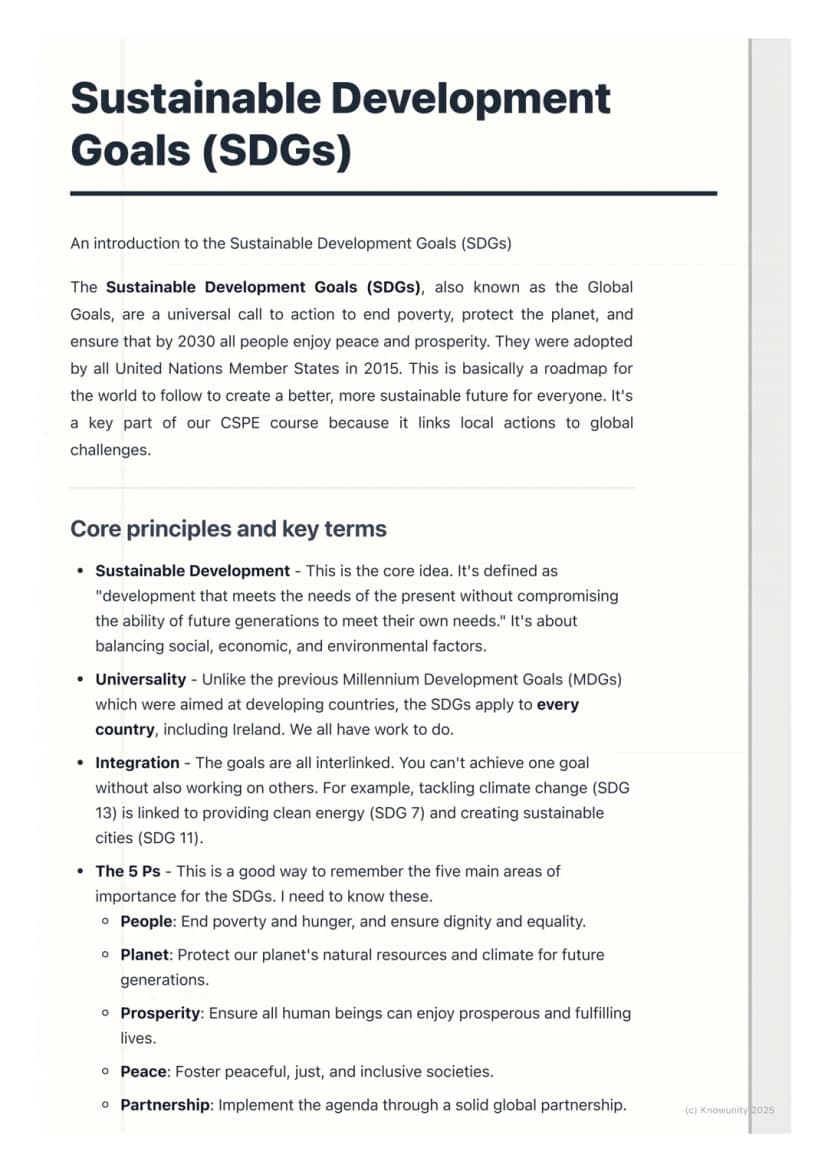
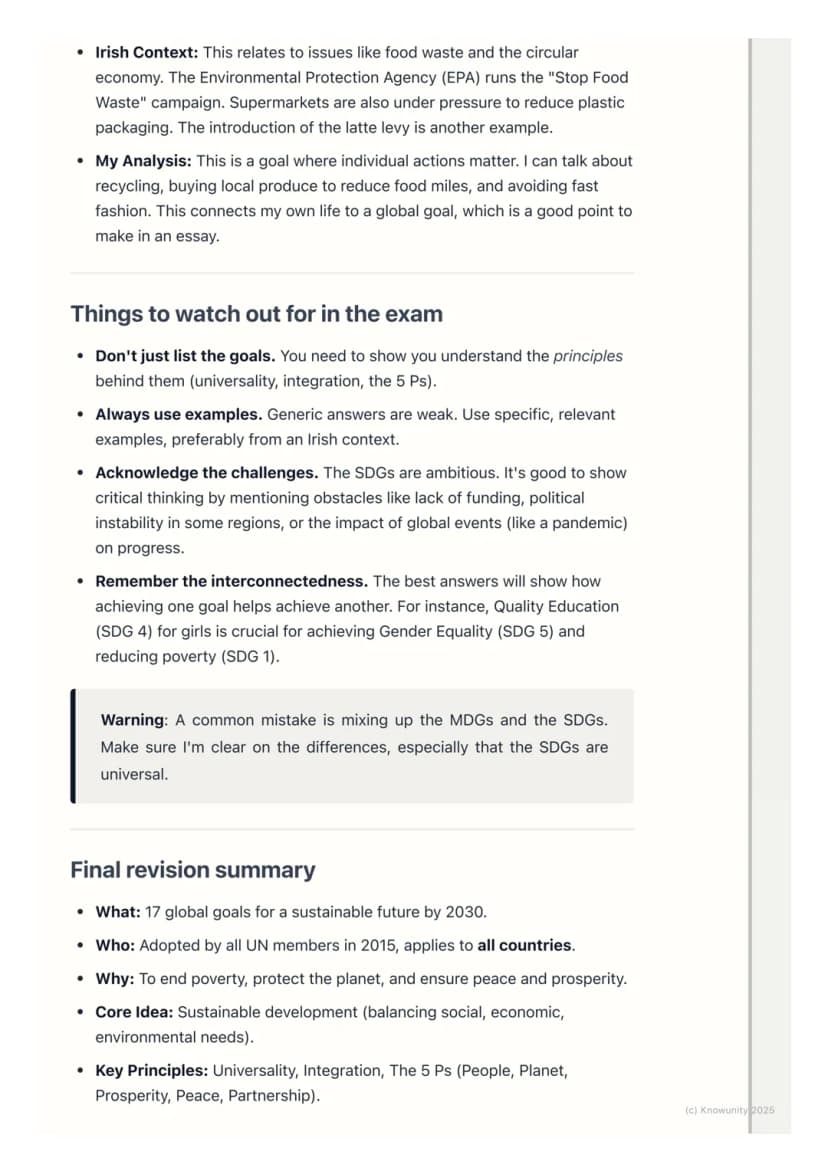
Think of the SDGs as the world's biggest group project - every single UN member country signed up in 2015 to work towards 17 ambitious goals by 2030. Unlike previous global initiatives that only focused on poorer countries, these goals apply to everyone, including Ireland.
The core idea is sustainable development - meeting today's needs without screwing over future generations. It's all about finding the right balance between social needs, economic growth, and protecting the environment.
The beauty of these goals is that they're all connected. You can't solve climate change without tackling poverty, and you can't achieve gender equality without ensuring quality education for everyone.
Quick Tip: Remember the 5 Ps - People, Planet, Prosperity, Peace, and Partnership. These cover all the main areas the SDGs focus on, and they're likely to come up in your exam!
2
of 6
The 17 Goals Breakdown
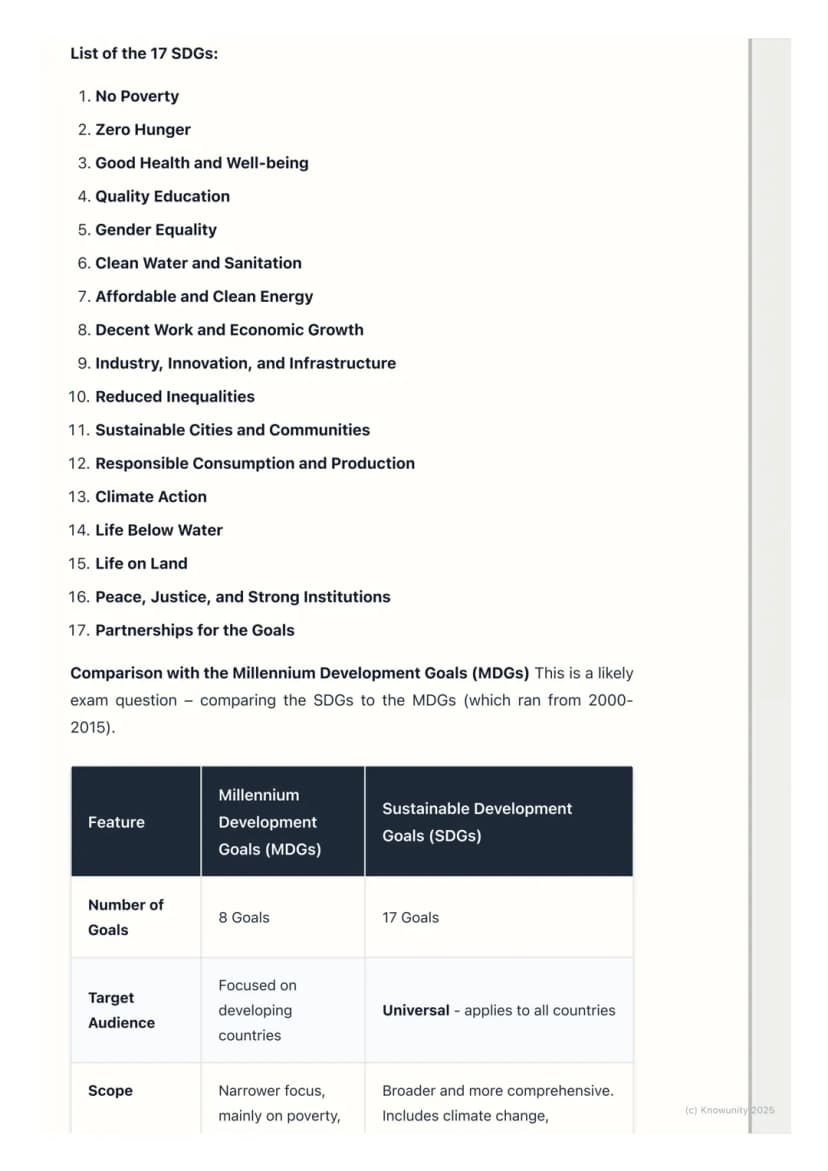
Here's what the world is working towards: No Poverty, Zero Hunger, Good Health and Well-being, Quality Education, Gender Equality, Clean Water and Sanitation, Affordable and Clean Energy, Decent Work and Economic Growth, Industry Innovation and Infrastructure, Reduced Inequalities, Sustainable Cities and Communities, Responsible Consumption and Production, Climate Action, Life Below Water, Life on Land, Peace Justice and Strong Institutions, and Partnerships for the Goals.
These aren't legally binding - think of them more as a framework that countries use to create their own action plans. Governments are expected to take ownership and figure out how to achieve these goals in their own context.
The goals are universal (apply to all countries) and integrated (all interconnected). This makes them much more comprehensive than the previous Millennium Development Goals, which only had 8 goals and mainly focused on developing countries.
Exam Alert: You'll likely be asked to compare the SDGs with the older MDGs. Remember: SDGs are broader, apply to everyone, and were developed with input from millions of people worldwide.
3
of 6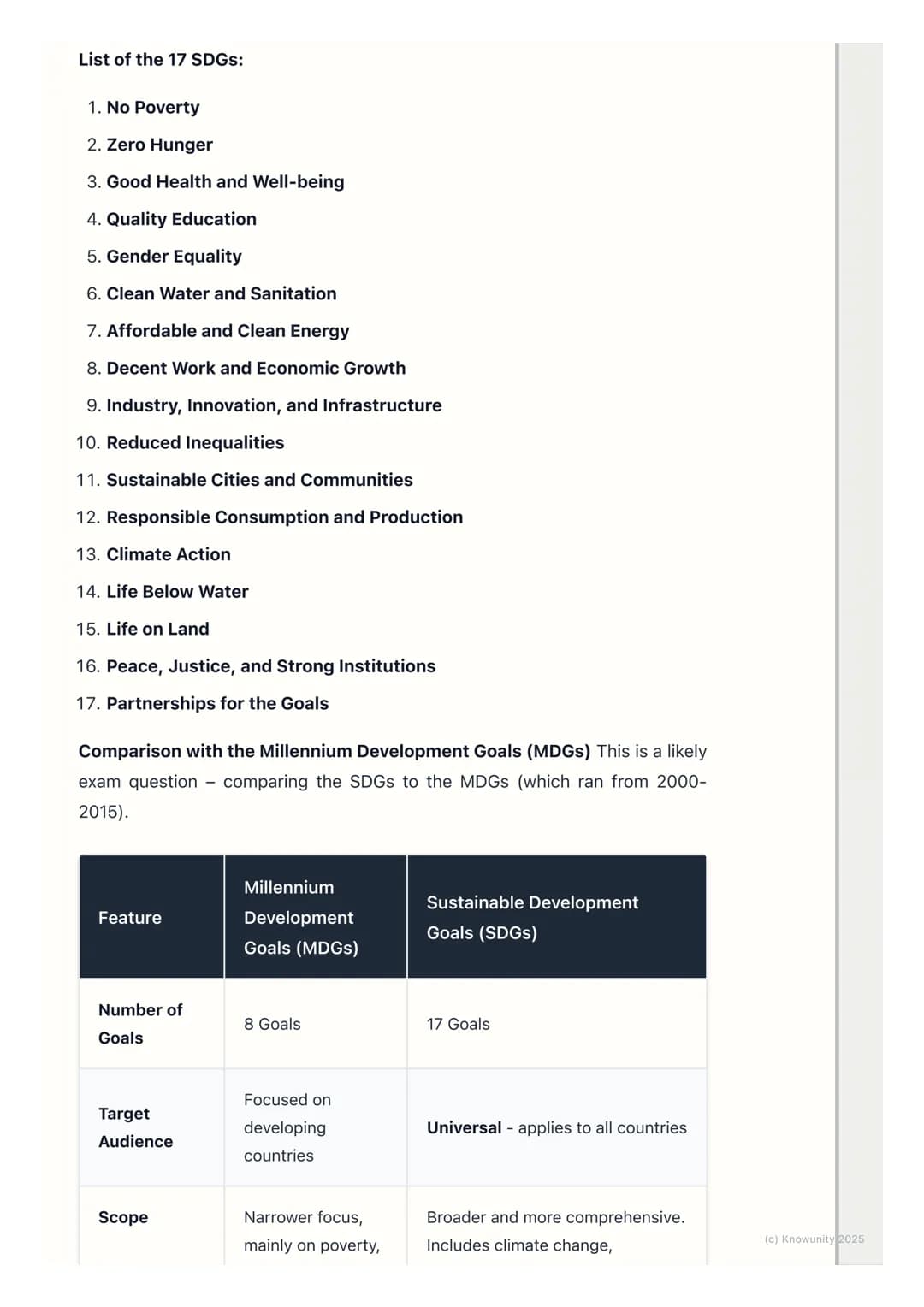
SDGs vs MDGs - What Changed?
The Millennium Development Goals (2000-2015) were the SDGs' predecessor, but they were quite different. The MDGs had only 8 goals, focused mainly on developing countries, and were created by a small group of experts using a top-down approach.
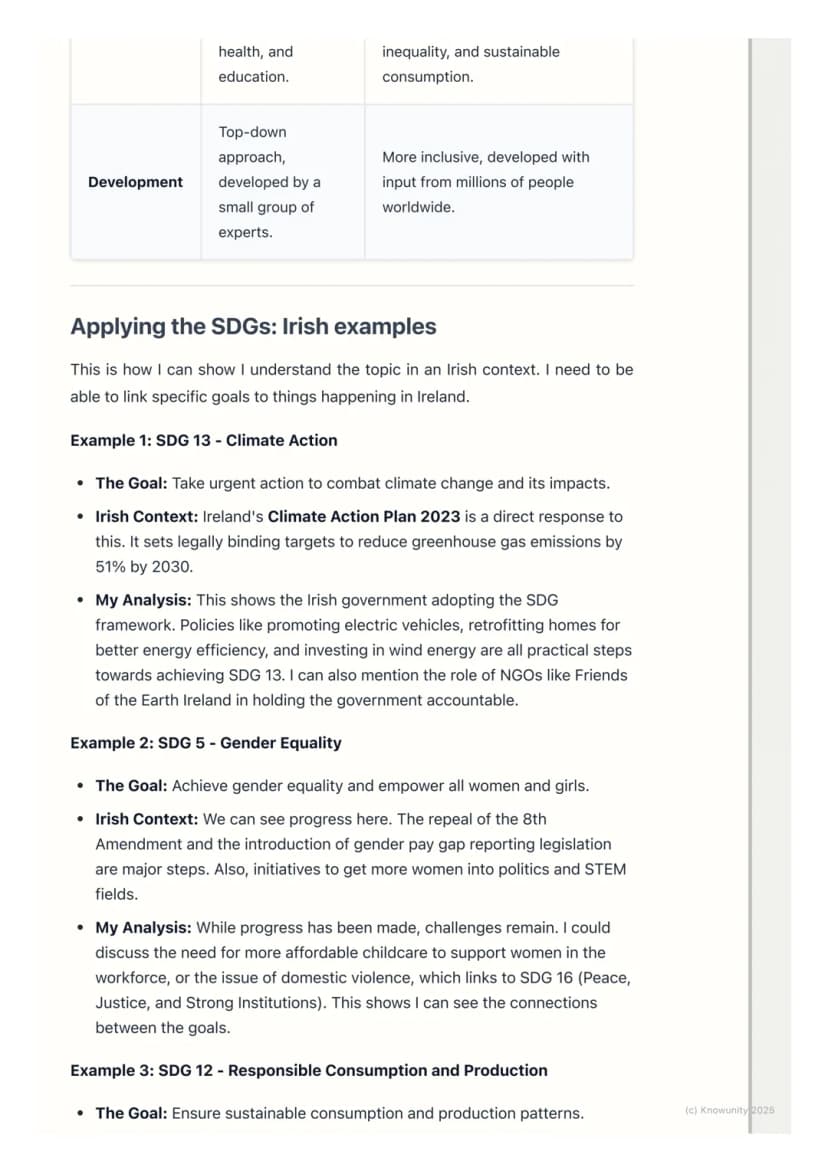
The SDGs expanded to 17 goals, apply universally to all countries, and were developed through a much more inclusive process with input from millions of people worldwide. They also cover much broader issues - while MDGs focused mainly on poverty, health, and education, SDGs include climate change, inequality, and sustainable consumption.
This shift shows how global thinking evolved. The world realised that challenges like climate change and inequality affect everyone, not just poorer countries. Ireland faces these same challenges and has a role to play in solving them.
The integration principle is crucial - the goals are designed to work together. For example, providing quality education (SDG 4) for girls directly supports gender equality (SDG 5) and helps reduce poverty (SDG 1).
Pro Tip: Don't just memorise the differences - understand why they changed. The world became more interconnected, and global challenges required global solutions.
4
of 6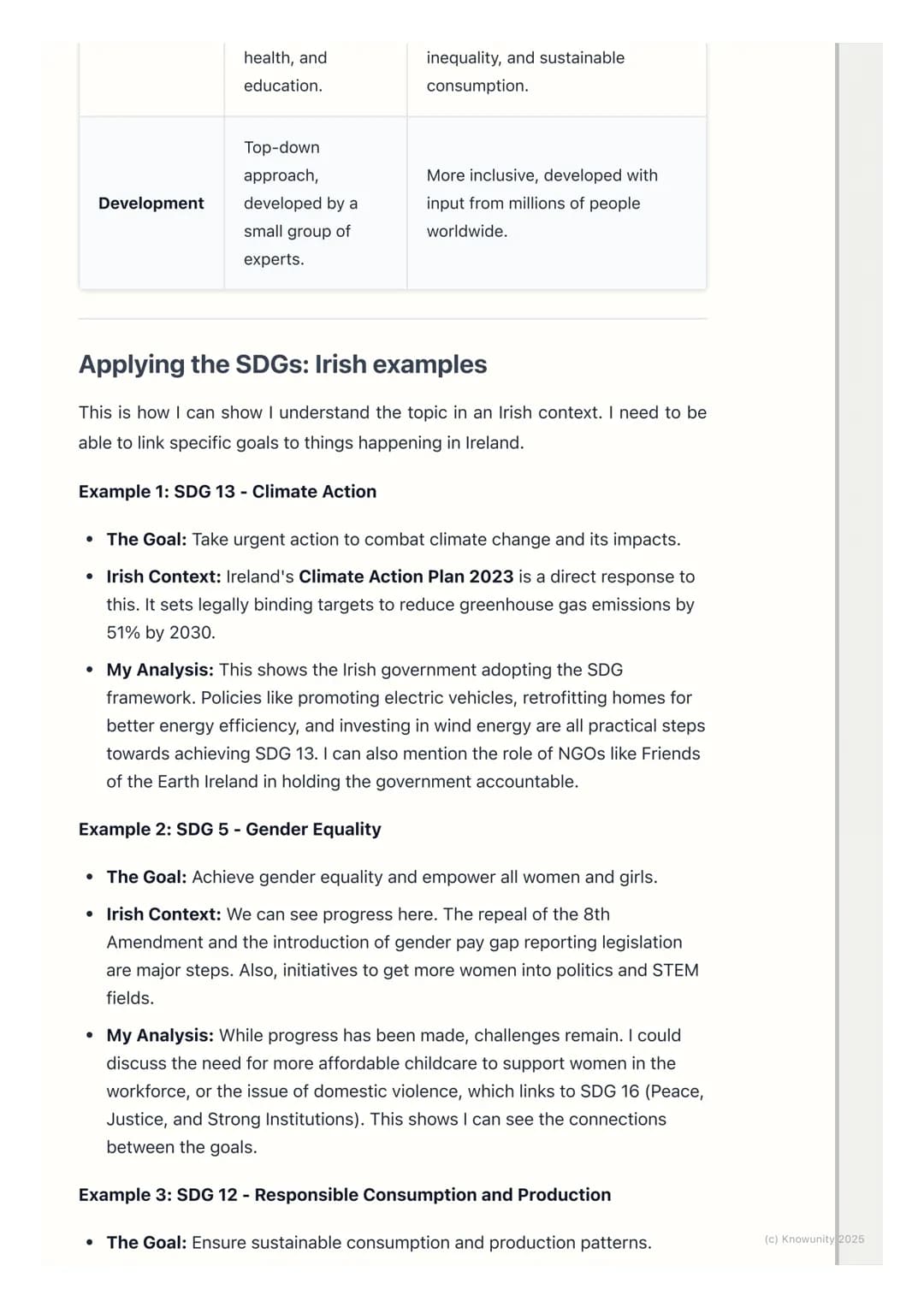
SDGs in Action - Irish Examples
Climate Action (SDG 13) is huge in Ireland right now. Our Climate Action Plan 2023 sets legally binding targets to cut greenhouse gas emissions by 51% by 2030. You can see this in policies promoting electric vehicles, home retrofitting for energy efficiency, and massive investment in wind energy.
Gender Equality (SDG 5) has seen major progress here. The repeal of the 8th Amendment and new gender pay gap reporting laws show Ireland taking this goal seriously. However, challenges remain around affordable childcare and domestic violence rates.
Responsible Consumption and Production (SDG 12) connects directly to your daily life. The EPA's "Stop Food Waste" campaign, pressure on supermarkets to reduce plastic packaging, and the introduction of charges on disposable cups all tackle this goal.
These examples show how global goals translate into local action. When you recycle, buy local produce, or support renewable energy, you're contributing to achieving the SDGs.
Essay Gold: Always use specific Irish examples in your answers. Generic responses won't impress examiners - show you understand how these global goals apply to Ireland specifically.
5
of 6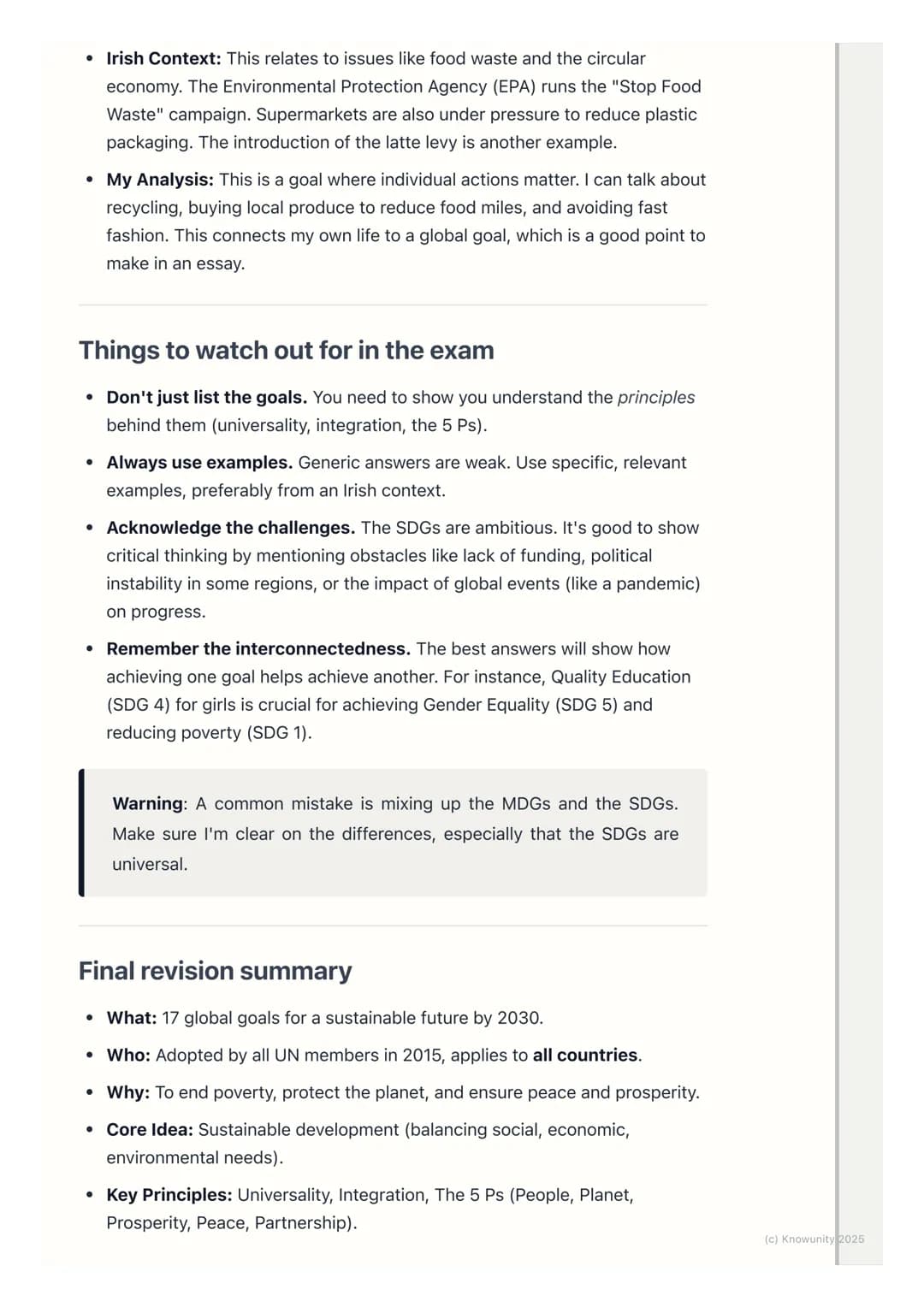
Challenges and Critical Thinking
The SDGs are incredibly ambitious - maybe too ambitious. Funding is a massive issue, especially for developing countries. Political instability, corruption, and global crises like pandemics can completely derail progress.
Even in Ireland, we're struggling with some goals. Our housing crisis makes Sustainable Cities and Communities (SDG 11) challenging to achieve. Climate targets are ambitious but require massive behaviour changes from everyone.
The interconnected nature of the goals means that failing in one area affects others. If we don't tackle inequality (SDG 10), it becomes much harder to achieve quality education (SDG 4) or good health (SDG 3) for everyone.
However, this interconnectedness also creates opportunities. Investing in renewable energy creates jobs (SDG 8), helps tackle climate change (SDG 13), and can reduce inequalities (SDG 10) if done right.
Critical Analysis: The best exam answers acknowledge both the potential and the problems with the SDGs. Show you can think critically about these global challenges.
6
of 6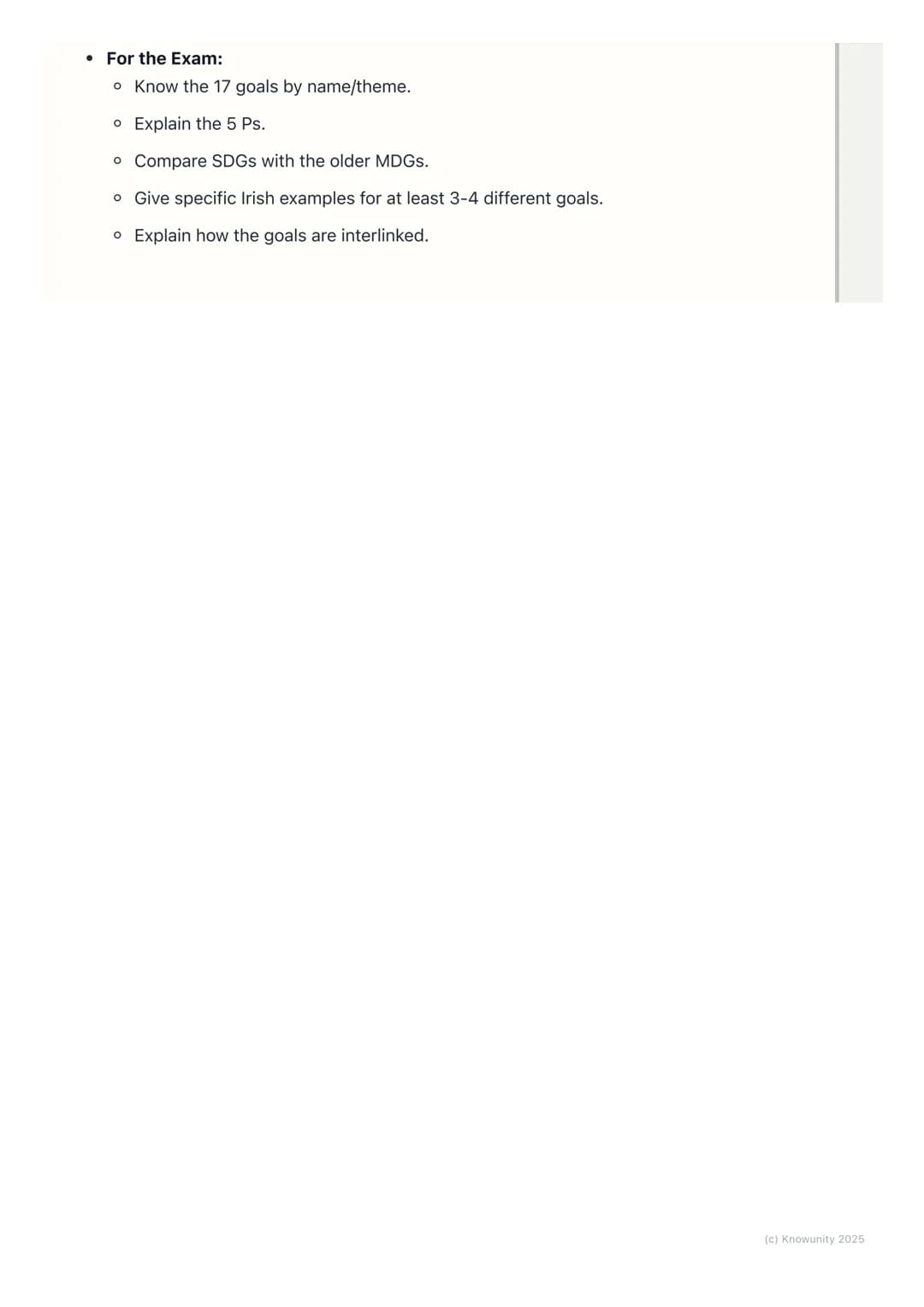
Exam Success Strategy
For your CSPE exam, focus on understanding the principles behind the SDGs, not just memorising the list. Know the 5 Ps inside out - they're exam favourites. Be ready to compare SDGs with MDGs, highlighting the shift to universal application and broader scope.
Always include specific Irish examples - generic answers won't cut it. Link at least 3-4 different goals to Irish policies, initiatives, or challenges. Show you understand how these global goals play out in your own country.
Demonstrate the interconnected nature of the goals. Explain how achieving one goal helps achieve others, or how failure in one area creates problems elsewhere. This shows sophisticated understanding.
Don't forget to mention the role of different actors - government policies, NGO campaigns, individual actions, and international cooperation all contribute to achieving these goals.
Final Reminder: These aren't just abstract global targets - they're about creating the world you'll live and work in. Understanding them helps you become a more informed and engaged citizen.
Pensávamos que não ias perguntar...
O que é o Companheiro de Aprendizagem com IA da Knowunity?
O nosso companheiro de aprendizagem com IA foi especificamente criado para as necessidades dos estudantes. Com base nos milhões de conteúdos que temos na plataforma, podemos fornecer respostas verdadeiramente significativas e relevantes para os estudantes. Mas não se trata apenas de respostas, o companheiro foca-se mais em guiar os estudantes através dos seus desafios diários de aprendizagem, com planos de estudo personalizados, quizzes ou conteúdos no chat e 100% de personalização baseada nas habilidades e desenvolvimentos do estudante.
Onde posso fazer o download da app Knowunity?
Pode descarregar a aplicação na Google Play Store e na Apple App Store.
Como posso receber o meu pagamento? Quanto posso ganhar?
Sim, tem acesso gratuito ao conteúdo da aplicação e ao nosso companheiro de IA. Para desbloquear determinadas funcionalidades da aplicação, pode adquirir o Knowunity Pro.
Conteúdos mais populares
9 Irish
IrishIrish oral questions and answers
Questions and answers for the leaving cert oral
5th Year4264
 English
Key Quotes : Sive
Key Quotes and explanations: Sive
6th Year2842
IrishIrish oral questions
Outline of oral questions
5th Year2055
IrishIníon- le hÁine Durkin
Aine Durkin’s poem, Iníon: Themes & summary
5th Year850
IrishIrish poetry 2027
Iníon + Dínit an Bhróin
5th Year1133
IrishLC HL notes- Iníon (poem)
Includes poem in English and Irish, theme, key words & phrases
5th Year2284
EnglishCultural Context : Shawshank Redemption : Sive : Small Things Like These
Comparative Study : Cultural Context : Shawshank Redemption, Sive and Small Things Like These
6th Year1430
IrishMo Ghrá-sa (Idir Lúibíní)
Notes on mo ghrá-sa
5th Year380
IrishAn Gaeilge Aiste
Irish Language essay
6th Year1320
Não encontra o que procura? Explore outras disciplinas.
Avaliações dos nossos utilizadores. Eles adoraram tudo — e tu também vais adorar.
4.6/5App Store
4.7/5Google Play
A App é muito fácil de usar e está nem organizada. Encontrei tudo o que estava à procura até agora e consegui aprender muito com as apresentações! Vou usar a app para um trabalho escolar! E claro que também me ajuda muito como inspiração.
João Sutilizador iOS
Esta app é realmente incrível. Há tantas anotações de estudo e ajuda [...]. A minha disciplina problemática é Francês, por exemplo, e a app tem muitas opções de ajuda. Graças a esta app, melhorei o meu Francês. Eu recomendo a qualquer pessoa.
Sara C.utilizadora Android
Uau, estou realmente impressionado. Acabei de experimentar o app porque o vi anunciado muitas vezes e fiquei absolutamente surpreso. Este app é A AJUDA que você quer para a escola e, acima de tudo, oferece tantas coisas, como exercícios e folhas de fatos, que têm sido MUITO úteis para mim pessoalmente.
Anautilizadora iOS
CSPE15 visualizações·Atualizado Jun 12, 2026·6 páginasUnderstanding the United Nations' Sustainable Development Goals
The Sustainable Development Goals (SDGs) are basically the world's to-do list for creating a better future by 2030. These 17 goals tackle everything from ending poverty to fighting climate change, and they're not just for developing countries - Ireland has...
1
of 6
Cadastre-se para ver o conteúdo. É grátis!
- Acesso a todos os documentos
- Melhore suas notas
- Junte-se a milhões de estudantes
What Are the Sustainable Development Goals?
Think of the SDGs as the world's biggest group project - every single UN member country signed up in 2015 to work towards 17 ambitious goals by 2030. Unlike previous global initiatives that only focused on poorer countries, these goals apply to everyone, including Ireland.
The core idea is sustainable development - meeting today's needs without screwing over future generations. It's all about finding the right balance between social needs, economic growth, and protecting the environment.
The beauty of these goals is that they're all connected. You can't solve climate change without tackling poverty, and you can't achieve gender equality without ensuring quality education for everyone.
Quick Tip: Remember the 5 Ps - People, Planet, Prosperity, Peace, and Partnership. These cover all the main areas the SDGs focus on, and they're likely to come up in your exam!
2
of 6Cadastre-se para ver o conteúdo. É grátis!
- Acesso a todos os documentos
- Melhore suas notas
- Junte-se a milhões de estudantes
The 17 Goals Breakdown
Here's what the world is working towards: No Poverty, Zero Hunger, Good Health and Well-being, Quality Education, Gender Equality, Clean Water and Sanitation, Affordable and Clean Energy, Decent Work and Economic Growth, Industry Innovation and Infrastructure, Reduced Inequalities, Sustainable Cities and Communities, Responsible Consumption and Production, Climate Action, Life Below Water, Life on Land, Peace Justice and Strong Institutions, and Partnerships for the Goals.
These aren't legally binding - think of them more as a framework that countries use to create their own action plans. Governments are expected to take ownership and figure out how to achieve these goals in their own context.
The goals are universal (apply to all countries) and integrated (all interconnected). This makes them much more comprehensive than the previous Millennium Development Goals, which only had 8 goals and mainly focused on developing countries.
Exam Alert: You'll likely be asked to compare the SDGs with the older MDGs. Remember: SDGs are broader, apply to everyone, and were developed with input from millions of people worldwide.
3
of 6Cadastre-se para ver o conteúdo. É grátis!
- Acesso a todos os documentos
- Melhore suas notas
- Junte-se a milhões de estudantes
SDGs vs MDGs - What Changed?
The Millennium Development Goals (2000-2015) were the SDGs' predecessor, but they were quite different. The MDGs had only 8 goals, focused mainly on developing countries, and were created by a small group of experts using a top-down approach.
The SDGs expanded to 17 goals, apply universally to all countries, and were developed through a much more inclusive process with input from millions of people worldwide. They also cover much broader issues - while MDGs focused mainly on poverty, health, and education, SDGs include climate change, inequality, and sustainable consumption.
This shift shows how global thinking evolved. The world realised that challenges like climate change and inequality affect everyone, not just poorer countries. Ireland faces these same challenges and has a role to play in solving them.
The integration principle is crucial - the goals are designed to work together. For example, providing quality education (SDG 4) for girls directly supports gender equality (SDG 5) and helps reduce poverty (SDG 1).
Pro Tip: Don't just memorise the differences - understand why they changed. The world became more interconnected, and global challenges required global solutions.
4
of 6Cadastre-se para ver o conteúdo. É grátis!
- Acesso a todos os documentos
- Melhore suas notas
- Junte-se a milhões de estudantes
SDGs in Action - Irish Examples
Climate Action (SDG 13) is huge in Ireland right now. Our Climate Action Plan 2023 sets legally binding targets to cut greenhouse gas emissions by 51% by 2030. You can see this in policies promoting electric vehicles, home retrofitting for energy efficiency, and massive investment in wind energy.
Gender Equality (SDG 5) has seen major progress here. The repeal of the 8th Amendment and new gender pay gap reporting laws show Ireland taking this goal seriously. However, challenges remain around affordable childcare and domestic violence rates.
Responsible Consumption and Production (SDG 12) connects directly to your daily life. The EPA's "Stop Food Waste" campaign, pressure on supermarkets to reduce plastic packaging, and the introduction of charges on disposable cups all tackle this goal.
These examples show how global goals translate into local action. When you recycle, buy local produce, or support renewable energy, you're contributing to achieving the SDGs.
Essay Gold: Always use specific Irish examples in your answers. Generic responses won't impress examiners - show you understand how these global goals apply to Ireland specifically.
5
of 6Cadastre-se para ver o conteúdo. É grátis!
- Acesso a todos os documentos
- Melhore suas notas
- Junte-se a milhões de estudantes
Challenges and Critical Thinking
The SDGs are incredibly ambitious - maybe too ambitious. Funding is a massive issue, especially for developing countries. Political instability, corruption, and global crises like pandemics can completely derail progress.
Even in Ireland, we're struggling with some goals. Our housing crisis makes Sustainable Cities and Communities (SDG 11) challenging to achieve. Climate targets are ambitious but require massive behaviour changes from everyone.
The interconnected nature of the goals means that failing in one area affects others. If we don't tackle inequality (SDG 10), it becomes much harder to achieve quality education (SDG 4) or good health (SDG 3) for everyone.
However, this interconnectedness also creates opportunities. Investing in renewable energy creates jobs (SDG 8), helps tackle climate change (SDG 13), and can reduce inequalities (SDG 10) if done right.
Critical Analysis: The best exam answers acknowledge both the potential and the problems with the SDGs. Show you can think critically about these global challenges.
6
of 6Cadastre-se para ver o conteúdo. É grátis!
- Acesso a todos os documentos
- Melhore suas notas
- Junte-se a milhões de estudantes
Exam Success Strategy
For your CSPE exam, focus on understanding the principles behind the SDGs, not just memorising the list. Know the 5 Ps inside out - they're exam favourites. Be ready to compare SDGs with MDGs, highlighting the shift to universal application and broader scope.
Always include specific Irish examples - generic answers won't cut it. Link at least 3-4 different goals to Irish policies, initiatives, or challenges. Show you understand how these global goals play out in your own country.
Demonstrate the interconnected nature of the goals. Explain how achieving one goal helps achieve others, or how failure in one area creates problems elsewhere. This shows sophisticated understanding.
Don't forget to mention the role of different actors - government policies, NGO campaigns, individual actions, and international cooperation all contribute to achieving these goals.
Final Reminder: These aren't just abstract global targets - they're about creating the world you'll live and work in. Understanding them helps you become a more informed and engaged citizen.
Pensávamos que não ias perguntar...
O que é o Companheiro de Aprendizagem com IA da Knowunity?
O nosso companheiro de aprendizagem com IA foi especificamente criado para as necessidades dos estudantes. Com base nos milhões de conteúdos que temos na plataforma, podemos fornecer respostas verdadeiramente significativas e relevantes para os estudantes. Mas não se trata apenas de respostas, o companheiro foca-se mais em guiar os estudantes através dos seus desafios diários de aprendizagem, com planos de estudo personalizados, quizzes ou conteúdos no chat e 100% de personalização baseada nas habilidades e desenvolvimentos do estudante.
Onde posso fazer o download da app Knowunity?
Pode descarregar a aplicação na Google Play Store e na Apple App Store.
Como posso receber o meu pagamento? Quanto posso ganhar?
Sim, tem acesso gratuito ao conteúdo da aplicação e ao nosso companheiro de IA. Para desbloquear determinadas funcionalidades da aplicação, pode adquirir o Knowunity Pro.
Conteúdos mais populares
9IrishIrish oral questions and answers
Questions and answers for the leaving cert oral
5th Year4264
EnglishKey Quotes : Sive
Key Quotes and explanations: Sive
6th Year2842
IrishIrish oral questions
Outline of oral questions
5th Year2055
IrishIníon- le hÁine Durkin
Aine Durkin’s poem, Iníon: Themes & summary
5th Year850
IrishIrish poetry 2027
Iníon + Dínit an Bhróin
5th Year1133
IrishLC HL notes- Iníon (poem)
Includes poem in English and Irish, theme, key words & phrases
5th Year2284
EnglishCultural Context : Shawshank Redemption : Sive : Small Things Like These
Comparative Study : Cultural Context : Shawshank Redemption, Sive and Small Things Like These
6th Year1430
IrishMo Ghrá-sa (Idir Lúibíní)
Notes on mo ghrá-sa
5th Year380
IrishAn Gaeilge Aiste
Irish Language essay
6th Year1320
Não encontra o que procura? Explore outras disciplinas.
Avaliações dos nossos utilizadores. Eles adoraram tudo — e tu também vais adorar.
4.6/5App Store
4.7/5Google Play
A App é muito fácil de usar e está nem organizada. Encontrei tudo o que estava à procura até agora e consegui aprender muito com as apresentações! Vou usar a app para um trabalho escolar! E claro que também me ajuda muito como inspiração.
João Sutilizador iOS
Esta app é realmente incrível. Há tantas anotações de estudo e ajuda [...]. A minha disciplina problemática é Francês, por exemplo, e a app tem muitas opções de ajuda. Graças a esta app, melhorei o meu Francês. Eu recomendo a qualquer pessoa.
Sara C.utilizadora Android
Uau, estou realmente impressionado. Acabei de experimentar o app porque o vi anunciado muitas vezes e fiquei absolutamente surpreso. Este app é A AJUDA que você quer para a escola e, acima de tudo, oferece tantas coisas, como exercícios e folhas de fatos, que têm sido MUITO úteis para mim pessoalmente.
Anautilizadora iOS