
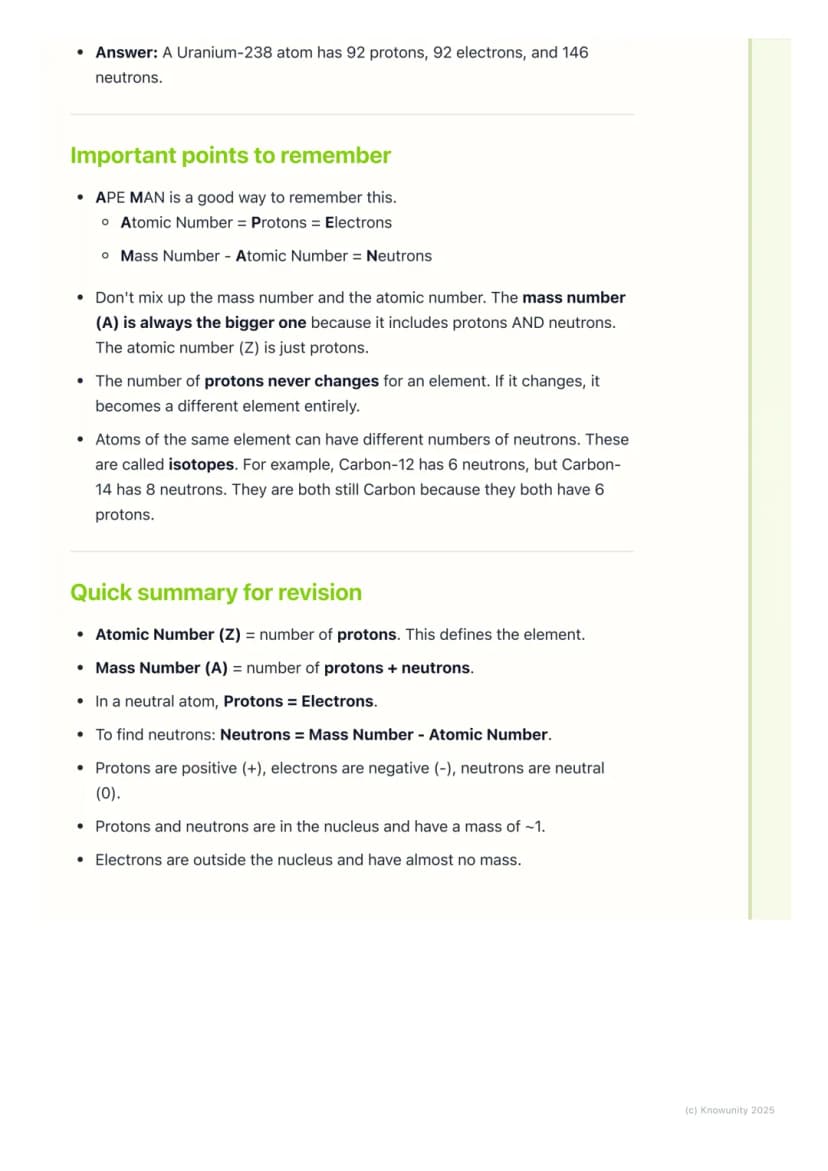
Every single element on the Periodic Table is made up...
 Chemistry7 visualizações·Atualizado Jun 18, 2026·5 páginas
Understanding Atomic Number and Mass Number
1 / 5
1
of 5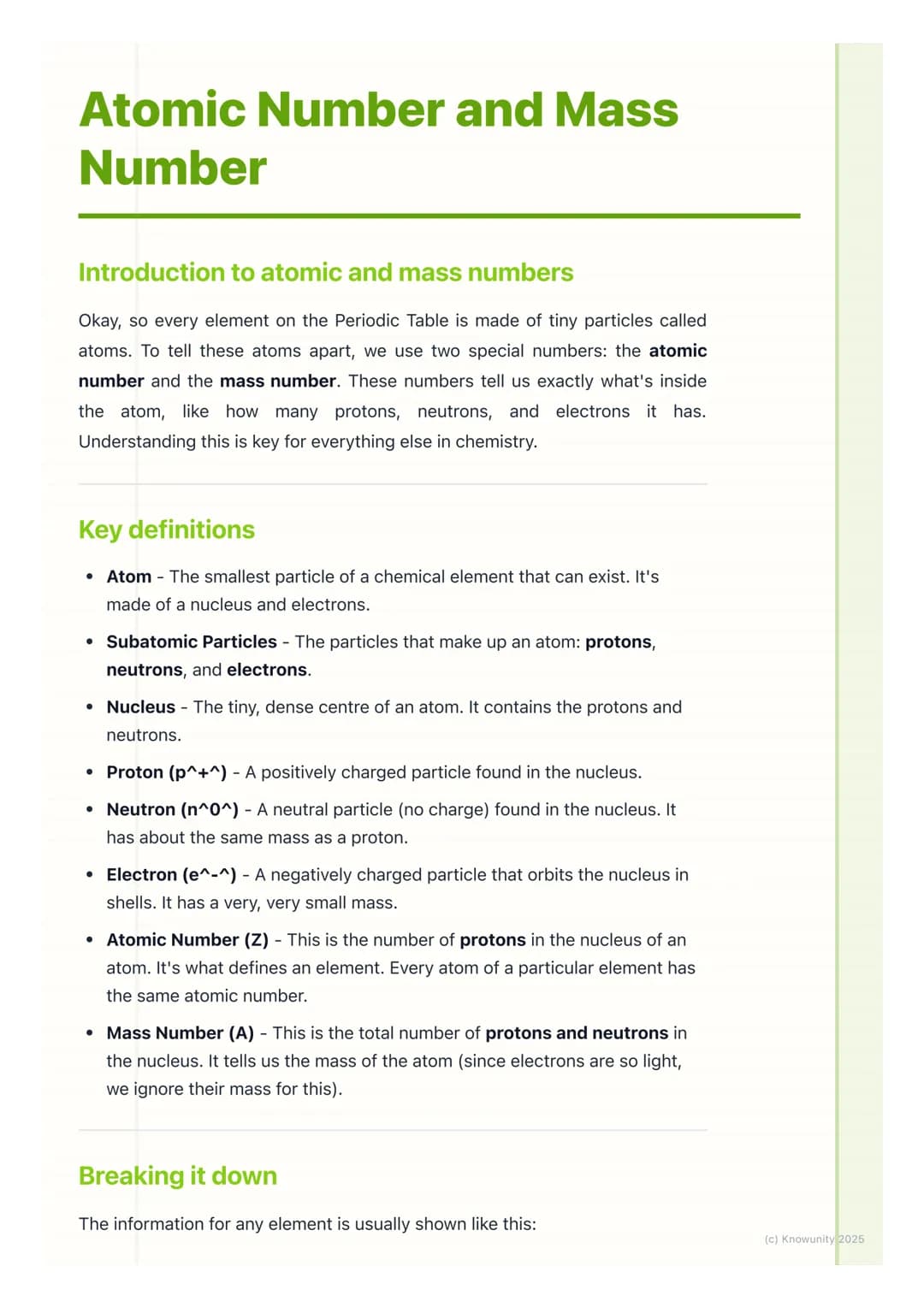
Understanding Atoms and Their Building Blocks
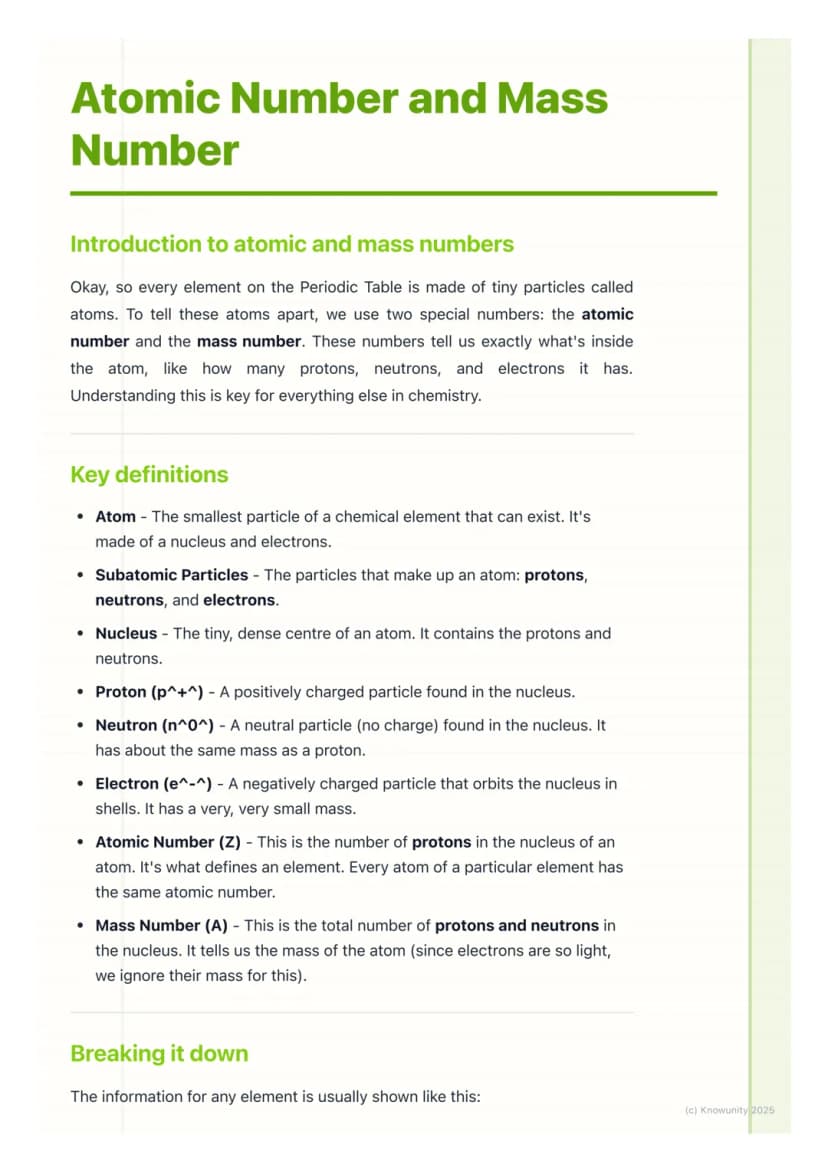
Think of an atom as the tiniest LEGO piece of any element - you literally can't get smaller than this and still have the element. Every atom is like a mini solar system with a dense centre called the nucleus surrounded by tiny particles whizzing around it.
Inside that nucleus, you've got protons (positively charged particles) and neutrons (particles with no charge at all). Flying around the outside are electrons - negatively charged particles that are so light they barely count towards the atom's weight.
Here's the brilliant bit: the atomic number is simply how many protons are packed into that nucleus. This number is like an element's fingerprint - every carbon atom has exactly 6 protons, every oxygen atom has exactly 8, and so on.
Quick Tip: The atomic number is what makes an element unique - change the number of protons, and you've got a completely different element!
2
of 5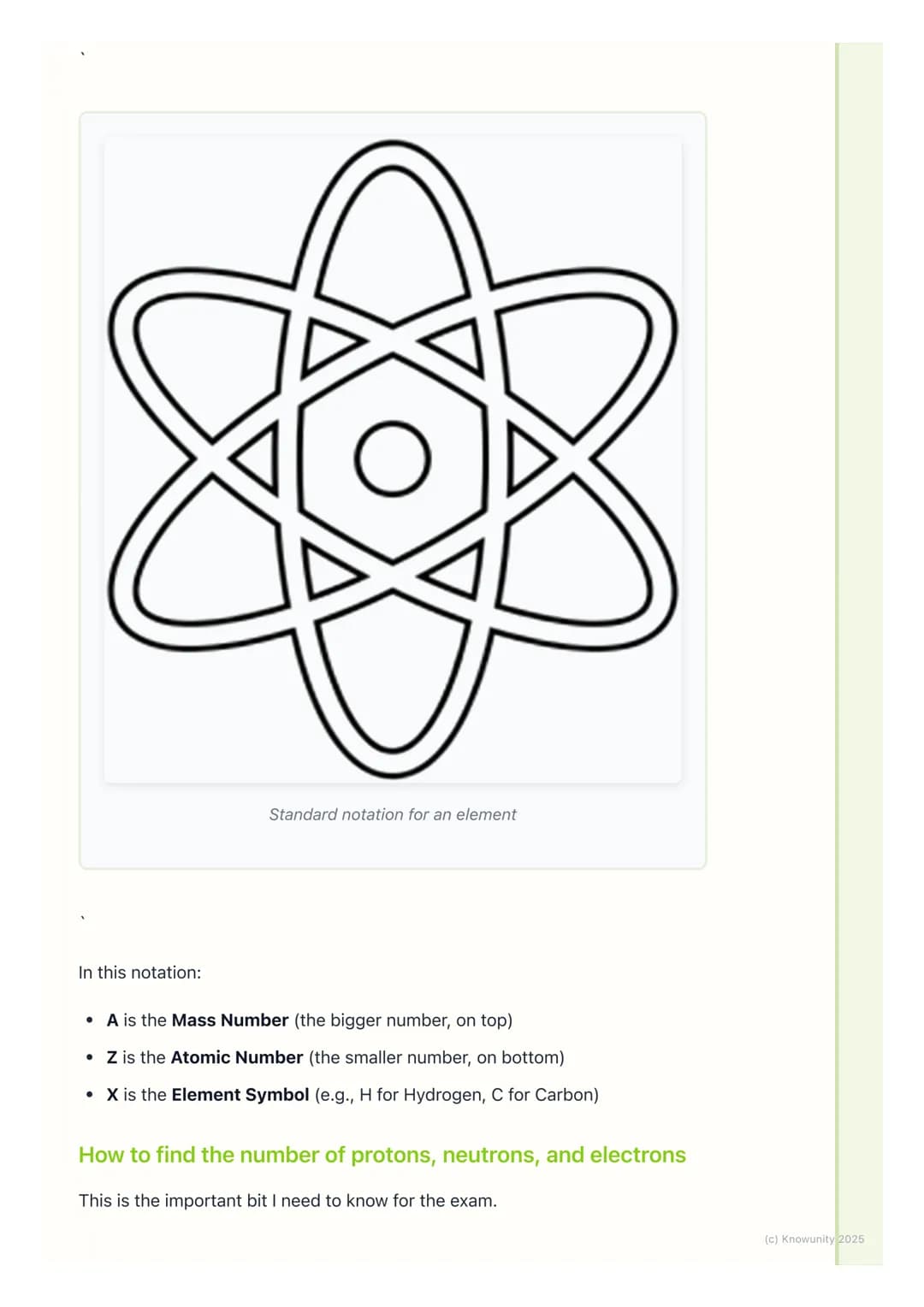
Decoding Atomic Notation
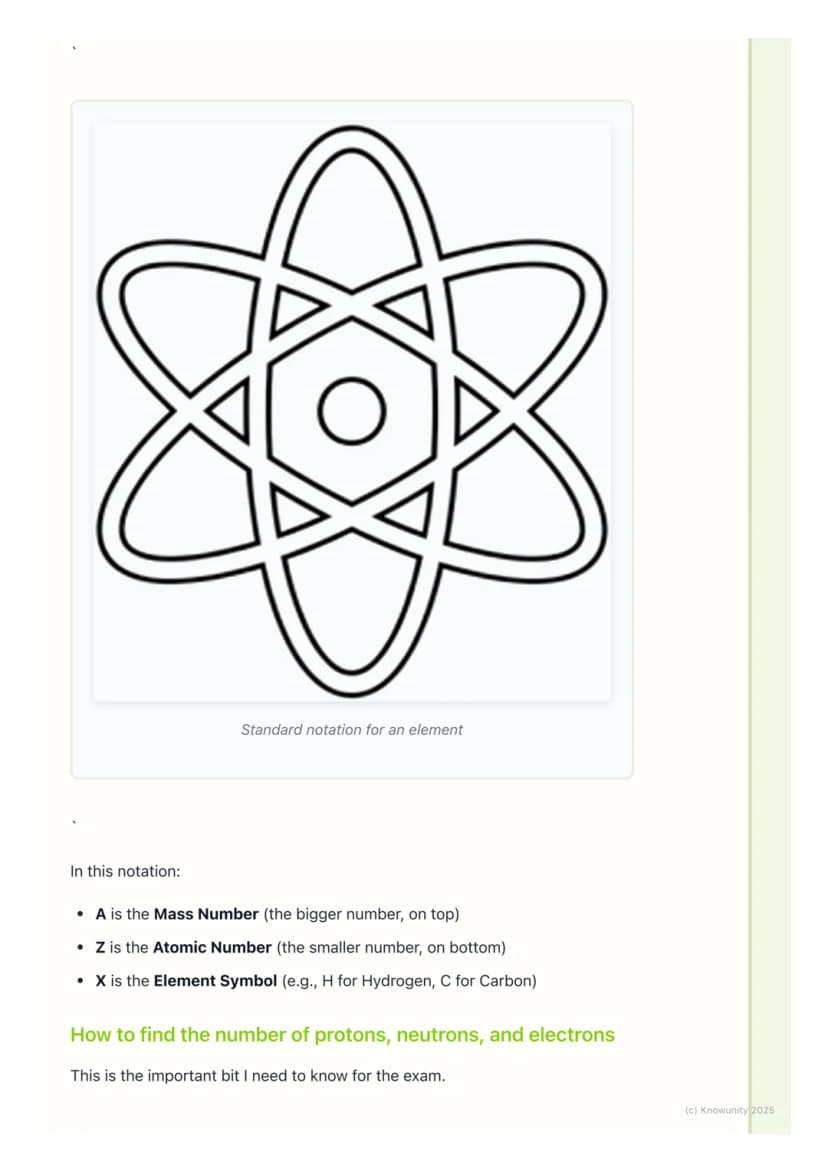
You'll see elements written in a special way that looks a bit like a fraction. The mass number (the bigger number) sits on top, the atomic number (smaller number) sits on the bottom, and the element symbol sits alongside them.
The mass number tells you the combined total of protons and neutrons in the nucleus. Since electrons weigh practically nothing, we just ignore them when calculating an atom's mass.
This notation system is your roadmap to understanding any atom. Once you can read it, you can figure out exactly what's inside any element's atom.
Remember: Mass number = protons + neutrons, whilst atomic number = protons only!
3
of 5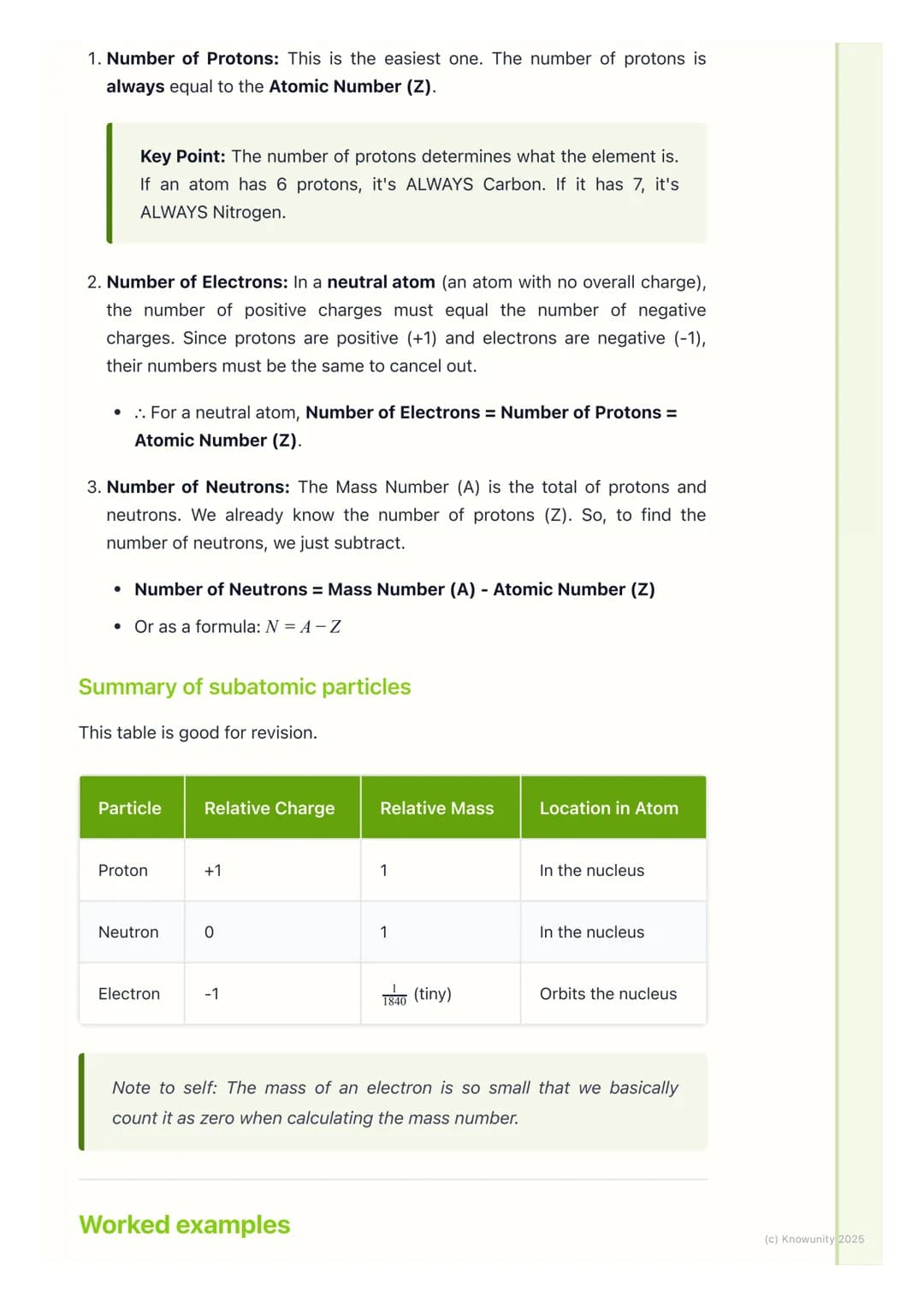
Finding Protons, Electrons, and Neutrons
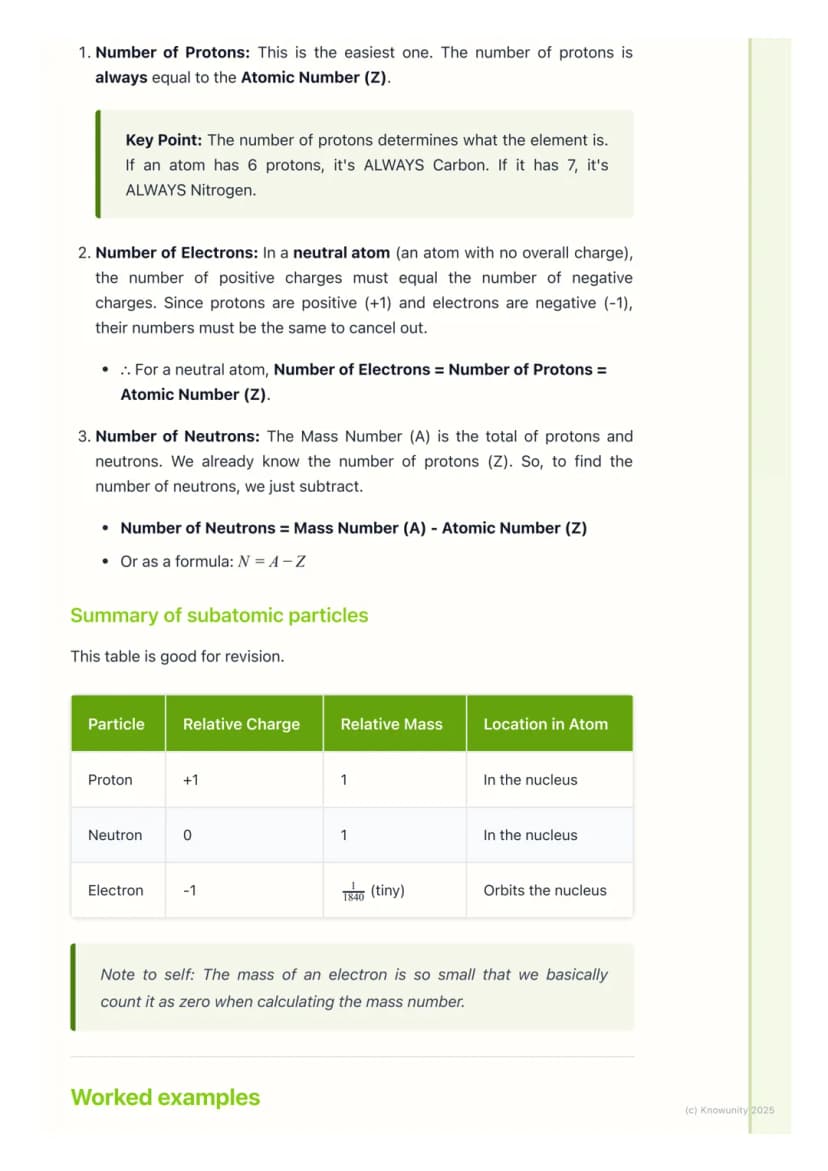
Finding protons is dead easy - it's always equal to the atomic number. If you see the atomic number is 11, you've got 11 protons. Job done.
Finding electrons in a neutral atom is just as simple. Since atoms normally have no overall charge, the positive charges (protons) must balance the negative charges (electrons). So electrons = protons = atomic number.
Finding neutrons needs one quick sum: neutrons = mass number - atomic number. If your mass number is 23 and your atomic number is 11, you've got 23 - 11 = 12 neutrons.
The APE MAN trick helps you remember: Atomic Number = Protons = Electrons, Mass Number - Atomic Number = Neutrons.
Exam Tip: Always double-check your neutron calculation - it's the one students mess up most often!
4
of 5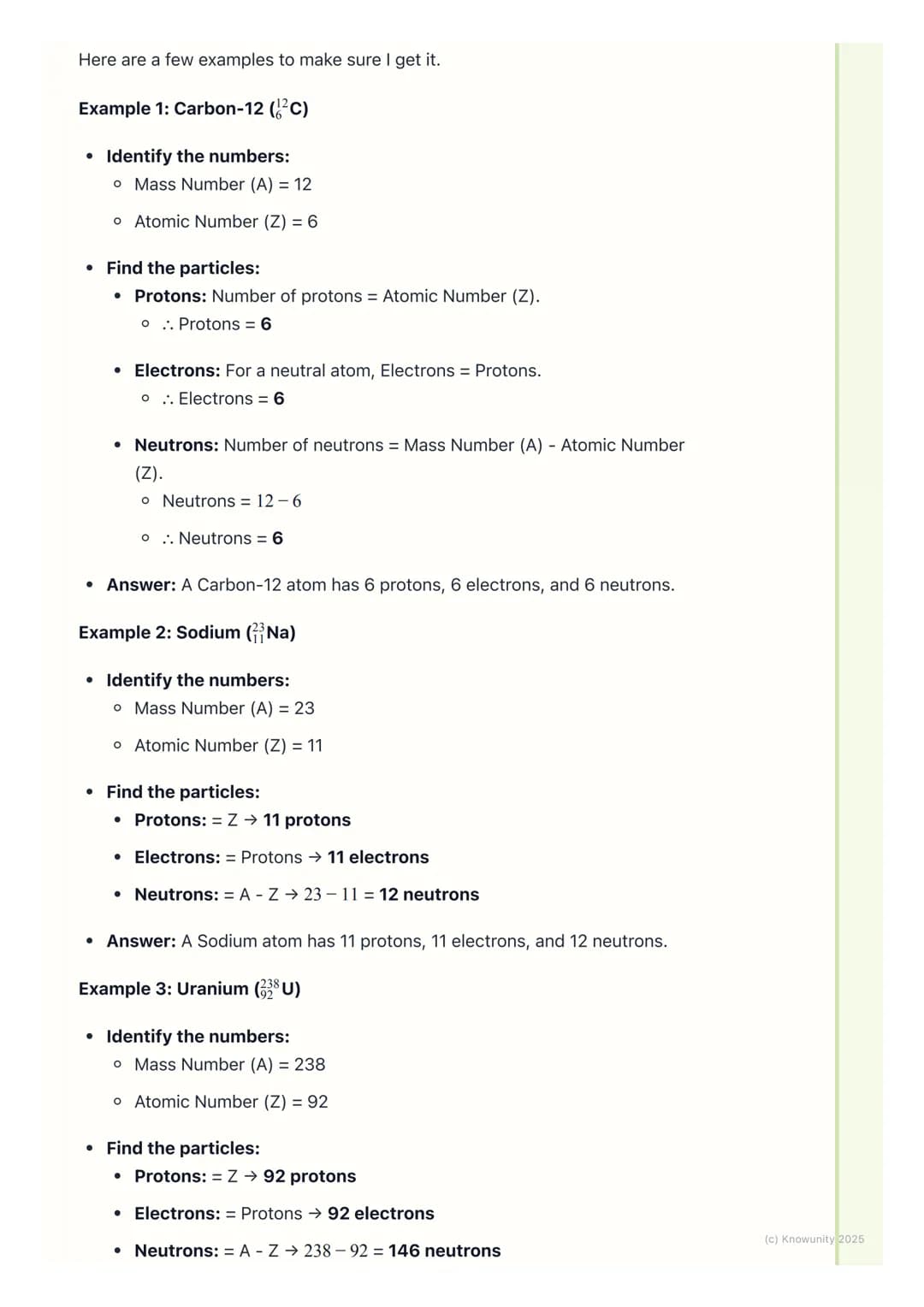
Working Through Real Examples
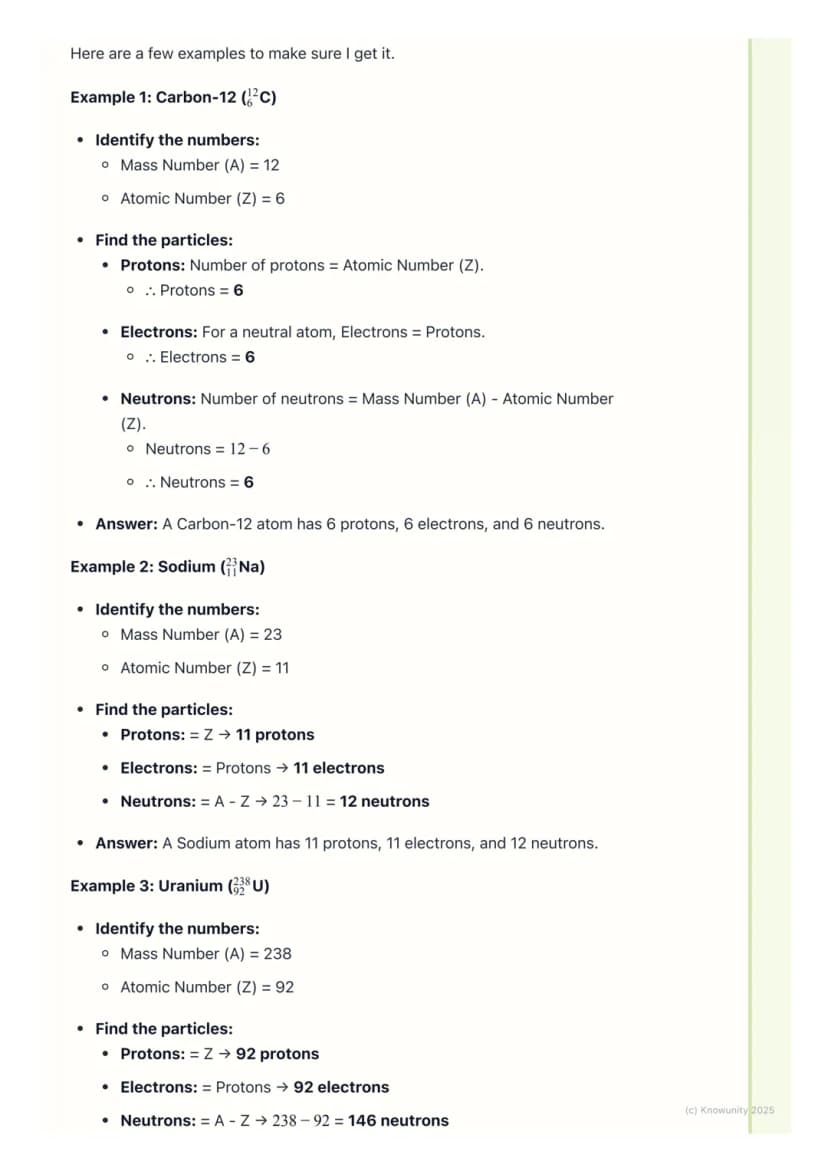
Let's crack the code for Carbon-12: the mass number is 12, atomic number is 6. This means 6 protons, 6 electrons (same as protons), and 12 - 6 = 6 neutrons. Easy!
Sodium gets a bit trickier with a mass number of 23 and atomic number of 11. That gives us 11 protons, 11 electrons, and 23 - 11 = 12 neutrons.
Uranium-238 looks scary but follows the same pattern: 92 protons (from atomic number), 92 electrons, and a whopping 238 - 92 = 146 neutrons. The method never changes, regardless of how big the numbers get.
Confidence Booster: Once you've mastered these three examples, you can tackle any element on the Periodic Table!
5
of 5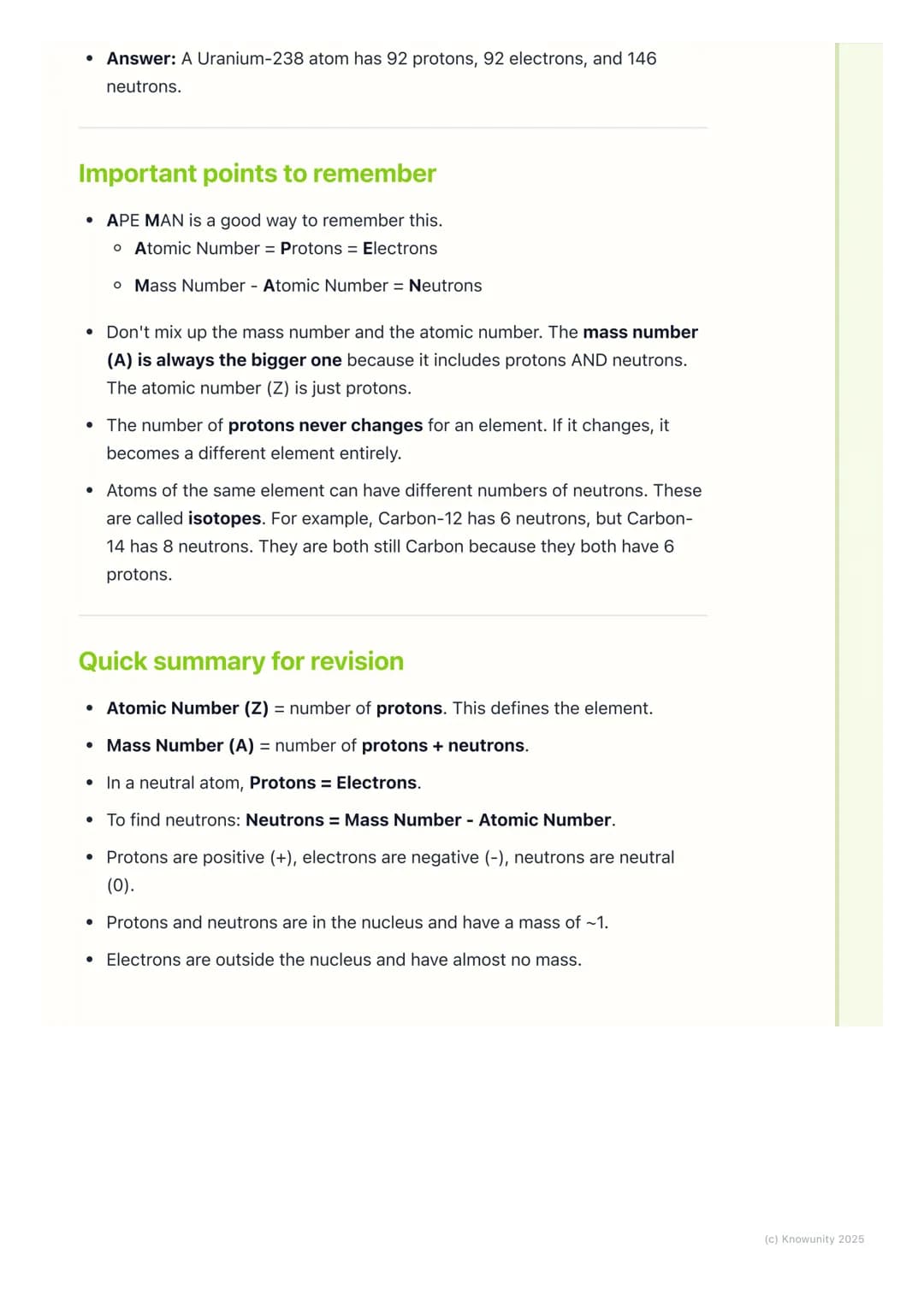
Key Points for Your Exams
The mass number is always the bigger number because it includes both protons and neutrons. The atomic number is smaller because it's just counting protons.
Here's something mind-blowing: atoms of the same element can have different numbers of neutrons. These are called isotopes. Carbon-12 and Carbon-14 are both carbon (same protons), but they have different neutrons.
Remember that protons and neutrons have roughly the same mass and live in the nucleus, whilst electrons are practically weightless and orbit around the outside. The number of protons never changes for an element - if it did, you'd have a completely different element!
Final Reminder: Master the APE MAN formula and you'll never get stuck on atomic structure questions again!
Pensávamos que não ias perguntar...
O que é o Companheiro de Aprendizagem com IA da Knowunity?
O nosso companheiro de aprendizagem com IA foi especificamente criado para as necessidades dos estudantes. Com base nos milhões de conteúdos que temos na plataforma, podemos fornecer respostas verdadeiramente significativas e relevantes para os estudantes. Mas não se trata apenas de respostas, o companheiro foca-se mais em guiar os estudantes através dos seus desafios diários de aprendizagem, com planos de estudo personalizados, quizzes ou conteúdos no chat e 100% de personalização baseada nas habilidades e desenvolvimentos do estudante.
Onde posso fazer o download da app Knowunity?
Pode descarregar a aplicação na Google Play Store e na Apple App Store.
Como posso receber o meu pagamento? Quanto posso ganhar?
Sim, tem acesso gratuito ao conteúdo da aplicação e ao nosso companheiro de IA. Para desbloquear determinadas funcionalidades da aplicação, pode adquirir o Knowunity Pro.
Conteúdos mais populares
9 Irish
IrishIrish oral questions and answers
Questions and answers for the leaving cert oral
5th Year4264
 English
Key Quotes : Sive
Key Quotes and explanations: Sive
6th Year2842
IrishIrish oral questions
Outline of oral questions
5th Year2055
IrishIníon- le hÁine Durkin
Aine Durkin’s poem, Iníon: Themes & summary
5th Year890
IrishIrish poetry 2027
Iníon + Dínit an Bhróin
5th Year1153
IrishLC HL notes- Iníon (poem)
Includes poem in English and Irish, theme, key words & phrases
5th Year2304
EnglishCultural Context : Shawshank Redemption : Sive : Small Things Like These
Comparative Study : Cultural Context : Shawshank Redemption, Sive and Small Things Like These
6th Year1430
IrishMo Ghrá-sa (Idir Lúibíní)
Notes on mo ghrá-sa
5th Year380
IrishAn Gaeilge Aiste
Irish Language essay
6th Year1320
Não encontra o que procura? Explore outras disciplinas.
Avaliações dos nossos utilizadores. Eles adoraram tudo — e tu também vais adorar.
4.6/5App Store
4.7/5Google Play
A App é muito fácil de usar e está nem organizada. Encontrei tudo o que estava à procura até agora e consegui aprender muito com as apresentações! Vou usar a app para um trabalho escolar! E claro que também me ajuda muito como inspiração.
João Sutilizador iOS
Esta app é realmente incrível. Há tantas anotações de estudo e ajuda [...]. A minha disciplina problemática é Francês, por exemplo, e a app tem muitas opções de ajuda. Graças a esta app, melhorei o meu Francês. Eu recomendo a qualquer pessoa.
Sara C.utilizadora Android
Uau, estou realmente impressionado. Acabei de experimentar o app porque o vi anunciado muitas vezes e fiquei absolutamente surpreso. Este app é A AJUDA que você quer para a escola e, acima de tudo, oferece tantas coisas, como exercícios e folhas de fatos, que têm sido MUITO úteis para mim pessoalmente.
Anautilizadora iOS
Chemistry7 visualizações·Atualizado Jun 18, 2026·5 páginasUnderstanding Atomic Number and Mass Number
Every single element on the Periodic Table is made up of tiny atoms, and each atom has its own unique "ID card" made up of two special numbers. These atomic and mass numbers tell you exactly what's hiding inside any...
1
of 5
Cadastre-se para ver o conteúdo. É grátis!
- Acesso a todos os documentos
- Melhore suas notas
- Junte-se a milhões de estudantes
Understanding Atoms and Their Building Blocks
Think of an atom as the tiniest LEGO piece of any element - you literally can't get smaller than this and still have the element. Every atom is like a mini solar system with a dense centre called the nucleus surrounded by tiny particles whizzing around it.
Inside that nucleus, you've got protons (positively charged particles) and neutrons (particles with no charge at all). Flying around the outside are electrons - negatively charged particles that are so light they barely count towards the atom's weight.
Here's the brilliant bit: the atomic number is simply how many protons are packed into that nucleus. This number is like an element's fingerprint - every carbon atom has exactly 6 protons, every oxygen atom has exactly 8, and so on.
Quick Tip: The atomic number is what makes an element unique - change the number of protons, and you've got a completely different element!
2
of 5Cadastre-se para ver o conteúdo. É grátis!
- Acesso a todos os documentos
- Melhore suas notas
- Junte-se a milhões de estudantes
Decoding Atomic Notation
You'll see elements written in a special way that looks a bit like a fraction. The mass number (the bigger number) sits on top, the atomic number (smaller number) sits on the bottom, and the element symbol sits alongside them.
The mass number tells you the combined total of protons and neutrons in the nucleus. Since electrons weigh practically nothing, we just ignore them when calculating an atom's mass.
This notation system is your roadmap to understanding any atom. Once you can read it, you can figure out exactly what's inside any element's atom.
Remember: Mass number = protons + neutrons, whilst atomic number = protons only!
3
of 5Cadastre-se para ver o conteúdo. É grátis!
- Acesso a todos os documentos
- Melhore suas notas
- Junte-se a milhões de estudantes
Finding Protons, Electrons, and Neutrons
Finding protons is dead easy - it's always equal to the atomic number. If you see the atomic number is 11, you've got 11 protons. Job done.
Finding electrons in a neutral atom is just as simple. Since atoms normally have no overall charge, the positive charges (protons) must balance the negative charges (electrons). So electrons = protons = atomic number.
Finding neutrons needs one quick sum: neutrons = mass number - atomic number. If your mass number is 23 and your atomic number is 11, you've got 23 - 11 = 12 neutrons.
The APE MAN trick helps you remember: Atomic Number = Protons = Electrons, Mass Number - Atomic Number = Neutrons.
Exam Tip: Always double-check your neutron calculation - it's the one students mess up most often!
4
of 5Cadastre-se para ver o conteúdo. É grátis!
- Acesso a todos os documentos
- Melhore suas notas
- Junte-se a milhões de estudantes
Working Through Real Examples
Let's crack the code for Carbon-12: the mass number is 12, atomic number is 6. This means 6 protons, 6 electrons (same as protons), and 12 - 6 = 6 neutrons. Easy!
Sodium gets a bit trickier with a mass number of 23 and atomic number of 11. That gives us 11 protons, 11 electrons, and 23 - 11 = 12 neutrons.
Uranium-238 looks scary but follows the same pattern: 92 protons (from atomic number), 92 electrons, and a whopping 238 - 92 = 146 neutrons. The method never changes, regardless of how big the numbers get.
Confidence Booster: Once you've mastered these three examples, you can tackle any element on the Periodic Table!
5
of 5Cadastre-se para ver o conteúdo. É grátis!
- Acesso a todos os documentos
- Melhore suas notas
- Junte-se a milhões de estudantes
Key Points for Your Exams
The mass number is always the bigger number because it includes both protons and neutrons. The atomic number is smaller because it's just counting protons.
Here's something mind-blowing: atoms of the same element can have different numbers of neutrons. These are called isotopes. Carbon-12 and Carbon-14 are both carbon (same protons), but they have different neutrons.
Remember that protons and neutrons have roughly the same mass and live in the nucleus, whilst electrons are practically weightless and orbit around the outside. The number of protons never changes for an element - if it did, you'd have a completely different element!
Final Reminder: Master the APE MAN formula and you'll never get stuck on atomic structure questions again!
Pensávamos que não ias perguntar...
O que é o Companheiro de Aprendizagem com IA da Knowunity?
O nosso companheiro de aprendizagem com IA foi especificamente criado para as necessidades dos estudantes. Com base nos milhões de conteúdos que temos na plataforma, podemos fornecer respostas verdadeiramente significativas e relevantes para os estudantes. Mas não se trata apenas de respostas, o companheiro foca-se mais em guiar os estudantes através dos seus desafios diários de aprendizagem, com planos de estudo personalizados, quizzes ou conteúdos no chat e 100% de personalização baseada nas habilidades e desenvolvimentos do estudante.
Onde posso fazer o download da app Knowunity?
Pode descarregar a aplicação na Google Play Store e na Apple App Store.
Como posso receber o meu pagamento? Quanto posso ganhar?
Sim, tem acesso gratuito ao conteúdo da aplicação e ao nosso companheiro de IA. Para desbloquear determinadas funcionalidades da aplicação, pode adquirir o Knowunity Pro.
Conteúdos mais populares
9IrishIrish oral questions and answers
Questions and answers for the leaving cert oral
5th Year4264
EnglishKey Quotes : Sive
Key Quotes and explanations: Sive
6th Year2842
IrishIrish oral questions
Outline of oral questions
5th Year2055
IrishIníon- le hÁine Durkin
Aine Durkin’s poem, Iníon: Themes & summary
5th Year890
IrishIrish poetry 2027
Iníon + Dínit an Bhróin
5th Year1153
IrishLC HL notes- Iníon (poem)
Includes poem in English and Irish, theme, key words & phrases
5th Year2304
EnglishCultural Context : Shawshank Redemption : Sive : Small Things Like These
Comparative Study : Cultural Context : Shawshank Redemption, Sive and Small Things Like These
6th Year1430
IrishMo Ghrá-sa (Idir Lúibíní)
Notes on mo ghrá-sa
5th Year380
IrishAn Gaeilge Aiste
Irish Language essay
6th Year1320
Não encontra o que procura? Explore outras disciplinas.
Avaliações dos nossos utilizadores. Eles adoraram tudo — e tu também vais adorar.
4.6/5App Store
4.7/5Google Play
A App é muito fácil de usar e está nem organizada. Encontrei tudo o que estava à procura até agora e consegui aprender muito com as apresentações! Vou usar a app para um trabalho escolar! E claro que também me ajuda muito como inspiração.
João Sutilizador iOS
Esta app é realmente incrível. Há tantas anotações de estudo e ajuda [...]. A minha disciplina problemática é Francês, por exemplo, e a app tem muitas opções de ajuda. Graças a esta app, melhorei o meu Francês. Eu recomendo a qualquer pessoa.
Sara C.utilizadora Android
Uau, estou realmente impressionado. Acabei de experimentar o app porque o vi anunciado muitas vezes e fiquei absolutamente surpreso. Este app é A AJUDA que você quer para a escola e, acima de tudo, oferece tantas coisas, como exercícios e folhas de fatos, que têm sido MUITO úteis para mim pessoalmente.
Anautilizadora iOS