
Every living thing around you - from your pet dog...
 Biology2 visualizações·Atualizado Jun 7, 2026·4 páginas
Cells: The Building Blocks of Life
1 / 4
1
of 4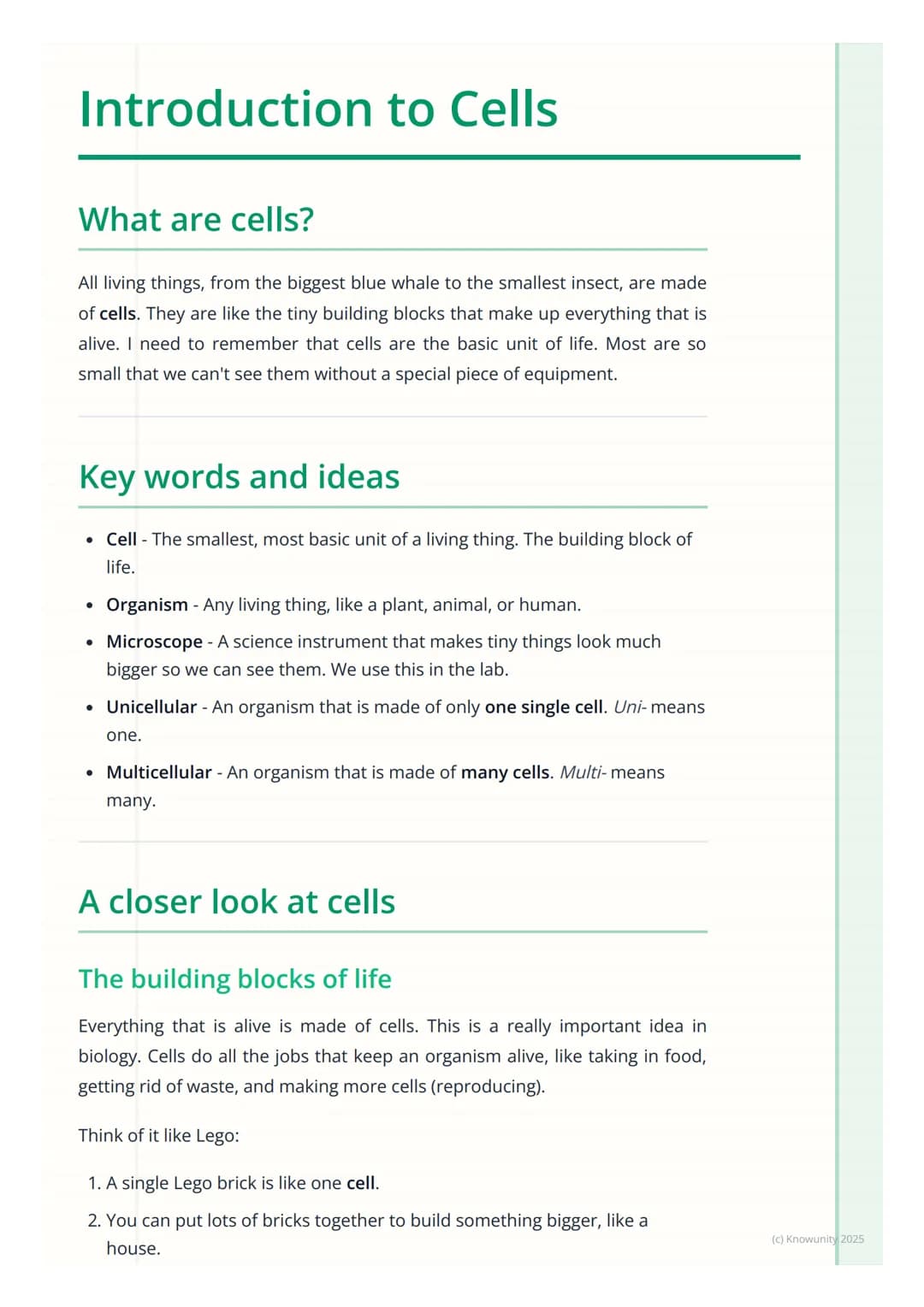
What Are Cells?
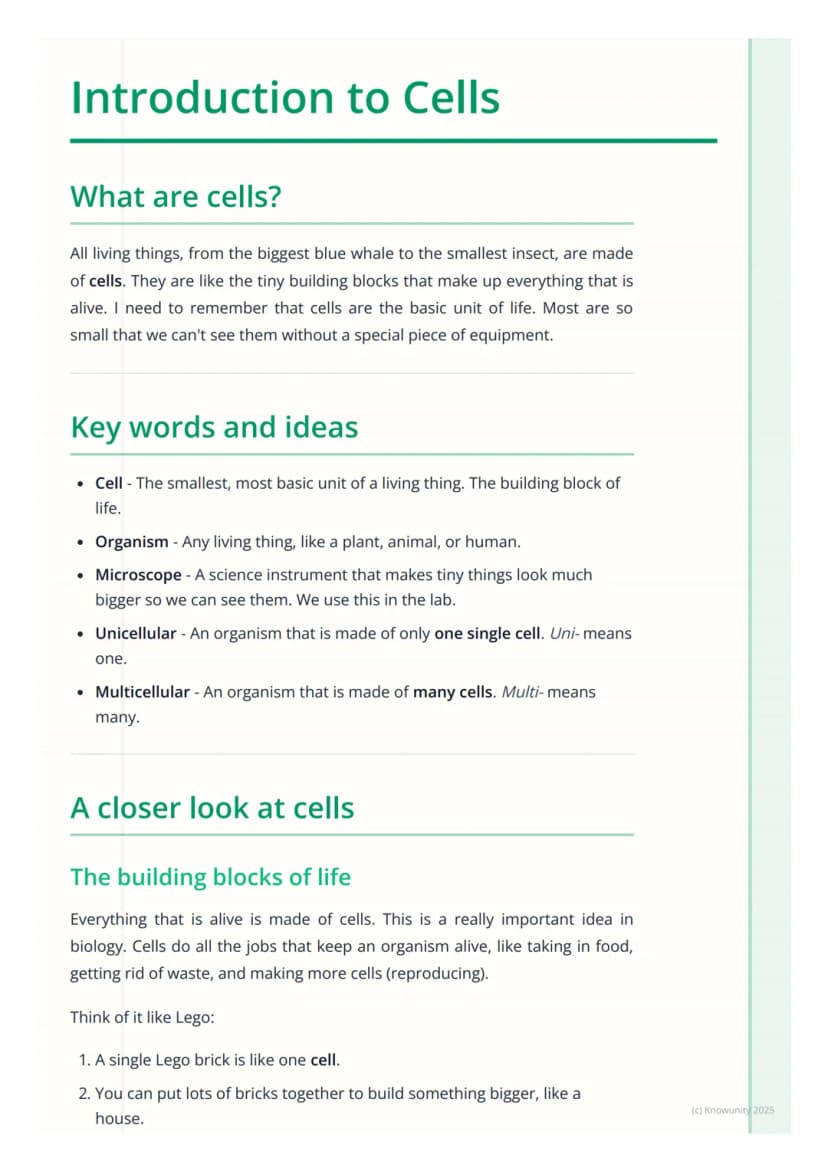
Think of cells as the Lego bricks of life - they're the smallest building blocks that make up every living thing on Earth. Just like you can build incredible structures with Lego bricks, nature uses cells to build everything from massive blue whales to tiny insects.
Most cells are microscopic, which means they're so incredibly small that you need a special tool called a microscope to see them. If you lined up 10 human skin cells, they'd only be as thick as a single sheet of paper - that's proper tiny!
Here's something cool: scientists didn't even know cells existed until the 1600s when microscopes were invented. A scientist named Robert Hooke first spotted them in a piece of cork and called them "cells" because they looked like little prison cells or rooms.
Remember: Everything that's alive is made of cells - this is one of the most important rules in biology!
2
of 4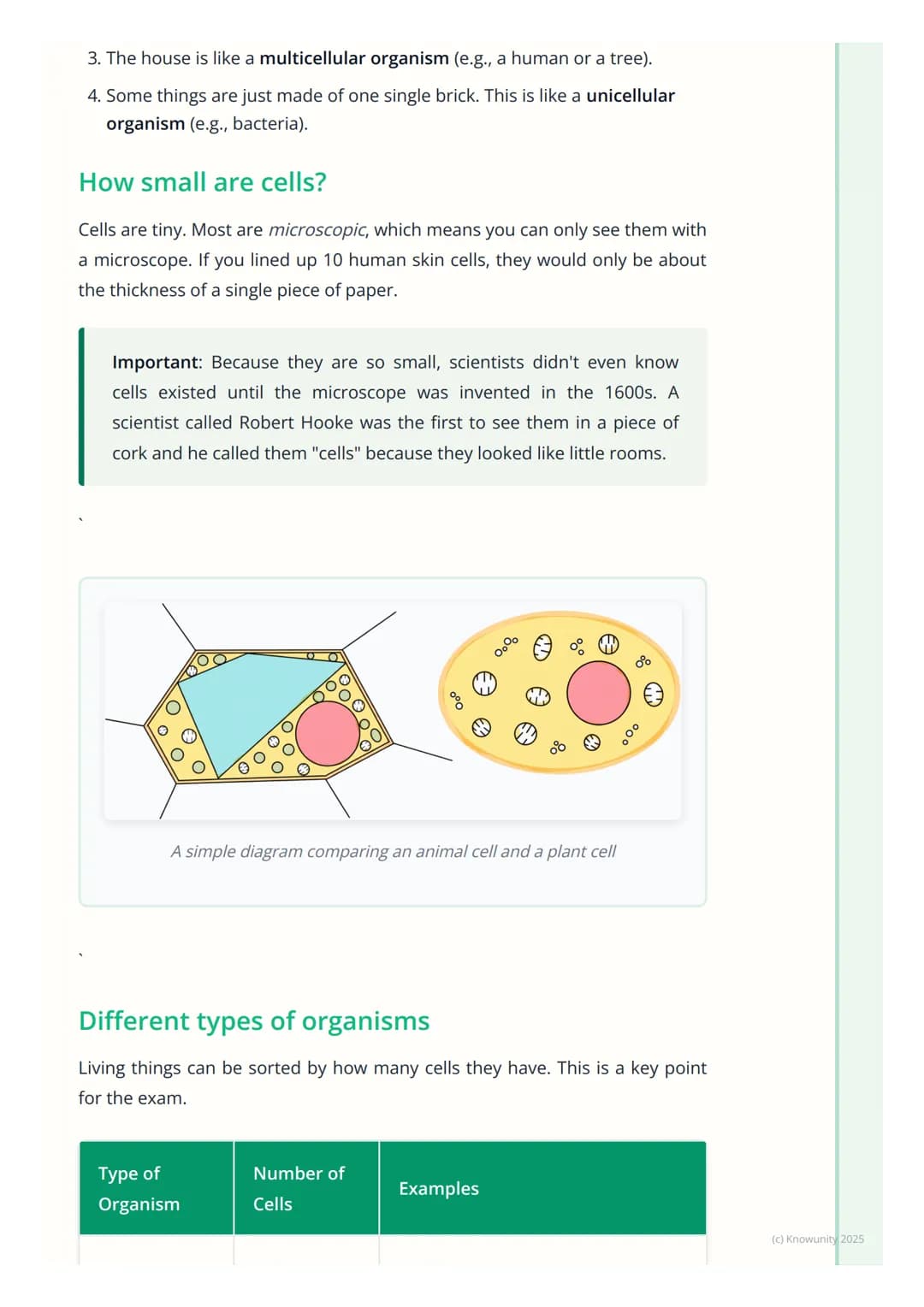
Unicellular vs Multicellular Organisms
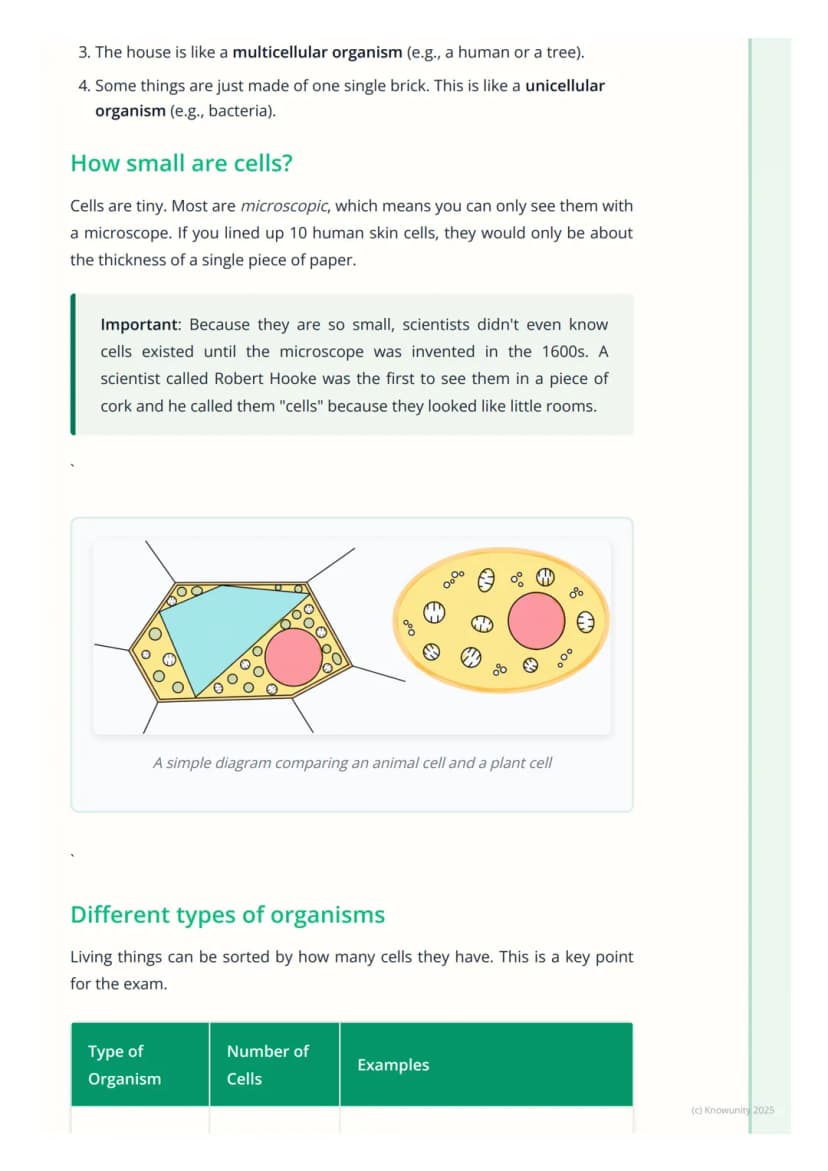
Living things come in two main types based on how many cells they have. Unicellular organisms are made of just one single cell that does everything needed to stay alive - pretty impressive for something so tiny!
Bacteria and amoeba are perfect examples of unicellular organisms. An amoeba living in pond water can move, eat, and get rid of waste all with just one cell. It's like having a entire factory squeezed into a microscopic space.
Multicellular organisms like humans, dogs, and trees are made of millions or even trillions of cells working together as a team. In your body, different cells have different jobs - muscle cells help you move, nerve cells carry messages, and red blood cells transport oxygen around your body.
Fun fact: You're made of roughly 37 trillion cells all working together to keep you alive right now!
3
of 4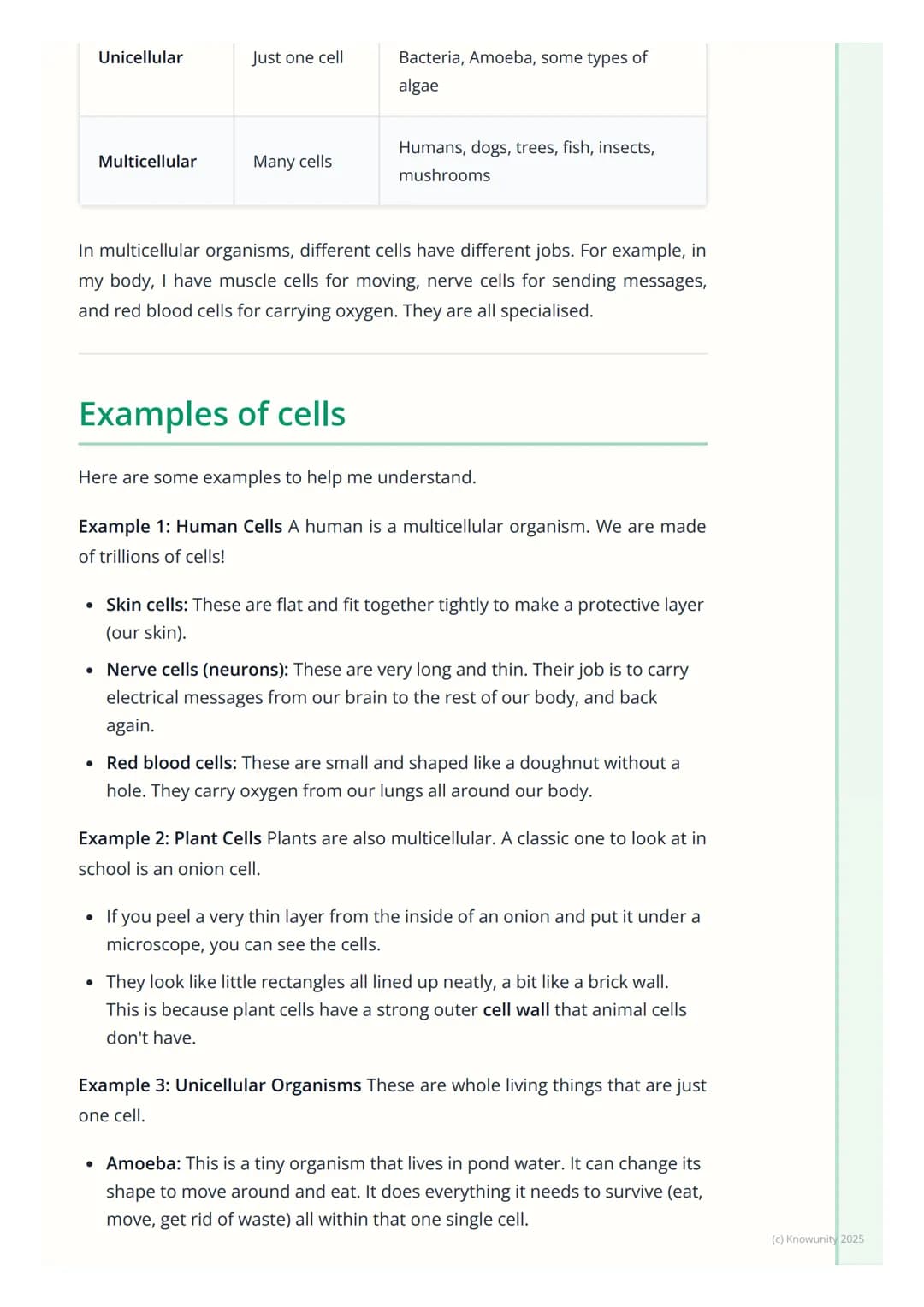
Examples of Different Cell Types
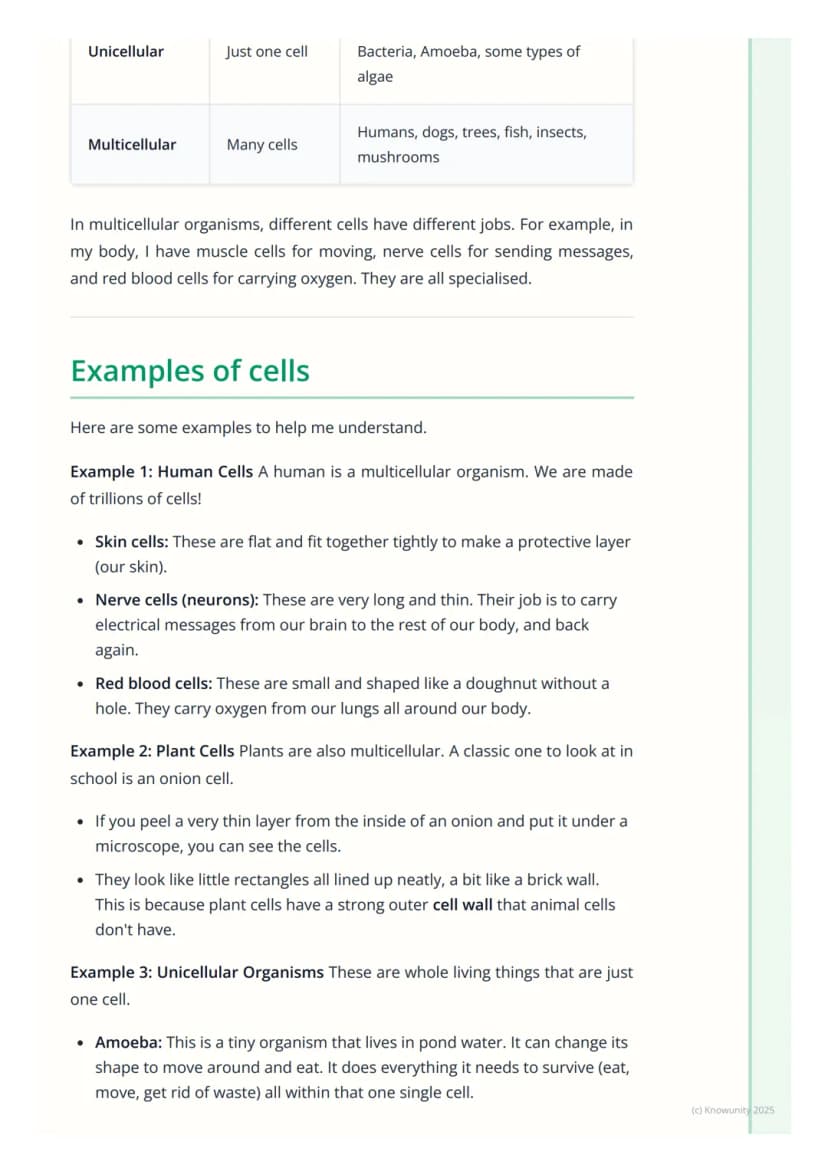
Your body is like a bustling city with different types of cells doing specialised jobs. Skin cells are flat and fit together tightly to create a protective barrier. Nerve cells are super long and thin, perfect for carrying electrical messages from your brain to your toes.
Red blood cells have a unique doughnut shape (without the hole) that helps them squeeze through tiny blood vessels whilst carrying oxygen. Each cell type is perfectly designed for its specific job.
Plant cells look quite different from animal cells. If you peek at an onion skin under a microscope, you'll see rectangular cells lined up like bricks in a wall. This is because plant cells have a tough cell wall that animal cells don't have.
Top tip: Remember that cells are actually 3D shapes like tiny balls or boxes, even though diagrams make them look flat!
4
of 4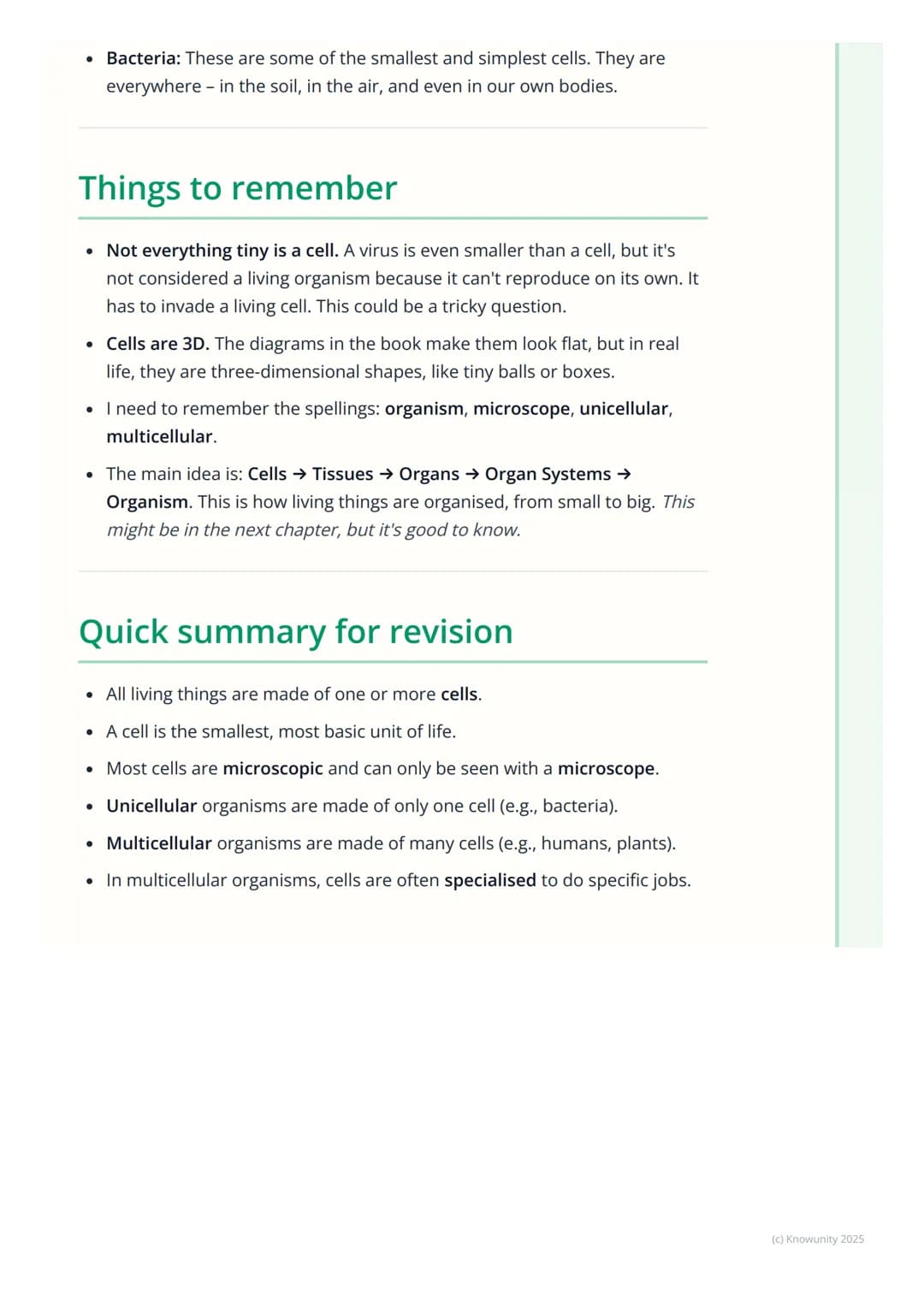
Key Points to Remember
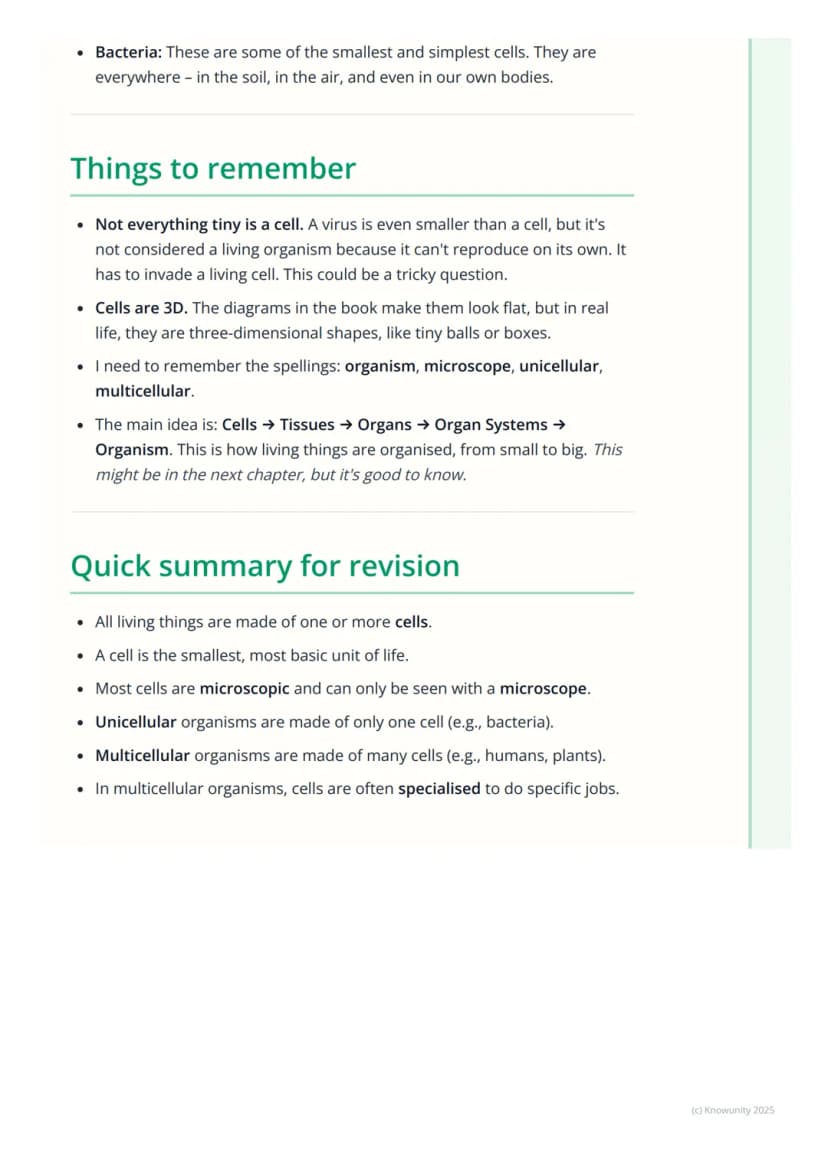
Here's what you absolutely need to know for your exams: cells are the basic unit of life, and every organism (living thing) is made of one or more cells. This simple idea explains how all life works.
Don't get tricked by viruses though - they're smaller than cells but aren't considered living organisms because they can't reproduce on their own. They have to hijack other cells to survive.
The organisation of life follows a simple pattern: Cells → Tissues → Organs → Organ Systems → Organism. It's like building from the smallest parts to create something amazing and complex.
Exam success: Make sure you can spell the key terms: organism, microscope, unicellular, and multicellular - these will definitely appear on your test!
Pensávamos que não ias perguntar...
O que é o Companheiro de Aprendizagem com IA da Knowunity?
O nosso companheiro de aprendizagem com IA foi especificamente criado para as necessidades dos estudantes. Com base nos milhões de conteúdos que temos na plataforma, podemos fornecer respostas verdadeiramente significativas e relevantes para os estudantes. Mas não se trata apenas de respostas, o companheiro foca-se mais em guiar os estudantes através dos seus desafios diários de aprendizagem, com planos de estudo personalizados, quizzes ou conteúdos no chat e 100% de personalização baseada nas habilidades e desenvolvimentos do estudante.
Onde posso fazer o download da app Knowunity?
Pode descarregar a aplicação na Google Play Store e na Apple App Store.
Como posso receber o meu pagamento? Quanto posso ganhar?
Sim, tem acesso gratuito ao conteúdo da aplicação e ao nosso companheiro de IA. Para desbloquear determinadas funcionalidades da aplicação, pode adquirir o Knowunity Pro.
Conteúdos mais populares de Biology
8BiologyEcology introduction notes!
Start of the leaving cert ecology chapter
6th Year131
BiologyDNA & RNA
All notes on DNA & RNA including protein synthesis which is a HL topic
5th Year250
BiologyVertebrates and Invertebrates
Students will distinguish between animals that have a backbone (vertebrates) and those that do not (invertebrates), identifying examples of each.
2nd Year240
BiologyBiomolecules: chapter 8
Summary and easily understandable notes to revise chapter 8 biomolecules. Includes good labelled diagrams for visual learners
5th Year210
BiologyCirculatory System
Students will learn about the heart, blood, and blood vessels, and how this system transports oxygen, nutrients, and waste products around the body.
3rd Year140
BiologyRespiration
All respiration notes including simple diagrams and glycolysis and the Krebs cycle
5th Year120
BiologyPhotosynthesis : Biology
Photosynthesis
6th Year371
BiologyPlant Cells
Learning about the unique structures found in plant cells, such as the cell wall, chloroplasts, and large vacuole, and how they differ from animal cells.
1st Year80
Conteúdos mais populares
9 Irish
IrishIrish oral questions and answers
Questions and answers for the leaving cert oral
5th Year4264
 English
Key Quotes : Sive
Key Quotes and explanations: Sive
6th Year2842
IrishIrish oral questions
Outline of oral questions
5th Year2055
IrishIníon- le hÁine Durkin
Aine Durkin’s poem, Iníon: Themes & summary
5th Year850
IrishIrish poetry 2027
Iníon + Dínit an Bhróin
5th Year1133
IrishLC HL notes- Iníon (poem)
Includes poem in English and Irish, theme, key words & phrases
5th Year2284
EnglishCultural Context : Shawshank Redemption : Sive : Small Things Like These
Comparative Study : Cultural Context : Shawshank Redemption, Sive and Small Things Like These
6th Year1430
IrishMo Ghrá-sa (Idir Lúibíní)
Notes on mo ghrá-sa
5th Year380
IrishAn Gaeilge Aiste
Irish Language essay
6th Year1320
Não encontra o que procura? Explore outras disciplinas.
Avaliações dos nossos utilizadores. Eles adoraram tudo — e tu também vais adorar.
4.6/5App Store
4.7/5Google Play
A App é muito fácil de usar e está nem organizada. Encontrei tudo o que estava à procura até agora e consegui aprender muito com as apresentações! Vou usar a app para um trabalho escolar! E claro que também me ajuda muito como inspiração.
João Sutilizador iOS
Esta app é realmente incrível. Há tantas anotações de estudo e ajuda [...]. A minha disciplina problemática é Francês, por exemplo, e a app tem muitas opções de ajuda. Graças a esta app, melhorei o meu Francês. Eu recomendo a qualquer pessoa.
Sara C.utilizadora Android
Uau, estou realmente impressionado. Acabei de experimentar o app porque o vi anunciado muitas vezes e fiquei absolutamente surpreso. Este app é A AJUDA que você quer para a escola e, acima de tudo, oferece tantas coisas, como exercícios e folhas de fatos, que têm sido MUITO úteis para mim pessoalmente.
Anautilizadora iOS
Biology2 visualizações·Atualizado Jun 7, 2026·4 páginasCells: The Building Blocks of Life
Every living thing around you - from your pet dog to the tiniest bacteria - is made up of amazing microscopic building blocks called cells. Understanding cells is like unlocking the secret to how all life works, and it's actually...
1
of 4
Cadastre-se para ver o conteúdo. É grátis!
- Acesso a todos os documentos
- Melhore suas notas
- Junte-se a milhões de estudantes
What Are Cells?
Think of cells as the Lego bricks of life - they're the smallest building blocks that make up every living thing on Earth. Just like you can build incredible structures with Lego bricks, nature uses cells to build everything from massive blue whales to tiny insects.
Most cells are microscopic, which means they're so incredibly small that you need a special tool called a microscope to see them. If you lined up 10 human skin cells, they'd only be as thick as a single sheet of paper - that's proper tiny!
Here's something cool: scientists didn't even know cells existed until the 1600s when microscopes were invented. A scientist named Robert Hooke first spotted them in a piece of cork and called them "cells" because they looked like little prison cells or rooms.
Remember: Everything that's alive is made of cells - this is one of the most important rules in biology!
2
of 4Cadastre-se para ver o conteúdo. É grátis!
- Acesso a todos os documentos
- Melhore suas notas
- Junte-se a milhões de estudantes
Unicellular vs Multicellular Organisms
Living things come in two main types based on how many cells they have. Unicellular organisms are made of just one single cell that does everything needed to stay alive - pretty impressive for something so tiny!
Bacteria and amoeba are perfect examples of unicellular organisms. An amoeba living in pond water can move, eat, and get rid of waste all with just one cell. It's like having a entire factory squeezed into a microscopic space.
Multicellular organisms like humans, dogs, and trees are made of millions or even trillions of cells working together as a team. In your body, different cells have different jobs - muscle cells help you move, nerve cells carry messages, and red blood cells transport oxygen around your body.
Fun fact: You're made of roughly 37 trillion cells all working together to keep you alive right now!
3
of 4Cadastre-se para ver o conteúdo. É grátis!
- Acesso a todos os documentos
- Melhore suas notas
- Junte-se a milhões de estudantes
Examples of Different Cell Types
Your body is like a bustling city with different types of cells doing specialised jobs. Skin cells are flat and fit together tightly to create a protective barrier. Nerve cells are super long and thin, perfect for carrying electrical messages from your brain to your toes.
Red blood cells have a unique doughnut shape (without the hole) that helps them squeeze through tiny blood vessels whilst carrying oxygen. Each cell type is perfectly designed for its specific job.
Plant cells look quite different from animal cells. If you peek at an onion skin under a microscope, you'll see rectangular cells lined up like bricks in a wall. This is because plant cells have a tough cell wall that animal cells don't have.
Top tip: Remember that cells are actually 3D shapes like tiny balls or boxes, even though diagrams make them look flat!
4
of 4Cadastre-se para ver o conteúdo. É grátis!
- Acesso a todos os documentos
- Melhore suas notas
- Junte-se a milhões de estudantes
Key Points to Remember
Here's what you absolutely need to know for your exams: cells are the basic unit of life, and every organism (living thing) is made of one or more cells. This simple idea explains how all life works.
Don't get tricked by viruses though - they're smaller than cells but aren't considered living organisms because they can't reproduce on their own. They have to hijack other cells to survive.
The organisation of life follows a simple pattern: Cells → Tissues → Organs → Organ Systems → Organism. It's like building from the smallest parts to create something amazing and complex.
Exam success: Make sure you can spell the key terms: organism, microscope, unicellular, and multicellular - these will definitely appear on your test!
Pensávamos que não ias perguntar...
O que é o Companheiro de Aprendizagem com IA da Knowunity?
O nosso companheiro de aprendizagem com IA foi especificamente criado para as necessidades dos estudantes. Com base nos milhões de conteúdos que temos na plataforma, podemos fornecer respostas verdadeiramente significativas e relevantes para os estudantes. Mas não se trata apenas de respostas, o companheiro foca-se mais em guiar os estudantes através dos seus desafios diários de aprendizagem, com planos de estudo personalizados, quizzes ou conteúdos no chat e 100% de personalização baseada nas habilidades e desenvolvimentos do estudante.
Onde posso fazer o download da app Knowunity?
Pode descarregar a aplicação na Google Play Store e na Apple App Store.
Como posso receber o meu pagamento? Quanto posso ganhar?
Sim, tem acesso gratuito ao conteúdo da aplicação e ao nosso companheiro de IA. Para desbloquear determinadas funcionalidades da aplicação, pode adquirir o Knowunity Pro.
Conteúdos mais populares de Biology
8BiologyEcology introduction notes!
Start of the leaving cert ecology chapter
6th Year131
BiologyDNA & RNA
All notes on DNA & RNA including protein synthesis which is a HL topic
5th Year250
BiologyVertebrates and Invertebrates
Students will distinguish between animals that have a backbone (vertebrates) and those that do not (invertebrates), identifying examples of each.
2nd Year240
BiologyBiomolecules: chapter 8
Summary and easily understandable notes to revise chapter 8 biomolecules. Includes good labelled diagrams for visual learners
5th Year210
BiologyCirculatory System
Students will learn about the heart, blood, and blood vessels, and how this system transports oxygen, nutrients, and waste products around the body.
3rd Year140
BiologyRespiration
All respiration notes including simple diagrams and glycolysis and the Krebs cycle
5th Year120
BiologyPhotosynthesis : Biology
Photosynthesis
6th Year371
BiologyPlant Cells
Learning about the unique structures found in plant cells, such as the cell wall, chloroplasts, and large vacuole, and how they differ from animal cells.
1st Year80
Conteúdos mais populares
9IrishIrish oral questions and answers
Questions and answers for the leaving cert oral
5th Year4264
EnglishKey Quotes : Sive
Key Quotes and explanations: Sive
6th Year2842
IrishIrish oral questions
Outline of oral questions
5th Year2055
IrishIníon- le hÁine Durkin
Aine Durkin’s poem, Iníon: Themes & summary
5th Year850
IrishIrish poetry 2027
Iníon + Dínit an Bhróin
5th Year1133
IrishLC HL notes- Iníon (poem)
Includes poem in English and Irish, theme, key words & phrases
5th Year2284
EnglishCultural Context : Shawshank Redemption : Sive : Small Things Like These
Comparative Study : Cultural Context : Shawshank Redemption, Sive and Small Things Like These
6th Year1430
IrishMo Ghrá-sa (Idir Lúibíní)
Notes on mo ghrá-sa
5th Year380
IrishAn Gaeilge Aiste
Irish Language essay
6th Year1320
Não encontra o que procura? Explore outras disciplinas.
Avaliações dos nossos utilizadores. Eles adoraram tudo — e tu também vais adorar.
4.6/5App Store
4.7/5Google Play
A App é muito fácil de usar e está nem organizada. Encontrei tudo o que estava à procura até agora e consegui aprender muito com as apresentações! Vou usar a app para um trabalho escolar! E claro que também me ajuda muito como inspiração.
João Sutilizador iOS
Esta app é realmente incrível. Há tantas anotações de estudo e ajuda [...]. A minha disciplina problemática é Francês, por exemplo, e a app tem muitas opções de ajuda. Graças a esta app, melhorei o meu Francês. Eu recomendo a qualquer pessoa.
Sara C.utilizadora Android
Uau, estou realmente impressionado. Acabei de experimentar o app porque o vi anunciado muitas vezes e fiquei absolutamente surpreso. Este app é A AJUDA que você quer para a escola e, acima de tudo, oferece tantas coisas, como exercícios e folhas de fatos, que têm sido MUITO úteis para mim pessoalmente.
Anautilizadora iOS