
Ever wonder how farmers decide which animals become the parents...
 Agricultural Science1 visualizações·Atualizado Jun 16, 2026·6 páginas
Choosing Quality Breeding Animals
1 / 6
1
of 6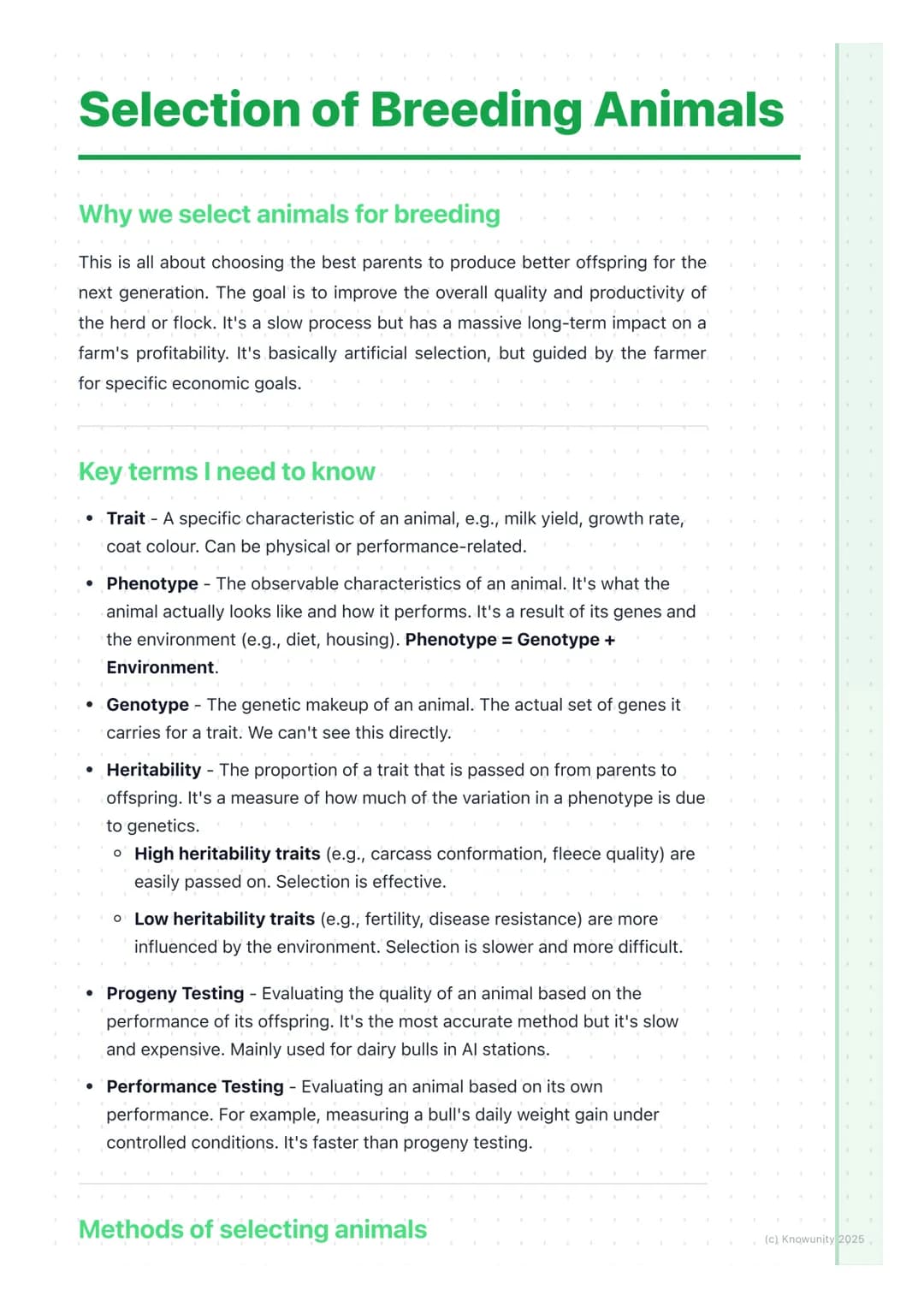
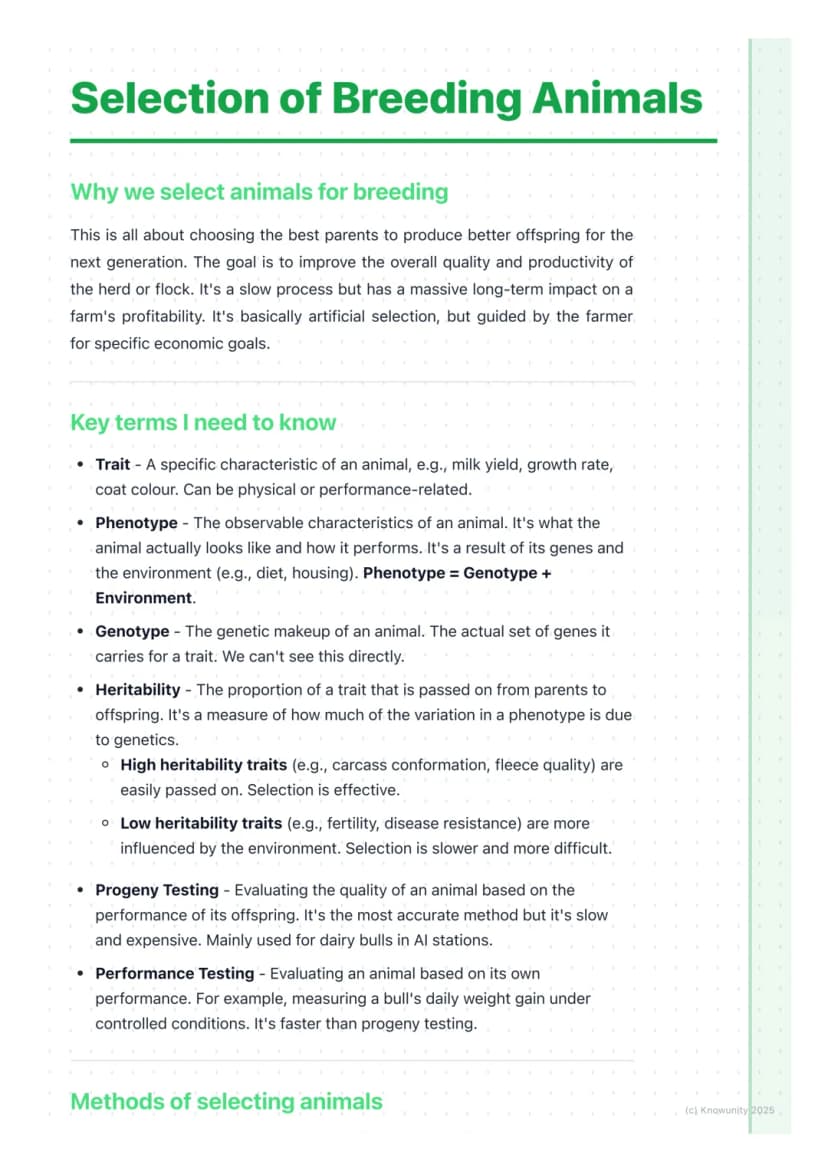
Why We Select Breeding Animals
Think of animal breeding like building a championship sports team - you want the best performers to create even better offspring. Farmers use artificial selection to improve their herds over generations, focusing on economically important traits.
Understanding the key terms is essential for grasping how breeding works. A trait is any characteristic you can measure, like milk yield or growth rate. The phenotype is what you actually observe - how the animal looks and performs. The genotype is the animal's genetic blueprint that you can't see directly.
Heritability tells you how much of a trait gets passed from parents to offspring. High heritability traits like carcass quality are easily improved through selection, whilst low heritability traits like fertility require more patience and environmental management.
Key Point: Remember the formula: Phenotype = Genotype + Environment. Even animals with great genes need proper care to reach their potential.
2
of 6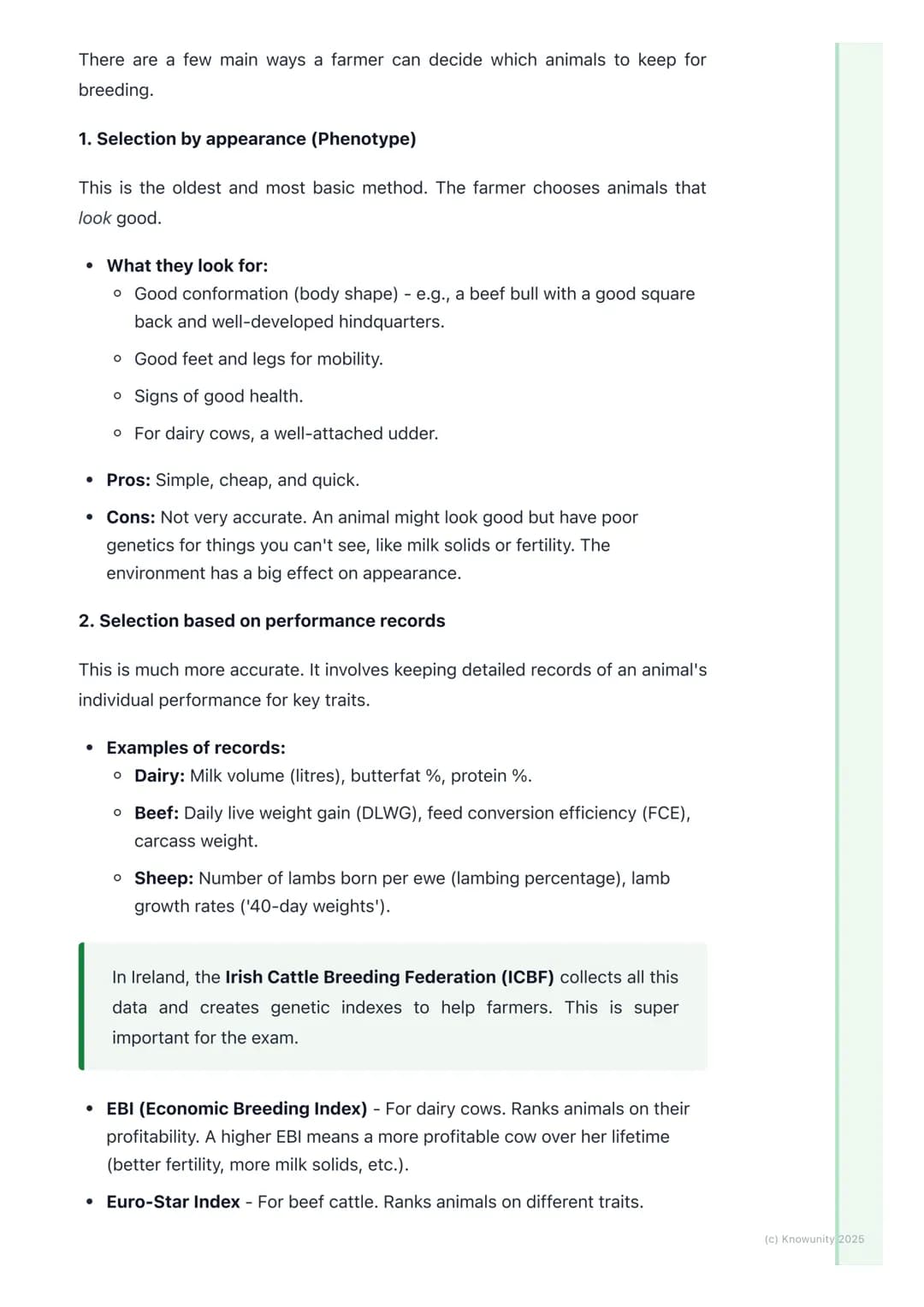
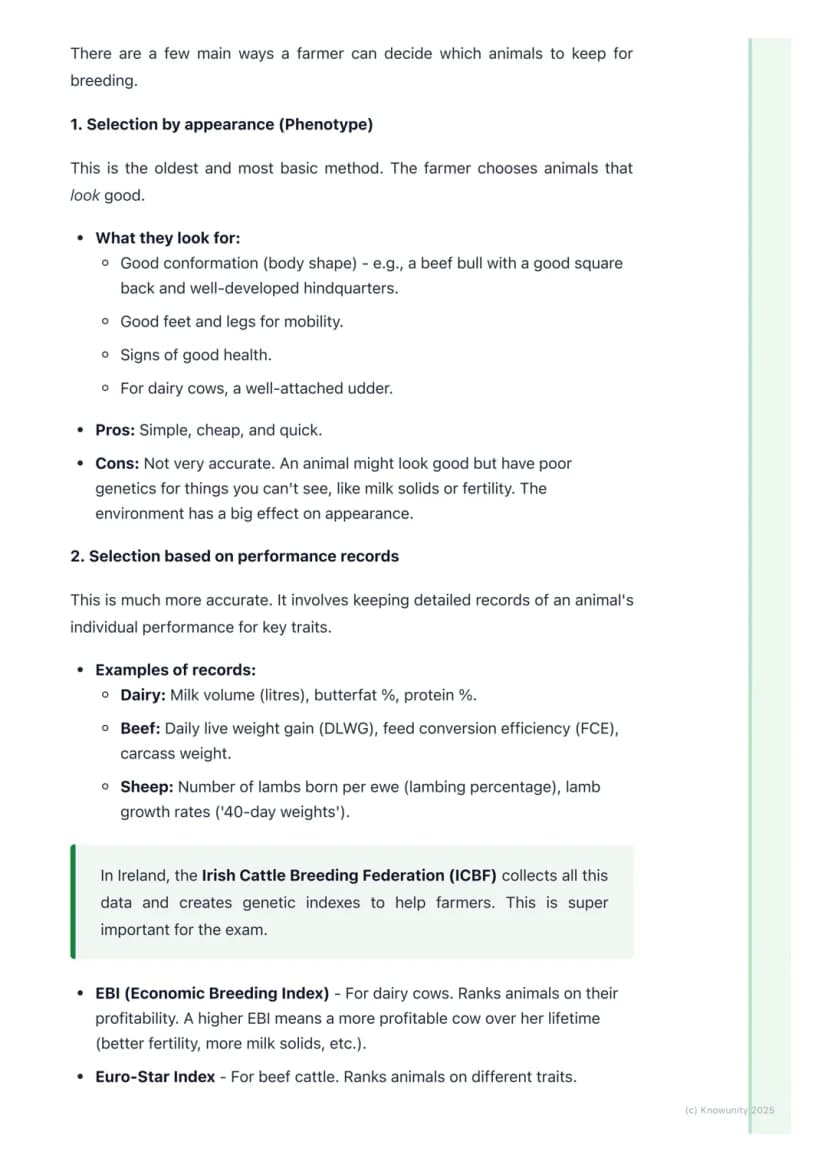
Selection Methods - From Basic to High-Tech
The simplest method is selection by appearance - choosing animals that look good. Farmers examine body shape, leg quality, and health signs. It's quick and cheap, but appearances can be deceiving since environment heavily influences how animals look.
Performance testing involves keeping detailed records of individual animals. Irish dairy farmers track milk volume, butterfat percentage, and protein content, whilst beef farmers measure daily weight gain and feed conversion efficiency. This data-driven approach is far more reliable than just looking at animals.
The Irish Cattle Breeding Federation (ICBF) processes all this performance data to create genetic indexes. The Economic Breeding Index (EBI) ranks dairy cows on lifetime profitability, considering milk production, fertility, and health together. For beef cattle, the Euro-Star system provides separate indexes for different purposes.
Exam Tip: Know the difference between Terminal Index (breeding for slaughter) and Replacement Index (breeding future mothers) - this comes up frequently in questions.
3
of 6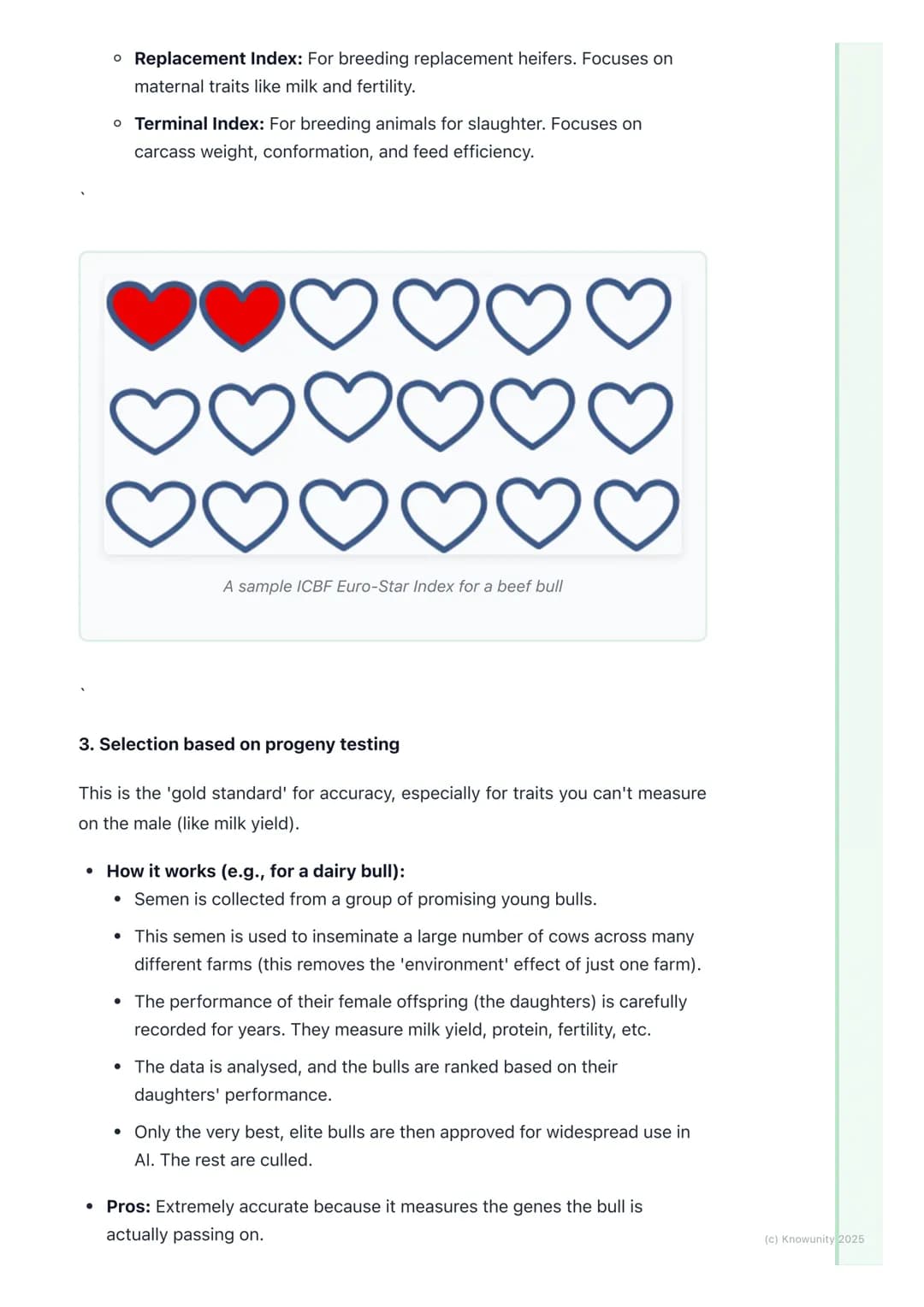
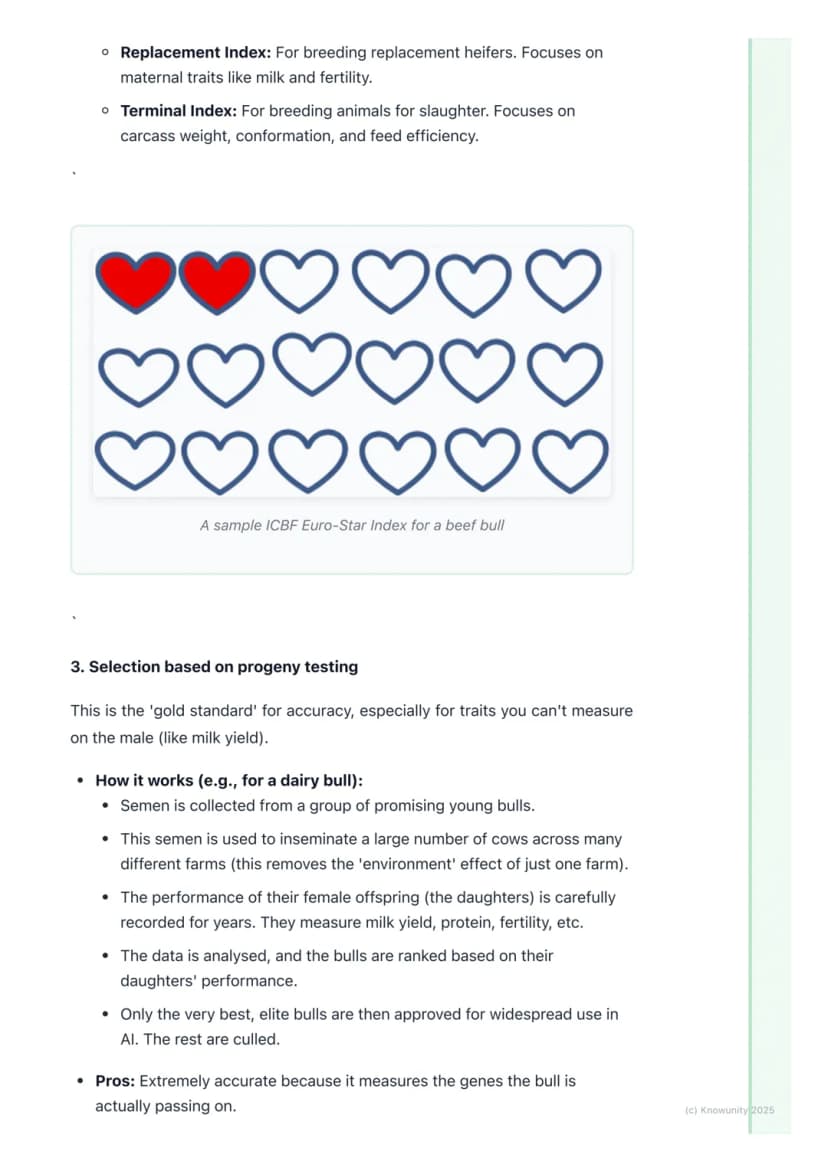
Progeny Testing - The Gold Standard
Progeny testing is like judging a teacher by how well their students perform. Young bulls have their semen collected and used across multiple farms. Years later, researchers analyse how their daughters perform compared to other cows.
This method works brilliantly for traits you can't measure directly on males, like milk production. The process takes 5-7 years and costs enormous amounts, but it's incredibly accurate because it shows what genes bulls actually pass on to offspring.
Only elite bulls that prove themselves through progeny testing get approved for widespread artificial insemination. The rest are culled, ensuring only the very best genetics spread through the population.
The system removes environmental bias by testing across different farms and management systems. If a bull's daughters consistently outperform others regardless of farm conditions, you know he's genetically superior.
Real World: This is why AI bulls are so expensive - they've undergone years of testing to prove their genetic worth.
4
of 6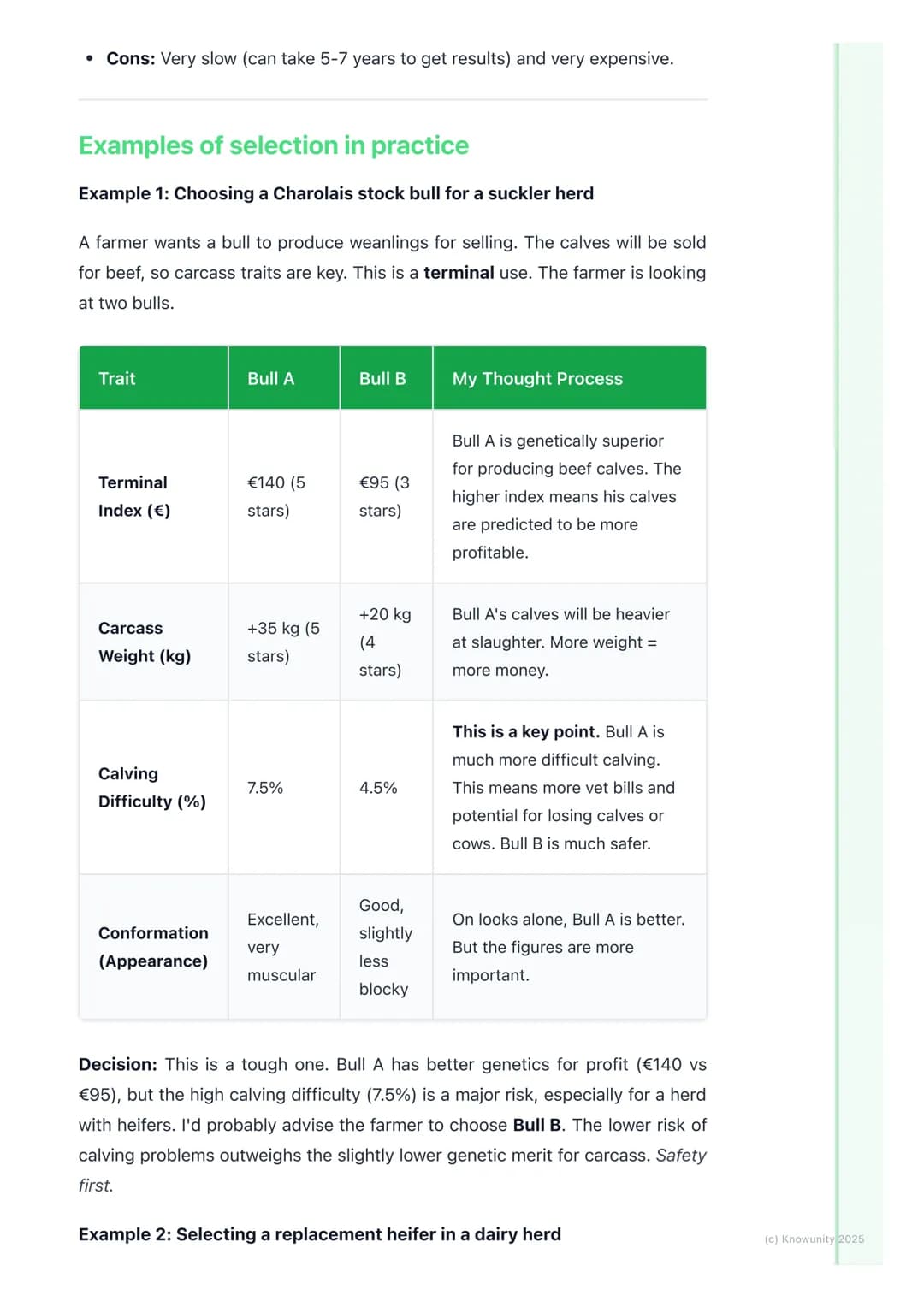
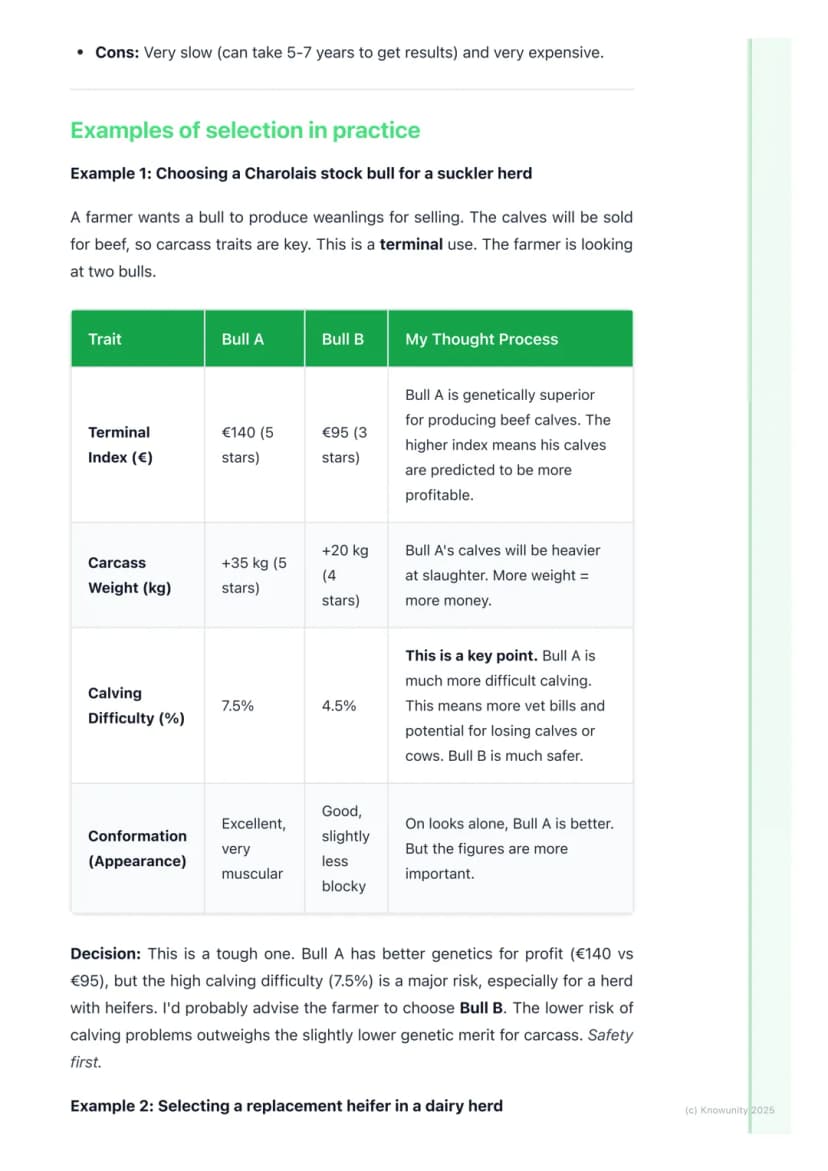
Practical Selection Examples
When choosing a Charolais stock bull for beef production, farmers compare terminal indexes focusing on carcass weight, conformation, and feed efficiency. Bull A might excel in daily weight gain whilst Bull B shows superior carcass quality - the choice depends on market demands and farm goals.
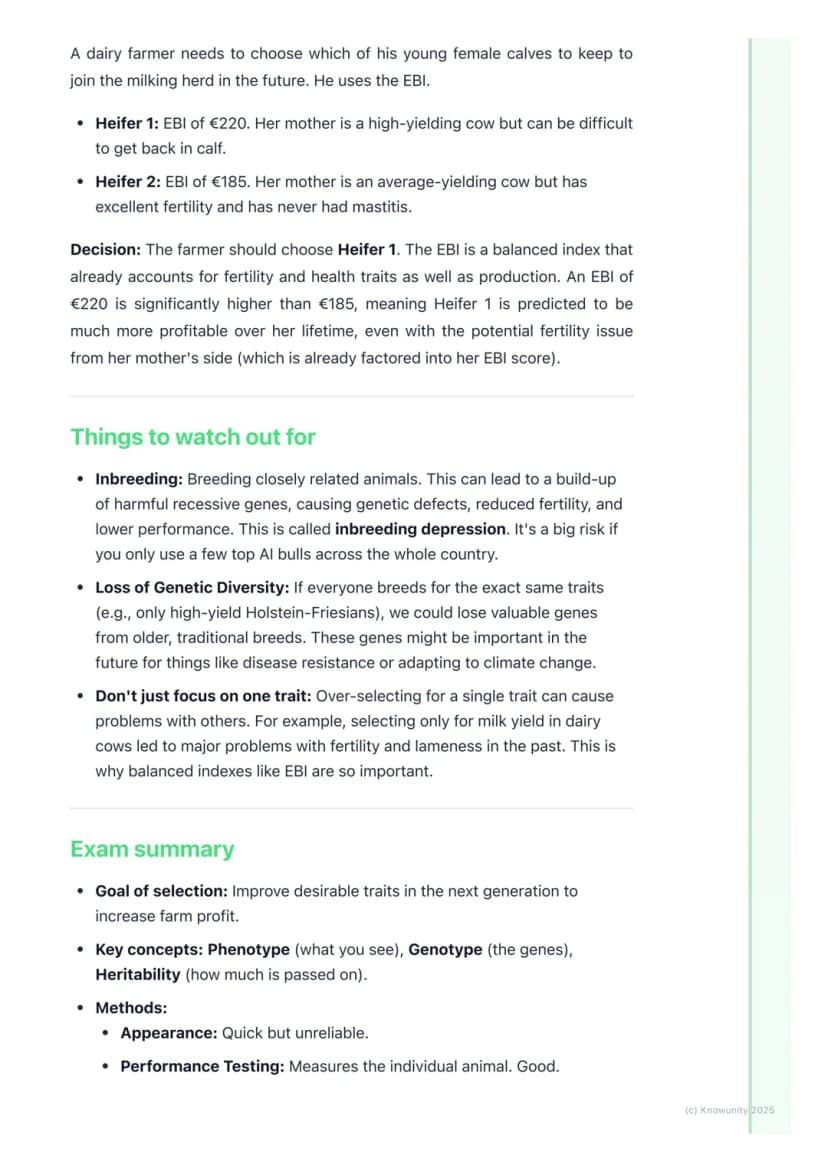
For dairy replacement heifers, farmers rely heavily on EBI scores. A heifer with an EBI of €220 will likely be more profitable over her lifetime than one scoring €185, even if her mother had fertility issues. The EBI already accounts for all major traits in balanced proportions.
Smart farmers avoid tunnel vision. Focusing solely on milk yield led to serious fertility and health problems in dairy herds during the 1980s and 1990s. This is why modern breeding uses balanced indexes that consider multiple traits simultaneously.
Selection intensity also matters - choosing only the top 10% of animals creates faster genetic progress than keeping the top 50%. However, this must be balanced against maintaining adequate herd size and genetic diversity.
Critical Thinking: Always ask yourself - what's the end goal? Terminal breeding for immediate slaughter requires different selection criteria than breeding replacement females.
5
of 6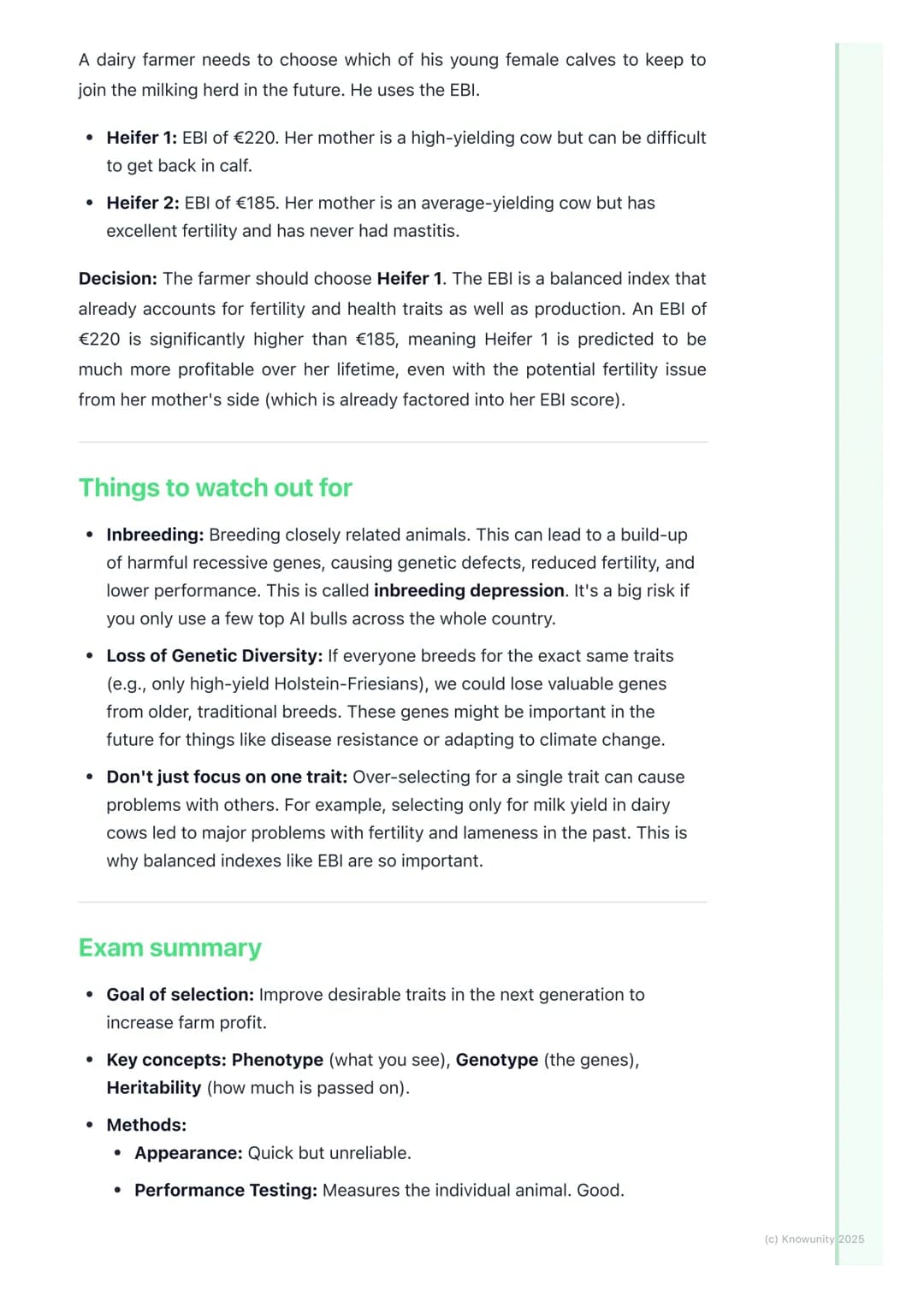
Avoiding Genetic Pitfalls
Inbreeding occurs when closely related animals mate, leading to inbreeding depression - reduced fertility, genetic defects, and poor performance. This becomes a serious risk when everyone uses the same popular AI bulls without checking family relationships.
Modern breeding programs face the challenge of maintaining genetic diversity whilst improving performance. If farmers only choose high-yielding Holstein-Friesians, valuable genes from traditional breeds might be lost forever. These genes could prove crucial for disease resistance or climate adaptation in the future.
The key is balanced selection using proven indexes rather than chasing single traits. The EBI system prevents the mistakes of the past by giving appropriate weight to fertility, health, and longevity alongside production traits.
Successful farmers understand that genetic improvement is a marathon, not a sprint. Consistent use of superior genetics combined with excellent management creates sustainable improvements over decades.
Future Focus: Climate change may require animals with different traits than today's ideal - maintaining genetic diversity keeps options open.
6
of 6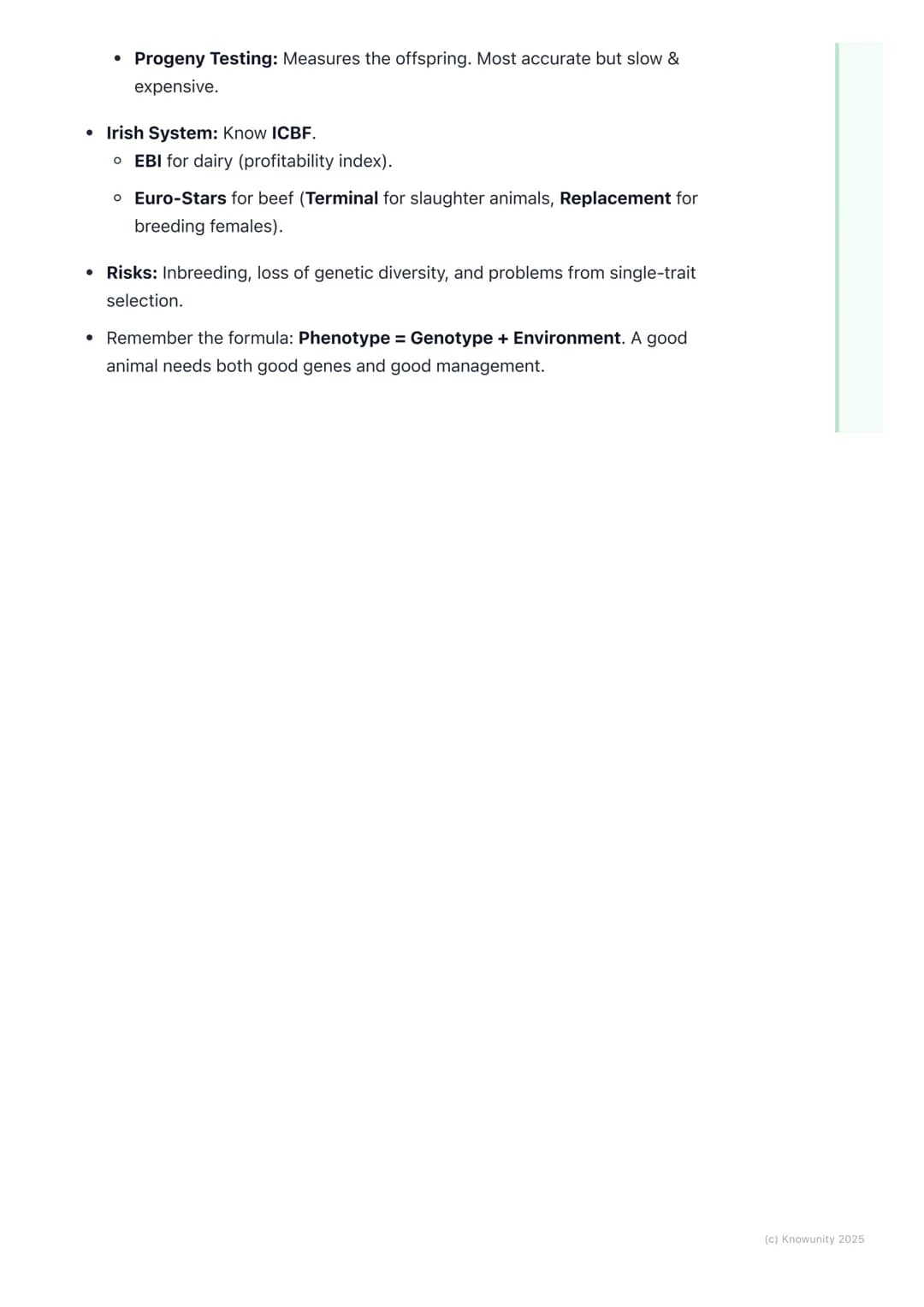
Exam Summary and Key Takeaways
Selection goals: Improve profitable traits through choosing superior parents for the next generation. Success requires understanding heritability - how much traits pass from parents to offspring.
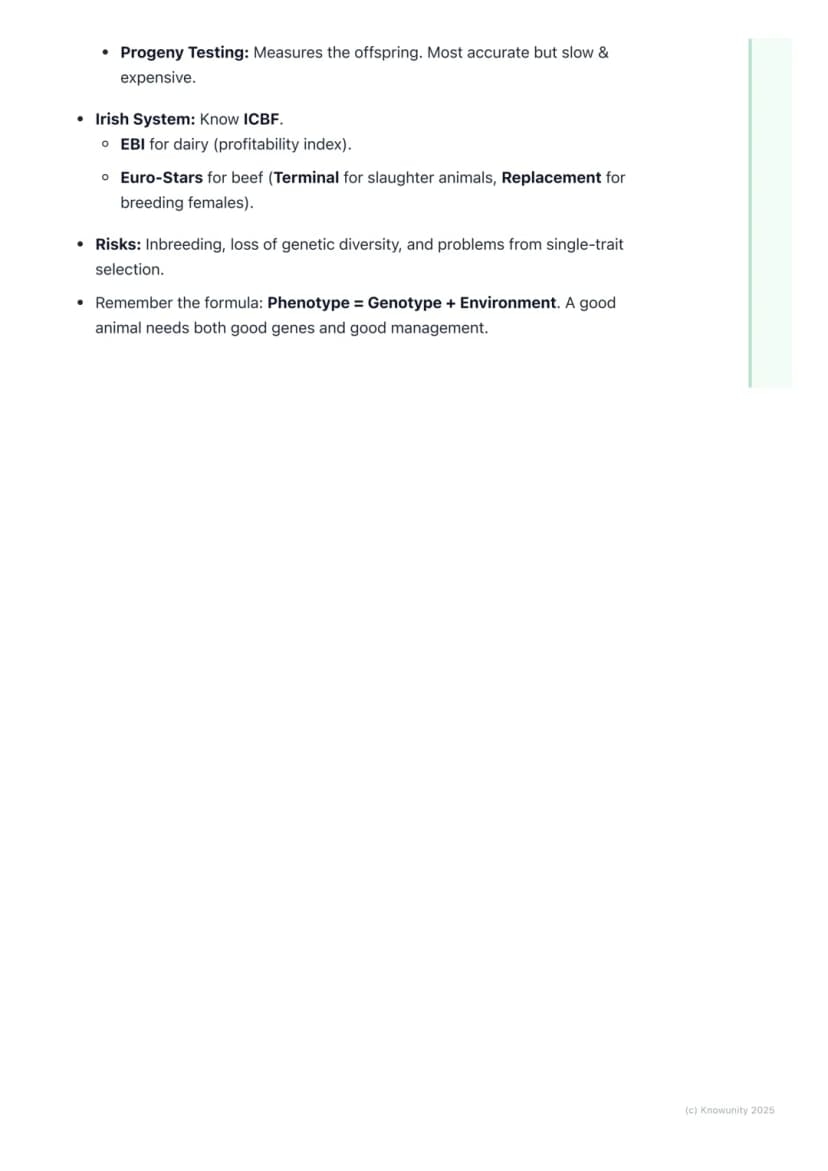
Three main methods: Appearance (quick but unreliable), performance testing (good balance of accuracy and speed), and progeny testing (most accurate but slow and expensive). Each has its place in modern breeding programs.
Irish breeding systems you must know: ICBF coordinates data collection, EBI ranks dairy cattle on lifetime profitability, and Euro-Star indexes guide beef breeding decisions. Terminal indexes focus on slaughter traits, replacement indexes on maternal abilities.
Critical risks include: inbreeding depression from using related animals, loss of genetic diversity from narrow selection, and problems from single-trait focus. Balanced selection using proven indexes avoids these pitfalls whilst maintaining steady genetic progress.
Success Formula: Great breeding = Superior genetics + Excellent management + Long-term thinking. Master this combination and you'll understand how modern agriculture creates better animals each generation.
Pensávamos que não ias perguntar...
O que é o Companheiro de Aprendizagem com IA da Knowunity?
O nosso companheiro de aprendizagem com IA foi especificamente criado para as necessidades dos estudantes. Com base nos milhões de conteúdos que temos na plataforma, podemos fornecer respostas verdadeiramente significativas e relevantes para os estudantes. Mas não se trata apenas de respostas, o companheiro foca-se mais em guiar os estudantes através dos seus desafios diários de aprendizagem, com planos de estudo personalizados, quizzes ou conteúdos no chat e 100% de personalização baseada nas habilidades e desenvolvimentos do estudante.
Onde posso fazer o download da app Knowunity?
Pode descarregar a aplicação na Google Play Store e na Apple App Store.
Como posso receber o meu pagamento? Quanto posso ganhar?
Sim, tem acesso gratuito ao conteúdo da aplicação e ao nosso companheiro de IA. Para desbloquear determinadas funcionalidades da aplicação, pode adquirir o Knowunity Pro.
Conteúdos mais populares
9 Irish
IrishIrish oral questions and answers
Questions and answers for the leaving cert oral
5th Year4264
 English
Key Quotes : Sive
Key Quotes and explanations: Sive
6th Year2842
IrishIrish oral questions
Outline of oral questions
5th Year2055
IrishIníon- le hÁine Durkin
Aine Durkin’s poem, Iníon: Themes & summary
5th Year850
IrishIrish poetry 2027
Iníon + Dínit an Bhróin
5th Year1133
IrishLC HL notes- Iníon (poem)
Includes poem in English and Irish, theme, key words & phrases
5th Year2284
EnglishCultural Context : Shawshank Redemption : Sive : Small Things Like These
Comparative Study : Cultural Context : Shawshank Redemption, Sive and Small Things Like These
6th Year1430
IrishMo Ghrá-sa (Idir Lúibíní)
Notes on mo ghrá-sa
5th Year380
IrishAn Gaeilge Aiste
Irish Language essay
6th Year1320
Não encontra o que procura? Explore outras disciplinas.
Avaliações dos nossos utilizadores. Eles adoraram tudo — e tu também vais adorar.
4.6/5App Store
4.7/5Google Play
A App é muito fácil de usar e está nem organizada. Encontrei tudo o que estava à procura até agora e consegui aprender muito com as apresentações! Vou usar a app para um trabalho escolar! E claro que também me ajuda muito como inspiração.
João Sutilizador iOS
Esta app é realmente incrível. Há tantas anotações de estudo e ajuda [...]. A minha disciplina problemática é Francês, por exemplo, e a app tem muitas opções de ajuda. Graças a esta app, melhorei o meu Francês. Eu recomendo a qualquer pessoa.
Sara C.utilizadora Android
Uau, estou realmente impressionado. Acabei de experimentar o app porque o vi anunciado muitas vezes e fiquei absolutamente surpreso. Este app é A AJUDA que você quer para a escola e, acima de tudo, oferece tantas coisas, como exercícios e folhas de fatos, que têm sido MUITO úteis para mim pessoalmente.
Anautilizadora iOS
Agricultural Science1 visualizações·Atualizado Jun 16, 2026·6 páginasChoosing Quality Breeding Animals
Ever wonder how farmers decide which animals become the parents of the next generation? It's all about artificial selection- choosing the best breeding animals to improve traits like milk production, growth rate, and disease resistance. This process is crucial...
1
of 6
Cadastre-se para ver o conteúdo. É grátis!
- Acesso a todos os documentos
- Melhore suas notas
- Junte-se a milhões de estudantes
Why We Select Breeding Animals
Think of animal breeding like building a championship sports team - you want the best performers to create even better offspring. Farmers use artificial selection to improve their herds over generations, focusing on economically important traits.
Understanding the key terms is essential for grasping how breeding works. A trait is any characteristic you can measure, like milk yield or growth rate. The phenotype is what you actually observe - how the animal looks and performs. The genotype is the animal's genetic blueprint that you can't see directly.
Heritability tells you how much of a trait gets passed from parents to offspring. High heritability traits like carcass quality are easily improved through selection, whilst low heritability traits like fertility require more patience and environmental management.
Key Point: Remember the formula: Phenotype = Genotype + Environment. Even animals with great genes need proper care to reach their potential.
2
of 6Cadastre-se para ver o conteúdo. É grátis!
- Acesso a todos os documentos
- Melhore suas notas
- Junte-se a milhões de estudantes
Selection Methods - From Basic to High-Tech
The simplest method is selection by appearance - choosing animals that look good. Farmers examine body shape, leg quality, and health signs. It's quick and cheap, but appearances can be deceiving since environment heavily influences how animals look.
Performance testing involves keeping detailed records of individual animals. Irish dairy farmers track milk volume, butterfat percentage, and protein content, whilst beef farmers measure daily weight gain and feed conversion efficiency. This data-driven approach is far more reliable than just looking at animals.
The Irish Cattle Breeding Federation (ICBF) processes all this performance data to create genetic indexes. The Economic Breeding Index (EBI) ranks dairy cows on lifetime profitability, considering milk production, fertility, and health together. For beef cattle, the Euro-Star system provides separate indexes for different purposes.
Exam Tip: Know the difference between Terminal Index (breeding for slaughter) and Replacement Index (breeding future mothers) - this comes up frequently in questions.
3
of 6Cadastre-se para ver o conteúdo. É grátis!
- Acesso a todos os documentos
- Melhore suas notas
- Junte-se a milhões de estudantes
Progeny Testing - The Gold Standard
Progeny testing is like judging a teacher by how well their students perform. Young bulls have their semen collected and used across multiple farms. Years later, researchers analyse how their daughters perform compared to other cows.
This method works brilliantly for traits you can't measure directly on males, like milk production. The process takes 5-7 years and costs enormous amounts, but it's incredibly accurate because it shows what genes bulls actually pass on to offspring.
Only elite bulls that prove themselves through progeny testing get approved for widespread artificial insemination. The rest are culled, ensuring only the very best genetics spread through the population.
The system removes environmental bias by testing across different farms and management systems. If a bull's daughters consistently outperform others regardless of farm conditions, you know he's genetically superior.
Real World: This is why AI bulls are so expensive - they've undergone years of testing to prove their genetic worth.
4
of 6Cadastre-se para ver o conteúdo. É grátis!
- Acesso a todos os documentos
- Melhore suas notas
- Junte-se a milhões de estudantes
Practical Selection Examples
When choosing a Charolais stock bull for beef production, farmers compare terminal indexes focusing on carcass weight, conformation, and feed efficiency. Bull A might excel in daily weight gain whilst Bull B shows superior carcass quality - the choice depends on market demands and farm goals.
For dairy replacement heifers, farmers rely heavily on EBI scores. A heifer with an EBI of €220 will likely be more profitable over her lifetime than one scoring €185, even if her mother had fertility issues. The EBI already accounts for all major traits in balanced proportions.
Smart farmers avoid tunnel vision. Focusing solely on milk yield led to serious fertility and health problems in dairy herds during the 1980s and 1990s. This is why modern breeding uses balanced indexes that consider multiple traits simultaneously.
Selection intensity also matters - choosing only the top 10% of animals creates faster genetic progress than keeping the top 50%. However, this must be balanced against maintaining adequate herd size and genetic diversity.
Critical Thinking: Always ask yourself - what's the end goal? Terminal breeding for immediate slaughter requires different selection criteria than breeding replacement females.
5
of 6Cadastre-se para ver o conteúdo. É grátis!
- Acesso a todos os documentos
- Melhore suas notas
- Junte-se a milhões de estudantes
Avoiding Genetic Pitfalls
Inbreeding occurs when closely related animals mate, leading to inbreeding depression - reduced fertility, genetic defects, and poor performance. This becomes a serious risk when everyone uses the same popular AI bulls without checking family relationships.
Modern breeding programs face the challenge of maintaining genetic diversity whilst improving performance. If farmers only choose high-yielding Holstein-Friesians, valuable genes from traditional breeds might be lost forever. These genes could prove crucial for disease resistance or climate adaptation in the future.
The key is balanced selection using proven indexes rather than chasing single traits. The EBI system prevents the mistakes of the past by giving appropriate weight to fertility, health, and longevity alongside production traits.
Successful farmers understand that genetic improvement is a marathon, not a sprint. Consistent use of superior genetics combined with excellent management creates sustainable improvements over decades.
Future Focus: Climate change may require animals with different traits than today's ideal - maintaining genetic diversity keeps options open.
6
of 6Cadastre-se para ver o conteúdo. É grátis!
- Acesso a todos os documentos
- Melhore suas notas
- Junte-se a milhões de estudantes
Exam Summary and Key Takeaways
Selection goals: Improve profitable traits through choosing superior parents for the next generation. Success requires understanding heritability - how much traits pass from parents to offspring.
Three main methods: Appearance (quick but unreliable), performance testing (good balance of accuracy and speed), and progeny testing (most accurate but slow and expensive). Each has its place in modern breeding programs.
Irish breeding systems you must know: ICBF coordinates data collection, EBI ranks dairy cattle on lifetime profitability, and Euro-Star indexes guide beef breeding decisions. Terminal indexes focus on slaughter traits, replacement indexes on maternal abilities.
Critical risks include: inbreeding depression from using related animals, loss of genetic diversity from narrow selection, and problems from single-trait focus. Balanced selection using proven indexes avoids these pitfalls whilst maintaining steady genetic progress.
Success Formula: Great breeding = Superior genetics + Excellent management + Long-term thinking. Master this combination and you'll understand how modern agriculture creates better animals each generation.
Pensávamos que não ias perguntar...
O que é o Companheiro de Aprendizagem com IA da Knowunity?
O nosso companheiro de aprendizagem com IA foi especificamente criado para as necessidades dos estudantes. Com base nos milhões de conteúdos que temos na plataforma, podemos fornecer respostas verdadeiramente significativas e relevantes para os estudantes. Mas não se trata apenas de respostas, o companheiro foca-se mais em guiar os estudantes através dos seus desafios diários de aprendizagem, com planos de estudo personalizados, quizzes ou conteúdos no chat e 100% de personalização baseada nas habilidades e desenvolvimentos do estudante.
Onde posso fazer o download da app Knowunity?
Pode descarregar a aplicação na Google Play Store e na Apple App Store.
Como posso receber o meu pagamento? Quanto posso ganhar?
Sim, tem acesso gratuito ao conteúdo da aplicação e ao nosso companheiro de IA. Para desbloquear determinadas funcionalidades da aplicação, pode adquirir o Knowunity Pro.
Conteúdos mais populares
9IrishIrish oral questions and answers
Questions and answers for the leaving cert oral
5th Year4264
EnglishKey Quotes : Sive
Key Quotes and explanations: Sive
6th Year2842
IrishIrish oral questions
Outline of oral questions
5th Year2055
IrishIníon- le hÁine Durkin
Aine Durkin’s poem, Iníon: Themes & summary
5th Year850
IrishIrish poetry 2027
Iníon + Dínit an Bhróin
5th Year1133
IrishLC HL notes- Iníon (poem)
Includes poem in English and Irish, theme, key words & phrases
5th Year2284
EnglishCultural Context : Shawshank Redemption : Sive : Small Things Like These
Comparative Study : Cultural Context : Shawshank Redemption, Sive and Small Things Like These
6th Year1430
IrishMo Ghrá-sa (Idir Lúibíní)
Notes on mo ghrá-sa
5th Year380
IrishAn Gaeilge Aiste
Irish Language essay
6th Year1320
Não encontra o que procura? Explore outras disciplinas.
Avaliações dos nossos utilizadores. Eles adoraram tudo — e tu também vais adorar.
4.6/5App Store
4.7/5Google Play
A App é muito fácil de usar e está nem organizada. Encontrei tudo o que estava à procura até agora e consegui aprender muito com as apresentações! Vou usar a app para um trabalho escolar! E claro que também me ajuda muito como inspiração.
João Sutilizador iOS
Esta app é realmente incrível. Há tantas anotações de estudo e ajuda [...]. A minha disciplina problemática é Francês, por exemplo, e a app tem muitas opções de ajuda. Graças a esta app, melhorei o meu Francês. Eu recomendo a qualquer pessoa.
Sara C.utilizadora Android
Uau, estou realmente impressionado. Acabei de experimentar o app porque o vi anunciado muitas vezes e fiquei absolutamente surpreso. Este app é A AJUDA que você quer para a escola e, acima de tudo, oferece tantas coisas, como exercícios e folhas de fatos, que têm sido MUITO úteis para mim pessoalmente.
Anautilizadora iOS